Gluten-free pizza can be safe for people with celiac disease, but only under two conditions: the kitchen uses genuinely separated prep and baking procedures or a certified gluten-free process, and staff can answer specific questions about how your pizza is made. Health Canada's 20 parts per million benchmark guides packaged food labelling, not restaurant kitchens, so a menu that says "gluten-free" tells you little on its own. If staff hesitate or give vague answers, choose a certified packaged option instead.
TL;DR:
- Dedicated or time-separated gluten-free prep stations significantly reduce the risk of cross-contact in busy pizzerias.
- Using separate tools, marked storage, and strict procedures is more effective than relying on cleaning or shorter bake times.
- Asking specific questions about equipment, process, and timing before ordering can reveal whether a restaurant practices safe workflow.
- Sharing fryers, stacked trays, and surfaces can transfer gluten unnoticed, making process management critical for safety.
- The presence of a gluten-free menu does not guarantee safety; operational safeguards are the true measure of risk reduction.
Table of Contents
- Where cross-contact happens during a pizza order
- What makes a restaurant actually safe
- Questions to ask before you order or sit down
- Takeout, delivery, and what happens after the pizza leaves the kitchen
- What the evidence says about restaurant gluten-free pizza
- How we think about gluten-free pizza in our own kitchens
- Our take: process beats labels, every time
- Ordering gluten-free from HellCrust with confidence
- FAQ
- Sources
Where cross-contact happens during a pizza order
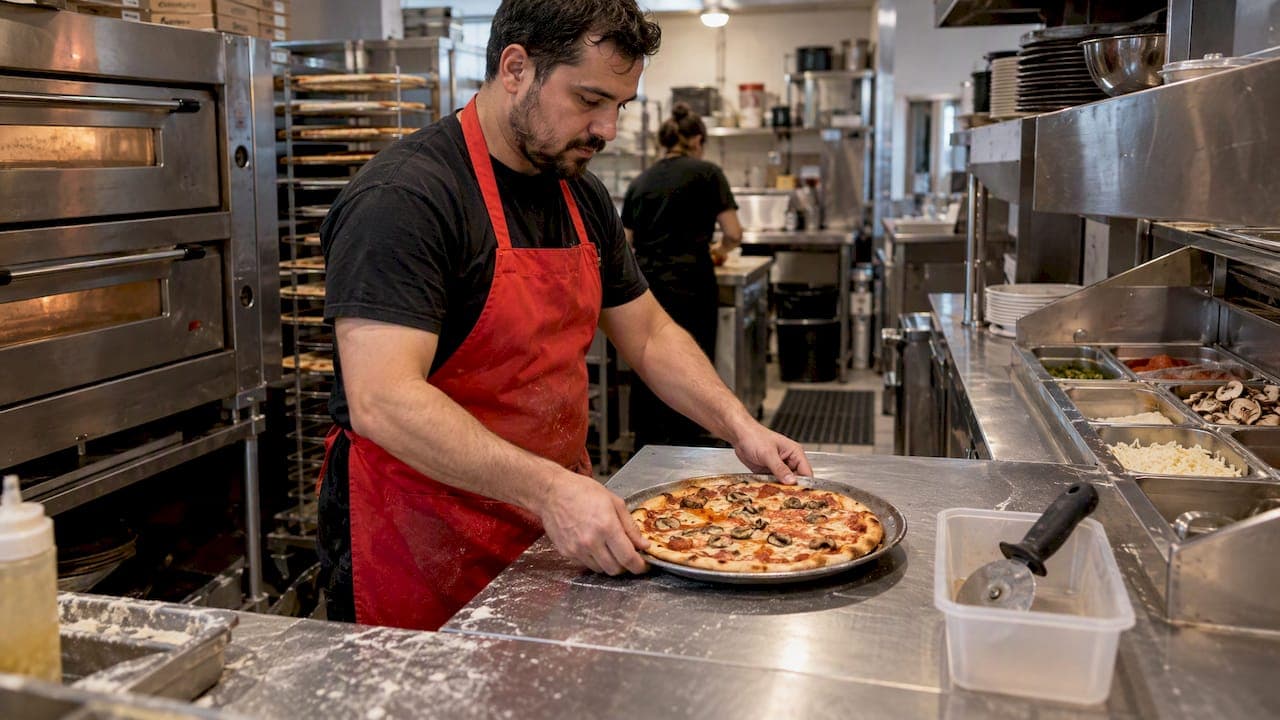
Pizza kitchens are busy, flour-heavy environments, and that combination creates more opportunities for cross-contact than most diners realize. Flour dust settles on every surface within reach of an active prep station, including a gluten-free crust sitting a few feet from where someone is tossing regular dough.
The risk rarely comes from one dramatic mistake. It comes from a string of small, routine moments:
- Airborne flour from dough tossing and bench flouring drifts onto open crusts and toppings.
- Shared prep surfaces, topping bins, serving spoons, and pizza cutters carry crumbs from one order to the next.
- Pans, peels, and stacking trays used for regular pizzas transfer residue even after a quick wipe.
- Shared fryers used for garlic knots or breaded sides introduce gluten into foods that look unrelated to pizza.
- Cutting and boxing are common final-transfer points, since the same cutter or counter often handles every order that day.
A shorter bake or a quick surface wipe does not reliably remove this risk. Gluten protein does not break down with heat the way bacteria do, and a damp cloth can spread flour residue rather than clear it. The workflow has to prevent contact in the first place, not clean it up afterward.
What makes a restaurant actually safe
A kitchen that takes gluten-free pizza seriously builds separation into its workflow rather than relying on good intentions during a rush. The strongest signal is dedicated or time-separated prep: a gluten-free station that regular flour never touches, or a kitchen that makes all gluten-free orders before opening and before flour becomes airborne.
Look for these practices, roughly in order of how much they matter:
- Dedicated pans, peels, and marked storage that never cross over with wheat-based ingredients.
- Colour-coded utensils and clearly labelled bins, so a rushed staff member cannot grab the wrong scoop by mistake.
- Written procedures and staff training, the kind of system Celiac Canada's food-service guidance lays out for restaurants committing to safe practices.
- Boxing rules that keep gluten-free pizzas in high-sided pans and separate boxes, away from pizzas baking at the same time.
- A policy against baking gluten-free and regular pizzas side by side in the same oven window.
Pro Tip: Ask whether the gluten-free pizza is made first, before the kitchen gets busy with regular orders. Timing matters as much as equipment.
The difference between a credible answer and a hollow one is specificity. "Yes, we're careful" tells you nothing. "We use a dedicated pan, a separate cutter stored in a marked container, and we prep gluten-free orders before the lunch rush" tells you the kitchen has actually thought this through.
Questions to ask before you order or sit down
A short conversation before you order does more to protect you than any menu label. Ask directly, and listen for specifics rather than reassurance.
- "Do you have a dedicated area or separate tools for gluten-free pizza?"
- "Is the gluten-free crust baked on its own pan, or does it touch the same surface as regular dough?"
- "Do your fries or sides share a fryer with breaded items?"
- "How is the pizza boxed? Separately, or alongside other orders?"
Answers like "we're pretty careful" or "it should be fine" are red flags. A credible answer names a specific tool, pan, or step. If you need a small accommodation, ask for it directly: a fresh pair of gloves, a wiped section of counter, or a separate box. A kitchen confident in its process will not hesitate.
If staff cannot answer these questions, or seem unsure what you're asking, that uncertainty is itself useful information. Choose a certified packaged product instead of gambling on a dish made under unclear conditions.
Takeout, delivery, and what happens after the pizza leaves the kitchen
Even a pizza made correctly in the kitchen can pick up gluten on the way to your table. Boxing and delivery handling are where a careful prep job can quietly unravel.
- A pizza boxed on a counter that just held a regular order can pick up crumbs in seconds.
- Delivery bags are often shared and insulated, carrying heat (and flour dust) from wheat-based pizzas stacked nearby.
- Drivers handling multiple orders rarely know which box needs extra care unless it's clearly marked.
Pro Tip: Ask the restaurant to write "gluten-free, separate" on the box itself. It costs nothing and reduces the chance of a mix-up at pickup or during delivery.
When your order arrives, open the box away from other food, check for visible flour dust on the crust, and transfer the pizza to a clean plate before eating. These habits take seconds and close a gap that many people overlook entirely. When any part of this chain feels uncertain, a sealed, certified packaged pizza remains the safer bet.

What the evidence says about restaurant gluten-free pizza
The research paints a mixed picture, and the details matter more than the headline. A 2018 crowd-sourced study from Columbia University's Mailman School of Public Health tested 5,624 restaurant foods labelled gluten-free in the United States and found 32% contained detectable gluten, with 53.2% of gluten-free pizza samples testing positive. That's a striking figure, but it's crowd-sourced, US-based, and not a direct prediction for any specific kitchen.
Contrast that with peer-reviewed research on pizza restaurants, which found that pizzas made under disciplined procedures or in certified kitchens often tested below detection or below 20 parts per million. The gap between these two findings isn't about pizza itself: it's about process. Shared fryers tell a similar story. A study testing fries from shared fryers found variable gluten levels, with some orders exceeding 20 ppm, and noted that ELISA testing after heat can underestimate gluten content.
- A kitchen's procedures predict safety better than its label or its oven type.
- "Below detection" does not guarantee zero gluten, only that none was measured by that test.
A substantial proportion of tested gluten-free pizza samples in a 2018 crowd-sourced US study contained detectable gluten, a figure that underscores why asking about process matters more than reading a menu description (Columbia University).
How we think about gluten-free pizza in our own kitchens
We built our gluten-free offering around the same principle this guide follows: separation has to be deliberate, not incidental. That means dedicated tools, marked storage, and staff who know why those details exist, not just that a rule says to follow them.
Our app includes a special instructions field where you can ask for extra care, and you're always welcome to call ahead and confirm how an order will be handled. We'd still encourage you to use the checklist above wherever you order, from us or anywhere else, since practices can vary by location and by shift.
Our take: process beats labels, every time
The conventional advice on this topic focuses too much on whether a restaurant "has a gluten-free menu," as if the label itself were the safeguard. It isn't. A menu listing is a marketing decision. A dedicated pan, a separate cutter, and a staff member who preps your order before the lunch rush are operational decisions, and only the operational decisions actually protect you.

We'd also push back gently on the instinct to treat every shared kitchen as automatically unsafe. The research on certified kitchens and disciplined procedures shows that a shared oven, managed well, can produce a pizza that tests below detection. The real variable isn't the equipment, it's whether anyone in that kitchen has thought through the whole workflow, from flour dust to boxing.
If you take one thing from this guide, let it be this: ask about process, not promises. A kitchen that can describe its own safeguards in specific, concrete terms has usually built them for a reason. One that can't has usually not thought about it as carefully as you need them to.
— jaskirat Singh
Ordering gluten-free from HellCrust with confidence
Our gluten-free pizza is prepared with care to minimize cross-contact, and we'd rather you ask us questions than wonder. When you order through our app, add a note in the special instructions field if you'd like your pizza boxed separately or prepped with extra care, and our team will accommodate your request.
If you have celiac disease or a serious gluten sensitivity, we'd genuinely encourage a quick call to your local HellCrust before ordering, especially the first time. You can browse our full menu, including gluten-free and vegan options, place your order, and confirm any details that matter to you before checkout. We'd rather answer a question upfront than have you second-guess a pizza after it arrives.
This article is general information, not a substitute for advice from a qualified doctor. Consult a qualified healthcare professional about your own circumstances before acting on anything here.
FAQ
How safe is Domino's gluten-free pizza?
Large chains vary by location and by how consistently staff follow separation procedures, so there's no single answer that applies everywhere. The safest approach is to ask the specific questions in this guide, about dedicated pans, prep timing, and boxing, rather than relying on a brand's general reputation.
Why are many doctors against a gluten-free diet?
Some physicians express caution about gluten-free diets for people without celiac disease or diagnosed gluten sensitivity, since unnecessary dietary restriction can reduce fibre and nutrient intake without a clear benefit. For people diagnosed with celiac disease, however, a strict gluten-free diet is the established medical treatment.
What are some common problems with gluten-free pizza crust?
The crust itself is rarely the main problem; cross-contact during preparation is. Even a correctly made gluten-free crust can pick up gluten from shared surfaces, airborne flour, or a cutter also used on regular pizza, which is why kitchen workflow matters as much as the ingredients.
Why is Matt Damon gluten-free?
Public figures sometimes follow gluten-free diets for personal health reasons unrelated to celiac disease, and specific details about any individual's motivations aren't something we can verify. For readers with celiac disease, the relevant standard is medical necessity, not a public figure's personal choice.
Sources
The sources below cover the regulatory, scientific, and food-service guidance referenced throughout this guide, useful if you want to read the primary material yourself or share it with a restaurant's staff.
- Inspection Canada — Allergen and gluten labelling (Health Canada summary)
- Columbia University Mailman School of Public Health — One-third of gluten-free restaurant foods in U.S. test positive for gluten
- Peer-reviewed study on gluten contamination in pizza restaurants (PubMed)
- Shared fryers and gluten contamination study (PMC)
- Celiac Canada — Gluten-free food-service guidance