
Opening a pizza franchise in Canada typically means an all-in investment ranging from a lower amount for a delivery-focused concept to a higher amount for a larger dine-in location, and the franchise fee itself is rarely the number that makes or breaks your deal. What matters far more to a lender is whether you can bring the equity and the documentation to support a stacked financing structure.
TL;DR:
- Quick service builds commonly cost $250,000 to $600,000, with royalties of 4% to 8% and marketing contributions adding another 1% to 4%.
- Lenders usually expect 20% to 30% of project costs in owner equity, rising to 30% to 50% depending on credit, experience, and location.
- The CSBFP caps eligible equipment and leasehold improvement financing at $500,000, while franchise fees and working capital share a separate $150,000 sublimit.
- Build projections for 12 to 24 months, detail every month of year one, and use contractor bids rather than franchisor averages before signing a lease.
- Model sales 20% below forecast for three to six months after opening; if reserves last only a few weeks, increase working capital and contingency.
Table of Contents
- Quick snapshot: the all-in cost picture for pizza franchises in Canada
- Cost breakdown: franchise fee, build-out, equipment, and working capital explained
- How financing works in Canada for franchise buyers (the capital stack)
- What lenders and underwriters expect: documents and financial projections
- Tax and accounting considerations for Canadian franchisees
- How to build a realistic budget and stress-test your plan
- Due diligence and legal checks: reading the disclosure document and provincial rules
- Insurance requirements and associated costs for operating a pizza franchise in Canada
- Impact of brand reputation and market saturation on cost and profitability
- Typical timeline from franchise inquiry to opening for a pizza franchise in Canada
- Comparison of cost variations by region/province within Canada
- Publisher perspective: why HellCrust Pizza's franchise model may suit certain investors
- Next steps: request HellCrust Pizza franchise information and view our menu
- FAQ
- Sources
Quick snapshot: the all-in cost picture for pizza franchises in Canada
The spread in pizza franchise costs comes down almost entirely to format. A ghost kitchen or delivery-only unit needs less square footage, a smaller kitchen line, and no dining room build-out, so it sits at the low end. A typical quick-service pizza shop with a small dining area and walk-up counter lands in the middle. A larger dine-in or casual concept with full seating, bar service, or a patio pushes toward the top of the range.
- Delivery or ghost kitchen format: typically a lower investment covering a compact kitchen build-out, ovens, and a lean opening inventory.
- Typical quick-service pizza shop: commonly falls within the $250,000 to $600,000 build-out range cited for fast-food and quick-serve concepts, plus the franchise fee and working capital.
- Larger dine-in or casual pizza restaurant: often involves a higher investment once you add full seating, bar infrastructure, and a bigger working capital cushion.
Rent and labour costs in Toronto or Vancouver tend to push the high end of each band higher still, while smaller markets across the Prairies or Atlantic Canada can land closer to the low end. On top of your build-out, plan for ongoing fees: royalties commonly run 4% to 8% of gross sales, with marketing or co-op contributions adding another 1% to 4%.
Cost breakdown: franchise fee, build-out, equipment, and working capital explained
The franchise fee is the number most prospective owners fixate on, but it's usually the smallest line item in the whole project. National pizza chains tend to charge initial franchise fees in the $30,000 to $60,000 range, and that fee generally buys you the right to use the brand, initial training, and access to site-selection support. It doesn't cover a single tile of your floor or a single oven.
Build-out and leasehold improvements are where the real money goes. Kitchen layout, plumbing for a pizza oven line, ventilation, flooring, and dining room finishes all add up fast, and contractor quotes vary enormously by city and by the shape of the space you lease. Never rely on a franchisor's "typical" per-square-foot estimate as your actual budget: get at least two independent contractor bids before you sign a lease, because underestimating build-out costs is one of the most common reasons lenders reject a file.

Equipment and FF&E (furniture, fixtures, and equipment) is the next major category: ovens, walk-in coolers, prep tables, POS terminals, dining furniture, and signage. You'll need to decide early whether to lease or buy. Leasing preserves cash for working capital but adds a monthly obligation; buying outright (often financed separately) builds equity in assets you can depreciate. If you're specifying interior lighting as part of your build-out, a restaurant lighting design guide can help you scope fixture counts and costs before your contractor quote arrives, which keeps that line item from becoming a surprise.
Working capital is the category new owners underestimate most. Beyond your build-out and equipment, you need cash reserves for:
- Pre-opening payroll: hiring and training your crew two to four weeks before opening creates non-recoverable payroll burn that has to come from somewhere other than opening-day sales.
- Opening inventory: your first dough, cheese, sauce, and packaging order, plus enough backup stock to survive early supply hiccups.
- Contingency: most experienced operators build in a 10% to 15% buffer on top of every other estimate, because permits, equipment delays, and change orders are the rule, not the exception.
Pro Tip: Get your contractor and equipment quotes before you finalize your lease terms, not after. A landlord's tenant improvement allowance can shift your entire budget math.
How financing works in Canada for franchise buyers (the capital stack)
Canadian franchise buyers almost never fund a project from a single source. Financing is typically structured as a stack, layering several funding types to cover the full investment:
- Owner equity: your own cash contribution, usually the foundation every lender wants to see first.
- Canada Small Business Financing Program (CSBFP) term loan: a federally supported loan structure that many lenders use for franchise purchases.
- Equipment financing: a separate facility secured against ovens, refrigeration, and other hard assets.
- Lines of credit or leasing arrangements: shorter-term tools to smooth out working capital gaps.
The Canada Small Business Financing Program guidelines cap eligible financing for equipment and leasehold improvements at $500,000, with intangible costs like franchise fees sharing a separate $150,000 sub-limit alongside working capital. There's also a program registration fee charged when the loan is set up. These limits matter because they shape how much of your project a CSBFP loan can realistically carry, and how much still needs to come from equity or supplementary financing.
Lenders also tend to move faster, and approve more readily, for brands already sitting on their internal pre-approval lists. When a franchise isn't pre-vetted, lenders typically require additional brand due diligence, which can slow your timeline or add friction to the file. Asking a franchisor directly whether their brand carries existing lender relationships is a reasonable, practical question to raise early.
On down payments, expect lenders to ask for 20% to 30% of total project cost in equity, though some deals require 30% to 50% depending on your credit profile, experience, and the strength of the location. Borrowed equity, such as a personal line of credit used as your down payment, is viewed less favourably than true cash equity, so plan your contribution structure with that in mind.
What lenders and underwriters expect: documents and financial projections
A lender-ready application package moves faster through underwriting than a thin one, and the difference often comes down to whether you've assembled the full picture before you ask for money. Build your package around these pieces:
- Personal financial statement and proof of down payment: net worth summary, bank statements showing your equity source, and credit consent.
- Operator background and resume: your relevant experience, or a clear plan for hiring an experienced manager if you're new to food service.
- Franchise disclosure package and draft agreement: including Item 7 (estimated initial investment) and Item 19 (financial performance representations) excerpts where the franchisor provides them.
- Financial projections: 12 to 24 months out, with month-by-month detail for year one, plus a clear break-even calculation and realistic hiring and wage assumptions.
- Lease or letter of intent, plus contractor quotes: a signed lease or a strong LOI, backed by actual build-out quotes rather than placeholder estimates.
Lenders reviewing franchise files are essentially asking three questions: is the franchise properly disclosed, can you run it profitably, and is your capital stack realistic? A complete, lender-ready package that answers all three tends to clear underwriting noticeably faster than one assembled piecemeal after a lender starts asking questions.
Tax and accounting considerations for Canadian franchisees
The tax treatment of a franchise purchase trips up a lot of first-time owners because it splits your costs into two very different categories. Your initial franchise fee is generally treated as a capital cost, amortized under Class 14.1 or Class 14, while your ongoing royalty payments and advertising fund contributions are fully deductible operating expenses in the year you pay them.
Your equipment and leasehold improvements fall into their own capital cost allowance (CCA) classes:
- Class 8: general kitchen equipment, including ovens, prep tables, and refrigeration.
- Class 10: point-of-sale systems and related computer hardware.
- Class 13: leasehold improvements, amortized over the lease term.
- Class 12: small tools and smallwares below a certain cost threshold.
For Canadian-controlled private corporations, immediate expensing rules can allow faster write-offs on eligible equipment and leasehold improvements, which can create meaningful tax value in your first year of operation if your purchase timing lines up correctly.
On the GST/HST side, dine-in and takeout pizza sales are both taxable, and gift card sales have their own timing rules for when tax applies and when you can claim input tax credits on related purchases. None of this is a do-it-yourself exercise. A restaurant-savvy CPA who understands franchise structures can help you time your equipment purchases, structure your purchase agreement, and make the right elections before you file your first return, not after.
How to build a realistic budget and stress-test your plan
Before you approach a franchisor or a lender, build a simple use-of-funds worksheet with every cost category laid out on its own line:
- Franchise fee as quoted by the franchisor.
- Build-out and leasehold improvements from actual contractor bids.
- Equipment and FF&E from vendor quotes, broken out by lease versus purchase.
- Pre-opening payroll for your full training period.
- Opening inventory for your first few weeks of service.
- Working capital reserve to cover slower early months.
- Contingency at 10% to 15% of your total.
Chase down real numbers for each line rather than franchisor averages: contractor bids, equipment vendor quotes, and your landlord's tenant improvement terms all shift the math meaningfully once you have them in hand.
Then stress-test the plan. Model what happens if sales run 20% below projection for three to six months after opening, and check how long your working capital reserve actually lasts under that scenario. If the answer is "a few weeks," your contingency line is too thin.
Pro Tip: Run your break-even calculation at your projected average ticket size, not an optimistic one. A modest ticket assumption keeps your whole budget honest.
Due diligence and legal checks: reading the disclosure document and provincial rules
Several provinces, including Ontario, British Columbia, New Brunswick, Manitoba, and Prince Edward Island, require franchisors to deliver a statutory franchise disclosure document at least 14 days before you sign anything or pay any money. That waiting period exists specifically so you have time to review the document properly, ideally with a lawyer who handles franchise files.
Inside the disclosure document, pay particular attention to:
- Item 7: the franchisor's own estimate of your total initial investment, which you should compare against your own contractor and vendor quotes.
- Item 19: financial performance representations, when the franchisor provides them, which can offer a reality check on expected sales and margins.
- Existing franchisee contact lists: a chance to call current operators directly and ask about costs, support, and whether reality matched the disclosure.
Never sign a franchise agreement or hand over a deposit before your lawyer and accountant have reviewed the full package. If a franchisor pressures you to skip the 14-day window or declines to provide current franchisee contacts, treat that as a red flag worth taking seriously.
Insurance requirements and associated costs for operating a pizza franchise in Canada
Running a pizza franchise in Canada means carrying several layers of insurance, and your lender will typically require proof of most of them before releasing funds. Commercial general liability coverage protects against customer injury claims and property damage, a meaningful concern in any space with hot ovens, delivery traffic, and a public dining area. Property insurance covers your building improvements, equipment, and inventory against fire, water damage, and theft.
You'll also want business interruption coverage, which replaces lost income if a covered event forces you to close temporarily, and commercial auto insurance if you operate your own delivery fleet rather than relying on third-party delivery platforms. Workers' compensation coverage, mandatory in every province through the relevant provincial board, protects your staff and your business in the event of a workplace injury.
Premiums vary by province, location, square footage, and whether you deliver in-house, so getting quotes from a broker who understands food service is worth doing early in your planning, not after you've signed a lease. Build your annual insurance cost into your working capital projections rather than treating it as an afterthought once you're already operating, since lenders will expect to see it reflected in your financial plan before they approve financing.

Impact of brand reputation and market saturation on cost and profitability
A franchise brand's reputation shapes more than customer traffic. It shapes your financing terms too. Lenders view an established, well-known pizza brand as lower risk than an unproven concept, which can translate into smoother approvals and sometimes better terms, since the brand's track record gives underwriters more confidence in your projected sales.
Market saturation cuts the other way. In a market where several pizza brands already compete for the same delivery radius, a new unit faces a harder path to the sales volume your projections assume, even if the brand itself carries a strong reputation nationally. Before committing to a specific location, look closely at how many pizza competitors already operate within your planned delivery zone and what the population density actually supports.
The practical takeaway is that brand strength and local market conditions pull in different directions, and your due diligence needs to weigh both. A recognizable brand can ease your financing conversation, but it won't rescue a location that's already crowded with competitors chasing the same customers. Site selection deserves as much scrutiny as the franchise agreement itself.
Typical timeline from franchise inquiry to opening for a pizza franchise in Canada
Most pizza franchise journeys in Canada move through a fairly consistent sequence, though the pace depends heavily on how quickly you can secure financing and a lease. Initial inquiry and franchisor discovery calls typically take a few weeks, followed by receipt and review of the disclosure document, which includes the mandatory waiting period in provinces that require it.
Once you've decided to move forward, financing approval tends to be the longest variable in the whole process. A complete, lender-ready application package can move through underwriting in a matter of weeks, while an incomplete one, missing projections or contractor quotes, can stretch that timeline considerably. Site selection and lease negotiation often run in parallel with financing, since landlords want to see your financing is credible before committing a space to you.
After your lease is signed and financing is in place, build-out and permitting typically take several more weeks to a few months depending on the scope of construction and your municipality's permit timelines. Staff hiring and training generally happen in the final two to four weeks before opening day, timed closely with your projected opening date so payroll burn stays as short as possible.
Comparison of cost variations by region/province within Canada
Where you open shapes your budget as much as which brand you choose. Commercial rent in Toronto and Vancouver runs meaningfully higher than in most other Canadian markets, which pushes both your build-out cost per square foot and your ongoing occupancy costs toward the top of any range you've budgeted. Labour costs follow a similar pattern, with minimum wage and competitive market wages both running higher in these major metros.
Smaller cities and towns across the Prairies, Atlantic Canada, and parts of Quebec generally offer lower commercial rent and construction costs, which can bring your total build-out closer to the lower end of the typical quick-service range. That said, smaller markets also tend to support lower sales ceilings, so a cheaper build doesn't automatically mean better profitability once you account for your realistic revenue potential.
Permit timelines and municipal requirements also vary by province and even by municipality, which can affect how long your build-out phase takes and, in turn, how much working capital you burn before your doors open. Factoring your specific target city into every cost estimate, rather than relying on a single national average, gives you a far more accurate budget.
Publisher perspective: why HellCrust Pizza's franchise model may suit certain investors
We built our pizza concept around a unique multigrain, artificial additive-free dough, prepared ahead of time for a more digestible crust, alongside family-sized deals and app-based ordering designed to bring customers back. Those features speak directly to repeat-order economics, which matter more to franchise profitability than almost any other single factor. A customer who reorders through the app because the dough actually tastes different to them is worth more over time than one won on a one-time discount.
The profile that tends to fit our model best is an operator focused on delivery and neighbourhood family markets rather than large dine-in formats, paired with the equity and documentation lenders expect for a stacked financing structure.
— jaskirat Singh
Next steps: request HellCrust Pizza franchise information and view our menu
If what you've read here matches your financial profile and your appetite for a delivery-focused, family-oriented pizza concept, the next step is straightforward: reach out to request a franchise information pack, which will walk you through our specific fee structure and disclosure timeline in detail.
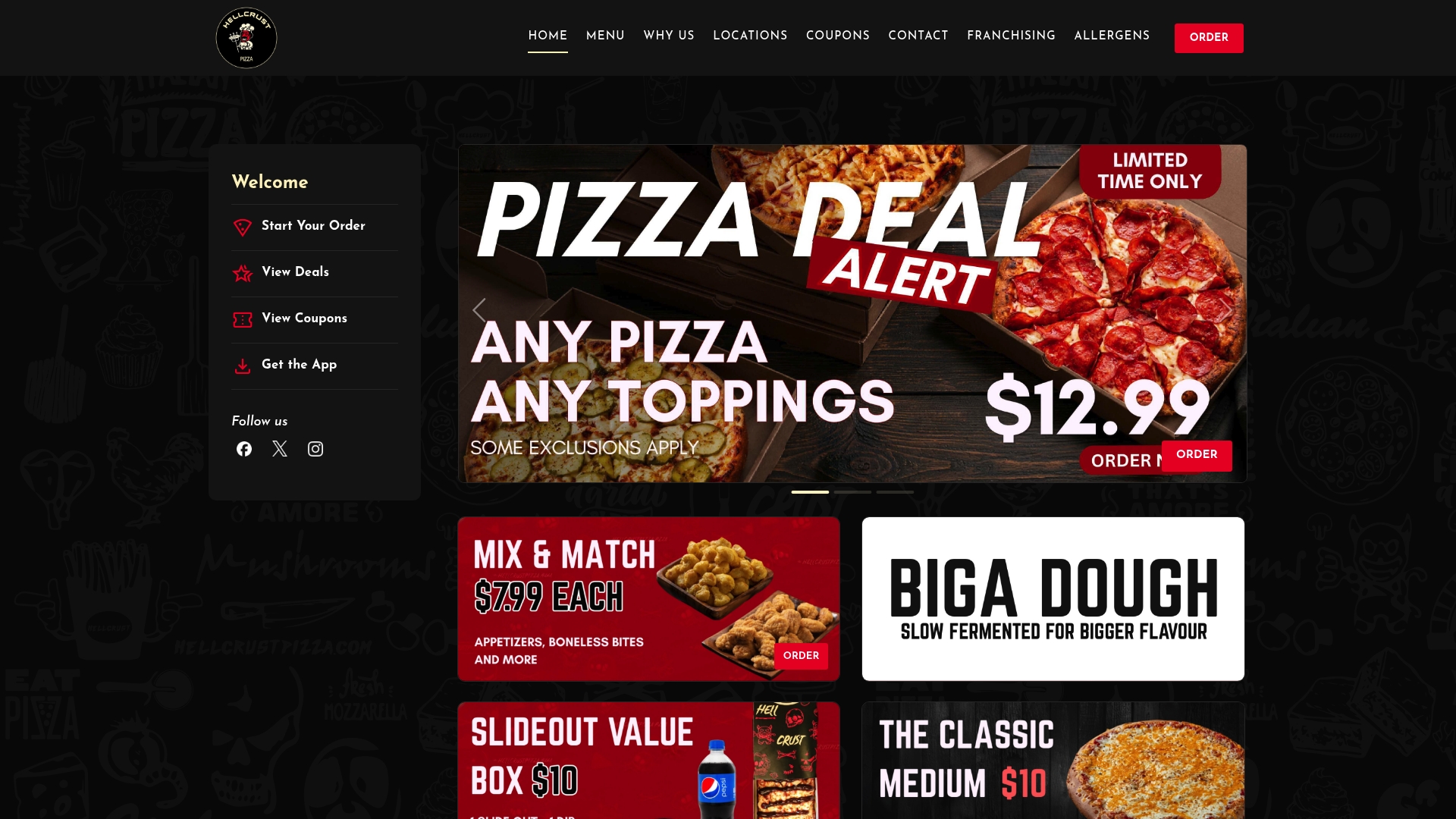
Before that conversation, it's worth seeing the product for yourself:
- Browse our full menu of pizzas, pastas, and sides to see the deal structure and variety that drives repeat orders.
- Prepare your personal financial statement and down payment proof ahead of your first call, since franchisors typically ask for this early to confirm fit.
- Come with questions about territory, build-out specs, and ongoing fees so the conversation moves efficiently toward a real answer.
FAQ
How much does it cost to open a pizza franchise in Canada?
Total investment typically ranges from a lower amount for a delivery-focused concept to a higher amount for a larger dine-in location, with quick-service builds commonly falling between $250,000 and $600,000. The franchise fee itself is usually the smallest piece of that total, with build-out, equipment, and working capital accounting for most of the cost.
What is the most profitable franchise to own in Canada?
Profitability depends far more on location, operator skill, and local market saturation than on brand alone, so there's no single franchise that's universally the most profitable. A format with lower build-out costs, like a delivery-focused pizza concept, can reach profitability faster on less invested capital, provided its delivery radius isn't already saturated with competitors.
Which pizza franchise is the cheapest in Canada?
Delivery and ghost-kitchen formats are generally the least expensive way to enter pizza franchising, since they avoid the cost of dining room build-out and front-of-house staffing. For exact current fee structures and total investment estimates, request a franchise disclosure document directly from the brand you're considering, since published fees vary by concept and change over time.
What is the cheapest pizza franchise to open?
Among pizza concepts generally, formats built around delivery and takeout rather than full dine-in service tend to carry the lowest all-in investment, since they need less square footage and a simpler kitchen build. If a smaller investment and family-oriented, delivery-focused positioning appeals to you, requesting a franchise information pack is a reasonable way to see exact current figures.