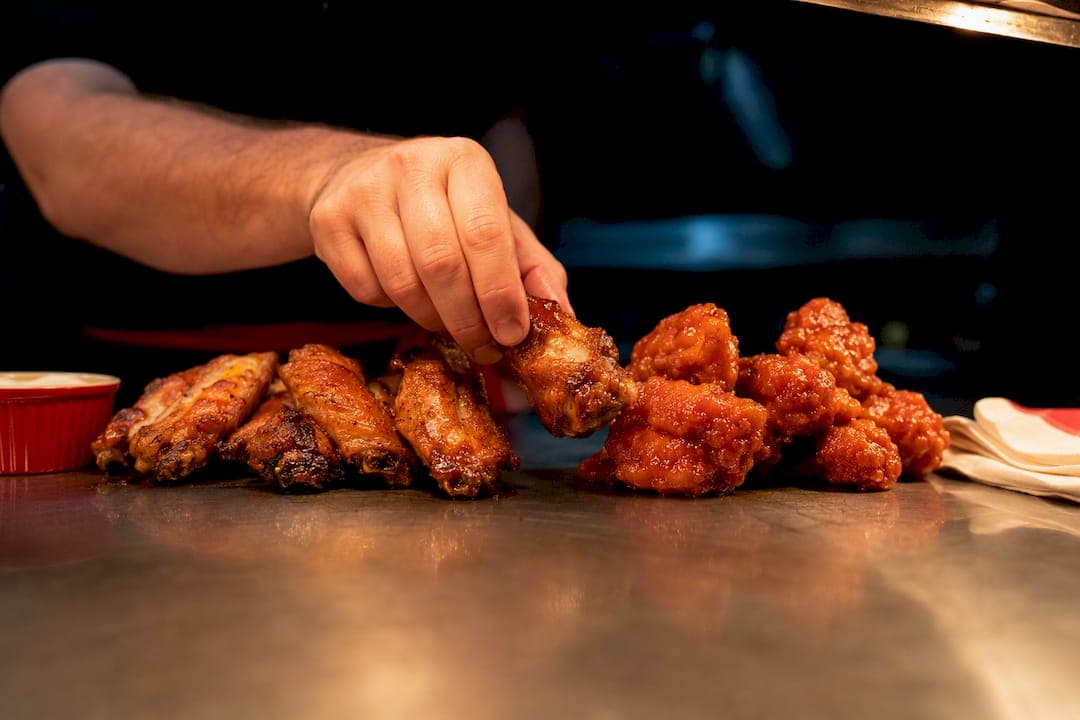
Choose bone-in wings when flavour and the ritual of eating with your hands matter most; choose boneless when you want speed, easy sharing, and food that survives a delivery bag. Neither format beats the other outright. One serves flavour purists at the table, the other serves families and anyone ordering ahead for a game night, and the right pick depends on what you value more that evening.
TL;DR:
- Bone-in wings are generally more flavorful and juicier due to higher fat, collagen, and skin rendering during cooking, but require more effort to eat.
- Boneless wings have higher calories and carbs because of breading and frying, making them less ideal for calorie-conscious diners.
- Prices for bone-in wings fluctuate with the wing market, while boneless typically cost more due to extra processing and labor.
- For delivery or quick meals, boneless wings travel better and stay crisp longer, whereas bone-in wings are preferable for sit-down, flavor-focused dining.
- When ordering, consider the occasion: choose bone-in for a flavor-rich experience and boneless for mess-free, kid-friendly, or faster service.
Table of Contents
- Bone-in vs boneless wings: the quick side-by-side differences
- Why bone-in wings taste richer: the science of skin, fat, and bone
- Which wing style is healthier: comparing nutrition side by side
- Why bone-in and boneless wings cost differently
- Cooking bone-in vs boneless wings: what changes in the kitchen
- How to decide between bone-in and boneless wings tonight
- How Hellcrustpizza sees the wing debate
- A simpler way to feed the table tonight
- Sources
Bone-in vs boneless wings: the quick side-by-side differences
Before you settle on an order, it helps to see how these two formats actually diverge. Bone-in wings come from the flat and drumette sections of the chicken; boneless wings, despite the name, are usually strips cut from the breast, breaded, and fried into a wing-shaped piece.
- Composition: bone-in uses actual wing meat with skin and bone intact; boneless uses breast meat cut and shaped.
- Skin and bone: bone-in keeps both, which affects texture and how sauce clings; boneless has neither.
- Breading: boneless is almost always breaded before frying; bone-in is typically sauced or dry-rubbed with no coating.
- Calories and carbs: boneless tends to run higher on both, largely because of the breading.
- Price tendency: bone-in prices swing with wing-specific markets; boneless tracks the broader breast market.
- Best use case: bone-in for sit-down flavour, boneless for delivery, kids, and mixed platters.
Here's a common misconception worth clearing up: boneless wings are not just chicken nuggets with a different name. As the breakdown from Webstaurant Store explains, they're cut, seasoned, and sauced to mimic the wing eating experience, even though the raw material is breast meat.
Why bone-in wings taste richer: the science of skin, fat, and bone
Wings are technically white meat, but they behave like dark meat on the plate. That's the twist America's Test Kitchen points to when explaining why a wing tastes so much more indulgent than a plain chicken breast. Wings carry more fat and collagen than breast meat, and that collagen breaks down into gelatin once the meat hits roughly 57°C during cooking. Gelatin traps moisture, so the meat stays juicy even after a hard sear or a stint in hot oil.
Skin plays its own role. Rendered skin crisps into a textured shell that holds sauce far better than bare breast meat ever could, which is why a properly cooked bone-in wing often tastes saucier than a boneless piece dunked in the same amount of glaze. The bone itself contributes too, conducting heat unevenly through the meat and concentrating flavour near the joint, the part regulars fight over.
The trade-off is real. Bone-in wings demand more effort at the table, sauce on your fingers, cartilage to navigate, and a bone to set aside. Boneless wings sacrifice some of that richness for a bite you can eat in one motion, no napkin negotiation required. Neither approach is wrong; they're built for different moments.
Which wing style is healthier: comparing nutrition side by side
Breading is the real dividing line here, not the wing itself. Because boneless wings are cut from breast meat and then breaded and fried, they typically pick up more oil and batter per bite, which pushes up calories, carbs, and sodium compared to an unbreaded bone-in wing tossed simply in sauce.
Nutrition roundups show meaningful spreads between the two, though exact figures shift depending on portion size and how a kitchen preps its batch.
| Metric (per typical shared serving) | Bone-in wings | Boneless wings |
|---|---|---|
| Calories | moderate range | higher moderate range |
| Carbohydrates | Low (minimal breading) | Higher (breading absorbs oil and sugar from sauce) |
| Sodium | Moderate (sauce-dependent) | Higher (breading plus sauce) |
| Protein | Comparable, varies by portion | Comparable, varies by portion |
These ranges come from comparative estimates reported by Eat Healthy 365, and they'll move depending on sauce choice and cooking method. Protein counts land in a similar range for both, but breading dilutes the meat percentage of each piece, so you're eating slightly less actual chicken per bite with boneless. If carbs or sodium are a concern, bone-in wings without heavy glazes are the safer lane, and oven-baking or air-frying boneless pieces cuts down on the oil uptake that drives up the calorie count.
Why bone-in and boneless wings cost differently
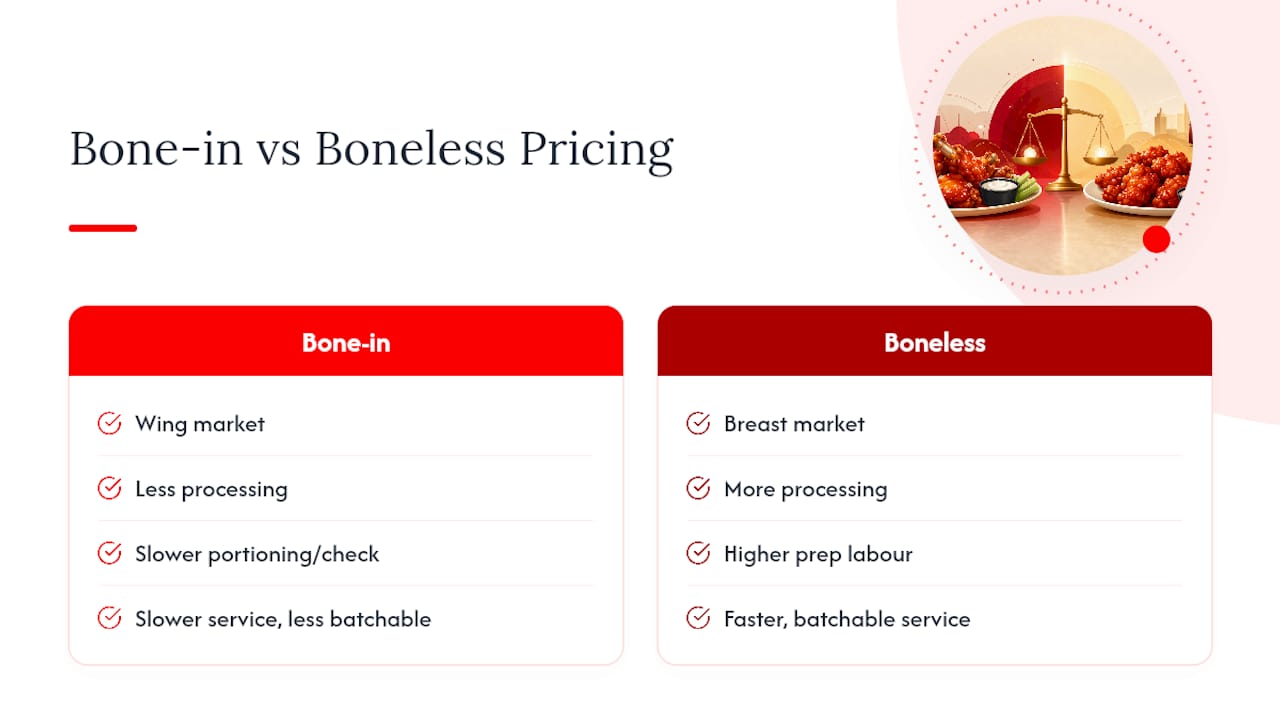
Restaurants don't price these two formats off the same commodity chart. Bone-in wings follow the wing market specifically, while boneless wings track the broader chicken breast market, and wing economics reporting from Blue Orbit shows these two markets can move in opposite directions in the same month. That's part of why a wing special one week doesn't always carry over to boneless pricing, and vice versa.
Labour and yield add another layer. Bone-in wings require less processing before they hit the fryer, but they take longer to portion and check for doneness individually. Boneless pieces cost more in prep labour and breading materials but move through service faster once cooked, since kitchens can batch them with more predictable timing.
That difference in labour and supply cost is why some operators treat bone-in and boneless as separate line items on their menu rather than pricing them the same per piece. It also explains why promotions tend to rotate: a kitchen sitting on cheap wing stock will push a bone-in deal, while a breast-heavy week favours a boneless special instead.
Cooking bone-in vs boneless wings: what changes in the kitchen
Boneless wings cook more evenly because every piece is roughly the same shape and thickness. Bone-in wings vary piece to piece, so restaurant operators often stagger their fry loads or check batches individually rather than pulling everything at once. That inconsistency is the price of the richer flavour bone-in delivers.
A few practical notes for home cooks: brine boneless pieces briefly before breading to keep the breast meat from drying out in the fryer. Finish bone-in wings under a broiler for the last two or three minutes to bronze the skin without overcooking the interior. If you're baking instead of frying, boneless pieces need less time in the oven than a full bone-in batch.
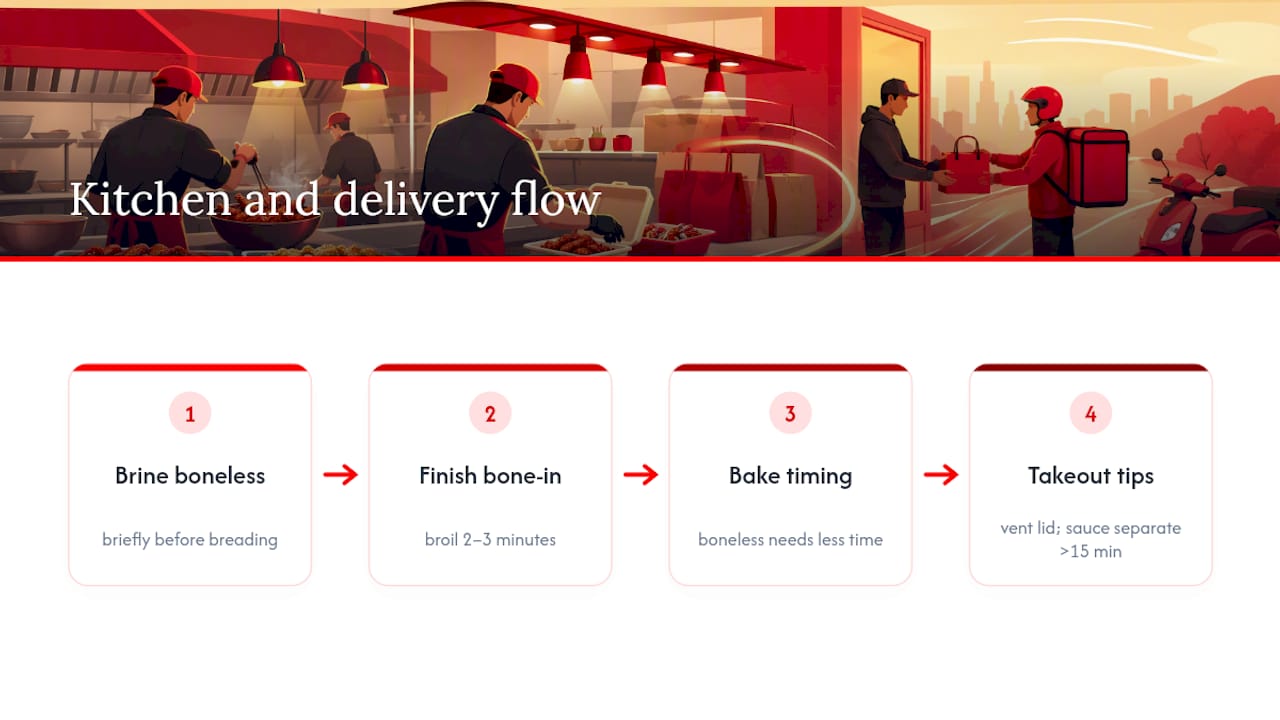
For takeout and delivery, boneless wings travel better; they don't steam inside a closed container the way skin-on bone-in wings can, which softens crispness fast. Vent the container lid slightly for either format, and separate sauce on the side when the trip is longer than fifteen minutes.
How to decide between bone-in and boneless wings tonight
Run through this quick checklist before you order: how much you value peak flavour, how much mess you're willing to tolerate, how fast the food needs to arrive, your budget for the night, and any dietary limits at the table.
- Flavour-first dine-in night: go bone-in. You'll get the richer bite and the full skin-and-sauce experience worth eating with your hands.
- Family order or delivery: go boneless. Kids and anyone eating in the car will appreciate the mess-free bite and even cooking.
- Calorie-conscious order: go bone-in without heavy breading, or ask for a lighter sauce on boneless pieces.
Three quick questions worth asking a restaurant before you order: Is the sauce tossed or served on the side? Are the boneless pieces breast strips or a processed patty? How long has the batch been sitting under the heat lamp? Many restaurants also find innovative uses for boneless wings in dishes like easy vegan wraps that stay crisp.
Pro Tip: If you're ordering both formats for a mixed group, ask for boneless sauced lightly and bone-in sauced heavier. The breading on boneless pieces absorbs sauce fast and can turn soggy if it's drenched the same way bone-in wings are.
How Hellcrustpizza sees the wing debate
Wing choice comes down to the same question we ask about every family order: what fits the moment? Bone-in suits a slower night at the table; boneless suits a delivery order with kids in the mix. Pair either with a lighter cheese pizza rather than a heavy one, so the flavours don't compete. Wing preference data and full author details aren't publicly listed here, but the same logic guides how we build our own pizza sides.
— jaskirat Singh
A simpler way to feed the table tonight
If wings aren't the centrepiece and you'd rather skip the debate entirely, Hellcrustpizza offers families and groups a fuss-free alternative with multigrain dough and customizable toppings.

We offer Mix & Match deals and family-sized specials so everyone gets what they want without five separate orders. Pair a pizza with customizable toppings and round it out with a side, and you've solved the "what do we order" problem faster than any wing negotiation. If sauce placement matters to your crew the way it does with wings, our guide on ordering sauce on the side applies just as well to pizza. Open the Hellcrustpizza app and place your order for pickup or delivery tonight.
Sources
- The Wing Dilemma of Bone-In vs. Boneless – What’s Best for Restaurants?
- Are Chicken Wings White or Dark Meat? | America's Test Kitchen
- What Are Boneless Wings & How Are They Made?
- Chicken wing economics: The real bar food math | BLUE ORBIT
- Boneless vs traditional wings: Which is healthier?