
Plan on covering a substantial portion of your total project cost with your own unencumbered equity, typically around one-third to one-half. The rest gets financed through a mix of Canada Small Business Financing Program loans, a BDC or chartered bank term loan, and a working-capital facility for the first year of operations. Your next move isn't calling a bank. It's assembling the franchise disclosure document, a draft lease or letter of intent, and a lender-ready business plan, because that package is what determines which door opens first.
TL;DR:
- Many first-time buyers underestimate build-out costs, making contractor quotes essential to meet sector benchmarks and avoid rejection.
- A 6 to 12 month working capital reserve is critical, as sales grow gradually, and undercapitalization leads to cash-flow issues early on.
- Loans from the Canada Small Business Financing Program, BDC, and banks serve different needs, with priority on equipment, advisory input, and speed, respectively.
- Preparing a complete, reconciled financing package, including detailed projections and documentation, significantly improves approval chances.
- Market saturation and cost volatility pose risks that must be mitigated through careful territory selection and budget cushions.
Table of Contents
- How much does a pizza franchise cost, and what cash buffer do you need?
- Primary Canadian financing channels: CSBFP, BDC, banks and credit unions
- Preparing a lender-ready financing package
- Building realistic projections and unit economics
- Practical funding mixes and equity sources for Canadian buyers
- Common pitfalls, underwriting rejections and a readiness checklist
- Risks and mitigation strategies specific to pizza franchise financing
- Advice on negotiating franchise fees and financing terms with the franchisor
- Impact of credit scores and financial history on financing options and approval chances
- Tax implications and benefits related to franchise financing and ownership
- Author perspective: what actually improves your approval odds
- How HellCrust Pizza can help prospective franchisees get started
- Sources
- FAQ
How much does a pizza franchise cost, and what cash buffer do you need?
Quick-serve pizza builds vary by market and location size, but the shape of the spending is fairly consistent across the sector. Build-out and kitchen equipment eat the largest share of your budget, followed by the initial franchise fee, then a runway of working capital that keeps the lights on before sales stabilize.
Here's roughly how a total project budget tends to break down:
- Build-out and leasehold improvements: often the single largest line item, varying widely by whether you're taking over an existing food-service space or gutting a bare shell.
- Equipment and kitchen fit-out: ovens, refrigeration, POS systems, and delivery-ready packaging stations.
- Franchise fee and soft costs: the upfront licensing fee plus legal review, permits, and initial training.
- Working capital reserve: the Canadian Franchise Association recommends budgeting 6 to 12 months of operating runway, and lenders expect to see it as a line item, not an afterthought.
That last point trips up more first-time buyers than any other. A pizza shop doesn't hit its stride the week it opens. Sales climb over months, not days, and the gap between your first invoice and your first profitable month is exactly where undercapitalized franchisees run into trouble. Build your total project number by adding build-out, equipment, the franchise fee, soft costs, and that 6 to 12 month buffer together, then treat the sum as your real financing target, not just the price tag the franchisor quotes you.
Primary Canadian financing channels: CSBFP, BDC, banks and credit unions
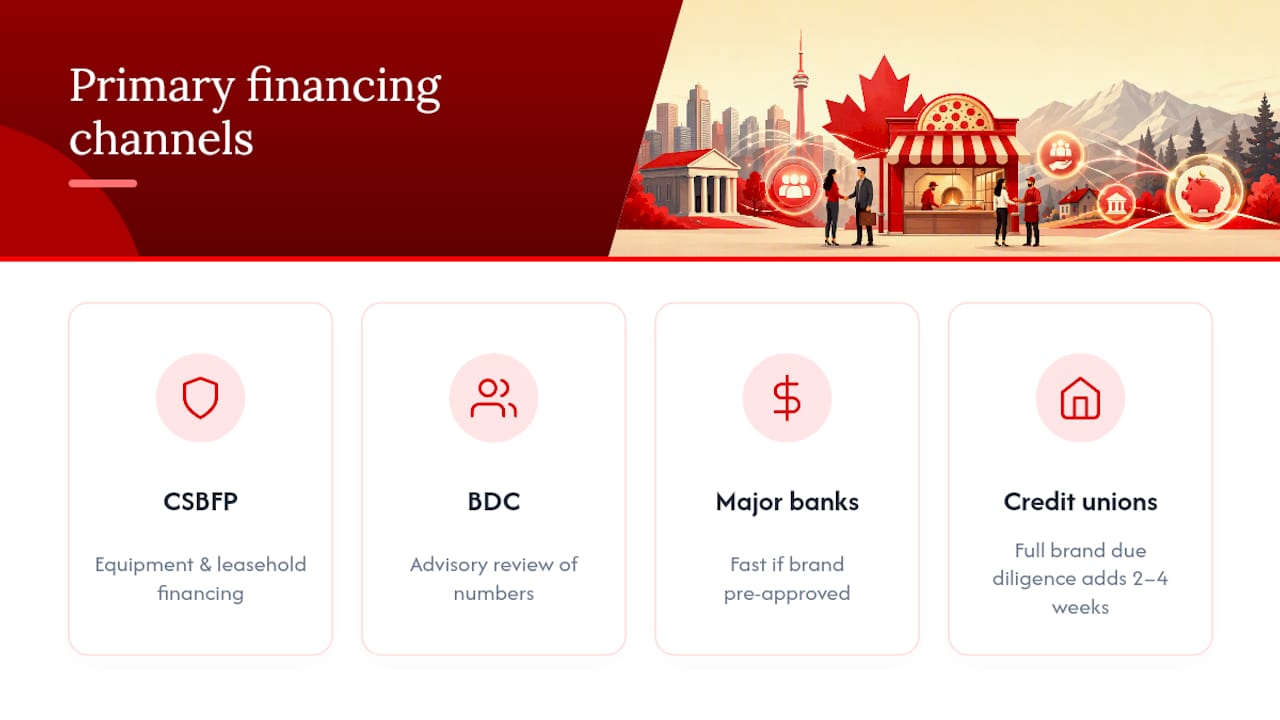
Four doors matter most for a Canadian franchise buyer, and each one wants something slightly different from you.
The Canada Small Business Financing Program is the one most first-timers misunderstand: you don't apply to the government. You apply through a participating lender, who administers the loan under a federal guarantee. The program can finance equipment purchases and leasehold improvements with total financing limits and sub-limits on equipment and leasehold categories as specified by the Canada Small Business Financing Program (source), plus a 2% registration fee rolled into the loan. It's a guarantee mechanism for the lender, not a discount for you, so full underwriting still applies.
BDC runs its own book of small-business and start-up lending, including online loans up to several hundred thousand dollars alongside larger tailored term loans for equipment and real estate. What sets BDC apart isn't just the capital. Its advisory team reviews your numbers before you take them anywhere else, which strengthens the file whether you close with BDC or a chartered bank.
Major banks and credit unions move fastest when your brand sits on their pre-approved franchise list. If it doesn't, expect full brand due diligence adding two to four weeks to your timeline.
Statistic to note: the CFA's own guidance frames a significant percentage of unencumbered equity typically recommended as a baseline as the baseline for a balanced capital structure, with cash-flow stability through the first 12 to 24 months as the real test lenders apply.
Prioritize by what you need most: CSBFP for equipment-heavy builds, BDC when you want advisory input alongside capital, and pre-approved bank lists when speed matters more than flexibility.
Preparing a lender-ready financing package
Underwriters reject incomplete files before they reject weak ones. A well-prepared package needs to arrive complete the first time.
- Franchise Disclosure Document and franchise agreement, with the royalty structure, marketing fund obligation, and territory terms flagged clearly.
- Personal net worth statement and two to three years of personal tax returns.
- Draft lease or signed letter of intent for the location.
- Contractor quotes for build-out, not estimates pulled from the franchisor's brochure.
- Three to five year financial projections that reconcile to the franchisor's Item 19 sales data, where disclosed.
Lenders read Item 19 the way an appraiser reads comparable sales. If your projections sit well above what similar units actually report, expect questions. If you can't explain a gap, expect a decline. Learn what documentation typically gets requested for buying into a pizza franchise before you sit down with a lender, so nothing catches you off guard.
Almost every franchise loan also carries a personal guarantee, and lenders will ask what collateral sits behind it. Come prepared with a clear answer rather than figuring it out in the meeting.
Pro Tip: Build a one-page reconciliation showing how your projected sales, royalty rate, and marketing contribution map directly to the franchisor's Item 19 figures. It answers the underwriter's first question before they ask it.
Building realistic projections and unit economics
Your gross margin story has to survive contact with royalties and marketing fees, and this is where a surprising number of applications fall apart. Advisors report that missing royalty and marketing fund deductions is one of the most common franchise-specific reasons loans get rejected, not because the business is weak, but because the projection was built wrong.
Start with revenue, subtract cost of goods, then subtract the royalty and marketing fund contribution before you calculate your adjusted gross margin. That order matters. Skipping it inflates your margin on paper and gets flagged the moment an underwriter runs the numbers themselves.
Benchmarks worth building into your model:
- Royalty fees typically run several percent of gross sales.
- Marketing fund contributions typically run a few percent.
- Rent and labour together are the two biggest levers on your debt-service coverage ratio.
A figure worth sitting with: lenders routinely compare your build-out estimate to sector midpoints, and a number significantly below the midpoint without contractor quotes to back it up reads as a red flag rather than a bargain.
If your debt-service coverage ratio holds above 1.0 in the stress scenario, your file has a real shot. If it collapses, that's the lender's cue to decline, and it should be yours to rework the plan first.
Practical funding mixes and equity sources for Canadian buyers
Real capital stacks in Canada rarely come from one source.
Experienced multi-unit operators lean harder on leverage and lighter on equity, because they can point lenders to an operating track record instead of projections alone. Common building blocks include:
- Personal cash and RRSP rollover proceeds
- Vendor or equipment financing tied directly to the build-out
- Partner or family investor capital, documented with a signed agreement, not a handshake
- A line of credit reserved specifically for working capital, not spent on build-out
Whatever mix you land on, document every dollar. Undocumented "friends and family" capital is one of the fastest ways to stall a file at the underwriting stage.
Common pitfalls, underwriting rejections and a readiness checklist
Three mistakes account for most declines, and all three are fixable before you ever submit an application.
- Underestimating build-out costs. Get contractor quotes, not brochure estimates, and expect underwriters to check your numbers against sector midpoints.
- Skipping the working-capital buffer. A file with no visible 6 to 12 month reserve reads as a business one bad month away from default.
- Submitting unsupported projections. Reconcile every sales assumption to Item 19 or comparable unit data, and show your math.
Before you approach a lender, confirm you have: a complete document package, a documented cash buffer, projections that tie back to real franchise numbers, and a shortlist of two to three lenders matched to your priorities on speed, amount, and brand approval status.
Risks and mitigation strategies specific to pizza franchise financing
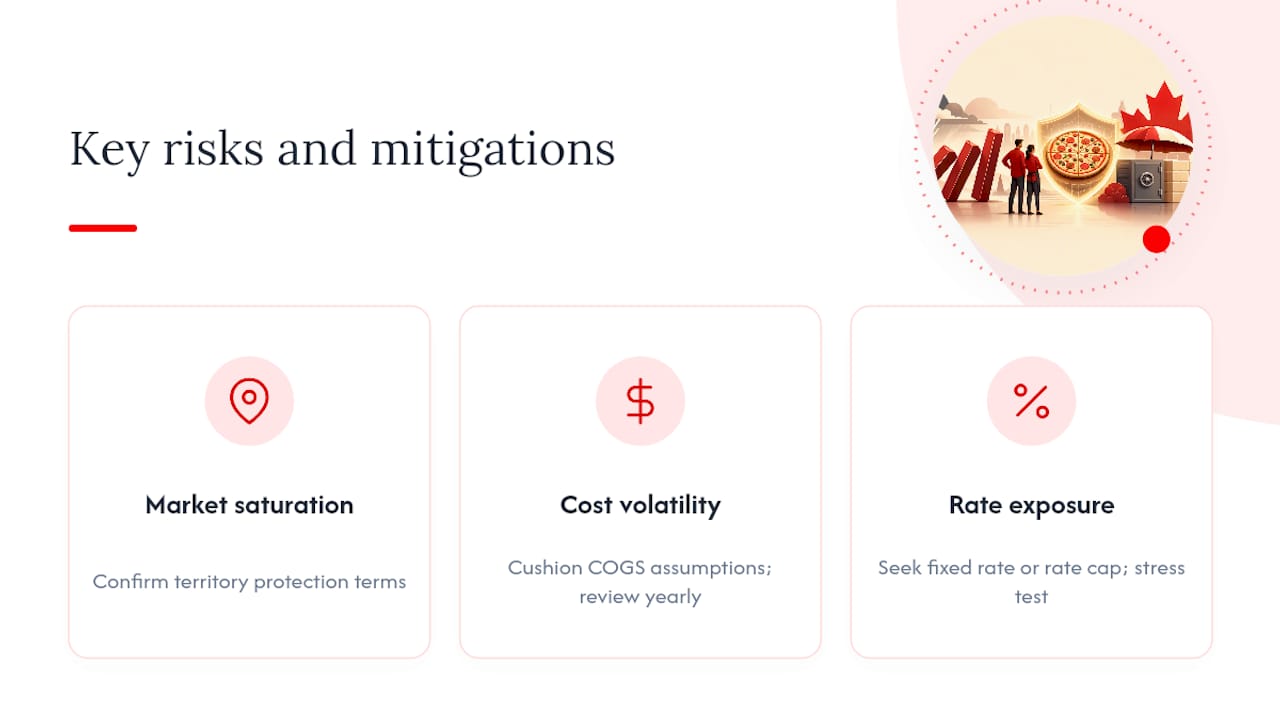
Market saturation is the risk most pizza franchise buyers underestimate at the outset. Delivery-heavy markets in and around Metro Vancouver and other major Canadian cities have grown crowded, and a lender will ask how your unit differentiates itself rather than just whether the brand is popular. Territory protection terms in your franchise agreement matter here. Read them closely, because a poorly defined territory can mean a second location from the same brand opening two kilometres away.
Operating cost volatility is the second major risk, and it shows up fastest in your food costs and labour line. Cheese, flour, and packaging prices move with commodity markets, and a margin model built on last year's costs can look very different twelve months later. The mitigation is straightforward but often skipped: build your projections with a cushion on cost-of-goods assumptions, not just on revenue, and revisit that cushion annually rather than assuming it holds.
Interest rate exposure is the third risk worth naming directly. If your term loan carries a variable rate, a rise in your debt-service payment can erode margin fast in a business that already runs thin. Ask your lender directly about fixed-rate options or rate caps, and factor a rate increase into your stress-test scenario alongside the sales-shock model.
The common thread across all three risks is the same: lenders want to see that you've modelled the downside, not just the upside, before you ask them to underwrite it.
Advice on negotiating franchise fees and financing terms with the franchisor
Franchise fees are more negotiable than most first-time buyers assume, particularly around territory size, training support, and the timing of royalty payments during your opening months. It rarely hurts to ask a franchisor whether royalty payments can be phased in or reduced during the first three to six months while sales ramp up. Established brands sometimes offer this for multi-unit commitments or for buyers entering a new or underdeveloped territory.
Financing terms tied to the franchisor matter just as much as the fee itself. Some franchisors offer vendor financing on equipment packages or introductions to preferred lenders who already understand the brand's unit economics. That relationship can shave real time off your approval process, since a lender familiar with the brand's Item 19 history spends less time on due diligence.
Before you sign anything, ask directly what support the franchisor provides during the financing process itself: introductions to lenders, sample financial projections, or a standard letter confirming territory rights for your lease negotiation. A franchisor with a mature financing relationship with banks or BDC is worth more to you at this stage than one offering a slightly lower fee with no financing infrastructure behind it.
Impact of credit scores and financial history on financing options and approval chances
Your personal credit history carries more weight in a franchise application than most new buyers expect, precisely because nearly every franchise loan in Canada requires a personal guarantee. A strong credit score doesn't just improve your approval odds. It often shapes the loan-to-value ratio a lender will offer and how much collateral they ask you to pledge against it.
A credit score in the high 600s or above generally keeps you within reach of mainstream bank and BDC products. Below that range, expect lenders to lean harder on CSBFP's guarantee structure, or to ask for additional collateral and a higher equity contribution to offset the perceived risk.
Financial history beyond the credit score matters too. Lenders review two to three years of personal tax returns and look for consistency: stable income, no unexplained gaps, and evidence you've managed debt responsibly through variable periods. A recent bankruptcy or consumer proposal doesn't automatically disqualify you, but it does typically mean a longer conversation and a higher equity requirement to compensate.
If your credit history has rough patches, address them directly in your application rather than hoping the underwriter won't notice. A short written explanation, paired with evidence of the issue being resolved, reads far better than silence.
Tax implications and benefits related to franchise financing and ownership
How you structure the purchase affects your tax position for years, which is why a specialist accountant belongs on your team before you sign anything, not after. Incorporating the franchise, rather than operating as a sole proprietor, opens access to the small business deduction on active business income, and it's also the structure that makes an RRSP rollover into the business legally possible.
Interest on financing used to purchase business assets is generally deductible against business income, which is one reason a well-structured term loan can be more tax-efficient than draining personal savings outright. Equipment purchased through the business, including anything financed under the CSBFP, typically qualifies for capital cost allowance, letting you depreciate the asset over time rather than absorbing the full cost in year one.
The franchise fee itself is usually treated as an intangible asset and amortized over time rather than deducted immediately, which affects how your early-year financial statements read to a lender reviewing them later for a second loan or a renewal.
None of this replaces a conversation with an accountant who understands franchise structures specifically. The rules around RRSP rollovers, capital cost allowance categories, and incorporation timing are precise enough that a generic small-business tax guide won't cover your actual situation.
Author perspective: what actually improves your approval odds
The buyers who get approved fastest do three things well: they reconcile every projection to the franchisor's Item 19, they show six to twelve months of documented liquidity instead of promising it, and they get contractor quotes before they get attached to a location. HellCrust Pizza's own franchise requirements guidance reflects exactly this discipline.
Pro Tip: Match your projections to the franchisor's Item 19 line by line before a lender asks you to.
— jaskirat Singh
How HellCrust Pizza can help prospective franchisees get started
If you're weighing CSBFP paperwork against a BDC advisory call, know there's a direct route into this process that starts with the brand itself rather than a lender's intake form. HellCrust Pizza built its franchise program around Biga multigrain, additive-free dough and a menu that's already proven with families and delivery customers in several locations, and that operating history is valuable to lenders when reflected in your projections.
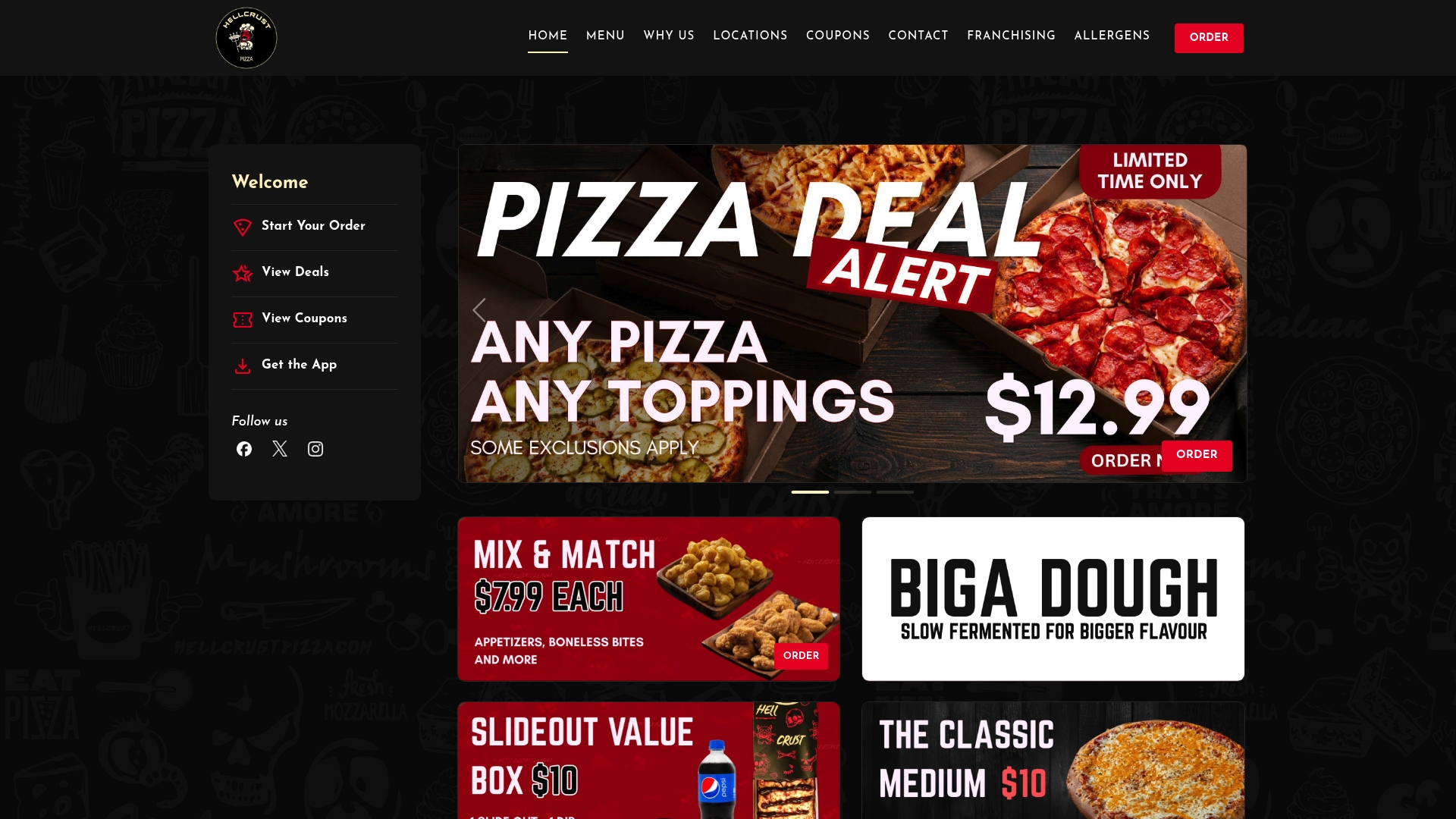
HellCrust's franchising overview walks through the fee structure and territory details you'll need for your loan package, and the blog covers deeper questions like multi-unit ownership for buyers thinking beyond a single location. This is a direct, brand-owned path, not a referral service, so the numbers you get are the numbers you'll actually finance. If you're ready to see the fee schedule and territory availability for yourself, visit the franchising page and submit an enquiry to start the conversation.
Sources
For deeper reading beyond this guide, the Canadian Franchise Association's funding guidance, BDC's financing overview, and the CSBFP explainer for prospective franchisees cover the regulatory and lender-side detail this article can't fully replicate. For structuring your own sales forecasts and KPIs, the restaurant analytics guidance from Fowst is a useful companion. Always review the franchisor's FDD line by line with a qualified accountant or franchise advisor before signing or applying for financing.
This article is general information, not a substitute for advice from a qualified financial advisor. Consult a qualified financial professional about your own circumstances before acting on anything here.
- How to fund your franchise — Canadian Franchise Association
- BDC financing overview — Business Development Bank of Canada
- How to write a franchise loan business plan (Canada) — Bridge Note
FAQ
Can I use the CSBFP to buy a pizza franchise directly from the government?
No. The CSBFP is administered through participating lenders, not applied for directly with the government, and it finances equipment and leasehold improvements up to $1,150,000 in total with a 2% registration fee.
Does HellCrust Pizza offer financing support for franchisees?
HellCrust Pizza provides franchise guidance and multi-unit content through its blog and franchising landing page, giving prospective buyers real operating data to bring into their lender package.
What's the biggest reason franchise loan applications get rejected?
Underestimated build-out costs and missing royalty or marketing fund deductions in cash-flow projections are the most common franchise-specific reasons for rejection.
How long should my working capital reserve last after opening?
Plan for 6 to 12 months of operating runway, which is the standard buffer lenders and franchise associations recommend for new units.