
A protected franchise territory usually stops another same-brand store from opening in your zone, but it rarely blocks the franchisor from selling there through online, delivery, or sister-brand channels. The word "protected" describes a boundary on paper, not a wall around your customers. The real risks sit in three carve-outs: e-commerce orders, ghost kitchens, and national accounts, all of which can legally reach your zone even while your storefront stays the only one for miles.
TL;DR:
- Protected territories often allow the franchisor to sell online, through apps, or via ghost kitchens within your zone, eroding actual market protection.
- Territory boundaries can be defined by radius, ZIP codes, population, or drive-time polygons, but each method has vulnerabilities that can shift the actual service area.
- Item 12 of the Franchise Disclosure Document must specify the exact territory boundaries, whether they are exclusive or protected, and any reserved channels or conditions for shrinking the zone.
- Carve-outs like online orders, ghost kitchens, and national accounts can operate inside your territory regardless of the boundary, often without your control or benefit.
- Effective protection requires contract language prohibiting franchisor channels inside the zone, a mapped exhibit referencing a reliable dataset, and clear performance benchmarks to prevent gradual encroachment.
Table of Contents
- Franchise territory rights: exclusive vs protected, and why the label is weaker than it sounds
- How territories are defined: radius, postal codes, population counts, and mapped exhibits
- What FDD Item 12 must disclose about your franchise area exclusivity
- Carve-outs that quietly erode your franchise market protection
- Negotiation checklist: contract language that actually protects franchise territorial agreements
- Encroachment, renewal, and re-measurement: how territories shrink over time
- What this looks like for a pizza franchise: app orders, delivery zones, and internal checkpoints
- Legal enforcement: how territory disputes actually get resolved
- How territory protection shapes franchisee profitability and market saturation
- Resolving disputes between franchisees over overlapping territory
- Do territory protection laws vary by region?
- A practical verdict on protecting your territory
- Sources
- FAQ
Franchise territory rights: exclusive vs protected, and why the label is weaker than it sounds
An exclusive territory is a specific legal promise: the franchisor will not open, license, or operate another unit of the same brand inside your boundary, full stop. Few modern agreements offer this anymore. Instead, most franchisors sell "protected" territories, a term with no fixed legal meaning of its own. What it actually protects depends entirely on the contract language and the disclosures in Item 12 of the FDD.
In practice, "protected" typically means:
- No other franchisee can open a physical location inside your mapped area.
- The franchisor may still sell into your zone through its own website, an app, or a delivery aggregator.
- Reserved channels, like ghost kitchens or national account deals, often sit outside the protection entirely.
This shift toward protected rather than exclusive territories reflects how franchise systems grow today. Chains want room to expand digitally without renegotiating every regional contract, and protected territories give them that room while still offering franchisees a baseline guarantee against a competing storefront next door.
How territories are defined: radius, postal codes, population counts, and mapped exhibits
Franchisors draw boundaries four common ways, and each carries its own failure point. A radius territory (a fixed distance from your address) sounds simple until a competing unit opens just outside that radius and pulls from the same commuter corridor. Postal or ZIP code territories can lump in unpopulated industrial parks while excluding a dense residential block one street over. Population-based zones try to guarantee a customer base but depend on census data that may become outdated between updates. Drive-time polygons account for traffic and geography more realistically, yet they shift if a new highway exit changes commute patterns.
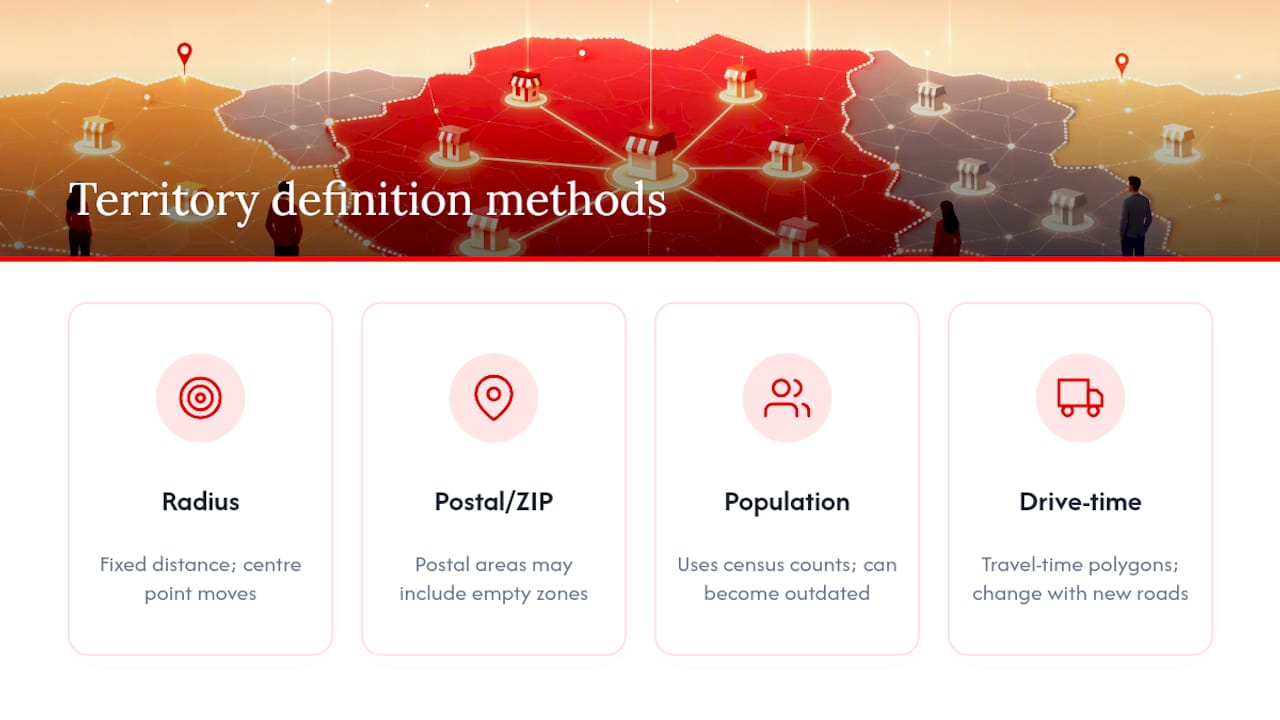
Measurement control matters because whoever owns the dataset controls the boundary. If a franchisor relocates your unit or redraws the "centre point" for the zone, your protected area can move with it, sometimes shrinking in the process, a pattern detailed in FDDIQ's breakdown of territory definition methods.
Pro Tip: Never accept a verbal description of your territory. Insist on a map exhibit attached to the franchise agreement, with the governing dataset (census year, GIS provider, or drive-time software) named explicitly, so nobody can quietly redraw your zone later.
What FDD Item 12 must disclose about your franchise area exclusivity
Item 12 of the Franchise Disclosure Document is the authoritative source for territory rights, not the sales brochure and not what a franchise development rep tells you over the phone. Federal disclosure rules require Item 12 to spell out:
- The precise boundaries of your territory and how they were calculated.
- Whether the territory is exclusive, protected, or non-exclusive.
- Every right the franchisor reserves for itself, including online sales, delivery, and alternative channels.
- The conditions under which your territory can shrink, such as population growth thresholds or sales performance triggers.
When a territory is non-exclusive, the FTC requires a specific warning statement disclosing that fact plainly, a detail Franchise Feast's Item 12 walkthrough covers in full. That warning is worth treating as a starting point for negotiation, not a dead end. Cross-check Item 12 against Item 20, which lists actual outlet locations and transfers, to see whether the franchisor's stated territory promises match its real-world development pattern. If Item 20 shows units opening closer together than Item 12's stated boundaries suggest, ask why before you sign anything.
Carve-outs that quietly erode your franchise market protection
Franchisors reserve several channels that can operate inside your territory no matter how tightly the boundary is drawn. Each one diverts revenue that would otherwise land on your point-of-sale system.
- Online and app-based ordering. The franchisor's own e-commerce platform can fulfill orders from customers inside your zone, sometimes routing them to a different unit entirely.
- Ghost kitchens. Delivery-only locations, run by the franchisor or a licensee, can serve your neighbourhood without ever opening a storefront there.
- National and institutional accounts. Deals with stadiums, hospitals, universities, or corporate cafeterias are almost always reserved for the franchisor, regardless of whose territory they sit in.
- Non-traditional venues. Airports, gas stations, and event centres frequently fall under separate licensing agreements outside standard territory maps.
Before signing, ask for historical data on how digital and third-party orders get attributed by location, and whether any revenue-sharing or commission policy exists when the franchisor's own channels sell into your zone.
Negotiation checklist: contract language that actually protects franchise territorial agreements
Territory protection is negotiated at the table, not fixed after the fact. Ask for these specific items, in this order of priority:
- Absolute prohibition language that bars the franchisor's own digital and delivery channels from operating inside your mapped zone, not just other franchisees.
- A map exhibit attached directly to the agreement, referencing a named dataset and update schedule.
- Right of first refusal (ROFR) on any adjacent territory that opens for development.
- A rebate or commission on any reserved-channel sales, like ghost kitchen or online orders, that land inside your boundary.
- Objective performance metrics (dollar sales, unit volume) rather than subjective standards like "adequately serving the market" as the trigger for any territory reduction.
Exclusivity is more realistically on the table for multi-unit development deals or proven multi-brand operators with leverage, something worth exploring if you're weighing a multi-unit franchise commitment. Attorneys who work in this space consistently point to the same lesson: the label on the contract matters less than the reservation-of-rights clause underneath it.
Pro Tip: Get every performance metric in writing as a number, not an adjective. "Sell $250,000 annually" can't be argued with. "Adequately serve the territory" can be interpreted six different ways, and five of them favour the franchisor.
Encroachment, renewal, and re-measurement: how territories shrink over time
Encroachment happens when a franchisor or another franchisee's activity cuts into your customer base without technically violating the boundary on paper. It shows up as a new ghost kitchen two postal codes over, a national account contract that routes catering orders to a competitor's kitchen, or a relocated sister unit that now sits just outside your radius but inside your actual drive-time market.
Many agreements include relocation clauses that redraw your boundary around a new approved site, and renewal clauses that require signing the franchisor's then-current agreement, which may define territory differently than the one you started with. Re-measurement at renewal is one of the most common ways a territory quietly shrinks, and it rarely gets flagged until the renewal paperwork is already on the table.
Realistic remedies after the fact are limited: mediation, arbitration under the franchise agreement's dispute clause, or in serious cases, litigation over breach of the territory covenant. Prevention beats all three. Negotiating durable, metric-based language before you sign costs nothing compared to fighting a redrawn boundary five years in.
What this looks like for a pizza franchise: app orders, delivery zones, and internal checkpoints
Restaurant franchises face this problem in a very literal way. When a customer three blocks outside your delivery radius opens the brand's app and orders, does that sale credit your location, a nearby unit, or a corporate-run channel? Ghost kitchens compound the issue further, since a delivery-only kitchen can legally serve your zip codes without ever showing up as a competing storefront on a map.
Before buying a pizza franchise, confirm in writing how app and third-party delivery orders get attributed, whether commission splits exist for reserved-channel sales inside your territory, and how delivery zone boundaries are drawn relative to your physical footprint. A restaurant analytics dashboard can help operators track exactly which location receives credit for online orders, which is useful leverage if you ever need to prove a pattern of misattribution. Readers evaluating a food-service franchise should start by reviewing the actual franchise requirements and territory language before signing anything.
Legal enforcement: how territory disputes actually get resolved
Territory covenants are enforced the same way most commercial contract terms are: through the dispute resolution clause written into the franchise agreement itself, which almost always points toward mandatory arbitration before litigation is even an option. Courts generally treat territory language as they would any other contractual promise, meaning the outcome hinges on the precise wording of the reservation-of-rights clause, not on what a franchisee assumed the word "protected" meant at signing.
This is why attorneys who focus on franchise law push clients to read Item 12 and the territory clause line by line before committing. A franchisee who signs an agreement with vague reservation language has little recourse if a ghost kitchen opens two kilometres away and starts fulfilling delivery orders inside the mapped zone. The contract, not the sales pitch, is what an arbitrator or judge will look at first.
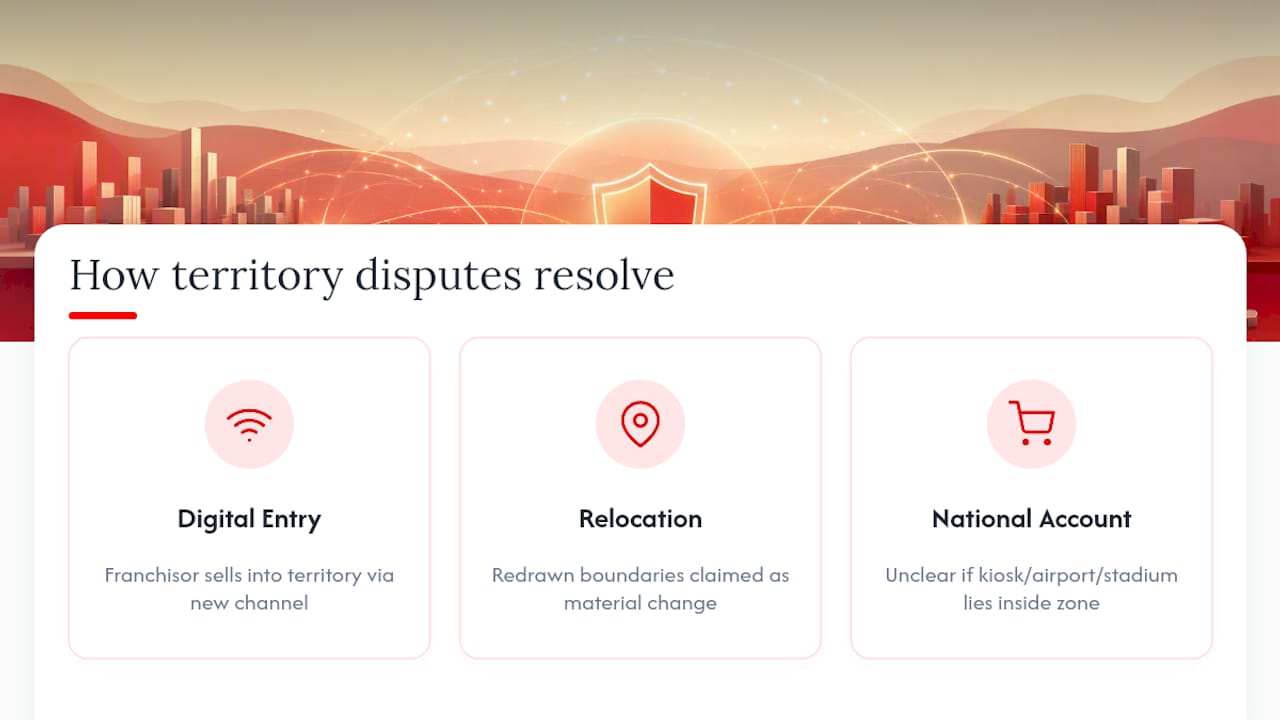
Franchise associations and legal commentators have noted a broader pattern across the sector: disputes tend to cluster around three fact patterns. The first is a franchisor selling directly into a franchisee's territory through a newly launched digital channel that didn't exist when the original agreement was signed. The second is a relocation or renewal clause redrawing boundaries in a way one party considers a material change. The third is ambiguity over whether a national account or non-traditional venue (an airport kiosk, a stadium concession stand) falls inside or outside a franchisee's protected zone.
None of these get resolved quickly, and remedies rarely restore lost revenue retroactively. Some agreements do build in cure periods or financial adjustments if a franchisor's own channel is proven to have materially cannibalized in-territory sales, but that language has to exist in the contract beforehand. It is not implied by law. That is the core reason legal counsel recommends negotiating precise, enforceable territory language up front rather than relying on a dispute process to fix a poorly worded clause after the damage is done.
How territory protection shapes franchisee profitability and market saturation
A weak territory clause has a direct line to your bottom line, and it shows up gradually rather than all at once. If a franchisor can license a new unit once your zone hits a certain population threshold, or open a ghost kitchen serving your postal codes without warning, your addressable customer base contracts even though your rent, staffing costs, and loan payments stay fixed.
Market saturation is the sharper end of this problem. Franchise systems grow by selling more units, and a franchisor's incentive to expand doesn't always align with an existing franchisee's incentive to protect their earning ceiling. This tension is exactly why the industry has moved toward tying territory conditions to objective, measurable metrics, like sales volume or population density, rather than vague operational language. A number in a contract is something you can point to. A phrase like "adequately serving the market" is something a franchisor can interpret however suits its next expansion plan.
Profitability projections built during due diligence should account for the realistic possibility of channel erosion, not just direct competition. A franchisee who models their break-even point assuming full territorial exclusivity, when the agreement actually reserves online and delivery channels for the franchisor, is working from numbers that don't hold up. Ask existing franchisees in the system, not just the ones the franchisor introduces you to, how territory carve-outs have actually affected their order volume since they opened. That conversation tends to reveal more than any projection in the FDD's Item 19.
Resolving disputes between franchisees over overlapping territory
When two franchisees within the same system believe their territories overlap, or that one is drawing customers the other believes belong to them, the fastest path rarely runs through a lawsuit against a fellow franchisee. Most systems route this through the franchisor's own dispute resolution process first, partly because the franchisor controls the master territory map and the underlying dataset that defines every boundary in the system.
Franchisee associations, where they exist within a given brand, often serve as an informal first stop for these disputes. A collective voice raising a pattern of boundary ambiguity carries more weight with a franchisor than a single unit owner's complaint, and it can prompt a systemwide clarification of map exhibits rather than a one-off fix that leaves the underlying ambiguity in place for the next dispute.
Mediation is the next practical step before formal arbitration, largely because ongoing franchisee relationships make an adversarial court fight costly in ways beyond legal fees. Two franchisees who need to coexist in a shared regional market, attend the same conventions, and potentially do business together down the line have real incentive to settle boundary disputes through a neutral third party rather than a public legal record.
The most durable fix, though, happens before a dispute ever starts: insisting during your own negotiation that the map exhibit is precise enough to leave no reasonable overlap with a neighbouring franchisee's zone. Vague radius descriptions or outdated postal code lists are the root cause of most inter-franchisee boundary fights, and they are entirely preventable at the contract stage.
Do territory protection laws vary by region?
Franchise territory law is not uniform, and the rules that govern disclosure, enforcement, and what counts as a legally defensible boundary differ by jurisdiction. In the United States, the Federal Trade Commission's Franchise Rule sets the baseline disclosure requirement for Item 12, but several states layer on additional franchise relationship laws that affect how territory disputes get resolved and what remedies are available to franchisees.
Outside the U.S., territory protection often works through different legal mechanisms entirely. Some jurisdictions rely more heavily on general contract and competition law rather than a franchise-specific disclosure regime, meaning the protections you'd expect from an FDD simply don't exist in the same form. A franchisee evaluating an international system, or a master franchise arrangement that spans multiple countries, needs jurisdiction-specific legal advice rather than assuming the disclosure norms from one market apply everywhere.
This matters most for prospective franchisees looking at brands with cross-border development plans, where a territory that feels protected in one country's legal framework might carry weaker enforcement teeth in another. The practical takeaway holds regardless of jurisdiction: read the actual governing contract law clause in your franchise agreement, understand which country's or state's courts (or arbitration rules) will hear a dispute, and confirm with a local franchise attorney what remedies are realistically available before you sign, not after a conflict arises.
A practical verdict on protecting your territory
If there's one habit worth building before signing anything, it's this: negotiate the reservation-of-rights language as hard as you negotiate the fee. Read Item 12 with a franchise attorney, insist on a mapped exhibit, and push for ROFR or a rebate on reserved-channel sales. Readers weighing a food-service franchise can start that homework on HellCrust's franchising page.
— jaskirat Singh
This article is general information, not a substitute for advice from a qualified lawyer. Consult a qualified legal professional about your own circumstances before acting on anything here.
Sources
- Franchise Genesis — FDD Item 12
- Franchise Feast — FDD Item 12 explained
- Vet My Franchise — FDD Item 12 territory rights
- Varnum LLP — Exclusive vs protected franchise territories
FAQ
What is a franchise territory?
A franchise territory is the geographic zone, defined in the franchise agreement and disclosed in Item 12 of the FDD, where a franchisee operates and where the franchisor limits (to varying degrees) competition from other units of the same brand.
Is an FDD legally required?
Yes. Under the FTC Franchise Rule, franchisors must provide a Franchise Disclosure Document to prospective franchisees before any sale, and it must include the Item 12 territory disclosures covered above.
How hard is it to get out of a franchise agreement?
Exiting early is typically difficult and costly, since most agreements include long terms, transfer restrictions, and post-termination non-compete clauses; a franchise attorney should review your specific contract before you sign or attempt to exit.
What is the most profitable franchise to own in Canada?
Profitability depends heavily on territory quality, local market saturation, and the strength of your reservation-of-rights clause rather than the brand name alone, which is why reviewing Item 12 and real unit-level performance data matters more than industry rankings.
Does a protected territory guarantee exclusivity?
No. "Protected" typically blocks another same-brand storefront from opening in your zone, but it commonly still allows the franchisor's online, delivery, or ghost-kitchen channels to operate there.