The best kids cooking party is one where every child makes something they can eat, nobody waits long for a turn, and the adults are not scraping dough off the ceiling afterwards. Choose a build-your-own menu (pizza, tacos, sundaes), give each child one real job, keep perishable food cold until the moment it is used, and plan allergies days ahead. Below you will find nine menus, a two-hour timeline and the safety rules that matter, written from the point of view of a pizza kitchen that has watched plenty of small hands at work.
TL;DR
- Assembly-style menus (pizza, tacos, parfaits, wraps) suit groups best, because every child finishes something and nobody needs a full kitchen.
- Plan about two hours: a short welcome, 60 to 90 minutes of hands-on making, then eating and cake.
- Wash hands for at least 20 seconds, keep dairy and meat at 4°C or colder until use, and keep children away from raw meat and eggs.
- Talk to parents about allergies days before the party, and keep safe snacks on hand.
- Short on space or time? Make the dough part of the day or host it somewhere with the mess already handled.
Table of Contents
- Why a cooking party works better than another bouncy castle
- Nine kids cooking party ideas to choose from
- A simple two-hour timeline
- Set up the space without a full kitchen
- Food safety: what to get right
- Allergies and dietary needs
- Our perspective: why we think pizza makes the best party dish
- When to host at home and when to hand it off
- Feeding the rest of the party
- Need pizza for the party or after it?
- A short checklist before the day
- FAQ
- Sources
Why a cooking party works better than another bouncy castle
Children like to make things, and they like to eat what they made. A cooking party gives the whole group a shared project, a built-in activity and a meal in one. Nobody is bored, because everyone has a bowl in front of them.
It also suits a wide range of ages. Health Canada's guidance on involving kids in planning and preparing meals notes that family members, kids included, can take on age-appropriate food tasks. That is the heart of party planning: match the job to the age, and everyone feels capable.
You do not need a professional setup either. Education specialists at Teach Nutrition advise that no-cook or assembly-only recipes work well for large groups, and that simple equipment such as a microwave, electric grill or blender is enough to teach real skills.

Nine kids cooking party ideas to choose from
These are ordered roughly from easiest to most ambitious. Each one is built so a group of 6 to 12 children can work at once without queues at the oven.
1. Build-your-own pizza
The classic, and for good reason. Everyone gets a base, sauce, cheese and a tray of toppings, and every pizza comes out different. Pre-bake plain rounds or flatbreads for younger kids, so the work is all spreading, sprinkling and arranging. Older children (roughly 8 and up) can shape their own dough with a grown-up on hand.
Topping tips from our kitchen: offer more mild choices than adventurous ones, cut vegetables small, and put cheese in several small bowls so it is not one scramble for one bowl. If you want help with quantities, our guide on pizza slices per person does the arithmetic for any group size. For the full party format, see our walkthrough of kids' pizza making parties, including what to do yourself and what to hand off.
2. Taco or quesadilla bar
Soft tortillas, shredded cheese, beans, mild salsa, diced peppers and cooked chicken that an adult has prepared in advance. Kids fill, fold and you toast quesadillas in a pan or electric grill. It works well for mixed ages since there is no precision involved.
3. Mini sundaes and parfaits
Yoghurt, granola, berries and a drizzle of honey for the cheerful-but-sensible option, or ice cream with sprinkles for the full birthday version. No heat at all, which makes it ideal for four- and five-year-olds. Keep the yoghurt and fruit chilled until serving.
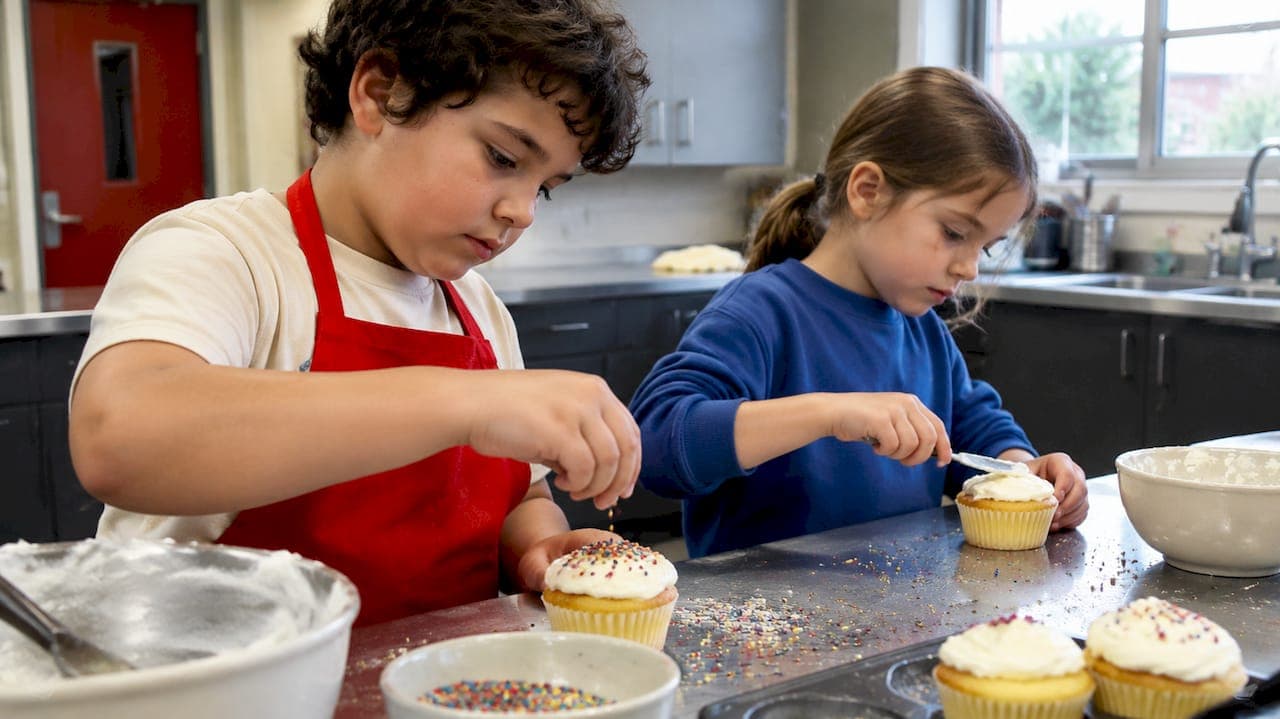
4. Decorate-your-own cupcakes or cookies
Bake the cupcakes the day before. At the party, the children frost, sprinkle and sculpt. It doubles as the cake course and as the take-home favour, if you box them up at the end.
5. Pasta from scratch
Better for ages 9 and up. Rolling and cutting dough is satisfying and fairly forgiving. Note that fresh pasta dough often uses raw eggs, so an adult should crack and handle them (more on that in the safety section).
6. Sushi-style wraps and rice rolls
Cucumber, avocado, cooked carrot and cream cheese in rice paper or on rice with nori. Skip raw fish entirely for a children's party. The rolling is fiddly, so it suits tweens.
7. Slider and burger station
An adult cooks the patties; kids stack buns, lettuce, tomato and sauces. Having the hot step done by a grown-up keeps the line moving and the risk low.
8. Fruit skewers and dips
A fine opener while the main dish bakes. Threading fruit on skewers builds fine motor skills, though blunt or short skewers are wiser for little ones.
9. A mini bake-off
Split into teams, give each a simple recipe such as pizza muffins or cheese scones, and let a panel of parents taste. Keep the judging gentle: everyone gets a ribbon for something, whether it is boldest topping or neatest fold.
A simple two-hour timeline
Professional children's cooking parties in Canada tend to run about two hours, with most of the time on guided activity and the rest for eating and celebrating. At home, the same shape works well:
- 0:00 to 0:15, arrival and hand washing. Aprons on, names on aprons if you can manage it. A quick, cheerful hand-washing lap at the sink.
- 0:15 to 0:25, the plan. Show what you will make, who does what, and the one rule: tasting happens after hands are washed, not from the shared bowls.
- 0:25 to 1:25, make it. Stagger the jobs so the group is not lined up at one bench. Some children spread sauce while others prepare toppings, then swap.
- 1:25 to 1:50, bake and tidy. Children clear their own space while food cooks. This is a good window for a quick game.
- 1:50 to 2:30, eat and celebrate. Sit down together, then candles and cake.
Build in a buffer. Something always takes longer than planned, and it is usually the oven.
Set up the space without a full kitchen
A dining table with a wipeable cover can serve as a work area. Give each child a tray or large board as their own station, with their portion of ingredients in small bowls. Individual portions cut down on shared dipping and on arguments.
A few practical details:
- Put an adult at each heat source and keep kids at a distance from the oven door.
- Use child-safe tools: butter knives, plastic scrapers and pastry brushes for younger kids.
- Keep a bin and a damp cloth at every table.
- Make aprons part of the party favour.
Looking for something to occupy children in the gaps? Our friends' roundup of low-prep playdate activities for building kids' skills has screen-free ideas that fill ten minutes while a tray bakes.
Food safety: what to get right
A birthday party means many children, shared surfaces and food that sits out. A few habits make the difference.
Hands, surfaces and sick children
Health Canada's food safety considerations call for washing hands for at least 20 seconds before and after cooking, and again after touching the nose, coughing, sneezing or using the restroom. Surfaces and utensils should be cleaned with soap and hot water before and after you prepare food.
If a child arrives with diarrhea, nausea, vomiting or fever, the Québec government's guidance on cooking with children says they should be left out of the activity. Say so kindly in the invitation, so a parent is never put on the spot at the door.
Keep cold food cold
The same Health Canada page describes the danger zone as 4°C to 60°C, where bacteria multiply quickly. Dairy, meat and cooked eggs should stay at 4°C or colder until the moment they are used. In practice: do not pre-set the table with cheese and cooked chicken an hour early. Keep them in the fridge and bring out small bowls in rounds.

Raw eggs, meat and cuts
The Québec guidance advises that children should not handle raw high-risk foods such as eggs, sprouts, meat, poultry or fish. Pick menus where an adult does that step, such as pre-cooked chicken, or a dough without raw egg. It also says that if a child gets a cut and any food has touched the wound or blood, that food must be thrown out. Keep a first-aid kit within reach and a bin ready.
Allergies and dietary needs
Talk to parents days before, not at the party. Food Allergy Canada's advice on children's parties is to include the child with allergies rather than exclude them, and to involve the child or parents in food decisions. It also suggests asking permission to contact parents directly about ingredient lists, and keeping safe alternative snacks on site.
For a cooking party this matters more than usual, because flour, nuts and dairy are airborne and on every surface. Put the allergy question on the RSVP, read labels yourself and plan one menu that works for everyone. Build-your-own menus help here: a child can pick a gluten-free base, skip cheese or choose vegan toppings without being singled out.
Our perspective: why we think pizza makes the best party dish
We make pizza for a living, so you might expect us to say that. But we have thought about it honestly. A pizza party gives you a project that every child understands, topping choices that suit picky eaters and adventurous ones, and a result that is hot, shareable and recognisably theirs.
The dough matters more than most people think. Ours is a Biga multigrain dough, prepared in advance and free of artificial additives. A preferment such as Biga gives the crust a rich, mature flavour and a more digestible, fibre-rich bite. Children do not care about fermentation, but they do notice when a crust tastes of something. If you are making pizza at home, even a simple trick helps: start the dough a day early and let it rest in the fridge.
Our honest advice for hosts:
- Do the dough ahead of time so the party is about toppings, not flour clouds.
- Offer more choice than you think you need, but keep portions small.
- Cut costs where children will not notice and spend on the one thing they will: good cheese and a crust worth finishing.
- Remember that you get what you pay for, but a party does not need to be expensive to be wholesome.
We also run in-store kids' pizza-making events, for parents who would rather someone else handle the setup and cleanup. If you want to compare doing it yourself with hosting, our guide to DIY and hosted pizza-making parties lays out both.
— jaskirat Singh
When to host at home and when to hand it off
Home parties are cheaper and cosy. They suit smaller groups, children aged four to six who need a lot of adult attention anyway, and families with a kitchen they are happy to lend to the cause.
Handing it off makes sense when the group is large, the home is small, or you simply want to enjoy your own child's birthday. A hosted party means someone else has the equipment, the cleanup and the timing. Living on the North Shore or in Vancouver? Our local guides look at the options by area: pizza party ideas in Vancouver, kids' birthday ideas in West Vancouver and budget-friendly birthday ideas in North Vancouver.
Feeding the rest of the party
A cooking party still needs a plan for the parents who stay, the siblings and the child who just wants a plain slice. Our pizza party menu ideas suggest two or three sides and packs for casual, kids' and adult groups. If you are ordering rather than making, our pizza party planning playbook shows how eight pizzas can feed twenty guests. And for choosy eaters, see how to order pizza for picky eaters and how to split toppings for your family.
Need pizza for the party or after it?
Sometimes the plan is to make mini pizzas and then discover half the children want more. We deliver and offer pickup in North Vancouver, West Vancouver and Vancouver, with Create Your Own Pizzas, Signature Pizzas, Vegan Pizzas, Baked Pasta, Wings & Bites, Desserts and more. Browse the HellCrust menu and keep a back-up order in your pocket, which is a gentle insurance policy for any party host.
A short checklist before the day
- Send invitations a few weeks ahead with a line about allergies and illness.
- Confirm dietary needs with parents directly.
- Prepare dough, bake bases or cook proteins in advance.
- Portion ingredients into small bowls and keep perishables in the fridge.
- Set out aprons, trays, wipes, bin and first-aid kit.
- Have safe snacks for any child who cannot eat the main menu.
- Plan one tidy-up game so the clearing is part of the fun.
FAQ
How many children should I invite to a cooking party?
Six to ten is comfortable for most home kitchens, with at least one adult for every four or five children. Younger children need more hands. If the group is bigger, stick to assembly menus so no one is waiting on an oven.
What age is right for a kids cooking party?
Children as young as four can spread, sprinkle and stir. From about eight or nine they can shape dough and use simple tools, and tweens can handle pasta or sushi-style rolls. Match the task to the age, with an adult handling heat and knives.
How long should a kids cooking party last?
Two hours is a good target: around an hour of making, then eating and cake. Younger children lose focus quickly, so shorten the cooking and keep the tasks simple.
Can a cooking party work with food allergies?
Yes, with planning. Contact parents days ahead, read every label, choose a menu with swappable ingredients, and keep safe alternative snacks nearby. Include the child in decisions rather than sidelining them.
Sources
- Teaching Canada's food guide: Food safety considerations, Health Canada
- Involve kids in planning and preparing meals, Health Canada
- Cooking with children, Gouvernement du Québec
- Helpful Tips for Cooking with Kids, Teach Nutrition Prairies
- Children's parties, Food Allergy Canada