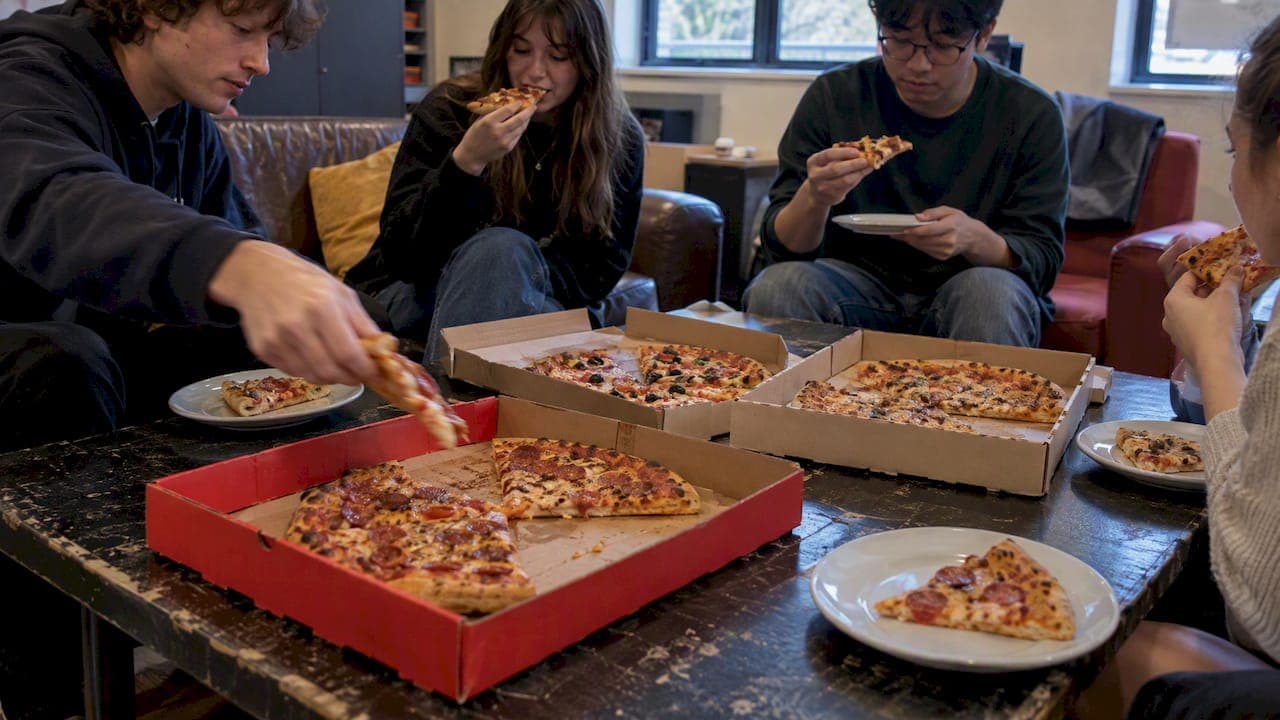
Plan on 2 to 3 slices for an average adult, 3 to 4 for a hungry adult, and 1 to 2 for a child, then convert that into pizzas using one simple formula. Most calculators treat a medium pizza as 8 slices and a large or extra-large as 10 to 12, so once you know your headcount, the math takes seconds. Below, we walk through the sizes, the formula, and a few worked examples so you can order with confidence.
TL;DR:
- Confirm your shop’s slice count first: the same 14 inch pie may yield eight or ten pieces, changing a large order by a whole pizza.
- For groups over 15, add a 5% to 10% cushion, and count children, teenagers, and seniors separately instead of treating everyone as an average adult.
- If you serve substantial sides, subtract about half a slice per adult; thick crust also fills diners faster than thin crust.
- Calculate dietary orders separately: gluten free pies are often smaller, with guests eating one or two slices, while vegan portions may need extra.
Table of Contents
- Standard pizza sizes and typical slices
- How to estimate pizzas for your group: formula and worked examples
- Adjust for appetite, event type and menu
- Quick planning cheatsheet and sample orders
- Age groups beyond adults and kids
- How slice size and crust thickness change the math
- Dietary preferences and how they shift your count
- Managing leftovers without over-ordering
- What hosts consistently get wrong about pizza math
- Order your group's pizza with HellCrust
- FAQ
- Sources
Standard pizza sizes and typical slices
Before you can convert people into pizzas, you need to know how many slices you are actually working with. Pizza shops do not all cut the same way, and a "large" at one place might feed noticeably more or fewer people than a "large" somewhere else.
As a general reference, pizza size charts break down like this:
| Size | Diameter | Typical slices | Feeds roughly |
|---|---|---|---|
| Personal | 6 to 8 inches | 4 slices | 1 person |
| Small | 10 inches | 6 slices | 2 to 3 people |
| Medium | 12 inches | 8 slices | 3 to 4 people |
| Large | 14 inches | 8 to 10 slices | 4 to 5 people |
| Extra-large | 16 to 18 inches | 12 or more slices | 6 to 7 people |
Square-cut or party-style pizzas change this math because the pieces are smaller and more numerous, which means a single party pizza can stretch further than a round pie of the same diameter. Always check your chosen shop's slice policy before you order. If your go-to spot cuts its large into 8 pieces instead of 10, scale your math down a little, and if it uses a generous 12-slice cut, you have a bit more breathing room than the chart suggests. For a deeper look at how sizing works across different pies, our pizza size guide walks through it step by step.
How to estimate pizzas for your group: formula and worked examples
Once you know your headcount and your pizza's slice count, the calculation is straightforward:
- Multiply the number of people by the slices per person you expect them to eat.
- Divide that total by the number of slices per pizza.
- Round up to the next whole pizza, since a fraction of a pie still needs to be ordered as a full one.
For larger gatherings, it helps to build in a small cushion:
- Add 5 to 10% extra for groups over 15 people, since appetite estimates get less precise at scale.
- Round up to a full extra pizza rather than guessing at partial slices when the math lands close to a whole number.
Here is how that plays out in practice. Say you are hosting 10 adults with average appetites, figured at 3 slices each with large pizzas cut into 8 slices. That is 10 times 3, or 30 slices needed, divided by 8 slices per pizza, which comes to 3.75, so you would round up to 4 large pizzas.
Now try a mixed group: 20 people including 5 children, with adults at 3 slices and kids at 1.5 slices. That is 15 adults times 3 (45 slices) plus 5 kids times 1.5 (7.5 slices), for a total of roughly 53 slices. Divided by about 10 slices per large pizza, that is 5.3, rounding up to 6 large pizzas.
Last example: 30 hungry adults at 4 slices each is 120 slices, divided by about 10 slices per large pizza, which equals about 12 pizzas, with no rounding needed at all.
Adjust for appetite, event type and menu
The baseline numbers only get you so far. Appetite varies by who is in the room and what else is on the table.
- Children: typically eat 1 to 2 slices, scaling with age.
- Average adults: typically eat 2 to 3 slices at a casual meal.
- Hungry adults: often eat 3 to 4 slices, especially at lunch or after activity.
- Dedicated pizza lovers: can easily eat 4 or more slices without blinking.
These bands line up with a U.S. dietary survey finding that men ate four slices and women ate three on average at a single pizza eating occasion, a useful anchor if your group skews toward one demographic.
The event itself shifts those numbers too. For example, a stand-up cocktail party where pizza is one of several finger foods can push consumption up as people graze over hours, while a shorter, more constrained lunch may reduce typical intake because of limited eating time. If you are serving substantial sides like salads, wings, or a hearty salad pairing, it is reasonable to shave about half a slice off your per-adult estimate, since fuller plates mean less room for pizza.
Pro Tip: When you are not sure who is coming or what their appetite will be, plan for 3 slices per adult and lean on variety rather than quantity alone, since a wider topping selection does more to satisfy a mixed crowd than an extra pie of the same kind.

Quick planning cheatsheet and sample orders
For hosts who want the math already done, here are a few common group sizes using large pizzas at 8 slices each, with average adult appetite assumed:
- 5 adults (3 slices each, 15 slices needed): order 2 large pizzas.
- 10 adults (3 slices each, 30 slices needed): order 4 large pizzas.
- 20 people, mixed adults and children (roughly 53 slices needed, per the earlier worked example): order 6 to 8 large pizzas depending on how many kids are in the mix.
Beyond the raw numbers, there is a judgment call between ordering a few large pizzas or several smaller ones. More small pizzas work well for picky eaters or groups with a wide spread of topping preferences, since everyone gets something closer to what they actually want. Fewer large pizzas are usually the simpler, more cost-efficient route when the group's tastes are fairly aligned, since you cut down on boxes and on the price-per-slice premium that smaller pies often carry.
If you are serving guests with dietary restrictions, it is worth splitting a pie rather than ordering a whole separate pizza nobody else touches. A shareable pizza approach lets you cover vegetarian, vegan, or gluten-free needs without overloading your order with pies that only a couple of people will eat.
Age groups beyond adults and kids
Most slice guides stop at "adult" and "child," but a real guest list usually has more texture than that. Teenagers, especially active ones, often eat closer to a hungry adult's share, sometimes 3 to 4 slices, and planning for them as children will leave you short.
Seniors, on the other hand, tend to eat on the lighter end of the adult scale, often closer to 2 slices, particularly at family gatherings where smaller portions and other dishes are also on the table. If your group skews older, it is reasonable to plan at the low end of the average adult band rather than the midpoint.
Young children under about 6 years old frequently eat less than the standard 1 to 2 slice range suggests, sometimes finishing just half a slice, while kids between 7 and 12 tend to land closer to a full child's portion or slightly more. When your group spans several age brackets, breaking the headcount into finer slices, so to speak, gives you a more honest total than lumping everyone over 13 into one adult bucket. It takes an extra minute of counting, but it is the difference between a table with just enough and one with a stack of unopened boxes at the end of the night.
How slice size and crust thickness change the math
Not all slices are created equal, and this is where a lot of ordering estimates quietly go wrong. A thin, crisp slice from a 14-inch pie cut into 10 pieces is a very different quantity of food from a thick, pan-style slice cut into 8. Someone who comfortably eats 3 thin slices might feel full after just 2 of the thicker variety.

Cutting style matters just as much as crust thickness. The same 14-inch pizza can be cut into 8 generous wedges or 10 narrower ones, and that single decision changes how far the pie stretches without changing the pizza itself at all. Square-cut party pizzas take this further still, often yielding smaller, more numerous pieces that let guests take a couple without committing to a full wedge-shaped slice.
If you know your group leans toward a deep-dish or thick-crust style, nudge your per-person slice count down slightly from the standard bands. If you are ordering a thin-crust or classic New York-style pie, the standard 2 to 3 slice range for an average adult holds up well, and hungrier eaters may even go a slice or two higher since thin crust is easier to eat quickly. When in doubt, ask your pizzeria how it cuts its pies before finalizing your count, since that one detail can shift your total pizza count by a full pie or more on a larger order.
Dietary preferences and how they shift your count
Vegan, vegetarian, and gluten-free guests do not always eat the same slice counts as everyone else, and planning around that can save you from both shortages and waste. Vegan pizzas, often lighter without dairy cheese, sometimes get eaten in slightly larger quantities per person than a traditional cheese pie, so it is worth padding that portion of your order by a slice or two per guest rather than assuming identical consumption.
Gluten-free crusts tend to be smaller and more filling, which usually means guests eating gluten-free land at the lower end of the slice range, often just 1 to 2 slices rather than the full 2 to 3 an average adult might take on a standard crust. Because gluten-free pies are also typically a separate, smaller-format order rather than a full-size pizza, it helps to treat that portion of your headcount as its own mini-calculation instead of folding it into your main pizza total.
When your guest list includes a handful of guests with dietary needs, splitting a dedicated vegan or gluten-free pie rather than ordering a full-size pizza avoids both waste and the awkwardness of one person getting a whole pie to themselves. Our vegan pizza lineup is built with exactly this kind of mixed-group ordering in mind, so a smaller group of vegan guests can still get a proper pie without unbalancing your overall count.
Managing leftovers without over-ordering
A little bit of leftover pizza is not a planning failure. The goal is not zero leftovers. It is avoiding the scenario where six people are still hungry and the boxes are empty.
That said, there is a point where extra pizza becomes genuine waste rather than a useful cushion. If you consistently find yourself with two or more full pizzas left over, your per-person estimate is likely running high, and it is worth dialing your next order down by half a slice per adult. Pizza also keeps well for a day or two in the refrigerator, so leftovers rarely go to waste outright. They just become tomorrow's lunch.
If you are genuinely unsure where your group will land, it is often smarter to order slightly fewer pizzas than your worst-case estimate and keep a backup order ready to go through the app. A fast reorder is almost always easier to manage than a kitchen full of pizza nobody is going to finish.
What hosts consistently get wrong about pizza math
The most common mistake we see is treating every guest as an "average adult" when the room is actually a mix of teenagers, light eaters, and one or two people who could eat a whole pizza solo. That single assumption is usually what causes an order to fall short by two or three slices right when everyone is at the table.
The second mistake is ignoring how the pizza is cut. A host who orders based on a 10-slice large but gets an 8-slice cut from their pizzeria ends up quietly short without ever changing their headcount math. Before placing a larger order, it is worth confirming slice counts directly, and leaning on mix and match deals to cover variety without guessing twice.
— jaskirat Singh
Order your group's pizza with HellCrust
Once you have your numbers worked out, putting them into action is the easy part. Our menu supports group ordering with family-sized specials and Mix & Match options that cater to different appetites and topping preferences.

Here is how we'd suggest working through your order:
- Use your slice count to pick a mix of sizes from our menu, rather than defaulting to one size for everyone.
- Add a side or two, like our Baked Pasta or Wings & Bites, if you want to stretch your pizza count a little further.
- Check the app for current deals before finalizing your cart, as group orders often provide added value.
Our dough is prepared in advance for a crust that holds up well regardless of the number of pies ordered, helping ensure a satisfying meal for your group. When you are ready, head to our menu and place your order through the app for the fastest route from headcount to hot pizza at your door.
FAQ
Will 5 pizzas feed 20 people?
It depends heavily on size and appetite, but 5 large pizzas at 8 slices each gives you 40 slices total, which works out to about 2 slices per person across 20 people. That is on the lean side for a group with average appetites, so it tends to work best for a casual gathering with other food available, rather than as the sole meal.
Is a large pizza 8 or 10 slices?
Both are common, and it depends entirely on the shop. Many pizzerias cut a 14-inch large into 8 slices, while others use a 10-slice cut for the same size, so it is worth confirming with your chosen pizzeria before finalizing your order count.
Is 2 pizzas enough for 10 people?
Generally not, unless the pizzas are extra-large or appetites are quite light. Two large pizzas at 8 slices each give you 16 slices total, which is fewer than the typical 2 to 3 slice average adult range for a group of 10.
Is 4 slices of pizza too much?
Not necessarily. Four slices sits within the hungry adult range, and dietary survey data shows men averaging four slices per pizza eating occasion, so it is a normal amount for a larger appetite rather than an excessive one.
Sources
- Dietary Data Brief No. 62: Pizza consumption in the U.S.
- Pizza sizes & slices: how many slices by inch & chain