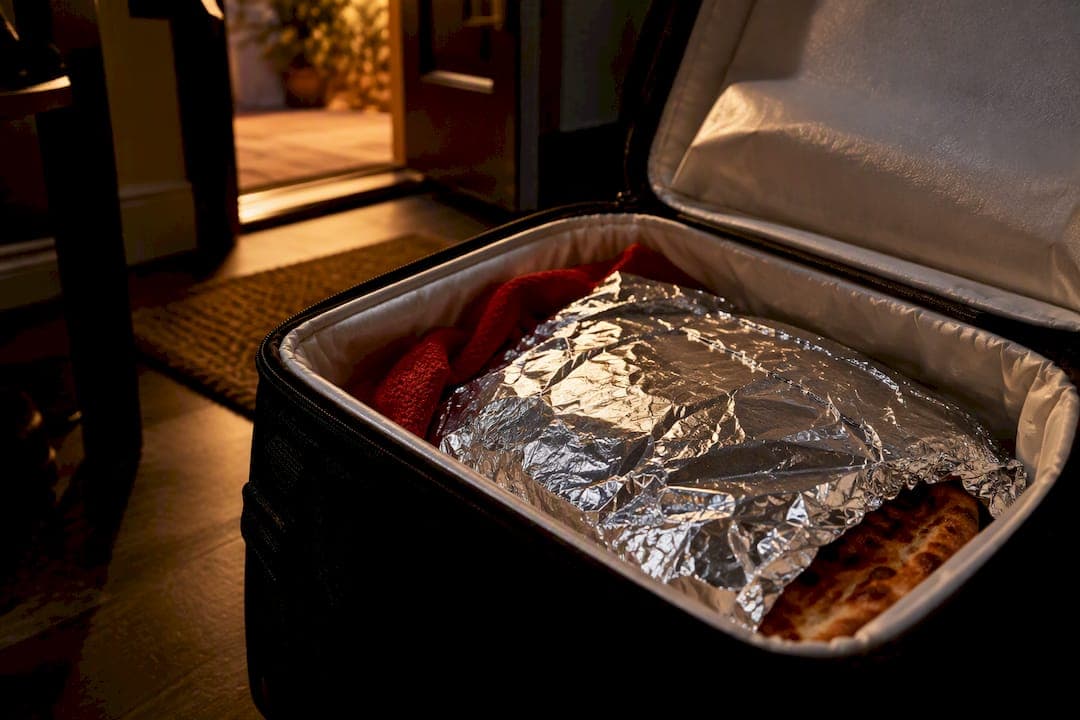
The fastest, most reliable way to keep pizza warm is a low oven set around 170 to 200°F (75 to 95°C), a good insulated bag preheated before you load it, or a wrap of foil and thick towels for a short car ride. Any of these hold heat well for 20 to 60 minutes. The safety baseline behind all of it: keep hot pizza at 60°C (140°F) or above, check it with a food thermometer, and don't let it linger past two hours at room temperature.
TL;DR:
- Maintaining pizza above 60°C (140°F) with a thermometer is crucial, and it should not be kept at room temperature for more than two hours.
- Using a wire rack over a sheet pan in a low oven and cracking the door slightly helps keep pizza crust crisp during short holds.
- Preheating insulated bags with hot water and wrapping the pizza in foil with towels extends its warmth during transport beyond 20 minutes.
- Wrapping pizzas tightly in foil and towels or using a preheated insulated box is effective for party settings with extended holding times without an oven.
- Reheating slices in half-power microwave with a water cup, followed by a quick dry pan finish, best preserves moisture and texture.
Table of Contents
- Best ways to keep pizza warm for 20 to 60 minutes
- How do you keep pizza warm during transport?
- How do you keep pizza warm at a party without an oven?
- How do you keep pizza crust from going soggy?
- HellCrust tips for reheating and party planning
- What temperature keeps pizza safe, not just warm?
- Microwave reheating techniques that preserve moisture and texture
- Can a pizza stone keep pizza warm at the table?
- Keeping pizza warm at home versus on the go
- Common mistakes that dry out or sog a pizza
- Playing it safe without making the party harder
- Skip the holding problem with HellCrust
- Sources
- FAQ
Best ways to keep pizza warm for 20 to 60 minutes
If your pizza needs to stay hot for less than an hour, your oven is the best tool in the house. Set it to its lowest usable setting, ideally between 170 and 200°F (75 to 95°C), and place the pizza on a wire rack set over a sheet pan rather than directly on the rack or a solid tray, that airflow underneath keeps steam from pooling and turning your crust into something closer to wet cardboard.
Skip putting the delivery box straight into a hot oven. Cardboard scorches faster than you'd think, and most boxes aren't built for sustained heat. If you have no rack available and the box is your only option, keep the oven temperature low and check on it every 10 minutes.
- Use a wire rack over a sheet pan, never a flat tray alone.
- Set the oven no higher than 200°F (95°C) for holding, not cooking.
- Crack the oven door slightly if you notice condensation building on the pizza's surface.
- Reserve your broiler or a 500°F blast for 60 to 90 seconds when the crust needs a genuine refresh, not for holding.
Pro Tip: Slide a second sheet pan on the rack below the pizza. It catches drips and adds a buffer layer that keeps the bottom crust from overheating in a smaller oven.
How do you keep pizza warm during transport?
Insulated pizza bags do real work because they trap the pizza's own heat rather than adding new heat, which means they only perform as well as what goes in them. The gap between a $15 consumer thermal bag from a kitchen shop and the heavy-duty nylon bags professional drivers use is mostly about wall thickness and seam quality. Both help, but a thin bag with a broken zipper isn't holding much of anything after 20 minutes.
You can borrow a trick from event caterers to squeeze extra minutes out of any carrier. Preheating insulated containers with boiling water, then emptying it right before loading the food, meaningfully extends how long the container holds heat.
- Fill your carrier or cooler with hot (not necessarily boiling, for a soft-sided bag) water for a few minutes, then dump it out completely.
- Wrap the pizza in foil, then line the carrier with a folded towel before placing the pizza inside.
- Set the carrier flat on the car floor near the centre of the cabin, not on a seat or in the trunk, where tilt and temperature swings do the most damage.
- If you're stacking multiple boxes, keep no more than two or three together and avoid setting anything heavy on top.
For readers skipping their own vehicle entirely, our guide to no-car pizza delivery covers contactless options that sidestep the transport problem altogether.
How do you keep pizza warm at a party without an oven?
Parties change the math. You're often holding several pizzas for longer than an hour, sometimes without an oven anywhere nearby, and the stakes for food safety go up with every extra pie on the table.
Wrap each whole pie, or a stack of slices, tightly in heavy-duty foil, then wrap that bundle again in a thick towel or two. This double layer traps heat without smothering the crust as badly as a sealed container would. From there, tuck the wrapped pizza into an insulated box or cooler, or into a low oven if the venue has one.
One appliance that seems like an obvious fix, but usually isn't, is a slow cooker on its "warm" setting. These settings are built to hold food that's already been kept hot, not to bring lukewarm pizza up to a safe temperature. UMN Extension warns against relying on "warm" settings without preheating the unit and checking it with a thermometer, because many don't reliably hold food above the danger zone.
Whatever method you choose, the clock matters more than the gadget:
- Two hours is the general safe limit for holding perishable hot food at room temperature.
- One hour is the limit once ambient temperature hits 32°C (90°F) or higher, which applies to backyard barbecues and outdoor parks just as much as it does to a kitchen with a broken air conditioner.
Past those windows, reheating to a safe internal temperature beats trying to stretch the hold any further.
How do you keep pizza crust from going soggy?
Steam is the enemy of a good crust, and steam builds up fast in any sealed container. Elevating the pizza on a rack, whether that's your oven rack, a cooling rack on the counter, or even a couple of chopsticks laid under the box, lets moisture escape instead of collecting under the dough.
- Keep pizza elevated, never sitting flat in a puddle of its own condensation.
- If the crust has already gone limp, a minute or two under the broiler or in a dry frying pan over medium heat brings back real crispness.
- Microwave reheating alone is a last resort. It's fast, but it steams the crust more than it heats it.
Pro Tip: Combine the microwave and skillet: 20 seconds in the microwave to warm the cheese through, then straight into a hot, dry pan for 60 to 90 seconds to firm the bottom back up. It's the closest you'll get to fresh without an oven.
HellCrust tips for reheating and party planning
We built our dough to hold its character even after a short wait on the counter, but even a great crust benefits from a little know-how. If you're reheating leftovers rather than holding a fresh order, our guide to reheating pizza in the oven walks through exactly when reheating beats holding, and when it doesn't.
Two habits make the biggest difference for hosts:
- Order through the app timed to land close to serving, rather than an hour early "just in case."
- Choose a family pack over several separate boxes. One well-packed box holds heat more evenly than four small ones scattered across a counter.
What temperature keeps pizza safe, not just warm?
"Warm" and "safe" are not the same claim, and treating them as interchangeable is where most party mishaps start. Food safety comes down to two numbers: the danger zone sits between 4°C and 60°C (40°F and 140°F), and that's where bacteria multiply fastest. Anything you're holding as "hot food" needs to stay at or above 60°C (140°F).
A thermometer is the only honest way to know where your pizza actually sits, since sight and smell tell you nothing about internal temperature. An appliance thermometer checks whether your oven or cooler is actually holding the temperature its dial claims.
- Keep hot pizza at 60°C (140°F) or above at all times.
- Follow the two-hour limit at room temperature, or one hour once conditions hit 32°C (90°F) or warmer.
- Reheat leftovers to 74°C (165°F) before eating them again, confirmed with a probe thermometer rather than a guess.
- Log the time pizza leaves the oven or delivery bag so you know exactly when the clock runs out.
Microwave reheating techniques that preserve moisture and texture
A microwave alone almost always produces a chewy, sometimes rubbery crust, because the appliance heats water molecules directly and pizza dough is full of them. The fix isn't skipping the microwave. It's controlling how long the pizza spends in it.
Set the microwave to 50% power rather than full blast. Full power heats the outside of the cheese and sauce fast while the crust underneath either stays cold or turns tough by the time the centre catches up. At half power, heat moves through the slice more evenly, giving the crust a chance to warm without seizing up.
Place a small cup of water in the microwave alongside the slice. The water absorbs some of the microwave energy and adds a bit of humidity to the chamber, which keeps the cheese from drying into a rubbery skin. Thirty to 45 seconds per slice at half power is usually enough, checked and adjusted rather than run on a single long cycle.

If you have even one extra minute, finish the slice in a dry, hot skillet for 60 seconds after the microwave. This step matters more than people expect: it's the difference between a slice that tastes reheated and one that tastes freshly cooked. The microwave brings the interior up to temperature, and the skillet fixes the crust the microwave just softened.
Can a pizza stone keep pizza warm at the table?
A pizza stone or baking steel is a heat sponge, not a heat source, and that distinction matters for how you use one. Preheat the stone in your oven at your chosen holding temperature for at least 20 to 30 minutes before you set the pizza on it. A cold stone pulls heat away from the pizza instead of holding it in place.
Once preheated and placed on a trivet at the table, a stone or steel releases heat slowly for a reasonable stretch, which makes it a genuinely useful tool for a family dinner where the pizza sits out during a leisurely meal. Baking steels, being metal, heat up faster than ceramic stones but also cool faster once removed from the oven. Stones hold their temperature a little longer at the table, which makes them the better pick for extended holding rather than quick reheating.
Neither replaces the airflow a wire rack provides. A pizza sitting directly on a hot stone can still develop a soggy top if it's covered, since the stone manages the bottom crust while doing nothing for condensation collecting on the cheese. Combine the two: a preheated stone underneath, an open or loosely tented cover on top, and you get warmth from below without trapping steam above.

Keeping pizza warm at home versus on the go
At home, you control the variables. Your oven, your rack, your thermometer, and your timeline are all in one place, which means holding pizza safely is mostly a matter of setting the right temperature and checking it occasionally. The margin for error is wide because you can course correct in real time.
On the go, every one of those controls disappears. You're relying on stored heat rather than an active heat source, which means the clock starts working against you the moment the pizza leaves the oven. A car cabin fluctuates with outdoor temperature, a park bench offers no insulation at all, and a delivery bag only performs as well as its build quality and how it was preheated.
The practical result is that home holding gives you flexibility measured in hours, while transport holding gives you a window measured in minutes to a single hour before quality and safety both start slipping. Plan transport time as tightly as you'd plan a recipe: know how long the drive takes, and don't add a stop at the hardware store on the way.
Common mistakes that dry out or sog a pizza
Most warming mishaps trace back to one of a handful of repeat offenders, and nearly all of them are avoidable once you know what to watch for.
Sealing pizza in a fully airtight container is the single biggest cause of soggy crust, since trapped steam has nowhere to go and condenses right back onto the dough. The opposite mistake, leaving pizza uncovered in dry, moving air, dries out the cheese and toughens the crust from the outside in. The fix sits in between: loose coverage that blocks direct drafts without sealing in moisture.
Cranking the oven too high for holding is another common error. A holding oven isn't a cooking oven, and treating it like one scorches the bottom crust while the centre barely warms. Stick to the 170 to 200°F (75 to 95°C) range for holding, and save higher heat for an intentional, short refresh.
Skipping the thermometer rounds out the list. Guessing at temperature by touch or by how long something's been sitting out leads to two failure modes: throwing away pizza that was actually still safe, or serving pizza that spent too long in the danger zone without anyone noticing.
Playing it safe without making the party harder
When you can't confirm your setup holds at 60°C (140°F) or higher, the simplest rule beats any fancy trick: plan to reheat within two hours rather than gamble on a hold that might already be slipping. A quick reheat costs you five minutes. A guessing game costs you nothing if you're right, and a lot if you're wrong.
I'd rather see a host reheat a slightly cooled pizza to 165°F than trust a cooler bag that's never been tested. Build your timing around delivery landing close to serving, and keep the thermometer within reach.
— jaskirat Singh
Skip the holding problem with HellCrust
Every method above works, but every method also asks something of you: a thermometer, a preheated bag, a watchful eye on the clock. App ordering helps solve the holding problem by delivering fresh pizza timed to when you actually want to eat it, not an hour before.

Family packs make this even easier for parties, since one well insulated box holds heat more evenly than several smaller ones, and you skip the towel wrapping and rack juggling entirely. Browse the full menu to build your own pizza, grab a signature pie, or pull together a vegan option for guests who need one, and place your order close to serving time so the only thing you're managing is the first slice.
Sources
The temperature and time thresholds in this article aren't guesses. They come straight from public health guidance built for exactly this kind of question.
FAQ
How long can you keep pizza warm before it's unsafe?
Two hours is the general limit for holding hot pizza at room temperature. That drops to one hour once the ambient temperature hits 32°C (90°F) or higher, which matters for outdoor parties on hot days.
How do you keep pizza warm at a party in a park?
Wrap the pizza tightly in foil, then in a thick towel, and pack it into a preheated insulated bag or cooler right before you leave. Without a reliable heat source, treat the one hour limit on hot days as your hard cutoff rather than a suggestion.
Can pizza sit out for three hours?
No. Even under mild conditions, perishable hot food is only considered safe for up to two hours at room temperature before bacteria have had enough time to multiply to unsafe levels. Past that window, reheat to 74°C (165°F) or discard it.
How do you keep pizza warm at a party without an oven?
Preheat an insulated bag or cooler with hot water, empty it, then load foil-wrapped pizza wrapped again in a towel. A slow cooker's "warm" setting is not a dependable substitute unless it's been preheated and checked with a thermometer.
What's the best pizza warmer for a family gathering?
A low oven set between 170 and 200°F (75 to 95°C) with a wire rack works best when you have one available. For gatherings where reheating is easier than holding, ordering a HellCrust family pack timed close to serving removes the holding question altogether.