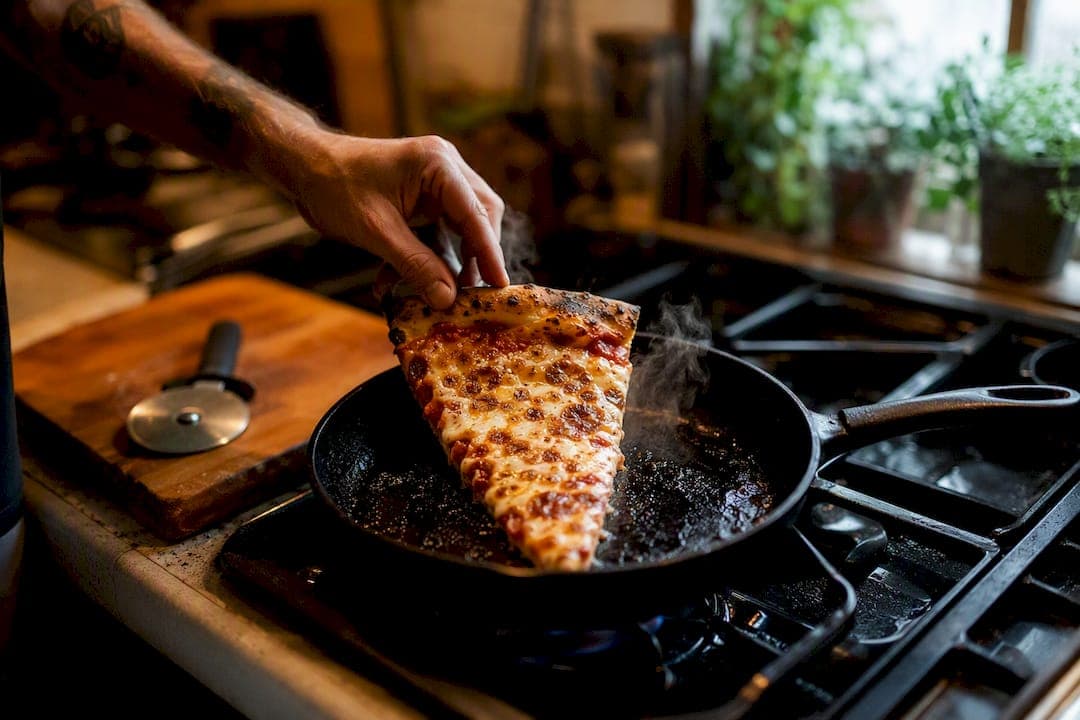
The best way to bring leftover pizza back to life is a preheated hot surface in the oven, around 425°F for 5 to 7 minutes. That's the method that restores a crisp bottom and a properly melted top without drying out the slice. If you're only reheating one slice and want it fast, a covered skillet beats the oven on speed. Got two to four slices and a countertop appliance handy? An air fryer or toaster oven does the job in under six minutes.
- One slice, fast: covered skillet, about 3 minutes total.
- Small batch (2–4 slices): air fryer or toaster oven, 375°F to 425°F, 3 to 6 minutes.
- A few slices, best texture: oven on a preheated stone, steel, or sheet pan, 425°F, 5 to 7 minutes.
- Microwave: only if nothing else is available, and always finish with a quick crisp elsewhere.
Before any of that, remember the basics: leftover pizza belongs in the fridge within two hours of baking, and it needs to come out hot enough to melt the cheese through, not just warm on the surface.
Key Takeaways
The most reliable way to reheat pizza is matching the tool to your slice count and crust thickness, using a preheated surface for crisping and steam only for melting cheese.
| Point | Details |
|---|---|
| Preheat the surface, not just the oven | A hot stone, steel, or sheet pan conducts heat into the crust for a crisp bottom. |
| Match temperature to crust style | Thin slices need 425°F for 4–7 minutes; thick slabs need 400–425°F for 7–9 minutes. |
| Skillet wins for single slices | A dry pan plus a few drops of water and a lid melts cheese in about 3 minutes. |
| Store safely before reheating | Refrigerate within 2 hours at or below 4°C, and use within 3–4 days. |
| Skip the microwave when possible | It heats unevenly and leaves crusts soggy; finish on a skillet if you must use it. |
Table of Contents
- How to reheat pizza in the oven for a crisp bottom
- Is the skillet method faster than the oven?
- Does an air fryer work as well as the oven?
- Why does the microwave make pizza soggy?
- How long is leftover pizza safe to eat?
- What makes multigrain dough reheat differently?
- Why the "one right method" advice misses the point
- Sources
How to reheat pizza in the oven for a crisp bottom
Here's the part most people skip: the oven itself doesn't crisp your crust, the surface does. An empty rack radiates heat around a slice, but a preheated stone, steel, or even a heavy sheet pan conducts heat directly into the dough, which is what actually re-crisps the bottom. Slide a slice onto a cold pan and you're just steaming it in its own moisture.
The temperature and timing depend on what kind of pizza you're working with. Testing across pizza styles shows that thin New York or Neapolitan slices do best at 425°F for 4 to 7 minutes on a preheated surface, while thicker Detroit or Sicilian squares need 400°F to 425°F for 7 to 9 minutes, sometimes with a brief foil tent over the top so the cheese doesn't scorch before the middle warms through. If you happen to own a baking steel, thin crusts can handle 450°F for as little as 4 to 6 minutes, since steel conducts heat faster than stone or aluminum.
Here's the sequence that works, every time:
- Preheat your oven to temperature, then leave the stone, steel, or sheet pan inside for another 10 to 12 minutes so the surface itself heats through, not just the air around it.
- Pull the pizza from the fridge and let it sit at room temperature for about 5 minutes. Ice-cold dough hitting a hot surface cooks unevenly.
- Slide the slice directly onto the hot surface. No parchment, no foil underneath. Direct contact is the whole point.
- Check thin slices at the 4 to 5 minute mark. Thicker slabs need the full 7 to 9 minutes.
- Pull it once the cheese is fully melted and the edges have a slight char. Let it rest 60 seconds before eating. It's hotter than it looks.
Foil has its place, but only as a tent over the top to shield toppings from a hot broiler element. Never wrap the whole slice, since that traps steam against the crust and undoes the crisping you're trying to achieve.
Pro Tip: If your oven runs hot or cold by even 15 degrees, trust your eyes over the clock. A bubbling, slightly blistered cheese surface tells you more than any timer does.
Is the skillet method faster than the oven?
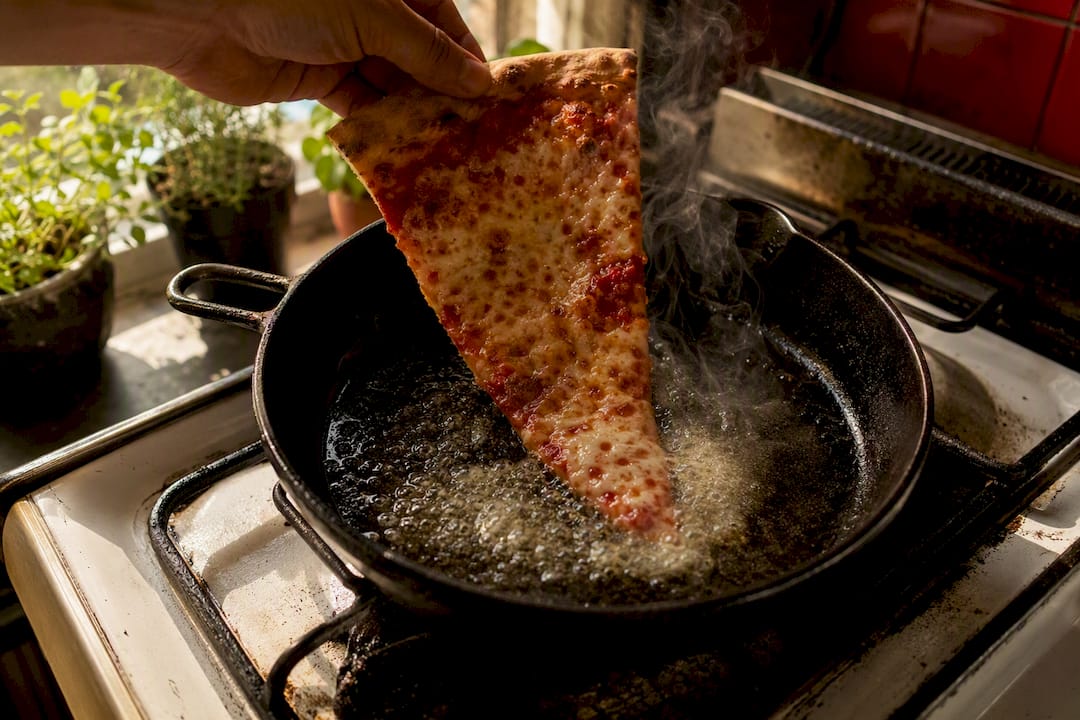
For a single slice, yes. The cold-pan-to-covered-lid technique that professional bakers favour takes about three minutes start to finish, and it's arguably the closest you'll get to fresh-from-the-box texture without firing up a whole oven.
- Place the slice in a dry skillet, cast iron or non-stick, over medium heat. No oil. Oil turns the crust greasy instead of crisp.
- Let it sit for 60 to 90 seconds until you can see and feel the bottom firming up.
- Add two or three drops of water to the pan, off to the side of the slice, then cover immediately with a lid. The steam melts the cheese in another 30 to 60 seconds without oversaturating the crust.
- Lift the lid once the cheese looks glossy and fully melted. If the bottom needs another few seconds of direct contact, give it that with the lid off.
This trick works because you only need the interior starches to hit roughly 140°F to regain their soft, pliable texture, a threshold pizzaiolos call the gelatinization point. Push past that with excessive heat and you're just drying out a slice that was already fine.
The skillet method has real limits, though. It shines for thin, NY-style, or Neapolitan slices. Thick Detroit or Sicilian squares are too tall to heat evenly this way, and if you're reheating four or more slices at once, you'll be doing batches, which defeats the speed advantage.
Pro Tip: Watch the cheese, not the clock, once the lid goes on. Steam works fast, and an extra 30 seconds can turn melted mozzarella rubbery.
Does an air fryer work as well as the oven?
For small batches, yes, and it's often quicker. An air fryer or toaster oven earns its place when you're reheating one to four slices and don't want to wait for a full oven to preheat.
- Set the temperature between 375°F and 425°F depending on your model. Smaller countertop units tend to run hotter than their dial suggests.
- Reheat for 3 to 6 minutes in a single layer, checking at the halfway point.
- Never stack slices. Airflow underneath is what crisps the bottom, and a stacked slice just steams.
- Use a rack or perforated tray rather than a solid basket liner if your model has one, so hot air can circulate below the crust.
- Start on the lower end of the temperature range with a new appliance, then add time in 30-second increments. Compact units run hot and can scorch toppings fast.
Compared to a full oven, an air fryer wins on speed for small portions but loses on capacity. If you're feeding a family off last night's leftovers, the oven's larger surface area still does more work at once.
Why does the microwave make pizza soggy?
A microwave heats water molecules unevenly throughout the slice, which is why crusts come out rubbery on top and soggy at the bottom instead of crisp anywhere. There's no dry heat involved, so there's nothing to recreate that oven-baked texture.
If a microwave is genuinely your only option, a few adjustments help:
- Heat in short 30 to 45 second bursts rather than one long cycle.
- Place a microwave-safe cup of water next to the slice. It won't restore crispness, but it absorbs some excess microwave energy and reduces how rubbery the cheese gets.
- Finish the slice in a dry skillet or under a broiler for 30 to 60 seconds to bring back some bottom crispness.
- Skip the foil. Microwaves and metal don't mix, and it won't help texture anyway.
Don't expect microwaved pizza to match oven results even with these tricks. Treat it as damage control, not a real method.
How long is leftover pizza safe to eat?
Get pizza into the fridge within two hours of baking, at a temperature at or below 4°C (40°F). Beyond that window, bacteria multiply fast enough that reheating won't make it safe again.
- Refrigerated pizza is best consumed within a few days. Past that, freezing is recommended to preserve safety and quality.
- Wrap slices tightly in plastic wrap or foil before freezing to limit freezer burn and preserve texture for the next reheat.
- Take pizza out of its delivery box before storing it. Cardboard traps moisture and odours that make crusts soggy and stale even in the fridge.
- Whatever method you use, reheat until the cheese is fully melted and the slice is hot throughout, not just warm on the surface.
- Toss anything with an off smell, slimy texture, or visible discolouration. No reheating method fixes spoiled pizza.
America's Test Kitchen also tested a slower, low-heat option worth knowing: 275°F for 25 to 30 minutes in a covered pan, which trades speed for gentler moisture retention if you're not in a rush.
What makes multigrain dough reheat differently?
HellCrust bakes every pizza on a biga multigrain dough, a slow, cold-fermented style with more structure and moisture retention than a same-day dough. That extra structure holds up well to high, direct heat, which is exactly why the preheated-surface oven method or the skillet technique works so well on it. Low, slow reheating tends to leave multigrain crusts a touch flat since they lose the contrast between crisp exterior and airy crumb that the biga process builds in.
A few practical notes worth keeping in mind:
- Pull slices out of the delivery box the moment they cool, for the same moisture reasons noted above.
- A finishing touch of fresh herbs or a light olive oil drizzle after reheating wakes up toppings that dulled slightly in the fridge, an idea covered in more depth in our guide to customizing crust and toppings.
- If you know you'll be reheating later, ask for a lighter bake the first time around; a fully charred crust has less room left to crisp on the second pass.
For the technical side of surface choice and why it matters so much for crust texture, our post on getting an extra crispy pizza at home walks through stone versus steel versus sheet pan in more detail. If you're curious how different oven setups get used in a working pizza kitchen, Flame Pizza & Pasta offers a good look at professional baking surfaces in action.
Why the "one right method" advice misses the point
Most reheating guides push a single best method as if pizza were one uniform product. It isn't. A thin Neapolitan slice and a thick Detroit square behave like different foods once they're in your fridge, and treating them identically is where most home reheats go wrong.
The conventional advice also overweights speed over judgment. The skillet method gets held up as the gold standard, and it deserves the praise for single slices, but it quietly falls apart the moment someone has four leftover slices and one pan. That's not a flaw in the method. It's a flaw in applying it universally.
What actually matters is matching tool to circumstance: surface conductivity, slice thickness, and how many mouths you're feeding. Readers should prioritize learning why preheating a surface works, the conductive heat transfer, the gelatinization threshold, over memorizing one fixed temperature. Once you understand the mechanism, adapting to a thicker crust or a smaller appliance stops being guesswork.
— jaskirat Singh
Sources
- How to Reheat Pizza in the Oven: Tested Guide by Style | The Pizza Craft
- The Best Way to Reheat Leftover Pizza, According to This Pro Baker | Serious Eats
- The Best Ways to Reheat Pizza | America's Test Kitchen
- How to reheat pizza on a baking steel (so it's better than fresh) | Baking Steel