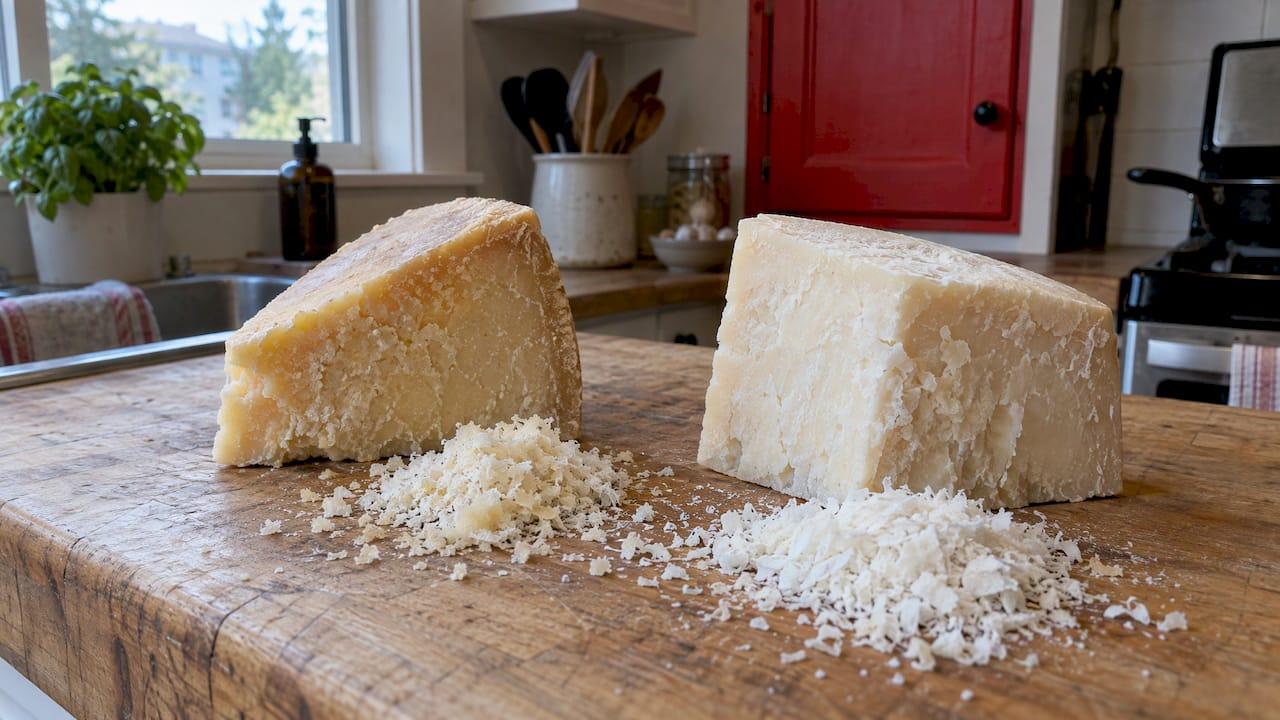
What is the real difference between Parmesan and Pecorino? Milk, ageing and salt. Parmigiano Reggiano, the cheese most people call Parmesan, is made from cow's milk and aged at least 12 months. Pecorino Romano is made from sheep's milk and aged at least five months. The result is a nutty, mellow Parmesan and a sharper, saltier Pecorino. Both are hard, both are grated over pasta, and they are close but not identical in the kitchen. Once you know which does what, you can pick the right one for tonight's dinner, or swap one for the other without ruining the dish.
TL;DR
- Parmesan (Parmigiano Reggiano): cow's milk, aged a minimum of 12 months, nutty, buttery and rounded. A good all-purpose grating cheese.
- Pecorino Romano: sheep's milk, aged a minimum of five months, tangy, salty and assertive. Best where you want a bold edge.
- Swapping: use about one-third less Pecorino than the Parmesan a recipe asks for, and go lighter on added salt.
- In Canada: the word "Parmesan" on a label can cover more than the Italian original, so check for the full name if you want the real thing.
- On pizza and baked pasta: Parmesan blends in quietly, while Pecorino stands out. Choose by how loud you want the cheese to be.
Table of Contents
- Parmesan and Pecorino at a glance
- Milk and making: where the flavour begins
- Ageing: why the clock matters
- Flavour and salt: the difference you actually taste
- Which one for which dish?
- Can you swap one for the other?
- Buying and storing in Canada
- What this means on pizza night
- Skip the grating tonight
- Our point of view
- FAQ
- Sources
Parmesan and Pecorino at a glance
Both cheeses are hard, aged, salty and Italian, and both are often sold as a wedge to grate at home. That is why they get mixed up in the cheese aisle. Pop Sugar's explainer is clear that they are not the same and not 100% interchangeable.
| Parmigiano Reggiano (Parmesan) | Pecorino Romano | |
|---|---|---|
| Milk | Raw cow's milk | Whole sheep's milk |
| Minimum ageing | 12 months, often much longer | 5 months for table use, 8 for grating |
| Where it is made | Emilia-Romagna and Mantova, Italy | Lazio, Sardinia and the Grosseto area of Tuscany, Italy |
| Flavour | Nutty, buttery, fruity, mellow | Tangy, spicy, salty, sharp |
| Texture | Granular, crumbly, crystalline when well aged | Dense, firm, drier and crumblier with age |
| Best at | Everyday grating, risotto, soup, salads | Bold pasta dishes, finishing, a salty punch |
The sections below unpack each row, in plain terms.
Milk and making: where the flavour begins
The biggest difference is the animal. Fine Dining Lovers explains that Parmigiano Reggiano is made from raw cow's milk, with only milk, salt and rennet (the enzyme that sets the milk into curd), while Pecorino Romano is made from whole sheep's milk that is heated but not pasteurised, set with lamb rennet.
Sheep's milk is naturally richer than cow's milk, and that richness shows up in the cheese. It tastes more pronounced, with the tangy, peppery bite people describe as "sharp". Cow's milk gives a rounder, sweeter, nuttier profile.

The Pecorino Romano consortium, the body that protects the cheese's name, describes it as a cooked hard cheese. It is made in big cylinders 25 to 40 cm high and weighing 20 to 35 kg. Parmesan wheels are just as imposing: the Canadian Dairy Commission describes a barrel-shaped block of Parmesan 46 cm across and weighing 33 to 36 kg. Neither is something you would ever bring home whole, but the scale hints at how much time and milk goes into each wedge.
What the labels mean in Canada
In Italy, Parmigiano Reggiano is a protected name tied to a specific region and method. In Canadian shops, "Parmesan" is a broader word. The Canadian Dairy Commission describes Parmesan as a hard cheese made from whole or partially skimmed cow's milk, or sometimes goat's milk, with a grainy texture and a fruity, almost sharp taste. Many Canadian grocery guides, such as Metro's cheese guide, use "Parmesan" to cover several Italian hard cheeses.
So when you want the Italian original, look for the full words Parmigiano Reggiano on the rind or label. When a recipe just says "Parmesan", any good hard cow's-milk Parmesan will do the job.
Ageing: why the clock matters
Age changes both cheeses, and it is the reason a simple "Pecorino is stronger" rule has exceptions.
- Parmigiano Reggiano must be aged at least 12 months. Locatelli, a cheese producer, states that 12 months is the minimum under Italian PDO standards (the protected designation of origin that guards the name). Fine Dining Lovers notes it is often aged up to 36 months. The longer it ages, the more crystalline it becomes. A Canadian cheese shop, Milano Fruiterie, points out that the little crunchy crystals you feel under your teeth are a sign of successful long ageing.
- Pecorino Romano is sold after a minimum of five months as a table cheese and eight months as a grating cheese, according to the consortium. Locatelli says it can go up to nine months for a more intense flavour.
The consortium describes the table version as aromatic, lightly spicy and tangy, and the grating version as intensely spicy. A young Pecorino can taste fairly gentle, while a wedge of Parmigiano aged for two years or more can taste quite pronounced. When you compare two wedges, check the age as well as the name.
Flavour and salt: the difference you actually taste
If you taste them side by side, three things stand out.
- Salt. Pecorino is the saltier of the two. The Manual notes that Pecorino tastes quite a bit saltier and advises adjusting the salt in a recipe when swapping.
- Tang. America's Test Kitchen describes both cheeses as rich in glutamates, the compounds that give food its savoury "umami" depth. It sums up cow's-milk Parmesan as more neutral and sheep's-milk Pecorino as more pungent and assertive.
- Sweetness and nuttiness. Parmesan is the nuttier, rounder, more buttery cheese, and the sweetness comes forward as it ages.
A simple way to remember it: Parmesan sits in the background of a dish and lifts everything around it, while Pecorino steps forward and announces itself.
Which one for which dish?
There is no single winner, and experienced cooks disagree. That is useful, because it tells you the choice is about the dish rather than about quality.
When Parmesan is the better pick
Epicurious writer David Tamarkin argues that Parmesan is the near-perfect all-purpose cheese for home cooks, because it melds gently into pasta, salads and sandwiches without taking over. The Canadian Dairy Commission lists the uses: grated into pasta dishes, soups such as minestrone, soufflés, stuffed vegetables and baked dishes like pizzas and omelettes.
That makes Parmesan the easy choice for:
- Weeknight spaghetti and red sauces
- Risotto, soup and roasted vegetables
- Caesar-style salads
- Anything a child might eat, since the flavour is gentle
When Pecorino is the better pick
The same Epicurious piece suggests keeping Pecorino for dishes like cacio e pepe, the Roman pasta of cheese and black pepper, where you want that assertive flavour. The Manual's Lindsay Parrill goes further, arguing that Pecorino wins on pasta because its creaminess adds texture and its tang suits lighter pastas and gratins. Many cooks also reach for Pecorino in other Roman-style pasta dishes, such as carbonara, because the sharpness cuts through rich egg and cured pork. Plenty of cooks use Parmesan there too, or blend the two for a rounder result.
Pecorino also works well as a table cheese with wine. Saputo Foodservice, a Canadian cheese producer, suggests adding Pecorino Romano in the last few minutes of cooking so its flavour stays pronounced. Good tip: heat softens its edge.
If you are building a pairing board, our guide to wine pairings for pizza toppings shows how salty, aged flavours play with different bottles.
Can you swap one for the other?
Yes, with a small adjustment. This is the part most readers are really after.
- Use less Pecorino. America's Test Kitchen's rule is to use one-third less Pecorino Romano than the recipe calls for Parmesan. Three ounces of Parmesan becomes two ounces of Pecorino, which in metric is roughly 90 g becoming 60 g. In their tests, a straight one-for-one swap was too salty in polenta.
- Cut back on added salt. The Spruce Eats advises adjusting the seasoning when you add Pecorino to a recipe that did not call for it. Salt the pasta water lightly and taste before you add more.
- Add it late. Stir it in at the end, away from heat, so you control the saltiness.
- Or blend. Half and half gives you Pecorino's tang and Parmesan's roundness. The Spruce Eats notes the two can be combined in recipes.
Going the other way, from Pecorino to Parmesan, you may want a little more cheese and a pinch more salt. You will lose some of the tang, so a grind of black pepper or a squeeze of lemon helps bring it back.
A worked example
Say a pasta recipe asks for 60 g of grated Parmesan and you only have Pecorino. Take two-thirds of that, about 40 g, and stir it through at the end. Taste the dish, then decide whether it needs any extra salt. Most of the time it will not.
Buying and storing in Canada
A few habits make either cheese taste better.
- Buy a block, not a tub. The Canadian Dairy Commission recommends buying Parmesan in blocks and grating it as needed. It says grated Parmesan keeps for about a week in the fridge, so grate only what you will use.
- Check the label. If you want Italian Parmigiano Reggiano or Pecorino Romano, look for the full names. Both carry PDO protection in Europe.
- Look at the age. A longer-aged wedge costs more but goes further, because a little delivers a lot of flavour.
- Keep the rind. Parmesan rinds add savoury depth to soups and stews. Drop one into a pot of minestrone and fish it out at the end.
Pecorino generally costs less than Parmesan in some shops and more in others, depending on the age and origin, so compare by weight on the day you shop.
What this means on pizza night
Pizza is where the choice gets fun. A mild cow's-milk Parmesan sprinkled over a hot pie works as a finishing seasoning, adding nuttiness without competing with the sauce. Pecorino gives a salty zing that suits toppings with a little sweetness, like caramelized onion, roasted peppers or a drizzle of honey, and bold toppings like sausage or mushrooms. Go easy on salty toppings when Pecorino is in the mix, because the two will stack up.

For the bigger picture on what melts, stretches and browns, our guide to cheese varieties on gourmet pizzas covers the main players. If you are choosing between the two classic melters, there is also mozzarella vs cheddar on pizza. For pasta nights, baked pasta types and their pairings shows which shapes hold a grated-cheese crust best.
Skip the grating tonight
If you would rather have the dinner than the project, we make pizza night easy. Our menu covers Create Your Own Pizza, Signature Pizzas, Vegan Pizzas, Baked Pasta, Appetizers, Wings & Bites, Desserts, Dips and Beverages. Everything starts on our Biga multigrain, artificial additive-free dough, and you can customize your toppings. Order for delivery or pickup, and check the app for exclusive deals. See the full HellCrust menu and build a pie the way your table likes it.

Families planning a birthday party or a kids' pizza-making event can ask us about our in-store kids' pizza-making experiences, a hands-on way for children to learn what goes on top.
Our point of view
We think about cheese the way we think about dough: it should be honest, and it should be allowed to do its job. Our crust is made from a Biga, a preferment that is prepared in advance so the dough matures slowly, develops a rich flavour and ends up with a crust we hope you find wholesome and easier to enjoy. Cheese, like that dough, rewards patience. A wedge that has aged for months has had time to become what it is.
That is why the Parmesan and Pecorino question matters to us, and why we like to answer it with taste rather than rules. Mellow and nutty, or sharp and salty: neither is wrong. What matters is that the flavour suits the people eating, whether that is a young family, a student on a budget, a couple on a casual date night or a table of kids at a birthday party.
At home, we would reach for a good block, grate it fresh and add it at the end. On our menu, we give you the freedom to customize toppings, mix and match, and find the combination you love. You get what you pay for, and we put our care into every pie so each bite is a small testament to that.
jaskirat Singh
FAQ
Is Pecorino the same as Parmesan?
No. Parmesan (Parmigiano Reggiano) is made from cow's milk and aged at least 12 months, while Pecorino Romano is made from sheep's milk and aged at least five months. Pecorino tastes saltier and tangier, and Parmesan is nuttier and milder. They look alike when grated, which is why they get confused.
Is Parmesan or Pecorino stronger?
Pecorino is generally the stronger and saltier of the two, especially the grating type, which the consortium calls intensely spicy. Age matters too. A young Pecorino can be fairly gentle, while a Parmigiano aged for two years or more can be pronounced. Compare wedges of similar age for a fair taste test.
Can I use Pecorino Romano instead of Parmesan?
Yes. America's Test Kitchen recommends using one-third less Pecorino than the Parmesan in the recipe, for example 60 g in place of 90 g. Hold back on added salt and taste at the end. Stirring it in late helps you control the saltiness.
Which is better for carbonara, Pecorino or Parmesan?
Both are used. Pecorino gives a sharper, saltier sauce that many cooks associate with Roman pasta, while Parmesan gives a rounder, milder one. A blend of the two is a safe middle path. If you use Pecorino, go easy on the salt in the pasta water.
How long does grated Parmesan last?
The Canadian Dairy Commission says grated Parmesan keeps about one week in the refrigerator. Buying a block and grating as you need it keeps the flavour fresher and the cheese lasts longer.
Sources
- Are Parmigiano Reggiano and Pecorino Romano the Same? (Pop Sugar)
- Pecorino Romano vs Parmigiano Reggiano: how to tell them apart (Fine Dining Lovers)
- Characteristics of Pecorino Romano (Consorzio per la Tutela del Formaggio Pecorino Romano)
- Parmesan Cheese (Canadian Dairy Commission)
- Parmesan (Metro)
- Know the Difference: Parmigiano Reggiano vs. Pecorino Romano (Locatelli)
- Cheese dairy (Milano Fruiterie)
- Which Is Superior? Parmesan Cheese or Pecorino Romano? (The Manual)
- Substituting Pecorino Romano for Parmesan (America's Test Kitchen)
- Pecorino vs Parmesan: Why Parmesan is Better (Epicurious)
- Parmigiano Reggiano, Grana Padano and Pecorino Romano (Saputo Foodservice)
- Pecorino Romano Cheese (The Spruce Eats)