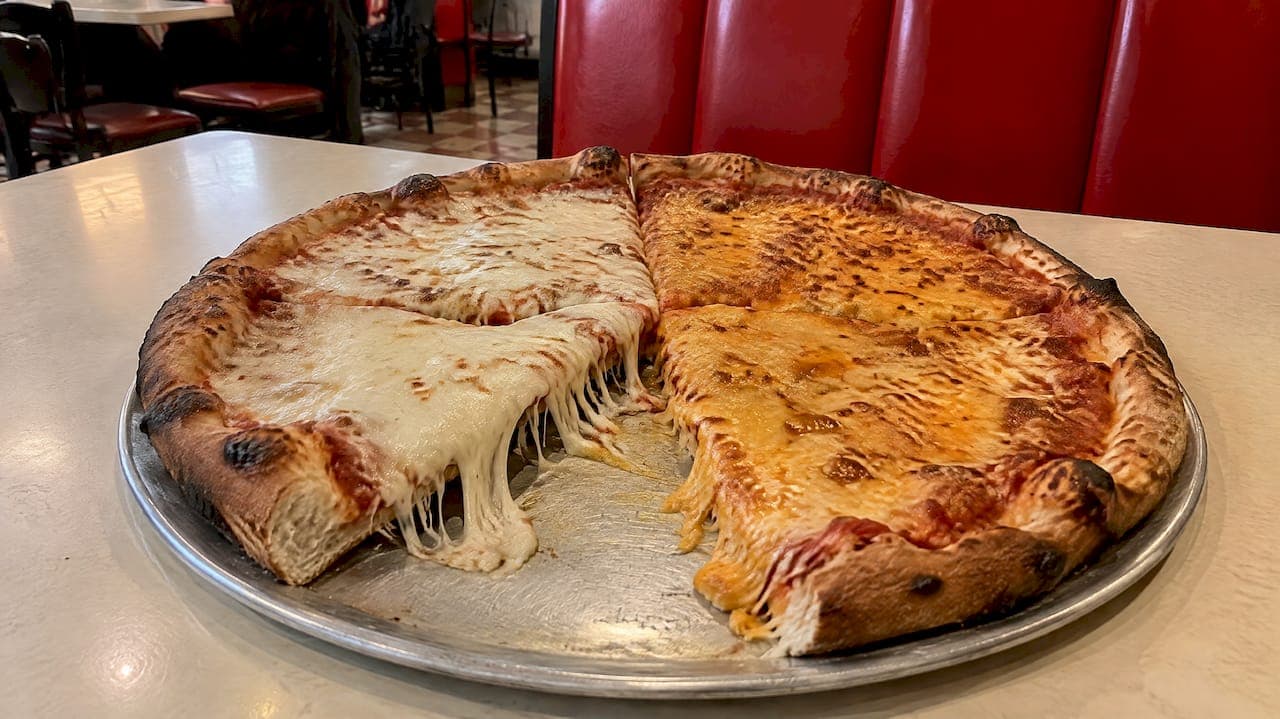
For a classic pizza, low-moisture mozzarella wins: it stretches, bubbles and browns the way you expect. Cheddar brings sharper flavour and melts readily, but it stretches less and can turn oily, so it shines best as a partner to mozzarella rather than a replacement. Below, we compare the two on melt, taste, price in Canada and nutrition, and show you how to use each one.
TL;DR
- Mozzarella is mild, milky and stretchy, which is why it is the default pizza cheese. Lab comparisons found it stretches more than cheddar.
- Cheddar has more flavour and flows easily when melted, but it can be oily. A common blend is about 70% mozzarella to 30% cheddar.
- Price depends far more on brand, age and package size than on the cheese type. Pizza mozzarella is often among the more affordable options.
- Nutrition is close per 30 g serving, but cheddar usually carries more sodium. Read the Nutrition Facts table on the package you buy.
Table of Contents
- How mozzarella and cheddar differ at the core
- Melt, stretch and browning on pizza
- Flavour: where cheddar earns its place
- Side-by-side comparison
- When to use which, and when to blend
- Which costs more in Canada?
- Nutrition: closer than most people expect
- Our perspective at HellCrust
- Build your own pizza with us
- Practical tips for using each cheese at home
- Why the science of stretch is not the whole story
- FAQ
- Sources
How mozzarella and cheddar differ at the core
These two cheeses come from different traditions and behave differently once the oven is hot.
Mozzarella is a pasta-filata cheese. The curds are stretched and kneaded until the proteins line up in parallel strands, and that structure is what gives it the characteristic stretch and elastic texture you see when you pull a slice away. Its flavour is mild and milky, which lets the sauce, herbs and toppings do the talking.
Cheddar is a firm, aged cheese, and its character changes with time. In the same PMQ explainer, mild cheddar is described as firm and elastic and melts well, medium cheddar is creamier with a fuller cheddar flavour, and aged cheddar turns crumbly and creamy. The older it gets, the more flavour it has, and the more it behaves like a seasoning rather than a blanket.
So the short version is this: mozzarella is about texture and balance, cheddar is about taste.
Melt, stretch and browning on pizza
This is where the two cheeses part ways most clearly.
A peer-reviewed comparison of commercial low-moisture mozzarella, cheddar and analogue pizza cheeses found that melted mozzarella had significantly greater mean stretchability than melted cheddar. The same study found cheddar had the highest mean flowability and the lowest apparent viscosity of the cheeses tested. In plain words, cheddar spreads and runs readily when it melts, but it does not form long, elastic strings.
Blistering matters too. BBC Future's write-up of pizza-cheese research says mozzarella uniquely combines enough moisture, elasticity and oil for the familiar bubbling and browning pattern, while cheddar, colby and edam were not elastic enough to form large bubbles.
Not every mozzarella behaves alike, though. A peer-reviewed review identifies low-moisture part-skim mozzarella as especially suited to pizza because the lower moisture improves shredding and the moderate fat supports the fat leakage you want during baking. PMQ's stretch table gives whole-milk mozzarella a relative melting distance of 6.4 mm, part-skim mozzarella 4.8 mm and cheddar 5 mm. That means a part-skim mozzarella and a cheddar can land close together, and "mozzarella" is not a single performance category.

The cheese is only half the story. How the crust bakes, how hot the oven runs and how thick the dough is all change what the cheese does, which is why pizza crust styles are worth understanding alongside your cheese choice.
Low-moisture or fresh mozzarella?
For most pizzas, and certainly for delivery, low-moisture mozzarella is the practical choice. Saputo's Canadian pizza-cheese guide says pizza mozzarella was developed for pizza, giving great stretch with a mild flavour that does not overwhelm toppings. It also suggests looking at milk-fat percentage, since higher milk fat improves stretch and blistering.
Fresh mozzarella has its place on a minimalist Margherita-style pizza. Wisconsin Cheese advises draining and drying fresh mozzarella for 20 to 25 minutes first, to reduce sogginess. Skip that step and the water ends up in your crust.

Flavour: where cheddar earns its place
If mozzarella is the quiet, reliable friend, cheddar is the one with opinions. Saputo calls cheddar savoury and adaptable, and that is exactly why pizza makers reach for it. A little sharp cheddar can lift a pizza topped with sweet caramelized onions, smoky bacon or roasted vegetables, because it adds the salty, tangy note mozzarella lacks.
The trade-off is oil. The same Saputo guide notes that cheddar is often paired with pizza mozzarella at about 70% mozzarella to 30% cheddar, because cheddar on its own can be too oily for full pizza coverage. That ratio is a good starting point, and you can nudge it toward cheddar if you like a bolder bite.
Side-by-side comparison
| Feature | Mozzarella (low-moisture) | Cheddar |
|---|---|---|
| Flavour | Mild, milky | Savoury; sharper as it ages |
| Stretch when melted | High | Lower than mozzarella |
| Flow when melted | Moderate | High, can turn oily |
| Browning and blistering | Classic bubbling and browning | Browns, but forms fewer large bubbles |
| Best use on pizza | Main cheese, base for blends | Flavour partner in a blend |
| Other uses | Au gratin dishes, baked pasta | Sandwiches, sauces, grilling |
When to use which, and when to blend
Use mozzarella alone when you want the classic result: an even melt, a good pull and a flavour that lets your sauce and toppings lead. Saputo says its pizza mozzarella is ideal for pizza and au gratin dishes, which is useful to remember for baked pasta too.
Reach for cheddar, or a blend, when:
- your toppings are sweet or smoky and need a sharper counterpoint;
- you are making a pan-style pizza and want a richer, crisper cheese edge;
- you simply like a more pronounced cheese flavour.
Blending is common practice, and mild cheddar melts well enough to make it easy. For Detroit-style pizza, Modernist Cuisine suggests equal parts Wisconsin brick cheese and pizza cheese or cheddar, and says that if you cannot find brick cheese, white cheddar and mozzarella will do. If you want to see how many other cheeses play a part, our guide to cheese varieties used on gourmet pizzas goes well beyond these two.
Sauce matters here as much as cheese. A sharper cheddar blend wants a sauce with enough acidity to cut through it, and we explain how in how sauce shapes pizza flavour.
Which costs more in Canada?
There is no single answer, because price follows brand, age, package size and promotion. Saputo's Canadian guide says pizza mozzarella was the most affordable of the cheeses it discussed, with specialty cheeses generally costing more, and cheddar and pizza mozzarella costing a bit less.
Here are some dated examples to give you a feel. They are snapshots, not national averages, and your store and week will differ:
- Walmart Canada listed a Cracker Barrel pizza mozzarella at $5.97, or $1.49 per 100 g on the page checked.
- Save-On-Foods showed Western Family pizza mozzarella at $6.49 for 340 g and $10.29 for 600 g, which works out to $1.91 and $1.72 per 100 g. Bigger packs cost less per gram.
- Narcity's report on Costco Canada's September 2025 flyer listed Kirkland shredded pizza mozzarella, two 625 g packs, at $14.99 on promotion, and Kirkland marble cheddar slices, 1 kg, at $11.99 on promotion.
- A July 2026 Costco East roundup listed Bothwell old cheddar, 1 kg, at $18.49, alongside Kirkland sliced mozzarella, two 450 g packs, at $13.99.
The lesson: an aged, branded cheddar can cost noticeably more than a store-brand pizza mozzarella, while a promotional cheddar can undercut it. Compare the price per 100 g, not the sticker price.
Nutrition: closer than most people expect
Many pages ranking for this search put cup-for-cup tables side by side, but cups of diced and shredded cheese weigh different amounts, so those comparisons can mislead. A weight-based serving is fairer.
Radio-Canada's Mordu test of 18 mozzarella products found that, per 30 g, the products supplied 80 to 110 calories, 7 to 9 g of protein and 0 to 2 g of carbohydrate, while fat varied more, from 5 to 9 g. Its best pick for sodium and fat was a lactose-free pizza mozzarella at 5 g fat and 200 mg sodium per 30 g. That spread inside one cheese type shows why the brand matters as much as the category.
Health Canada notes that the Canadian Nutrient File reflects average values for foods sold in Canada, and that shoppers wanting brand-specific figures should use the Nutrition Facts table on the package. That is the most reliable way to compare the two cheeses you are actually holding.
Is mozzarella healthy?
In moderation, it can fit a balanced diet. The Canadian Dairy Commission says mozzarella is high in protein and provides calcium, phosphorus, zinc and vitamins B12 and A in each serving.
What about sodium?
If you are watching sodium, portion size and cheese type both count. A Canadian health education tip card advises eating a smaller portion and looking for cheese with 15% milk fat or less, and notes that hard or brined cheeses such as cheddar or feta have more sodium than soft cheeses such as ricotta. If you have high blood pressure or a medical condition that limits sodium, ask your doctor or a registered dietitian how much cheese suits you.
For a wider view of what you are eating in a whole pizza, not just the cheese, see our look at nutrition in takeout pizza and what 400 to 800 calories look like for pizza and pasta.
Our perspective at HellCrust
We get asked about cheese a lot, and our honest answer starts somewhere other than the cheese. A pizza is a whole, and the crust is where we put our pride. Our dough is a Biga multigrain, free of artificial additives, prepared in advance so it develops a rich, mature flavour and a more digestible crumb. A cheese, whether mild and milky or sharp and savoury, can only be as good as what it sits on.
That is why we think of cheese as a partner to the crust, not a rival. A mild, stretchy mozzarella lets a fermented, multigrain crust taste like itself. A sharper cheddar note can be a lovely contrast when your toppings are sweet or smoky. And because you can customize toppings on our menu, you get to decide how bold your pizza should be. If you are weighing extra cheese against extra toppings, we wrote about how your crust decides the answer, and how fresh ingredients lift every bite.
Our rule of thumb is simple: you get what you pay for, so choose the cheese that suits your pizza, then taste it with care. Savour the first bite before you add anything else.
— jaskirat Singh
Build your own pizza with us
If this comparison made you hungry, we can take it from here. Create your own pizza on our Biga multigrain dough, pick your toppings, or try one of our signature or vegan pizzas. You can order for delivery or pickup in North Vancouver, Vancouver and West Vancouver, and our app gives you access to exclusive deals.

Browse the full HellCrust menu and build the pizza you have been imagining, or start from our home page.
Practical tips for using each cheese at home
Shred your own when you can. Block cheese you grate yourself usually melts more cleanly than pre-shredded cheese, which is coated to stop clumping. This is general kitchen practice rather than a tested claim, so try both and see what your oven prefers.
Keep the blend simple. Start with the 70/30 mozzarella to cheddar ratio, bake, and taste. Adjust by small steps.
Mind the moisture. Fresh mozzarella needs draining and drying, as noted above. Low-moisture cheese goes straight from the fridge to the pizza.
Match the cheese to the crust. A thin, crisp base can carry a sharper cheddar edge. A thicker, softer, fermented base is happy with a milder cheese. Our piece on hand-tossed versus pan shows how Biga multigrain dough behaves in each style.
Think about protein. Cured and spiced meats bring their own salt, so a milder cheese often balances them better. We explore this in why protein toppings are popular on pizza. If you are choosing a plant-based option, see our comparison of vegan pepperoni and regular.
Pour something good. A sharper cheese blend can change which drink works best, so have a look at our wine pairings for every pizza topping.
Why the science of stretch is not the whole story
It is tempting to declare a winner from a single number, and the research shows why that is a mistake. The University of Wisconsin Center for Dairy Research explains that stretch length and blistering are related but not identical: casein structure, pH, calcium loss, proteolysis, moisture and drying all shape the final result. In other words, two cheeses with the same label can bake differently, and two with different labels can bake alike.
That is also why the figures from PMQ place part-skim mozzarella and cheddar so close together. Age, moisture, fat and how the cheese was made matter as much as the name on the package. The practical takeaway is to bake a test pizza with the exact cheese you plan to use, rather than trusting the category alone.
FAQ
Which cheese is best for pizza?
Low-moisture mozzarella is the best all-round choice, because it stretches, blisters and browns the way most people expect, with a mild flavour that lets toppings shine. Cheddar works well as a partner, commonly at about 30% of the blend. Fresh mozzarella suits a simple Margherita-style pizza if you drain and dry it first.
Which cheese is more expensive, mozzarella or cheddar?
It depends on the brand, age and package size. Saputo says pizza mozzarella was the most affordable cheese it discussed, and cheddar was only a bit more. Aged or branded cheddar can cost clearly more, while promotions can flip the order, so compare the price per 100 g.
Is mozzarella cheese healthy?
In sensible portions, yes, it can be part of a healthy diet. The Canadian Dairy Commission notes it is high in protein and provides calcium, phosphorus, zinc and vitamins B12 and A. If you are limiting sodium or saturated fat, compare Nutrition Facts tables and talk to your doctor or dietitian.
What is the healthiest cheese?
There is no single answer, but a Canadian health tip card suggests eating smaller portions and choosing cheese with 15% milk fat or less. It also notes that hard cheeses such as cheddar have more sodium than soft cheeses such as ricotta. Your own health needs should guide the choice.
Sources
- Will It Melt? The Baking Characteristics of 6 Popular Pizza Cheeses, PMQ
- The compositional and functional properties of commercial pizza cheeses, International Journal of Dairy Technology
- Food: How mozzarella became the perfect pizza cheese, BBC Future
- Functional properties of Mozzarella cheese for its end use, PMC
- Popular picks: the best pizza cheeses in Canada, Saputo Foodservice
- How To Pick The Perfect Cheese For Pizza, Wisconsin Cheese
- An Essential Guide to Mozzarella Cheese, Saputo
- Detroit-Style Pizza Dough Recipe, Modernist Cuisine
- Block Cheese, Save-On-Foods
- Costco's flyer for September, Narcity
- Costco East cheese, dips and deli meat Super Post, July 2026
- Quel est le meilleur fromage mozzarella pour la pizza?, Radio-Canada Mordu
- Canadian Nutrient File Users Guide, Health Canada
- Mozzarella, Canadian Dairy Commission
- Choosing Healthy Foods: cheese tip card
- Dairy Pipeline, University of Wisconsin Center for Dairy Research
- Pizza Crust Styles Explained, From Neapolitan to New York