
Yes, pizza coupon stacking still works, but not the way most people assume. You cannot usually apply two promo codes at once. What you can do is layer three different types of savings: a merchant promo, a loyalty reward, and a payment or platform incentive. Combine those, and judge everything by the final checkout total, not the size of the discount banner; for example, some food-service partners like PopCornaa's gourmet popcorn offer separate savings layers that can complement your pizza deals.
TL;DR:
- Stacking pizza discounts involves layering a merchant promo, a loyalty reward, and a platform incentive, focusing on the final checkout total rather than individual discounts.
- Restrictions such as "one coupon per order," "cannot be combined," or geographic limitations often block stacking and should be checked at checkout rather than just in terms.
- Testing different sequences of applying discounts and comparing final totals helps identify the most economical option, especially when fees and taxes vary.
- Payment perks like cashback and statement credits reliably add to savings but require pre-enrollment and careful pairing with merchant offers for maximum benefit.
- Direct-order prices, pickup options, and avoiding inflated delivery fees from third-party apps can make simple coupons more effective than complicated stacking.
Table of Contents
- How coupon stacking for pizza actually works
- Common restrictions and the fine print that blocks stacking
- Step-by-step workflow to test a stack and choose the cheapest option
- Payment and card strategies that add reliably to a stack
- When stacking isn't worth it: inflated app pricing and marginal gains
- How HellCrust applies stacking in practice
- Building a savings system beats chasing one-off codes
- Redeem HellCrust deals as your merchant layer
- Sources
How coupon stacking for pizza actually works
Forget the idea that stacking means hunting for two codes that both apply. Real pizza coupon stacking happens across three separate systems that rarely compete with each other.
The first layer is the merchant-funded promo: the in-app code, the site coupon, the "$5 off $25" banner a pizzeria or its app pushes directly. These almost always carry a one-per-order rule, because the restaurant is footing the discount itself.
The second layer is account-funded loyalty. Points, punch cards, and reward redemptions come from a separate balance you have already earned through past orders. Because loyalty rewards draw from your account rather than the merchant's promo budget, many systems let them sit alongside a coupon even when two coupons would conflict.
The third layer is the platform or payment incentive. Delivery credits, card statement credits, and cashback percentages come from a bank, a card network, or the ordering platform itself. According to CreditCardGenius's breakdown of Canadian food delivery cards, pairing app loyalty points with a card offering cashback or statement credits on delivery categories is one of the more dependable ways to compound savings, because the money comes from an entirely different source than the coupon.
Why does the source matter so much? Because restrictions are almost always written to protect one budget, not all three:
- Merchant promos protect the restaurant's margin, so they block other merchant promos.
- Loyalty rewards protect the program's points economy, so they rarely interact with coupon terms at all.
- Payment incentives protect the bank or card issuer's marketing spend, so they apply automatically, after checkout, regardless of what coupon you used.
That separation is exactly why three-layer stacking survives where two-coupon stacking usually fails.
Common restrictions and the fine print that blocks stacking
Every failed stack traces back to a line of fine print someone skipped. PizzaHunt's coupon fine-print guide flags the same handful of restrictions across most pizza promotions, and once you know what they mean, you stop wasting time on combinations that were never going to work.
Here is what to check, in order, before you assume a stack will hold:
- "One coupon per order." This blocks a second merchant code, but it almost never touches loyalty points or a card's cashback offer.
- "Cannot be combined with any other offer, discount, or reward." This is the broadest wording and the one that actually kills loyalty stacking too. If you see it, test the cart before celebrating.
- "Excludes bundles, specials, or Mix & Match pricing." Bundle pricing is often already discounted, so a coupon layered on top gets rejected at checkout even if the promo banner never mentioned bundles.
- "Valid for delivery only" or "valid for carryout only." Channel exclusions are common and easy to miss, especially on third-party apps that display a restaurant's menu without its full promo terms.
- "Participating locations only." Franchise-run locations set their own promo rules, so a coupon that works at one address can fail at another under the same brand.
Restrictions surface in three places: the promotion's own terms page, small banner text inside the app, and, most reliably, a checkout error message once you have already built the cart. That third one is the truth-teller. Read the terms for a first pass, but treat the checkout screen as the final word.
Pro Tip: Build your full cart before reading a single word of fine print. Half the restrictions you need to know only trigger when the system actually tries to apply the discount, so let checkout do the checking for you.
Step-by-step workflow to test a stack and choose the cheapest option
Reading terms tells you what should work. Testing the cart tells you what does work. Pizzahunt recommends duplicating your order and running it through different sequences before you commit, since the order you apply offers in can genuinely change your final total.
Run this sequence:
- Benchmark first. Check the restaurant's direct-order price against the same order on a third-party app. Note your loyalty point balance while you are at it.
- Build the base cart with no discounts applied, then duplicate it two or three times in separate tabs or app sessions if your platform allows it.
- Test the merchant promo first, apply it, and record the subtotal after tax and fees.
- Reset and test loyalty redemption first instead, then see if the merchant promo still applies on top.
- Add the payment incentive last in every version, since cashback and statement credits typically apply automatically at the payment step regardless of order.
- Compare final totals, not discount percentages, across every version you ran.
A few things to watch for while you test:
- Percentage discounts applied before flat-dollar coupons often produce bigger absolute savings on larger carts, since the percentage is calculated on a higher base.
- A promo that looks identical in two sessions can behave differently once loyalty points are already applied, so don't assume yesterday's result still holds.
- Delivery fees, service charges, and small taxes can shift which sequence wins, so always let the app calculate the real total rather than eyeballing the math yourself.
The decision rule is simple once you have the numbers: pick whichever variant lands on the lowest total payable amount, tip included, full stop.
Payment and card strategies that add reliably to a stack
Not every payment perk works the same way, and knowing the difference keeps you from expecting a card to do something it was never designed to do. Cashback returns a percentage of your spend, usually credited days or weeks later. A statement credit wipes out a specific charge after the fact, often tied to a one-time enrollment or a spending threshold. Category bonuses pay a higher rate specifically on dining or delivery purchases, separate from your card's base rate.
CreditCardGenius's Canadian card comparison puts typical cashback and statement-credit ranges on delivery spending between 2% and 8%, depending on the card and the category bonus attached to it. That range is the payment layer's ceiling on top of whatever merchant and loyalty savings you have already locked in.
To pair card perks with app or aggregator promos effectively:
- Register any one-off statement-credit offer through your card issuer's portal before ordering, since most require enrollment ahead of the charge.
- Use a virtual card number when a platform requires you to add a new payment method to unlock a first-order promo, keeping your primary card's rewards intact elsewhere.
- Consider a delivery subscription service if you order more than a couple of times a month; waived delivery fees plus a cashback card can outperform chasing single-use codes, according to Pizzeria.
Card rewards are the layer most people forget entirely, which makes them the easiest extra savings to add to a stack you have already built.
When stacking isn't worth it: inflated app pricing and marginal gains
A discount is only real once fees and menu markups are accounted for. Third-party delivery apps sometimes charge more per item than a restaurant's own menu, so a coupon can shrink a bill that was inflated to begin with. According to PizzaHunt.online, a $12 special can turn into a $19 delivered order once fees and taxes land, even with a coupon applied.
Run this quick test before building an elaborate stack:
- Compare the aggregator's price against the restaurant's direct-order price for the same items.
- If the gap between them is bigger than your coupon's value, stop, order direct, and skip the stack entirely.
- If pickup is available and the delivery fee alone exceeds what a flat-dollar coupon saves you, take pickup.
Pro Tip: A simple flat-dollar coupon on a direct pickup order often beats a three-layer delivery stack on inflated menu pricing. Complexity is only worth it when the base price is already fair.
How HellCrust applies stacking in practice
App deals, Mix & Match specials, and posted coupons act as the merchant layer in the same role a promo code plays anywhere else. Add your loyalty balance on top, then let a cashback or statement-credit card cover the payment layer, and you have a working three-tier stack built from a single, easy starting point.
- For gatherings, HellCrust's group ordering guide explains the thresholds that unlock better per-person value.
- Larger households can cross-check bundle value using the family-sized ordering checklist before adding a coupon on top.
Building a savings system beats chasing one-off codes
Chasing the biggest single promo code gets old fast, and it rarely pays off as well as people expect. A steadier approach works better: pick a default setup, direct app plus loyalty plus a cashback card you already carry, and stick with it order after order. Loyalty programs and repeatable app offers tend to outperform occasional first-order promos over time, simply because they don't expire the moment a marketing campaign ends.
Test your actual cart before trusting a banner. A coupon that looks generous on the surface can lose to a plain loyalty redemption once fees are factored in. Starting from HellCrust's own coupon page and app gives you a real, working merchant layer to build that habit around from the first order.
— jaskirat Singh
Redeem HellCrust deals as your merchant layer
HellCrust gives you a merchant layer you can act on today, not a code that expires before you finish comparing it to three other apps. The base order is priced fairly, so a coupon stacks on real value instead of clawing back an inflated menu markup.
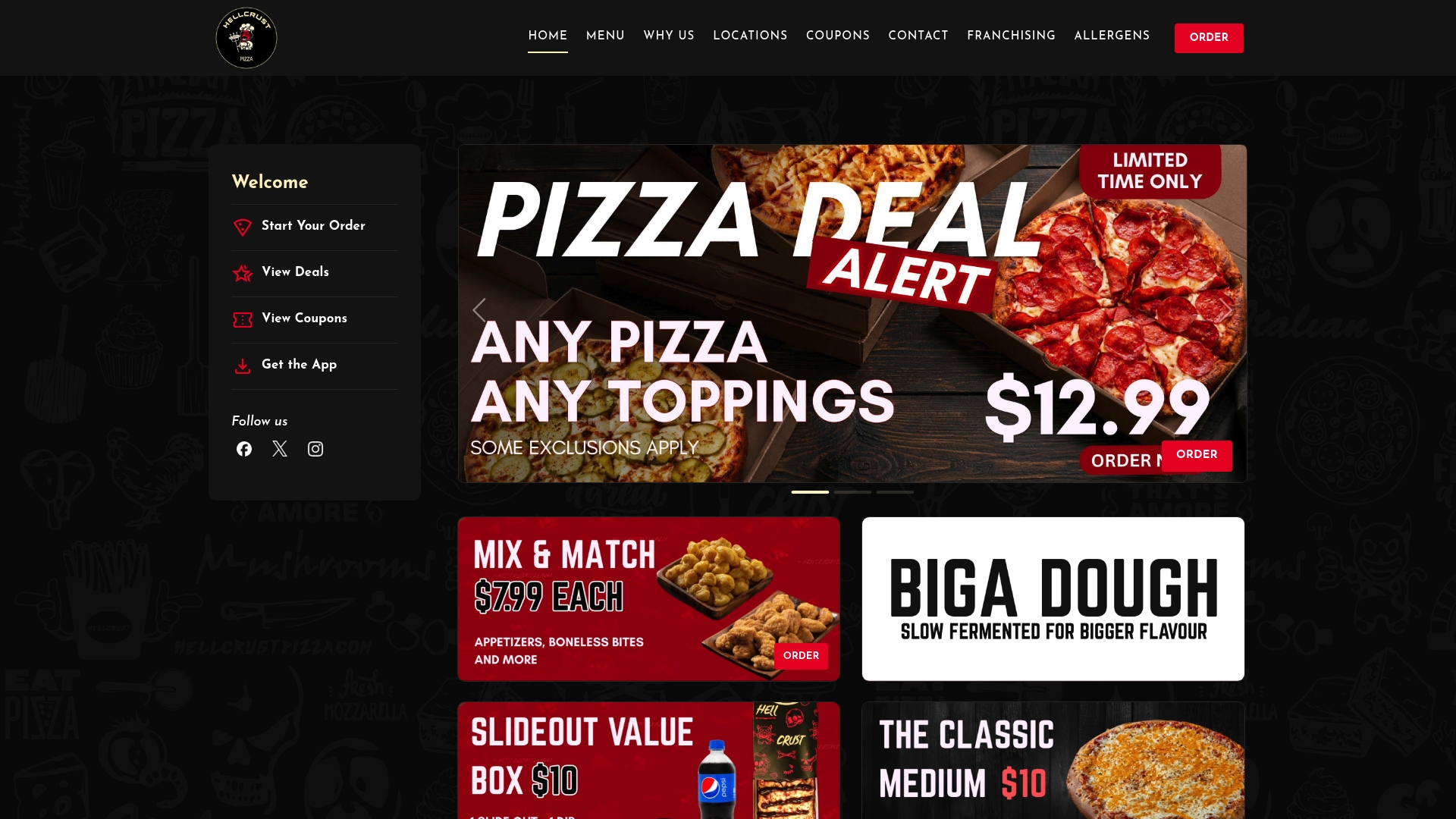
Start by opening the HellCrust coupons page and applying whichever app offer or Mix & Match special is live as your merchant layer. Add your loyalty balance next, then let your cashback or statement-credit card cover the payment layer at checkout. For a solo order or a small dinner, carryout with a flat-dollar coupon usually beats a complicated delivery stack outright, especially once you've checked the numbers yourself. Planning for a group? Pair a family special with the group-order thresholds in HellCrust's large-family app guide to split payments and stretch the discount further. Visit HellCrust's coupon page now to see what merchant layer is available for your next order.
Sources
- Food delivery in Canada: matching cards, promos and platforms (CreditCardGenius)
- Pizza coupon fine print guide (PizzaHunt)
- Pizzahunt