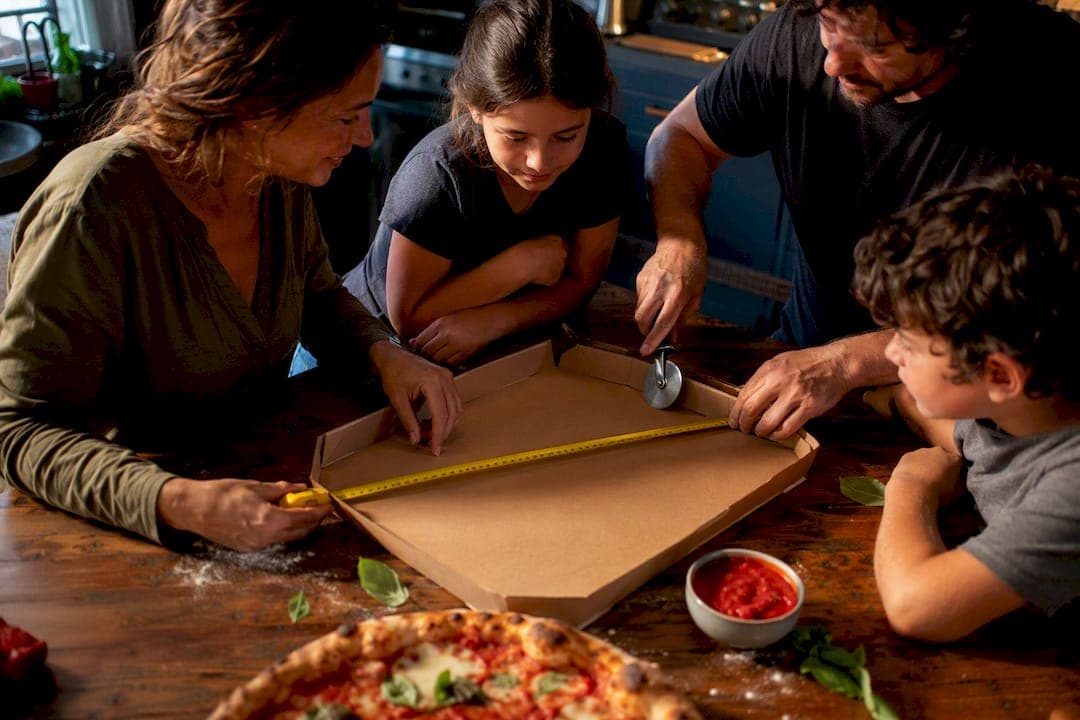
The rule is simple: plan on about three slices per adult and two per child, add up the total slices your group needs, then divide by how many slices come on the size you're ordering. Round that number up to the next whole pizza every time, and lean toward larger pies over multiple small ones when you can. Get those three moves right and you'll rarely order too little, or waste a box.
TL;DR:
- Larger pizzas provide better value per square inch than multiple smaller ones, making them the more economical choice for bigger groups.
- For every four adults, order three slices per person, and always round up to the nearest whole pizza to account for leftovers or high appetites.
- Crust styles influence slices needed, with thicker crusts satisfying more than thin crusts, so adjust the slice count accordingly when planning.
- Properly account for teenagers and hungry guests by increasing slice estimates, especially during high-energy events or when no sides are served.
- Use the formula of (adults times three) plus (children times two) to determine total slices, then divide by the chosen pizza size's slices and round up for an accurate order.
Table of Contents
- Pizza size guide: standard diameters and slice counts
- How do you calculate how many pizzas to order?
- How appetite, crust style and sides change the math
- Quick pizza size chart for common group sizes
- How HellCrust makes group ordering simple
- What actually trips people up when ordering
- Order your next group pizza the easy way
- Sources
Pizza size guide: standard diameters and slice counts
Pizza sizing isn't standardized across the industry, but most shops cluster around the same handful of diameters. Knowing them turns a guessing game into arithmetic.
A personal pizza runs roughly 8 inches with about 4 slices. Small pies land near 10 inches and typically have around 6 slices. Medium is the workhorse size at about 12 inches, generally cut into 8 pieces. Large climbs to around 14 inches, usually having between 8 and 10 slices, but noticeably more pizza per slice than a medium. Extra large starts at about 16 inches, often cut into approximately 10 to 12 slices.
| Size | Typical diameter | Typical slices | Best for |
|---|---|---|---|
| Personal | ~8" | 4 | One person |
| Small | ~10" | 6 | 1 to 2 people |
| Medium | ~12" | 8 | 2 to 3 people |
| Large | ~14" | 8 to 10 | 3 to 5 people |
| Extra large | 16"+ | 10 to 12 | 5 to 7 people |
Those slice counts are a starting point, not gospel. Shop cutting styles vary, and a "large" at one place might carry the same footprint as an "extra large" somewhere else, so it always pays to check the menu before you order.
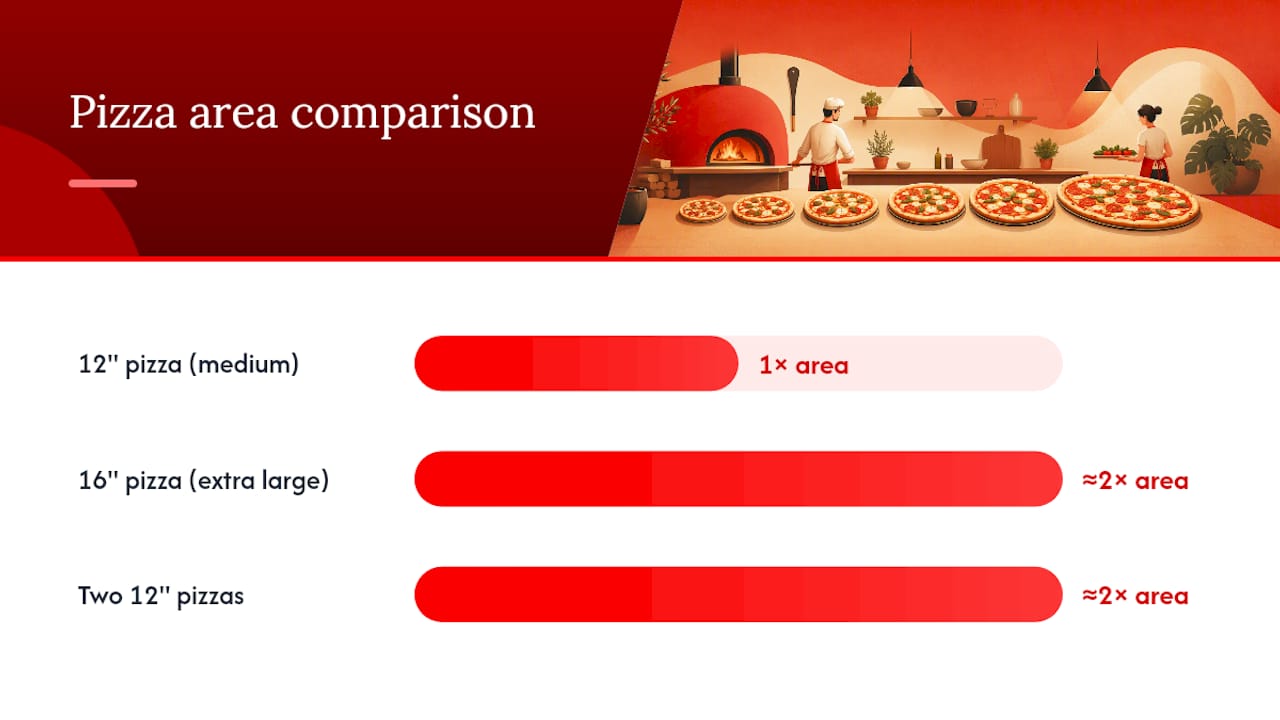
Here's the part most people miss: diameter grows in a straight line, but area grows exponentially. A 16 inch pizza has roughly double the surface area of a 12 inch pizza, even though it looks only a few inches wider on the box. That's why larger pies almost always deliver better value per square inch than ordering two smaller ones to match the same headcount. If your goal is best value pizza size for the dollar, sizing up usually beats stacking up.
How do you calculate how many pizzas to order?
The formula behind every reliable pizza portion guide is short enough to do in your head:
(Adults × 3) + (Children × 2) = total slices needed
Once you know the total slices, divide by the slice count on the pizza size you've chosen, then round up. A fraction always rounds up, never down. Calculator-based guides built specifically for this problem confirm the same logic: convert people to slices first, then convert slices to pizzas.
- Five adults, no kids. 5 × 3 = 15 slices needed. A large pizza with 8 slices means 15 ÷ 8 = 1.875, so order 2 large pizzas. You'll have a slice or two left over, which is exactly where you want to land.
- Ten people, mixed group (6 adults, 4 kids). 6 × 3 = 18, plus 4 × 2 = 8, for 26 slices total. At 8 slices per large, 26 ÷ 8 = 3.25, so order 4 large pizzas.
- Twenty-five adults, office lunch. 25 × 3 = 75 slices. Using large pizzas at 8 slices each, 75 ÷ 8 = 9.375, so order 10 large pizzas. This lines up with the kind of group lookup tables that suggest roughly 8 large pizzas for 20 adults eating pizza as the main meal.
Add one extra pizza on top of your calculated total when teenagers are involved (they eat closer to adult portions, sometimes more), when it's a game day or other high-energy event, or when pizza is the entire meal with no sides to fill gaps. A little slack costs less than a second delivery run.
How appetite, crust style and sides change the math
The 3-slices-per-adult baseline assumes an average eater with a normal side dish or two. Real groups rarely sit neatly in that lane, so it helps to think in bands. Light eaters land around 2 slices, average eaters around 3, and hungry eaters (think teenagers or anyone skipping lunch) closer to 4 or more. Multiply your headcount by the band that fits the crowd, not the generic default.
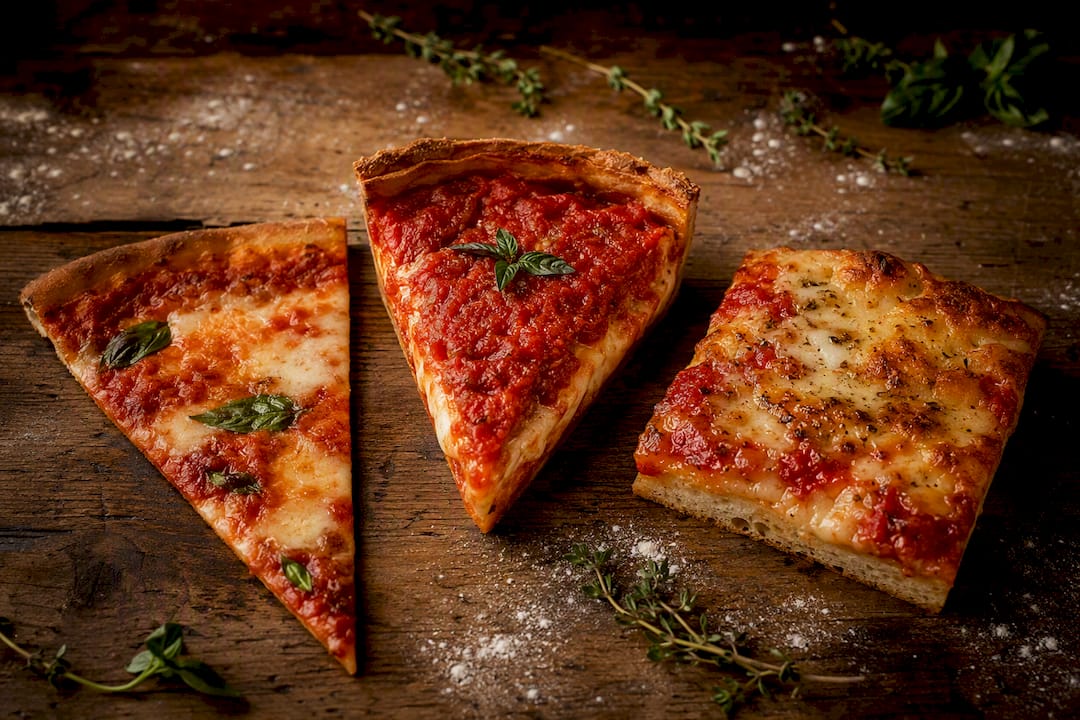
Crust style matters more than most people expect. Denser crusts like deep-dish or Sicilian fill people up faster than thin crust, so a thick-crust slice can satisfy what two thin-crust slices would otherwise cover. When you're ordering a heavier style, it's reasonable to count each pie as equivalent to 1.25 to 1.5 thin-crust pizzas for planning purposes.
Sides pull in the opposite direction. A table loaded with wings, salad, or garlic bread can knock a full slice off the per-person estimate. A simple heuristic: subtract half a slice per person for one substantial side, a full slice for two or more.
Quick pizza size chart for common group sizes
Skipping the math altogether? These numbers assume standard large pizzas (8 to 10 slices) and average appetite, so treat them as a starting point rather than a fixed rule; always glance at the shop's own slice count before finalizing.
- 1 to 2 people: 1 medium as a main meal, or 1 small with a side.
- 4 people: 2 medium pizzas as a main meal, or 1 large plus a side dish.
- 6 people: 2 to 3 large pizzas as a main meal, or 2 large with sides.
- 10 people: 4 large pizzas as a main meal, or 3 large with substantial sides.
- 20 people: roughly 8 large pizzas as a main meal, dropping to 6 or 7 when sides are heavy.
- 50 people: roughly 19 to 20 large pizzas as a main meal, scaled down with a full side spread.
For gatherings pushing past 100 guests, keeping dozens of pies hot and served on time becomes a logistics problem on its own, and it's worth thinking about staged delivery or on-site catering rather than one giant order landing all at once.
How HellCrust makes group ordering simple
We built HellCrust around the reality that most pizza orders aren't for one person doing the math alone at a laptop. They're for a family trying to feed everyone without three of the slices going stale in a box overnight. Our family-sized specials and Mix & Match options exist so you can combine variety and volume without recalculating everything from scratch, and our app keeps the whole process, from customizing toppings on our additive-free Biga multigrain dough to applying a deal, to a few taps.
Here's a sample worked order using that same math: a family of two adults and two kids needs 6 + 4 = 10 slices, comfortably covered by one of our family-sized specials, and we'd add one extra medium if a teenager or two joins the table. For a deeper walkthrough, our family-sized pizza ordering checklist covers the deal combinations that stretch furthest.
What actually trips people up when ordering
The mistakes I see aren't really about the formula, they're about the inputs people plug into it. Folks routinely undercount teenagers, treating them like children when their appetite tracks closer to a hungry adult. They skip checking the shop's actual slice count and assume every "large" is identical. And they anchor on "how many pizzas" instead of "how many slices," which is backwards: pizzas are just the container, slices are the unit that actually feeds people.
Pro Tip: When you're torn between ordering three smalls or one large plus one medium, take the large-plus-medium combo. You get more total area for the same or lower price, and you still get two flavours instead of committing an entire group to one topping.
— jaskirat Singh
Order your next group pizza the easy way
Once you've done the math, the ordering part should be the easy step, not another decision tree. HellCrust's family-sized specials and Mix & Match deals are built so a household or office group can land on the right quantity without juggling three separate orders, and every pizza starts from the same additive-free Biga multigrain dough whether you're feeding two people or twenty.
That matters most when a group has mixed appetites and mixed tastes, because splitting a large order across a couple of specialty pies and one customizable pie cuts down on leftover slices nobody wants. Our app also makes it simple to browse deals, adjust toppings, and check exactly how many slices a size includes before you commit. If your next gathering falls anywhere between "just us two" and "the whole office," place your order through HellCrust and let the family deals handle the sizing decisions for you. For split-payment groups, our guide to the best pizza apps for large families is worth a look too.
Sources
For unusual mixes or very large events, lean on a dedicated pizza calculator rather than eyeballing it, and cross-check against a group meal ordering guide when planning for a mixed office or family event.
- Pizza Calculator: How Many Pizzas to Order | ReadyToCalculate
- The easiest way to figure out how much pizza to order | Tasting Table
- How many pizzas do you need for 20, 50, or 100 guests? | Mobile Pizza Oven Catering