
A group pizza order is defined as a single, consolidated order where multiple people submit their individual pizza selections through one coordinated request, reducing redundant delivery and service fees for everyone involved. This method is also called collective ordering or shared ordering in catering contexts. Whether you are planning a team lunch, a birthday party, or a casual Friday gathering, understanding how group pizza ordering works saves you money and spares you the chaos of managing a dozen separate tabs. Consolidated group ordering can reduce overall costs by approximately 45% compared to individual delivery app orders, and achieves an on-time arrival rate of 98%. That kind of saving is not a rounding error. It is the difference between a budget that holds and one that quietly falls apart.
What is a group pizza order and how does it work?
A group pizza order works through a single shared link that the host creates and sends to every participant. Each person clicks the link, browses the menu, and adds their own selections. The platform then consolidates every choice into one order with labelled, individually packaged items. Specialised platforms generate one invoice and enable individual labelling, which drastically reduces logistics errors compared to manual coordination.

The host typically sets a deadline for selections, reviews the full order before confirming, and controls what goes through. This prevents last-minute additions that throw off the budget or delay delivery. Some platforms also allow order polls, where participants vote on shared pizzas rather than choosing individual ones.
Payment logistics vary by platform. On some apps, each participant pays for their own items at checkout. On others, the host pays the full total and collects money separately. The critical detail most groups miss: hosts managing group orders on popular third-party apps pay all aggregated fees and tips even when participants pay individually, which can add $10–$15 to the host's bill. Budget for that before you send the link.
Key features to look for in a group ordering platform:
- A shareable single link that does not require participants to create an account
- Individual item labelling so each pizza reaches the right person
- A host review step before the order is finalised
- A clear deadline timer visible to all participants
- Transparent fee breakdown before checkout
Pro Tip: Set your order deadline at least 30 minutes before you actually need to place it. Stragglers are guaranteed, and a buffer protects your delivery window.
How do group orders compare to individual orders on cost?
Group pizza orders cost significantly less per person than individual delivery orders placed separately. The savings come from consolidating delivery fees, service fees, and minimum order thresholds into one transaction instead of multiplying them across every participant.
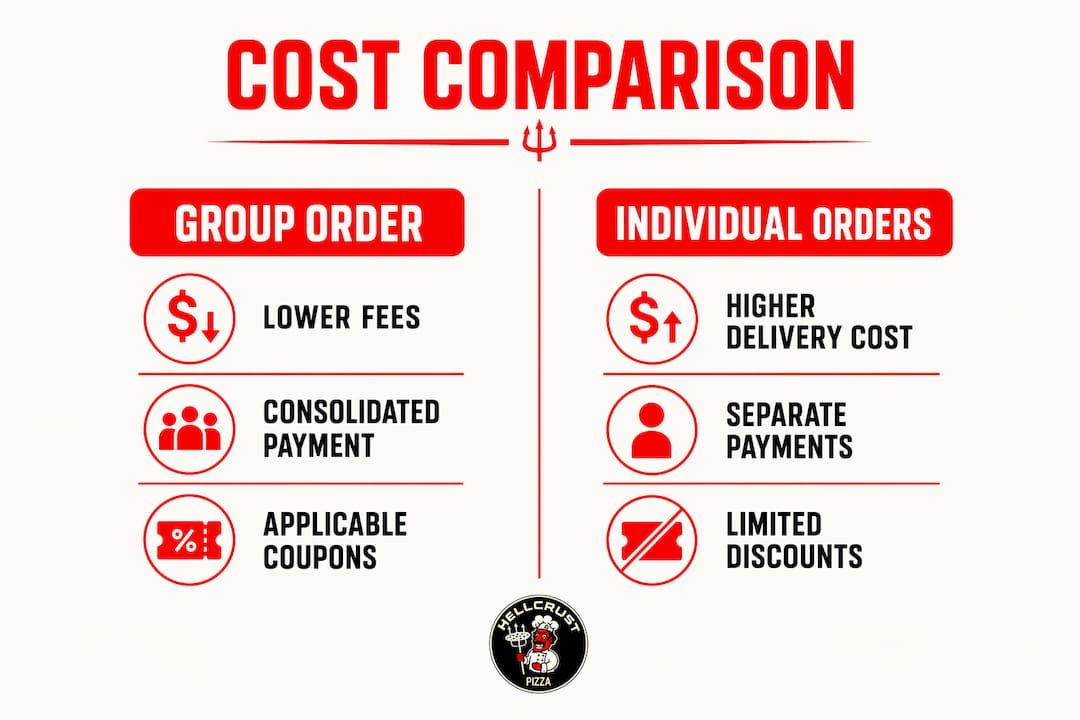
Percentage-off coupons often apply only to the pre-tax food subtotal, while service fees, delivery fees, and small order fees increase the final price considerably. When five people each place a separate order, each one absorbs a full set of those fees. A group order absorbs them once.
The table below illustrates a realistic cost comparison for a group of six people ordering pizza:
| Order method | Food cost (6 people) | Fees per order | Total fees paid | Estimated total |
|---|---|---|---|---|
| Six individual app orders | $90 | $8–$12 each | $48–$72 | $138–$162 |
| One group app order | $90 | $8–$12 once | $8–$12 | $98–$102 |
| Carryout group order | $90 | $0–$3 | $0–$3 | $90–$93 |
| Homemade pizza | $18–$24 | $0 | $0 | $18–$24 |
Homemade pizza sits at the far end of the savings spectrum. Making pizza at home can cost as little as $3 per pizza compared to $15–$25 for a delivered one, representing savings of nearly 80% per slice. That figure is real, but it does not account for your time, the equipment you need, or the fact that homemade pizza for twenty people is a full afternoon of work.
"The best pizza deal depends on order type and group needs rather than just the lowest price. Bundles help groups by pre-calculating volume and simplifying decision-making." — pizzahunt.net
For most groups, the carryout group order hits the sweet spot. You get restaurant-quality pizza, zero delivery fees, and a predictable total. The trade-off is that someone has to pick it up.
How to organise a group pizza order effectively
Effective group pizza ordering starts with a headcount and a slice estimate. The standard rule is three slices per adult for a meal, two slices per adult if sides are included. A large pizza typically yields eight slices, so divide your total expected slices by eight to get your pizza count. Round up, not down. Running short on pizza at a group event is far more disruptive than having two extra slices left over.
Managing dietary preferences is the second challenge. The customisable toppings approach works best for groups with diverse needs. Ask participants to flag vegetarian, vegan, or allergy requirements when they submit their selections. Order those pizzas separately and label them clearly so there is no cross-contamination confusion at the table.
Follow these steps for a smooth group order every time:
- Confirm your headcount at least two hours before placing the order. Last-minute additions are the most common cause of short orders.
- Set a firm selection deadline and communicate it clearly. A shared message with a countdown works better than a casual reminder.
- Designate one host who reviews the full order before confirming. Two people approving the same order creates duplicate items.
- Clarify payment upfront. Decide before the link goes out whether the host pays and collects, or whether everyone pays at checkout.
- Check the fee breakdown before confirming. Service fees and small order charges can add 20–30% to the food subtotal on some platforms.
- Order one pizza variety per four to five people if you are doing shared pizzas rather than individual selections. This keeps variety manageable without creating a logistics puzzle.
Pro Tip: Use the family-sized ordering checklist from Hellcrustpizza to pre-calculate quantities and avoid the most common over-ordering and under-ordering mistakes.
Scheduled group orders with admin management prevent common issues like payment disputes and missing items that appear in ad-hoc group orders. The admin structure is not bureaucracy. It is the thing that stops your office lunch from turning into a 45-minute argument about who owes what.
How do pizza deals actually work for group orders?
Pizza deals fall into four main categories: family bundles, buy-one-get-one (BOGO) offers, carryout specials, and delivery promos. Each type suits a different ordering situation, and choosing the wrong one for your group can cost more than ordering at full price.
Carryout discounts offer the most reliable everyday value, while bundles are better suited for groups and families because they pre-calculate food volume and reduce decision-making stress. That distinction matters. A carryout special saves you money on a single pizza. A family bundle saves you money and mental energy when you are feeding eight people.
Watch for these common pitfalls with pizza deal pricing:
- Bundle padding. A family pizza deal bundle typically includes pizzas, sides, desserts, and drinks, but can include low-value items or unwanted extras that reduce overall value. If your group does not drink soda, a bundle that forces two litres of it is not a deal.
- Coupon fine print. Percentage-off coupons often apply to the food subtotal only. Delivery fees, service fees, and taxes sit on top, and they are not discounted.
- Minimum order traps. Some delivery promos require a minimum spend that pushes groups to order more than they need.
- BOGO limitations. Buy-one-get-one deals frequently apply only to specific sizes or crust types. Read the terms before building your order around one.
The most practical approach for groups is to match the deal type to your actual eating needs. If you are picking up the order, a carryout special is almost always the best value. If delivery is non-negotiable, look for a group bundle that covers your headcount without forcing extras nobody wants. Finding the cheapest pizza deals online takes two minutes and can save a group of six anywhere from $15 to $40 on a single order.
Key takeaways
A group pizza order saves the most money when it consolidates fees into one transaction and matches the deal type to the group's actual needs.
| Point | Details |
|---|---|
| Define the order structure early | Decide on host-pays or individual-pays before sending the group link. |
| Consolidation cuts costs sharply | One group order absorbs fees once; six individual orders multiply them six times. |
| Match deals to your order type | Carryout specials suit smaller groups; family bundles suit larger ones with predictable appetites. |
| Read coupon terms carefully | Percentage-off deals apply to food subtotals only, not fees or taxes. |
| Set a firm deadline | A selection deadline with a buffer prevents late additions from delaying the whole order. |
Why organised group ordering changed how I think about pizza events
By jaskirat Singh
After coordinating pizza orders for everything from ten-person office lunches to fifty-person community events, the single biggest lesson I have learned is this: the problem is never the pizza. The problem is always the process.
Groups that skip a centralised ordering system spend more time managing confusion than enjoying the meal. Someone forgets to submit their selection. Someone changes their order after the host has already confirmed. Someone assumes the host is covering the fees. These are not edge cases. They happen at nearly every informal group order I have seen.
The shift to a structured group order, with a shared link, a deadline, and one designated host, eliminates most of that friction. What surprised me most was how much it also improved the food experience. When items are labelled and individually packaged, people actually get what they ordered. That sounds obvious, but it is genuinely rare in informal group settings.
My honest advice: do not treat the logistics as an afterthought. Spend five minutes setting up the order structure before you send anything to the group. Clarify payment, set the deadline, and review the fee breakdown yourself before confirming. That five minutes of preparation is worth more than any coupon you will find. And when the pizza arrives hot, labelled, and on time, the group notices. That is what makes people want to do it again.
— jaskirat Singh
Hellcrustpizza makes group ordering worth savouring
Feeding a group well does not have to mean overpaying or over-thinking. Hellcrustpizza is built around the belief that quality and affordability belong together, and that shows up in every detail, from the Biga multigrain dough crafted without artificial additives to the Mix & Match deals designed specifically for groups with different tastes.
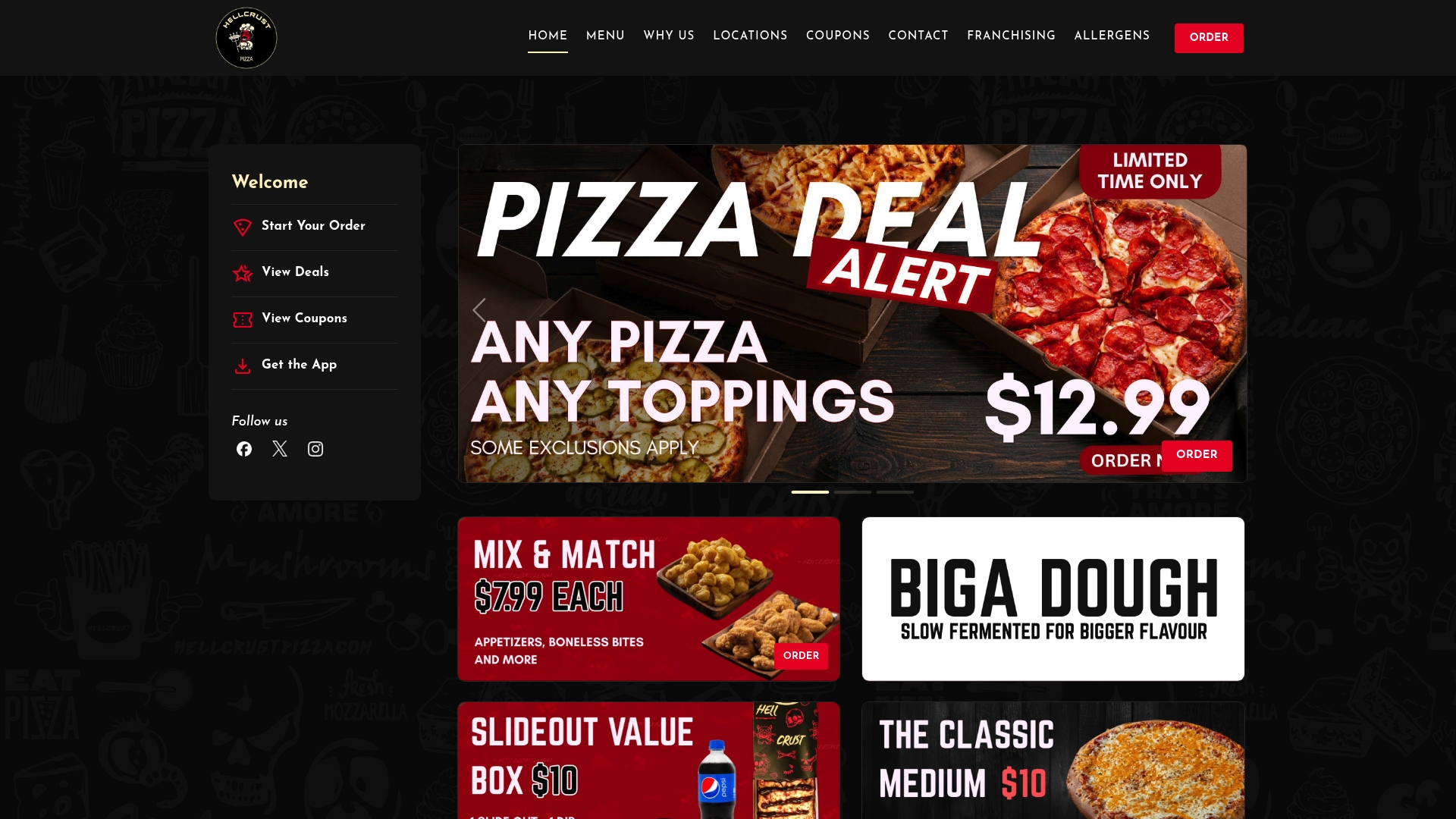
Whether you are ordering for a Friday team lunch or a weekend gathering, Hellcrustpizza's group-friendly deals and coupons take the guesswork out of budgeting. The app makes it straightforward to build your order, apply available offers, and confirm delivery without the usual back-and-forth. Visit Hellcrustpizza to browse current deals and put together an order your group will genuinely look forward to.
FAQ
What is a group pizza order?
A group pizza order is a single consolidated order where multiple people submit their individual selections through one shared link or request. It reduces redundant delivery and service fees compared to placing separate individual orders.
How many pizzas should I order for a group?
The standard estimate is three slices per adult for a meal, or two slices if sides are included. A large pizza yields approximately eight slices, so divide your total expected slices by eight and round up.
Who pays the delivery fees in a group pizza order?
The host typically pays all delivery fees, service fees, and tip, even when participants pay for their own food items separately. On many third-party apps, this can add $10–$15 to the host's total cost.
Are pizza bundle deals worth it for groups?
Family bundles are well-suited for groups because they pre-calculate food volume and simplify decision-making. Check that the bundle does not include low-value extras your group will not use, as these reduce the overall value of the deal.
What is the cheapest way to order pizza for a large group?
Carryout group orders offer the lowest total cost because they eliminate delivery fees entirely. Applying a carryout coupon on top of that produces the best savings without sacrificing restaurant-quality pizza.