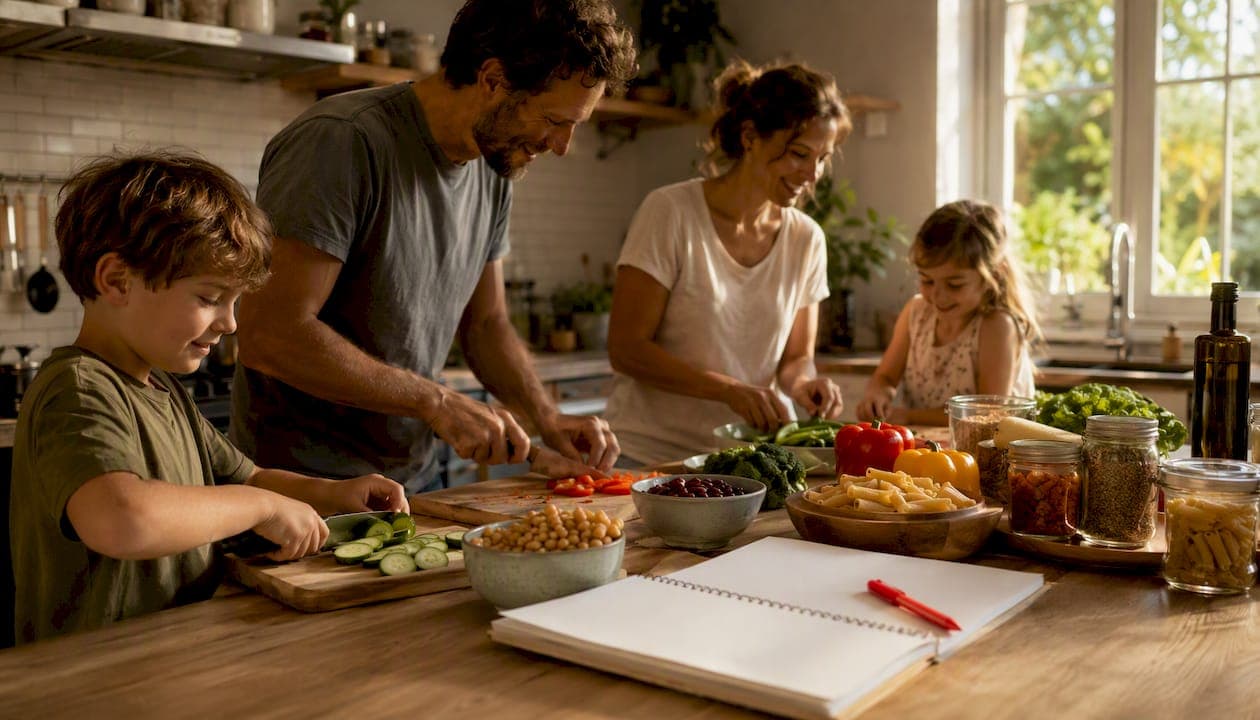
The most effective combined approach is simple: plan your meals before you shop, stock a handful of bulk staples, and stretch every protein with legumes or eggs. Families who do all three consistently can typically save 20–30% on their grocery spending compared with those who shop without a plan.
Three things you can do right now, before your next grocery trip:
- Check your pantry and fridge. Write down three items you already have that need to be used up this week.
- Set a per-meal target. A reasonable starting point for many families is a low-cost per person per meal, depending on your region and dietary needs.
- Pick one bulk staple to buy. Dried lentils, a large bag of rice, or a canister of rolled oats can anchor several meals affordably.
Pro Tip: Write your three "use-up" items on a sticky note and put it on the fridge door before you plan the week's meals. You'll build the plan around what you already own, which is the fastest way to cut waste and cost at the same time.
Key takeaways
| Point | Details |
|---|---|
| Plan before you shop | Using a meal plan and grocery list is associated with savings of about 20–30% compared with unplanned shopping. |
| Stretch proteins with legumes | A 50/50 blend of meat and cooked lentils or beans cuts cost per serving roughly in half without reducing protein. |
| Buy bulk staples | Rice, dried beans, oats, pasta, and frozen vegetables are the cheapest, most flexible foundations for family meals. |
| Use "anything meal" nights | One flexible meal per week (pizza, frittata, stir-fry) uses up leftovers, reduces waste, and cuts decision fatigue. |
| Hellcrustpizza for fallback nights | Family bundle deals and app coupons make an occasional order a budget-aware choice when home cooking is not possible. |
Track your actual spending for 30 days, note your impulse triggers, and adjust your per-meal target based on what you find. The numbers will tell you exactly where the money is going.
Table of Contents
- What to do before your next grocery trip
- Meal planning and batch cooking: your single best lever
- How to stretch protein without losing nutrition
- Which staples to keep on hand and when to buy in bulk
- Turn leftovers into meals your family will actually want
- Smart shopping tactics that reduce your grocery bill
- How to set a realistic family food budget
- A ready-to-use 7-day family meal plan
- Where to turn in Canada when the budget is not enough
- What the research actually says about budget cooking
- A perspective on what actually moves the needle
- Hellcrustpizza is a smart fallback for busy family nights
- Sources
What to do before your next grocery trip
A 10–30 minute pre-shop audit saves more money than any coupon. Here is a repeatable checklist.
Step 1: Audit the fridge and pantry. Pull everything forward, note expiry dates, and write down the three items closest to going off. These become the anchors for at least two meals this week.
Step 2: Set a weekly meal budget. Multiply your per-meal target by the number of meals you need to cover. A family of four eating three meals a day for seven days needs 84 meal-servings. At $2.50 per serving, that is $210 per week. Adjust up or down based on your actual spending history.
Step 3: Check flyers and loyalty apps before you write the list. Most major Canadian grocery chains publish weekly flyers online and through their apps. Scan protein prices first, since meat and fish drive the biggest swings. Government nutrition guidance confirms that planning meals before shopping and using a grocery list helps households organise spending and choose healthier, lower-cost options.
Step 4: Build the list by store section. Group items by produce, pantry, dairy, frozen, and protein. This reduces backtracking, limits impulse buys, and keeps you focused on what the plan actually requires.
Meal planning and batch cooking: your single best lever
A 30–60 minute weekly planning session is the single most effective habit for cutting food costs. Everything else, from bulk buying to coupon clipping, works better when it sits inside a plan.
The three-step weekly planning routine
- Inventory first. Before opening a recipe app, spend five minutes listing what proteins, grains, and vegetables you already have. Build at least two meals around those items.
- Plan around staples and sales. Check what is on sale this week and match it to a meal template you know your family will eat. Chili, pasta bake, and stir-fry are flexible enough to absorb almost any protein or vegetable on sale.
- Write one consolidated grocery list. A single list, organised by store section, prevents the "I'll just grab it" detours that add $15–$30 to a shop.
Two heuristics that keep it simple
The 3-3-3 rule works well for smaller families: plan three breakfasts, three lunches, and three dinners that rotate across the week. The 5-4-3-2-1 rule suits larger households: five dinners from scratch, four lunches repurposed from leftovers, three breakfasts from pantry staples, two batch-cooked proteins, and one flexible "anything meal" night.
Batch cooking amplifies both rules. Cook a double portion of rice, beans, or a protein on Sunday, then portion and freeze what you won't use by Wednesday. Batch-cooking guides recommend freezing in single-meal portions so weekday decisions take seconds, not 30 minutes of staring into the fridge.
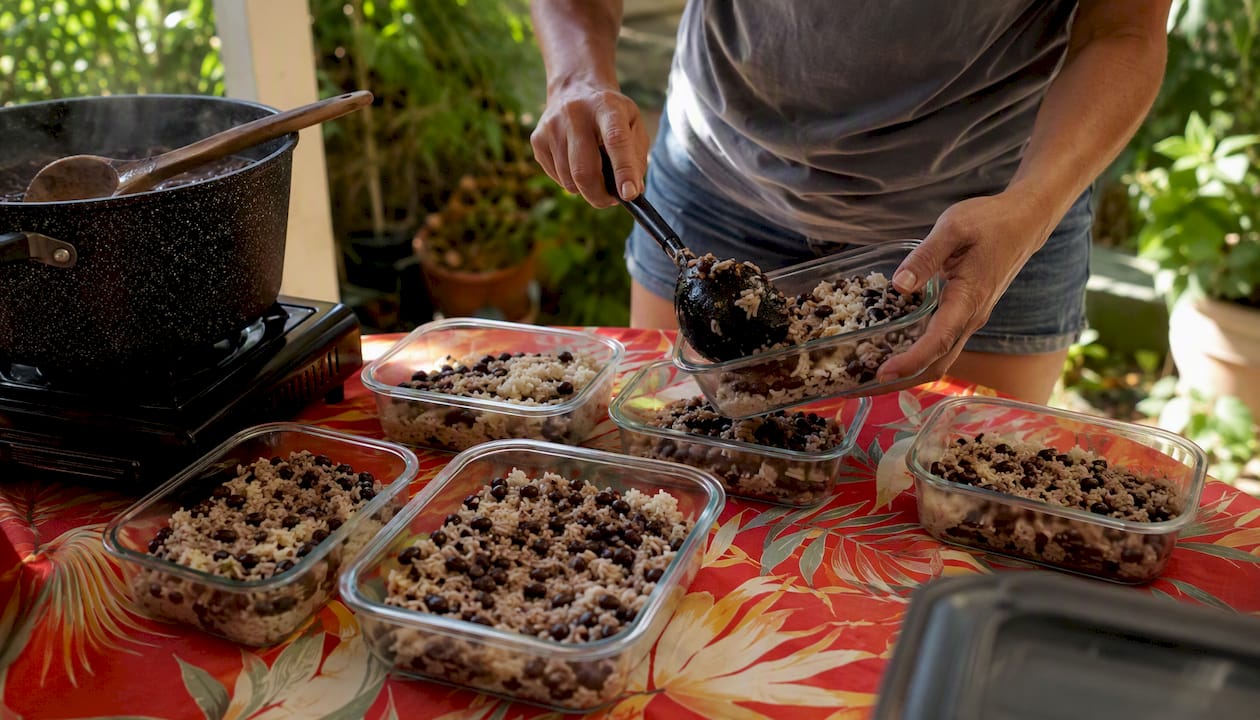
Pro Tip: Label every container with the date and the meal it is destined for. "Taco filling — Oct 14" is far more likely to be used than an unlabelled bag of brown mystery meat.
How to stretch protein without losing nutrition
Small swaps and "bulking" preserve both nutrition and satiety while cutting the cost per serving noticeably. Budget-cooking experts note that bulking meat-based meals with legumes and repurposing leftovers saves time and money more reliably than hours of complex scratch cooking.
Affordable proteins to keep on rotation:
- Dried lentils and chickpeas — among the cheapest protein sources per gram available in any Canadian grocery store
- Eggs — versatile, fast to cook, and nutritionally dense
- Canned fish (tuna, salmon, sardines) — shelf-stable and rich in omega-3s
- Tofu and tempeh — cost-effective plant proteins that absorb flavour well
- Bone-in chicken thighs — far cheaper per kilogram than boneless breasts and more flavourful for slow-cooked dishes
- Dried beans (black beans, kidney beans, navy beans) — cook a large batch on the weekend and use across three or four meals
Recipe templates that scale for any family size:
- Chili: replace half the ground beef with cooked lentils or black beans. The texture holds, the flavour deepens, and the cost per serving drops by roughly a third.
- Soup or stew: a chicken carcass or a ham bone plus whatever vegetables need using up makes a rich broth. Add barley or pasta to bulk it out.
- Taco mix: stretch seasoned ground meat with cooked brown lentils at a 50/50 ratio. Most families, including picky eaters, cannot tell the difference.
- Casseroles: canned beans or chickpeas added to a pasta bake add protein and fibre without changing the dish's character.
Pro Tip: Soak dried beans overnight and cook a large batch on Sunday. Freeze in 400 ml portions (roughly the equivalent of one can) so you always have a ready substitute for canned beans, at a fraction of the cost.
Which staples to keep on hand and when to buy in bulk
Rice, beans, oats, potatoes, and frozen vegetables are the cheapest, most flexible foundations for low-cost, nutritious family meals. Buying them in larger quantities lowers the cost per serving and reduces how often you need to shop.
High-value bulk staples:
- Long-grain white or brown rice — feeds a family as a side or a base for bowls, stir-fries, and soups
- Dried beans and lentils — store for up to a year and cost a fraction of canned equivalents
- Rolled oats — breakfast, baked goods, and a binder for meatballs or burgers
- Pasta — a 2 kg bag lasts weeks and anchors dozens of meals
- Canned tomatoes — the base for pasta sauces, soups, chili, and curries
- Frozen vegetables — nutritionally comparable to fresh, no prep waste, and available year-round at consistent prices
- Canola or vegetable oil, flour, and sugar — baking staples that are always cheaper per unit in larger sizes
How to compare unit pricing
Unit pricing is the cost per 100 g (or per litre) shown on the shelf tag. Always compare this number, not the package price.
Worked example: A 500 g bag of dried black beans costs $2.49 ($0.498 per 100 g). A 540 ml can of black beans costs $1.29 ($0.239 per 100 ml drained weight, but the dry beans yield roughly 1,200 g cooked from 500 g dry). The dried beans cost approximately $0.10 per 100 g cooked, versus $0.24 per 100 g for the canned version. Over a month of regular use, that gap adds up.
When you buy in bulk, portion and freeze proteins immediately. Divide a large pack of ground beef into 250 g or 500 g portions, label them, and freeze flat. They thaw quickly and you only use what a recipe needs.
Turn leftovers into meals your family will actually want
"Anything meals" are the fastest waste-reduction tool in a budget kitchen: pizza, frittatas, stir-fries, and tacos can absorb almost any leftover protein, vegetable, or grain without extra shopping. Professional food writers recommend flexible "anything meal" nights because they reduce decision fatigue, make leftovers feel intentional rather than recycled, and lower the need for multiple separate meals.
Four short templates:
- DIY pizza night: spread sauce on flatbread or homemade dough, then set out bowls of whatever proteins and vegetables are in the fridge. Everyone builds their own. For affordable pizza topping choices that work well with budget ingredients, a little creativity goes a long way.
- Frittata: whisk eggs with leftover roasted vegetables, cooked potato, or yesterday's rice. Bake in a cast-iron pan at 375°F for 20 minutes.
- Stir-fry: any cooked protein plus any vegetable plus soy sauce, garlic, and ginger over rice. Ready in 12 minutes.
- Taco bar: set out leftover meat or beans, shredded cabbage, salsa, and cheese. Let everyone assemble their own.
Storage safety note: cooked leftovers are safe in the fridge for up to four days and in the freezer for up to three months. Label everything with the date it was cooked, not the date you moved it to the freezer.
Pro Tip: For picky eaters, "build-your-own" stations work better than plating a finished dish. When children choose their own toppings, they are far more likely to eat what is in front of them, and you use up more of what needs to go.
Smart shopping tactics that reduce your grocery bill
Informed shopping decisions can reduce costs by a noticeable margin without requiring more time in the store. The key is making decisions before you arrive, not while you're standing in the aisle.
- Check flyers before you write your list. Proteins and produce rotate on sale weekly. If chicken thighs are on sale, build two or three meals around them. If they are not, default to eggs or legumes that week.
- Compare unit prices, not package prices. The larger package is not always cheaper per unit. Check the shelf tag's per-100 g or per-litre figure every time.
- Choose store-brand equivalents for staples. Free meal-planning tools consistently identify store brands and bulk staples as the two most reliable savings levers. For canned tomatoes, pasta, rice, oats, and frozen vegetables, the store brand is nutritionally identical to the name brand.
- Shop the perimeter for produce, then the inner aisles for staples. Avoid the centre aisles unless you have a specific item on your list. Impulse buys live there.
- Use a loyalty app for points and digital coupons. Most major Canadian chains offer app-exclusive discounts. Stack a digital coupon with a sale price when you can.
- Visit discount grocery outlets and ethnic grocery stores. Produce, dried legumes, spices, and specialty grains are often 20–40% cheaper at these stores than at full-price chains.
- Buy seasonal produce. Seasonal fruits and vegetables cost less and taste better. The nutritional benefits of seasonal buying are well documented, and the savings are immediate. In Canada, root vegetables, cabbage, and squash are winter staples; berries and stone fruit are summer buys.
How to set a realistic family food budget
Calculate your budget by multiplying meals required by your per-meal target, then adjust for your region and dietary needs. That single formula is more useful than any generic "spend X% of income on food" rule.
Worked example
These figures are estimates. Food costs vary significantly across Canadian provinces and territories. Northern and remote communities face substantially higher prices. Dietary restrictions (gluten-free, allergen-free) also raise per-serving costs.
To build your own 30-day tracking worksheet:
- Record every grocery receipt for four weeks, including convenience stores and farmers markets.
- Note any impulse purchases separately and total them at the end of the month.
- Identify your two or three highest-cost categories (usually meat, snacks, and beverages).
- Set a revised per-meal target for the following month based on what you actually spent.
If food costs are consistently consuming more than your household can manage, a non-profit credit counsellor or a financial counsellor through a provincial programme can help you build a broader household budget. This guide is general information, not financial advice.
A ready-to-use 7-day family meal plan
This plan is designed to be low-cost, family-friendly, and flexible. Swap any protein or vegetable for what is on sale or already in your fridge. Per-serving cost ranges are estimates based on typical Canadian grocery prices and are labelled as such.
| Day | Breakfast | Lunch | Dinner |
|---|---|---|---|
| Monday | Oatmeal with banana | Lentil soup (batch-cooked) | Pasta with tomato and lentil sauce |
| Tuesday | Scrambled eggs on toast | Leftover pasta | Chicken thigh stir-fry with rice |
| Wednesday | Oatmeal with peanut butter | Egg salad sandwich | Black bean tacos |
| Thursday | Toast with banana | Leftover taco filling in wraps | Vegetable and chickpea curry with rice |
| Friday | Scrambled eggs | Leftover curry | DIY pizza night (flatbread + fridge toppings) |
| Saturday | Pancakes (oat-based) | Frittata with leftover vegetables | Slow-cooker chicken and vegetable soup |
| Sunday | Oatmeal | Leftover soup | Chili (beef + lentils, 50/50) with cornbread |
Estimated per-serving cost range: $1.75–$3.50, depending on protein choices and regional prices.
Consolidated shopping list
Produce: bananas, onions, garlic, carrots, celery, cabbage, bell peppers, potatoes, any seasonal vegetable on sale
Pantry: rolled oats, long-grain rice, dried lentils, dried black beans, canned chickpeas, canned tomatoes (4 cans), pasta (1 kg), flour, baking powder, peanut butter, soy sauce, curry powder, cumin, chili powder, canola oil
Protein: bone-in chicken thighs (1–1.5 kg), eggs (2 dozen), ground beef (500 g)
Frozen: mixed vegetables (1 large bag)
Dairy/other: bread, flatbreads or tortillas, shredded cheese, butter or margarine
Free budget meal planners can generate a customised version of this list for your household size and weekly budget in minutes.
Where to turn in Canada when the budget is not enough
Community supports exist across Canada, and accessing them is a practical step, not a last resort. Food insecurity affects a significant number of Canadian households, and the programmes designed to help are there to be used.
Resources to search for in your area:
- Food banks: Food Banks Canada maintains a national directory. Most food banks do not require proof of income; bring a piece of ID and, if possible, proof of address.
- Community kitchens and cooking programmes: many municipalities and community centres run shared cooking programmes where families prepare meals together and take portions home. Search "[your city] community kitchen" to find local options.
- Subsidised meal programmes: schools, community centres, and faith organisations often run breakfast or lunch programmes for children. Contact your local school board or municipality.
- Farmers market discount programmes: some Canadian farmers markets accept SNAP-equivalent or provincial nutrition supplement programmes. Ask at the market information booth.
- Provincial nutrition supplements: several provinces offer nutrition allowances or food supplements for families with young children or pregnant individuals. Check your provincial health authority's website.
A note on stigma: food banks and community kitchens serve people from every income level and background. First-time visitors are often surprised by how welcoming and well-organised these spaces are. If you are unsure what to expect, call ahead and ask what to bring. Most staff are happy to walk you through the process.
What the research actually says about budget cooking
The common misconception is that saving money on food requires hours of complex scratch cooking every day. It does not. Small substitutions and reuse are more effective, and the evidence is consistent.
Three quick examples:
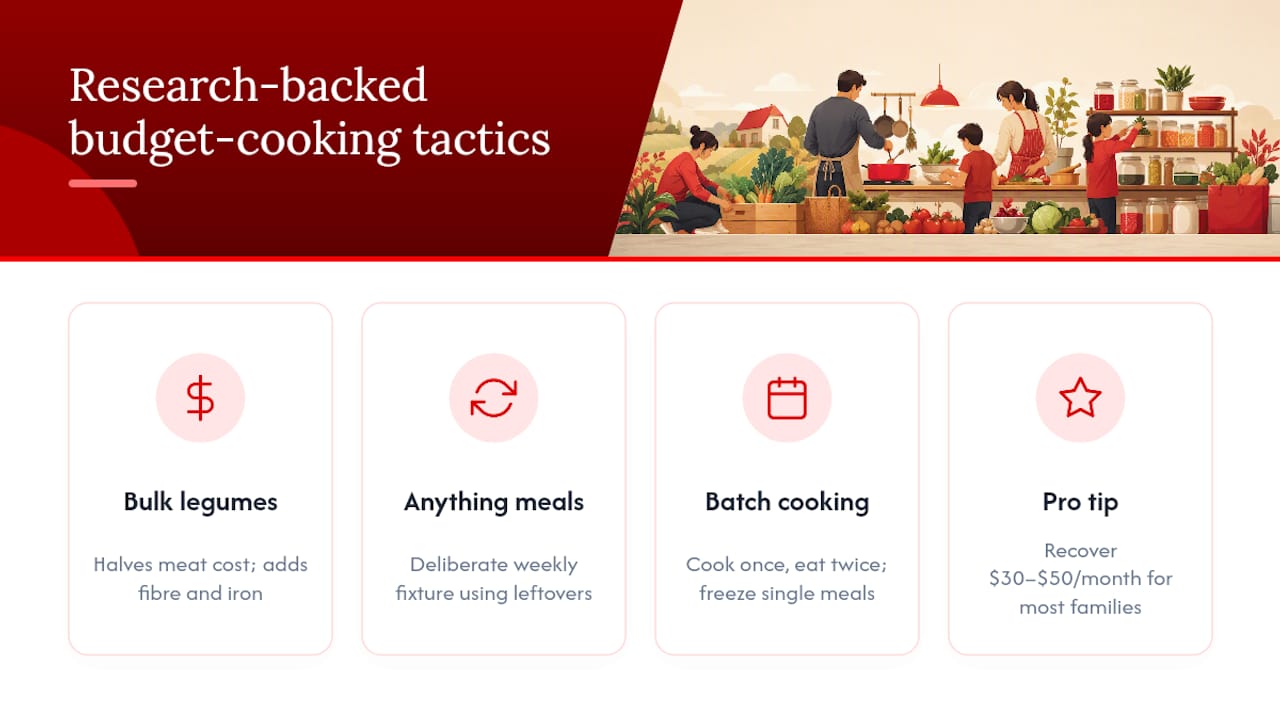
Bulking meat with legumes reduces cost per serving without reducing protein or satiety. A 50/50 blend of ground beef and cooked lentils in a chili or taco mix cuts the meat cost by roughly half while adding fibre and iron.
"Anything meals" (frittatas, stir-fries, DIY pizza nights) convert odds and ends into an appealing dinner without extra shopping. Experienced families treat these as a deliberate weekly fixture, not a sign of a bare fridge.
Planned batch cooking reduces takeout spending across the month. Cooking once to eat twice, then freezing the remainder in single-meal portions, preserves per-serving economics even on weeks when time is short.
Budget-cooking experts note that small shifts, like bulking meat-based meals with legumes and repurposing leftovers, save time and money more reliably than hours of complex scratch cooking. The goal is not perfection; it is a repeatable system that holds up on a tired Wednesday evening.
— NYT Cooking
Pro Tip: If time is genuinely short, focus on just two habits: batch-cook one protein on the weekend and keep one "anything meal" night per week. Those two changes alone can recover $30–$50 a month for most families.
A perspective on what actually moves the needle
There is a version of budget cooking advice that sounds thorough but quietly sets families up to fail. It involves elaborate weekly spreadsheets, 12-step meal plans, and the implicit assumption that the person doing the cooking has two free hours on Sunday afternoon and a deep enthusiasm for soaking beans.
Most families do not have that. What they have is a Tuesday evening, two tired adults, and three children with conflicting opinions about dinner.
The advice in this guide is built around that reality. The 3-3-3 rule, the "anything meal" night, the 50/50 lentil-and-meat swap: none of these require culinary skill or significant time. They require a decision made once, at the planning stage, so that execution on a weeknight is almost automatic.
The deeper truth is that the biggest savings in a family food budget rarely come from finding a cheaper ingredient. They come from reducing the number of times a tired family defaults to an unplanned, expensive decision. A $3 bag of lentils sitting in the pantry saves nothing if nobody thought to use it. The plan is the product.
Hellcrustpizza is a smart fallback for busy family nights
Cooking every single meal at home is a worthy goal, and this guide gives you the tools to get close. But there will be nights when the plan falls apart, the batch-cooked chicken is gone, and nobody has the energy to improvise. That is exactly when a well-timed takeout order makes sense, provided it fits the budget.

Hellcrustpizza's family pizza bundle deals and Mix & Match specials are crafted to feed a family without the per-person cost of a full restaurant order. The Biga multigrain, additive-free dough means you are not trading nutrition for convenience. App-exclusive offers and coupons and deals bring the per-serving cost down further, making an occasional order a genuine budget-conscious choice rather than a splurge. Check the coupons page before you order and stack whatever deal applies to your family size.
Disclosure: this is a brand mention. For budget goals, occasional takeout works best as a planned fallback, not a weekly default.
Sources
- NYT Cooking — grocery shopping and budget advice
- Nutrition
- GroceriesTracker — free meal budget planner
- Budgetfoodplanner
- The Thrifty Family — stretch healthy meals for large families
Check your provincial government's website for local nutrition supplements, community kitchen programmes, and farmers market discount initiatives specific to your region.
This article is general information, not a substitute for advice from a qualified financial advisor. Consult a qualified financial professional about your own circumstances before acting on anything here.