
The initial franchise fee is a one-time purchase of rights, training, and onboarding, paid once at signing. The royalty fee is the recurring cost, usually a percentage of gross sales, and it's the number that shapes your profitability for as long as you run the business. Get the upfront fee wrong and you overspend once. Get the royalty structure wrong and you feel it every single month.
TL;DR:
- A higher upfront franchise fee often indicates more comprehensive support during launch, benefiting first-time owners seeking hand-holding.
- Royalties usually range from 4% to 8% of gross sales, with Ontario data showing averages around 5.3% to 5.8%, depending on the industry.
- A minimum royalty floor can stabilize franchisor revenue but may increase franchisee costs during slow sales periods, so negotiate these clauses carefully.
- When comparing fees, model your projected earnings, break-even timeline, and support level to determine the best value for your specific situation.
- Always verify actual service costs paid with detailed, audited marketing spend reports and consult a franchise lawyer before signing any agreements.
Table of Contents
- Franchise fee vs royalty: definitions and timing
- What each fee actually pays for
- Where to find these fees in the Franchise Disclosure Document
- How to weigh a higher fee against a lower royalty
- Calculating your monthly royalty payment: a worked example
- Negotiation points and red flags in the fine print
- What transparent disclosure looks like in practice
- How should you prioritize fees when choosing a franchise?
- Sources
- FAQ
Franchise fee vs royalty: definitions and timing
The initial franchise fee is a one-time payment made when you sign the franchise agreement. It buys the licence to use the brand, initial training, operations manuals, and often a reserved territory. In some systems, it also covers pre-opening support from a franchise development team walking you through site selection.
The royalty fee is different in nature entirely. It's a recurring payment, typically due weekly or monthly, that keeps you licensed to use the brand and keeps ongoing support flowing your way. Most franchisors calculate it as a percentage of gross sales, though some use a flat fee, and a smaller number use a hybrid of both.
Royalties rarely travel alone. Expect these companions in most agreements:
- Marketing fund contributions — usually 1% to 3% of gross sales, pooled for national or regional advertising
- Technology fees — flat monthly charges for point-of-sale systems, ordering apps, or franchise management software
- Audit fees — charged if the franchisor finds underreported sales during a compliance review
What each fee actually pays for
Franchisors split costs into two buckets because the work itself splits into two phases. The initial fee funds everything tied to getting you open: onboarding, initial training, manuals, and often hands-on help with your first site. Royalties fund what continues after opening day.
Ongoing royalty dollars typically go toward:
- Field coaching visits and operational troubleshooting
- Research and development on new menu items or service offerings
- National marketing campaigns and brand-standard enforcement
- System-wide technology upgrades
Why split it this way? A franchisor needs capital up front to build training programs and territory maps, but it needs a steady incentive to keep supporting franchisees for years afterward. A purely fee-based or purely royalty-based model creates a weak spot, either starving the franchisor's launch budget or leaving long-term support underfunded. The two-fee structure aligns both sides.
Pro Tip: Before you sign anything, ask the franchisor to list, in writing, exactly which services your royalty dollars fund this year. If the answer is vague, that's your answer.
Where to find these fees in the Franchise Disclosure Document
Every legitimate franchise system in Canada and the US discloses its cost structure in a standardized document. You don't need to guess where to look.
- Item 5 of the Franchise Disclosure Document lists the initial franchise fee and confirms whether it's refundable under any circumstances
- Item 6 lists royalties, marketing fund contributions, technology fees, and every other recurring charge tied to the system
Benchmark ranges vary a lot by sector, so treat any single number with caution. Initial fees for food service systems commonly land in the $35,000 to $75,000 range, while royalties across many categories run 4% to 8% of gross revenue.
Regional data from Ontario shows average royalty rates closer to 5.3% to 5.8%, with average upfront fees in the mid $20,000 to mid $30,000 range depending on the province and industry. Food service tends to skew toward higher upfront fees and comparatively lower royalty percentages, while service-based franchises often show the reverse pattern.
Provincial disclosure timelines differ across Canada, so confirm the exact waiting period your province requires before signing.
How to weigh a higher fee against a lower royalty
Don't fixate on the headline numbers. Run the math before you sign anything.
Work through this checklist:
- Level of pre-opening support — site selection help, supplier negotiation, a real training curriculum versus a binder and a webinar
- Projected break-even timeline — ask the franchisor for their own median break-even estimate, then stress-test it against a slower ramp
- Expected earnings after royalties and marketing fees — model your EBITDA net of every recurring charge, not just the royalty percentage
As a rule of thumb, a higher initial fee often signals a franchisor investing more in your launch, which can suit a first-time owner who wants hand-holding. A lower fee with a higher royalty can favour an experienced operator confident in hitting volume fast enough to make the percentage irrelevant.
Bring three questions to the franchisor: What's the median franchisee revenue, split by percentile? What exactly does the marketing fund pay for, with receipts? Is there a minimum royalty floor regardless of sales? Then bring three more to existing franchisees: Does support actually show up when you call? Would you sign this agreement again? What surprised you most in year one?
Pro Tip: Ask for the revenue distribution across the system, not just the average. A median, 25th, and 75th percentile breakdown tells you far more than a single flattering number ever will.
Calculating your monthly royalty payment: a worked example
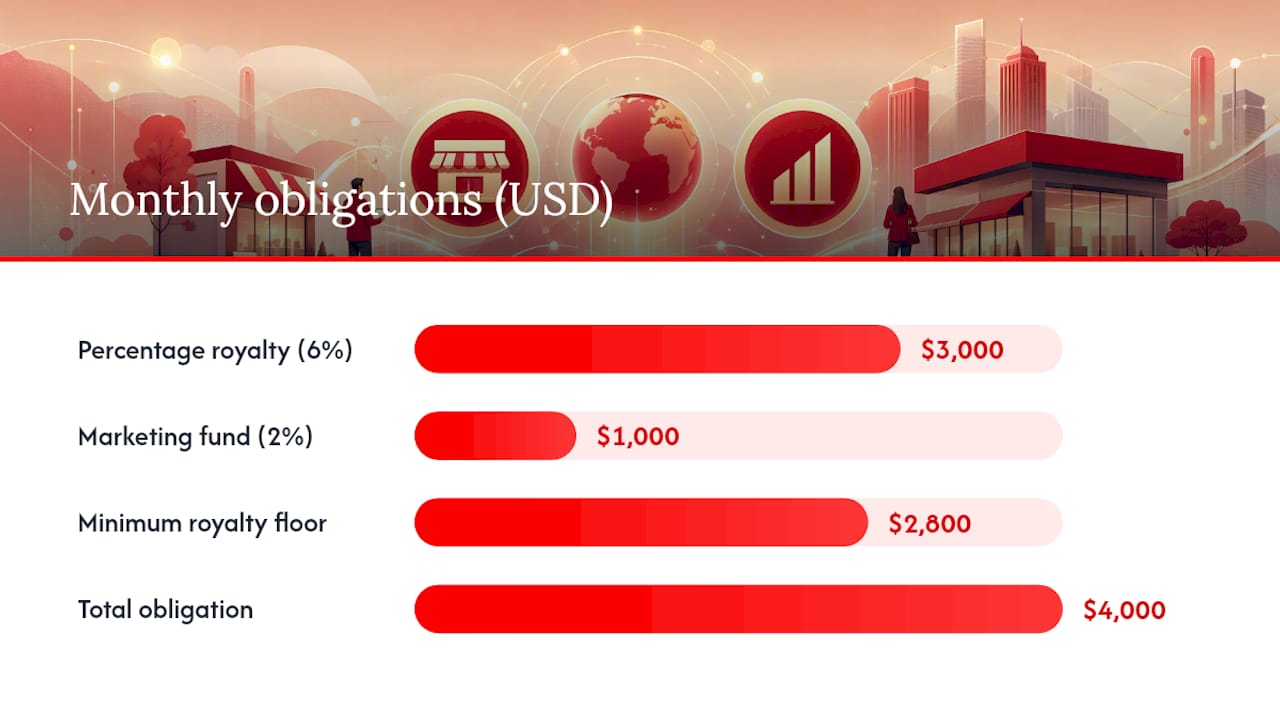
Say a franchise projects $600,000 in annual gross sales, with a 6% royalty and a 2% marketing fund contribution.
- Monthly royalty: $600,000 ÷ 12 × 6% = $3,000
- Monthly marketing fund: $600,000 ÷ 12 × 2% = $1,000
- Total monthly obligation: $4,000, or $48,000 annually
Now stress-test it. But if your agreement includes a minimum royalty floor, say $2,800 a month regardless of sales, that floor kicks in and you're paying more than the percentage would otherwise require during a slow stretch.
That single clause changes your break-even math entirely. A minimum royalty floor stabilizes revenue for the franchisor but can strain cash flow for a franchisee going through a slower season, which is exactly why it belongs on your negotiation checklist, not just your spreadsheet.
Negotiation points and red flags in the fine print
A few clauses deserve extra scrutiny before you sign.
- Minimum royalty clauses that charge you a floor amount even when sales fall short
- Vague marketing fund language that doesn't specify how contributions are spent or audited
- Undisclosed or escalating technology fees added after the agreement is signed
- Punitive audit or penalty clauses that impose steep charges for minor reporting errors
You have more room to negotiate than most first-time buyers assume. Phased royalty schedules (lower rates in year one, standard rates after) are common asks. Multi-unit discounts on the initial fee exist in many systems. Documented, itemized marketing fund reporting is a reasonable request, not an aggressive one.
Before signing, ask for audited brand-level marketing spend, speak with three to five current franchisees outside the ones the franchisor recommends, and hire a franchise lawyer to read the agreement line by line. A single clause buried in Item 6 can cost you thousands over a ten-year term. Our pizza franchise requirements breakdown walks through what documentation to expect at this stage.
What transparent disclosure looks like in practice
At Hellcrust Pizza, we've built our approach to franchising around the same craft philosophy that shaped our Biga multigrain dough: nothing hidden, nothing rushed. Our franchise opportunities page lays out what a franchisee can expect to review, and we encourage every prospective owner to treat our disclosure the same way they'd treat any franchisor's: cross-check every claim against Item 5 and Item 6 of the FDD, and talk to current franchisees before you commit a dollar.
Territory questions come up often, and our territory protection breakdown covers what a reserved territory typically includes. Publisher-provided materials, ours included, are a starting point for due diligence. They're never a substitute for legal review.
How should you prioritize fees when choosing a franchise?
Weigh demonstrable support and real unit economics ahead of any headline number. A low initial fee paired with weak training or a high, uncapped royalty is often a warning sign dressed up as a bargain. A higher upfront fee can be worth paying when it buys genuine hand-holding through your first year. Always get a lawyer's eyes on the agreement, and always talk to franchisees who've lived with the numbers you're only reading about.
Sources
For deeper detail, The Franchisor Blueprint covers benchmark royalty and fee ranges. Lusthaus Franchise Law explains FDD disclosure rules in plain terms. The UPS Store Canada offers a clear definitions primer, and if you're modelling your own investment, our financing guide with a 6 to 12 month cash buffer is worth reading alongside the worked example above.
- Franchise fee vs. royalty | The Franchisor Blueprint
- Initial franchise fee vs royalty fee: What’s The Difference? | Lusthaus Franchise Law
FAQ
What is a good royalty fee for a franchise?
There's no universal "good" number since it depends on sector and support level, but many franchise categories fall in the 4% to 8% range. A royalty at the low end paired with weak ongoing support can be a worse deal than a higher royalty backed by real coaching and marketing muscle.
What's a normal franchise fee?
Initial fees vary widely by sector, but food service systems commonly charge $35,000 to $75,000. Remember this fee alone rarely covers your full startup cost. Equipment, leasehold improvements, and working capital often push the total investment well beyond the fee itself.
What is a 5% royalty in business?
Your monthly royalty payment depends on your actual gross sales, royalty percentage, and any additional fees like marketing fund or technology charges. Calculating these amounts helps you understand your ongoing costs based on your specific sales figures.
What does a royalty fee mean?
A royalty fee is the ongoing payment a franchisee makes to keep using the franchisor's brand, systems, and support after opening. Unlike the one-time initial franchise fee, it recurs for the life of the agreement and typically scales with your sales volume.