
If you want proven systems, brand recognition and a support network to lean on, franchising is likely your better route. If you have real kitchen experience, a distinct concept and the appetite to build every process yourself, independent ownership offers full control and potential financial upside. The trade-off comes down to this: franchise fees provide structure and reduce uncertainty, while independence trades that safety net for greater creative freedom and keeping all the profits.
TL;DR:
- Franchising generally involves higher initial costs due to fees and mandated build-outs but offers lower failure risk through tested systems.
- Independent ownership can be cheaper upfront, but entails higher risk and requires building supply chains, marketing, and operations from scratch.
- Franchise fees often total 6 to 14 percent of gross sales annually, while independents save on royalties but pay more for supplies without group discounts.
- Analyzing franchise disclosure documents and consulting legal counsel before signing is essential to understand territory rights, termination clauses, and obligations.
- HellCrust Pizza offers a proven concept with specialized dough and app-based ordering, suitable for owners seeking a franchise with established product and support.
Table of Contents
- Comparing costs, risk, control and growth potential
- What it really costs to open each type of restaurant
- Understanding franchise disclosure and contract terms
- How training, suppliers and marketing differ day to day
- A practical checklist for deciding which path fits you
- HellCrust Pizza's franchise path for prospective owners
- A quick read on which owner type fits which path
- Ready to explore franchising with HellCrust Pizza?
- Where these figures come from
- Sources
- FAQ
Comparing costs, risk, control and growth potential
Numbers tell most of the story here, but the context around them matters just as much.
| Factor | Franchise | Independent |
|---|---|---|
| Initial investment | Often higher upfront due to franchise fees and mandated build-outs | Can be lower with careful equipment choices |
| Ongoing costs | Royalties and marketing fees, typically 6–14% of gross sales combined (QSR Pro) | No royalty structure, but no shared purchasing power either |
| Failure risk | Generally lower, supported by tested systems (QSR Pro) | Higher, with independent closures reported to be significantly elevated within five years in some analyses |
| Operational support | Training, supply contracts and marketing provided by the franchisor | Owner builds every system from scratch |
| Creative control | Limited to franchisor guidelines | Full control over menu, branding and pricing |
| Scalability | Proven playbook makes multi-unit growth more predictable | Growth depends entirely on the owner's capital and systems |
Franchising suits someone who values a track record over experimentation, while independence suits an owner who already knows how to run a kitchen and wants the freedom to prove it their own way.
- Franchise pros: brand recognition, structured training, group purchasing power.
- Franchise cons: ongoing fees, limited menu flexibility, franchisor oversight.
- Independent pros: full creative control, no royalty payments, direct customer relationships.
- Independent cons: higher failure risk, no built-in support network, slower brand-building.
What it really costs to open each type of restaurant
Startup costs vary widely, so treat any figure as a planning range rather than a guarantee. ISED's industry benchmarks offer a sanity check on revenue and expense ratios once you are comparing real numbers against your own projections.
- Franchise royalties typically run 4 to 8% of gross sales, with marketing fees adding another 2 to 6%, for a combined range of roughly 6 to 14% (QSR Pro).
- Independent owners skip those fees but often pay more per unit for food and supplies without group buying power.
- Choosing non-branded equipment and a simpler layout can save an independent owner an estimated $15,000 to $40,000 compared to a franchisor's mandated equipment list (QSR Pro).
Franchise or independent, lenders want to see a cash buffer covering three to six months of operating expenses before they take your application seriously. A broker can help you compare terms across multiple lenders when your own banking relationship falls short.
Understanding franchise disclosure and contract terms

Before you sign anything, know what the law requires and what the contract actually says. Under the Arthur Wishart Act and similar provincial rules, a franchisor must give you a disclosure document, generally at least 14 days before signing, that includes financial statements, litigation history and a list of current and former franchisees (Ontario). Provincial coverage varies, so confirm what applies where you plan to operate.
Once the disclosure document is in hand, focus your review on the terms that shape your day-to-day reality:
- Territory protections and whether they extend to digital or delivery channels, covered in more detail in our piece on franchise territory protection.
- Termination and transfer conditions, including what happens if you want to sell.
- Mandatory suppliers, required spend commitments and dispute resolution procedures.
Pro Tip: Hire an independent franchise lawyer before you sign, and ask for the current franchisee contact list early so you can hear the unfiltered version of what ownership is like.
How training, suppliers and marketing differ day to day
A franchisor typically hands you a playbook. An independent owner has to write one.
- Franchisors usually provide structured training, documented standard operating procedures, negotiated supply contracts and national marketing campaigns.
- Franchisors also impose constraints, including fixed menus and approved supplier lists that limit how much you can experiment or negotiate on price.
- Independent owners must build their own local marketing, their own SOPs and their own supplier relationships from the ground up, which demands broader operational skill early on.
- Group buying power matters because it lowers food costs at scale, a real margin advantage that independents can only replicate by growing large enough to negotiate similar volume.
A practical checklist for deciding which path fits you
Answer these questions honestly before you commit capital:
- Do you have hands-on restaurant experience, or would you benefit more from a tested system?
- How much capital can you access, and how long can you sustain the business before it turns a profit?
- Are you building toward multiple locations, or do you want one restaurant that reflects your own vision?
- How much oversight are you willing to accept in exchange for lower risk?
Watch for red flags in any franchise sales process: pressure to sign quickly, a missing or incomplete disclosure document, or growth claims you cannot verify with existing franchisees. Whichever path you lean toward, talk to current operators, request a realistic financial model, and bring both an accountant and a lawyer into the conversation before you sign.
HellCrust Pizza's franchise path for prospective owners
HellCrust Pizza built its concept around specialized dough and app-driven ordering that keep customers coming back, and that same foundation extends into its franchise offering. For an operator who wants a proven pizza concept rather than a blank slate, that combination of product consistency and repeat-order technology carries real weight.
- A dough process and menu system developed for delivery and takeout.
- App-based ordering infrastructure to support business operations.
- Franchise details and next steps available on the HellCrust Pizza franchising page.
Operators considering multi-unit growth may also want to read our take on multi-unit franchise ownership before scaling beyond a first location.
A quick read on which owner type fits which path
Three archetypes, three answers: the first-timer wanting structure fits franchising, the seasoned chef-operator with a distinct vision fits independence, and the ambitious builder often does both, using a franchise to learn the systems before launching a concept of their own.
— jaskirat Singh
Ready to explore franchising with HellCrust Pizza?
If the idea of a proven pizza concept with built-in repeat ordering appeals to you, HellCrust Pizza's franchise information pack lays out the basics: what qualifies a candidate, what the investment looks like, and what support comes with it.
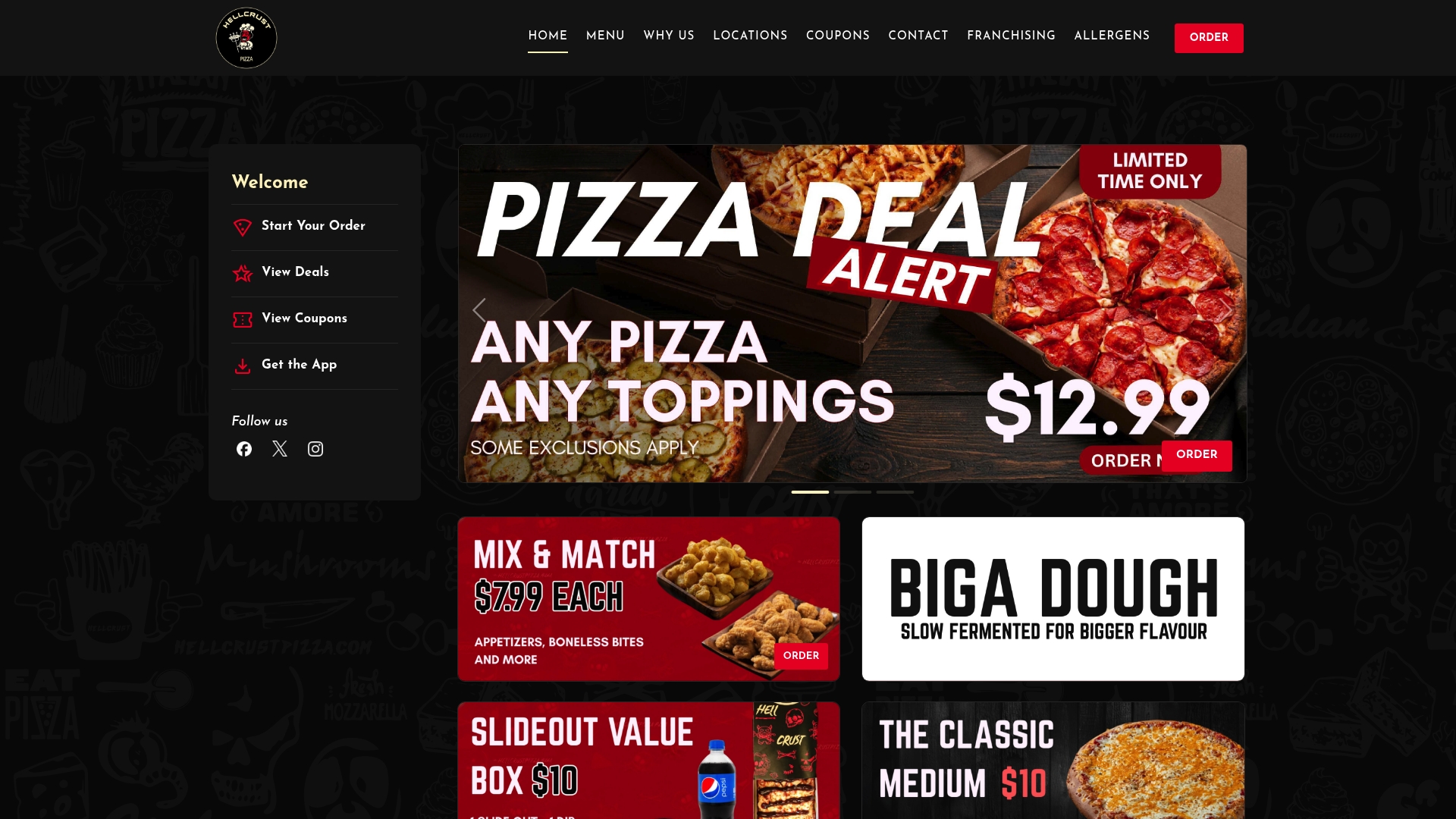
Before you request a pack, it helps to know what pizza franchise ownership actually demands day to day, covered in our guide on pizza franchise requirements. Franchisors that invest in brand recognition give new owners a head start that an independent concept has to build from zero.
- Review the HellCrust Pizza menu to understand the product line you would be franchising.
Where these figures come from
- ISED Canadian industry statistics for restaurant sector benchmarks.
- Ontario's franchising information page for disclosure law.
- Barchart's franchise industry coverage for franchisor support commentary.
Sources
- 'Really scalable': Franchise industry players share what it takes to succeed
- Full-service restaurants and limited-service eating places - 7225 - Financial performance - Canadian Industry Statistics
- Ontario
FAQ
Is it better to open a franchise or your own business?
It depends on your experience and priorities: franchising suits owners who want proven systems and lower failure risk, while independent ownership suits those with hospitality experience who want full creative control and every dollar of profit (QSR Pro). Neither model guarantees success, so your own capital, skills and market fit still decide the outcome.
What is the difference between a chain restaurant and an independent restaurant?
A chain restaurant operates under a shared brand, standardized menu and often a franchise agreement with centralized supply and marketing support, while an independent restaurant is owned and operated with no obligation to a larger brand's systems or fees. That independence means full menu and pricing control, but also no shared purchasing power or national marketing budget.
What are the three types of franchises?
Franchise structures generally fall into product distribution, manufacturing and business format franchises, with restaurant franchising almost always following the business format model that includes a full operating system, branding and ongoing support. Definitions can vary slightly by industry source, so confirm the terminology used in any disclosure document you receive.
What is the Arthur Wishart Act and why does it matter?
The Arthur Wishart Act is Ontario's franchise disclosure law requiring franchisors to give prospective buyers a disclosure document, generally at least 14 days before signing, containing financial details, litigation history and a list of current and former franchisees (ontario.ca). Similar disclosure obligations exist in some other provinces, so always confirm which rules apply where you plan to operate.
How much does it cost to buy a HellCrust Pizza franchise?
HellCrust Pizza does not publish franchise investment figures directly, so prospective buyers should request a current information pack through the franchising page for exact costs and terms. That pack outlines qualification basics and next steps for anyone ready to move forward.