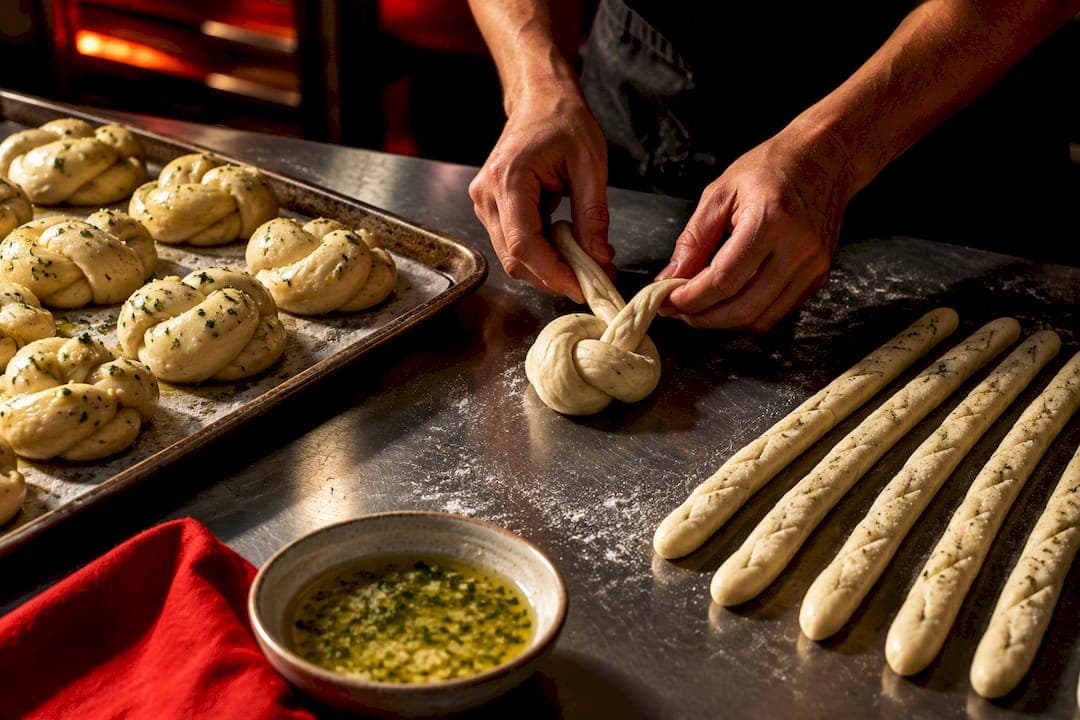
Pick garlic knots when you want a rich, buttery bite that feels like part of the meal. Pick breadsticks when you want something leaner to clean the palate between courses. The difference comes down to dough: knots are made from an enriched dough that soaks up garlic butter, while breadsticks come from a lean dough built for crunch, not absorption.
TL;DR:
- Garlic knots, made from enriched dough, absorb garlic butter and are softer and more indulgent than lean-dough breadsticks, which are crisper and drier.
- Knots are typically season after baking and paired with richer dips like marinara, while breadsticks are seasoned before baking and suited for dipping into thicker sauces.
- Both sides can be calorie-dense due to added fats and sodium, so requesting lighter coatings or sharing portions can help maintain a balanced diet.
- Making either at home requires specific shaping, seasoning, and reheating techniques to preserve their texture and flavor.
- Many restaurants prefer knots for ingredient efficiency, using leftover dough and applying butter and herbs post-baking to enhance flavor and appearance.
Table of Contents
- Garlic knots and breadsticks compared at a glance
- Why dough choice and shaping change the result
- How shape and surface area guide what you pair them with
- What garlic knots and breadsticks mean for your sodium and fat intake
- How to order the right one, and make a decent version at home
- Where HellCrust's dough philosophy fits into this comparison
- Craving one of these with your next order?
- Sources
- FAQ
Garlic knots and breadsticks compared at a glance
Garlic knots start life as strips of pizza dough, tied into a loose knot, baked, then tossed in garlic butter and often finished with grated Parmesan. The origin traces back to Brooklyn pizzerias, where cooks found a clever way to use up dough trimmings instead of tossing them. Breadsticks, by comparison, are straight lengths of lean dough, baked or sometimes fried, seasoned before or after baking, and served plain or with a light garlic brush.
The eating experience reflects that difference. A garlic knot is soft, a little chewy at the centre, and carries a rich, mature flavour from the butter that soaks into every fold. A breadstick snaps rather than yields, offering a crisp, dry bite that pairs well with something wetter on the plate.
- Garlic knots suit appetizer platters, shared starters, and anywhere you want a side that feels indulgent on its own.
- Breadsticks suit soups, salads, and dipping duty, where their job is to complement rather than compete.
- Portion-wise, two or three knots feel substantial, while breadsticks are often served in larger counts because they're lighter per piece.
Why dough choice and shaping change the result
The real divide between these two sides is not the shape. It's the dough underneath, and once you understand that, the rest makes sense.
Garlic knots are typically pulled from an enriched dough, one that includes fat and sometimes milk or egg, which gives the crumb a softer, more open structure. That softness is exactly what lets a knot absorb garlic butter without falling apart, and it's why a knot made from lean dough tends to turn greasy on the outside while staying tough in the middle. Enrichment is the reason a good knot feels indulgent rather than merely buttered.
Breadsticks, on the other hand, come from a lean dough, flour, water, yeast, and salt, with little or no added fat. That leanness is what gives breadsticks their structure and crackle. Industry reporting on pizzeria menus notes that breadsticks are frequently made from lean dough and can be prepared day-of, while knots often reuse dough already on hand, which is part of why operators favour knots as a way to stretch ingredients without sacrificing flavour.
Shaping finishes the story. A knot is tied, baked, then bathed in butter and herbs after it comes out of the oven, so the coating stays on the surface. A breadstick is often seasoned before baking, letting the seasoning bake into the crust rather than sit on top of it. Our breakdown of artisan dough types goes deeper into how these doughs behave under heat.

How shape and surface area guide what you pair them with
A knot's twisted shape creates folds and creases that trap butter, garlic, and cheese in every bite, which is exactly why it holds up next to something simple like marinara. A breadstick's straight, smooth surface has less to grip, so it works best as a tool for dipping into something with more body of its own.
- Pair garlic knots with marinara, a light tomato soup, or a simple green salad that won't compete with the butter.
- Pair breadsticks with creamy pastas, thicker soups, or a Caesar salad, letting the stick do the scooping.
- Finish knots with fresh Parmesan or herbs added after baking; finish breadsticks with a light garlic oil brushed before they go in.
Pro Tip: Add fresh herbs to garlic knots right after they come out of the oven, not before. Baking dulls delicate herbs like parsley, while a post-bake toss keeps their colour and brightness intact, a technique we cover in our notes on finishing herbs.
What garlic knots and breadsticks mean for your sodium and fat intake
Both sides are bread-based, and both can carry more sodium and saturated fat than they look like they should, especially once butter, cheese, and salt enter the picture. A buttered, cheese-topped breadstick can run notably calorie-dense, with one nutrient analysis entry showing a prepared garlic and Parmesan breadstick near 343 kilocalories per 100 grams, alongside meaningful fat and sodium.
Health Canada advises choosing foods with little to no added sodium or saturated fat where possible, and bread sides fall squarely into the category worth watching, particularly when butter and cheese are layered on generously.
A few swaps make a real difference without giving up the food you actually want:
Ask for garlic knots brushed lightly rather than soaked, or split a portion with someone at the table instead of finishing a full plate solo. For breadsticks, skip the extra cheese topping and let the dip carry the flavour instead. Treating either as a side dish, not a second entrée, keeps portions sensible.

How to order the right one, and make a decent version at home
Ordering well starts with reading the menu carefully. True garlic knots are usually described as tied, hand-shaped, or butter-brushed, since that shape and finish are what set them apart. Breadsticks are almost always listed plainly, sometimes with a garlic or Parmesan add-on, but rarely described as tied or knotted.
If you're making either at home, a few steps matter more than the recipe itself:
- Use a dough with added fat (butter, oil, or a touch of milk) if you're making knots. A lean pizza dough will bake dry and won't take on butter the same way.
- Shape knots loosely and let them rest 10 to 15 minutes before baking so the gluten relaxes and the tie holds its form.
- Bake breadsticks a shade longer than knots for the crack you're after, and season the dough before it goes in rather than after.
- Reheat knots wrapped in foil at a low oven temperature to keep them soft; breadsticks reheat better uncovered, so they stay crisp instead of turning soft.
- Store leftovers in a sealed container for a day or two, and butter knots fresh at reheating rather than storing them pre-buttered.
Ordering online or through an app makes it easier to spot these details up front, since most menus list preparation style alongside the item, a small convenience that online food ordering has made standard across the industry.
Where HellCrust's dough philosophy fits into this comparison
The menu is built around a Biga multigrain, artificial additive-free dough, a preferment that gives bread a rich, mature flavour before it meets any topping. This approach influences how the sides complement a shared pizza order, whether part of a Mix & Match combo or a family special. Our take on hand-tossed versus pan dough covers how these formulations carry through delivery.
— jaskirat Singh
Craving one of these with your next order?
If tonight's plan involves a side that earns its place at the table, the menu offers a full range of pizzas, pastas, and sides made in a wholesome way, crafted with multigrain dough rather than a shortcut version.

- Browse the full HellCrust menu for sides, dips, and combo deals.
- Order through the app for exclusive discounts and Mix & Match pricing.
- Pick up a family-sized special when you're feeding more than one appetite at the table.
Head over to the HellCrust Pizza menu and see what pairs best with tonight's order.
Sources
- Health Canada — applying the dietary guidelines: selecting foods with little to no added sodium or saturated fat
- Increase check averages with irresistible garlic knots, garlic bread, garlic breadsticks — Pizza Today
- Garlic knot — Wikipedia
- Fast foods, breadstick, soft, prepared with garlic and parmesan cheese — GetFoodFacts (USDA FDC-derived)
FAQ
What is the difference between garlic bread and garlic knots?
Garlic bread is typically a sliced loaf brushed with garlic butter and baked flat, while garlic knots start as tied strips of pizza dough that are baked, then tossed in garlic butter after cooking. The tying and post-bake coating is what gives knots their distinct texture and shape compared to a simple sliced loaf.
Can garlic knots be healthy?
Garlic knots can fit into a balanced diet when portioned reasonably and made with a light hand on butter and cheese. Health Canada recommends choosing foods with little added sodium or saturated fat, which applies directly to how knots are finished and how many you eat in one sitting.
Are garlic knots just pizza dough?
Garlic knots often start from the same enriched dough used for pizza, shaped into strips and tied before baking, which is part of why pizzerias sometimes use them to repurpose leftover dough from the day's orders. The garlic butter finish and knot shape are what turn that base dough into a distinct side rather than a plain crust.
Are breadsticks just pizza crust?
Breadsticks are usually made from a separate lean dough rather than repurposed pizza crust, formulated without the added fat found in enriched doughs. That leaner composition is what gives breadsticks their firmer bite and dry crunch, distinct from the softer chew of a pizza crust.