Additive-free pizza dough is defined by four ingredients only: flour, water, salt, and yeast, with no synthetic chemicals, dough conditioners, or artificial enhancers of any kind. This is the standard upheld by Neapolitan pizza tradition and increasingly by health-conscious bakers worldwide. Understanding what makes pizza dough additive free matters more now than ever, because industrial doughs routinely include compounds like potassium bromate, a synthetic oxidizer that Canada, the EU, India, and China have already banned. We believe that knowing exactly what goes into your dough is the first step toward eating food you can genuinely feel good about.
What ingredients are excluded to make pizza dough additive free?
Additive-free pizza dough excludes a specific class of ingredients: synthetic dough conditioners, chemical oxidizers, and artificial preservatives. These are the compounds that industrial bakeries rely on to speed up production and standardise texture across thousands of batches.
The most widely discussed excluded ingredient is potassium bromate. Potassium bromate is a synthetic oxidizer used for over a century to enhance gluten strength, elasticity, and volume in commercial dough. It works by accelerating gluten crosslinking and improving CO2 retention, which creates the chew and lightness you find in many restaurant pizzas. The problem is that its safety record is contested, and regulatory bans are expanding across Canada, the EU, India, and China, with jurisdictions like New York considering similar measures.
Beyond potassium bromate, additive-free dough also excludes:
- Emulsifiers such as DATEM (diacetyl tartaric acid esters of mono- and diglycerides), which soften crumb structure in industrial loaves
- Bleaching agents like azodicarbonamide, used to whiten flour and speed up gluten development
- Artificial preservatives such as calcium propionate, added to extend shelf life
- Refined sugars and oils beyond what a traditional recipe calls for, which alter fermentation behaviour and flavour
What does additive-free mean for health in this context? It means you are removing compounds whose long-term effects are still being studied, and replacing them with time and technique. That trade-off is the heart of the whole conversation.
Pro Tip: Read ingredient labels on store-bought pizza dough carefully. If you see anything beyond flour, water, salt, yeast, and occasionally olive oil, the dough contains additives.
How do traditional techniques create texture and flavour without additives?
Removing additives does not mean accepting inferior dough. It means the baker must do the work that chemicals used to do, and that work produces a noticeably better result.
The four pillars of great additive-free dough are flour quality, hydration, fermentation, and kneading. Each one compensates for the absence of synthetic conditioners in a different way.
-
Choose high-protein flour. Strong bread flour or "00" flour contains enough protein to form a well-developed gluten network without chemical assistance. The protein content directly determines how much structure the dough can build on its own.
-
Adjust hydration for your flour type. Organic flour absorbs water differently from conventional flour, requiring hydration adjustments of 2–5% to achieve proper texture and structure. Start at the lower end and add water gradually until the dough feels smooth and slightly tacky.
-
Ferment cold for at least 24 hours. Cold fermentation enhances flavour complexity, digestibility, and dough strength without any chemical additives. The slow enzymatic activity breaks down starches and proteins in ways that a two-hour room-temperature rise simply cannot replicate.
-
Knead thoroughly and rest patiently. Gluten develops through physical manipulation and time. A proper knead of 8–10 minutes followed by a rest period builds the elasticity that potassium bromate would otherwise provide artificially.
Organic flour's higher enzymatic activity also enhances browning and flavour development when the flour is fresh. This is why a well-made additive-free crust often has a more complex, slightly nutty flavour than its industrial counterpart. You get what you pay for in flour quality, and that investment shows up in every bite.
If you want to go further, the Biga preferment method takes cold fermentation a step further by pre-fermenting a portion of the flour before mixing the full dough. The result is a richer, more mature flavour and a crust with genuine depth.
Pro Tip: If you replace more than 30% of bread flour with whole wheat, gluten and elasticity drop noticeably. Compensate with a longer cold fermentation, which softens the bran and restores texture.
What are the health implications of additive-free pizza dough?
The health picture around additive-free dough is more nuanced than most food marketing suggests, and it is worth understanding clearly.
Scientific reviews show that many food additives are evaluated by authorities such as the FDA and EFSA for safety, and that removing them arbitrarily may decrease nutritional quality or increase food waste. That finding does not mean additives are harmless. It means the conversation is more complex than a simple "natural equals good" framing.
"Additive-free labels do not guarantee healthier foods. What matters is what replaces the additives and the overall nutritional profile of the product." Dietitians consistently make this point, and it is one that health-conscious eaters should take seriously. A pizza made with additive-free dough but loaded with processed toppings is not automatically a healthy meal.
Dietitians assert that "free-from" labels require careful ingredient assessment rather than simple label reliance. Consumer concern often arises from perceptions of "ultra-processed" foods and unfamiliar additives, which may not always reflect actual risk when those additives are properly regulated. The honest answer is that additive-free dough reduces your exposure to compounds with contested safety records, but it does not transform pizza into a health food on its own.
What it does do is give you full transparency. You know exactly what is in your dough. That transparency lets you make informed choices about fresh ingredients and toppings, which is where the real nutritional difference gets made. Choosing additive-free dough as a foundation, then pairing it with wholesome toppings, is genuinely a better dietary choice than starting with a chemically conditioned base.
How to make additive-free pizza dough at home
Making clean pizza dough at home is straightforward once you understand the principles. The process rewards patience more than skill.
What you need:
- Strong bread flour or "00" flour (high protein content is non-negotiable)
- Filtered or room-temperature water
- Fine sea salt
- Active dry yeast or fresh yeast (no instant yeast with added conditioners)
- Optional: a small amount of extra-virgin olive oil for flavour
Step-by-step process:
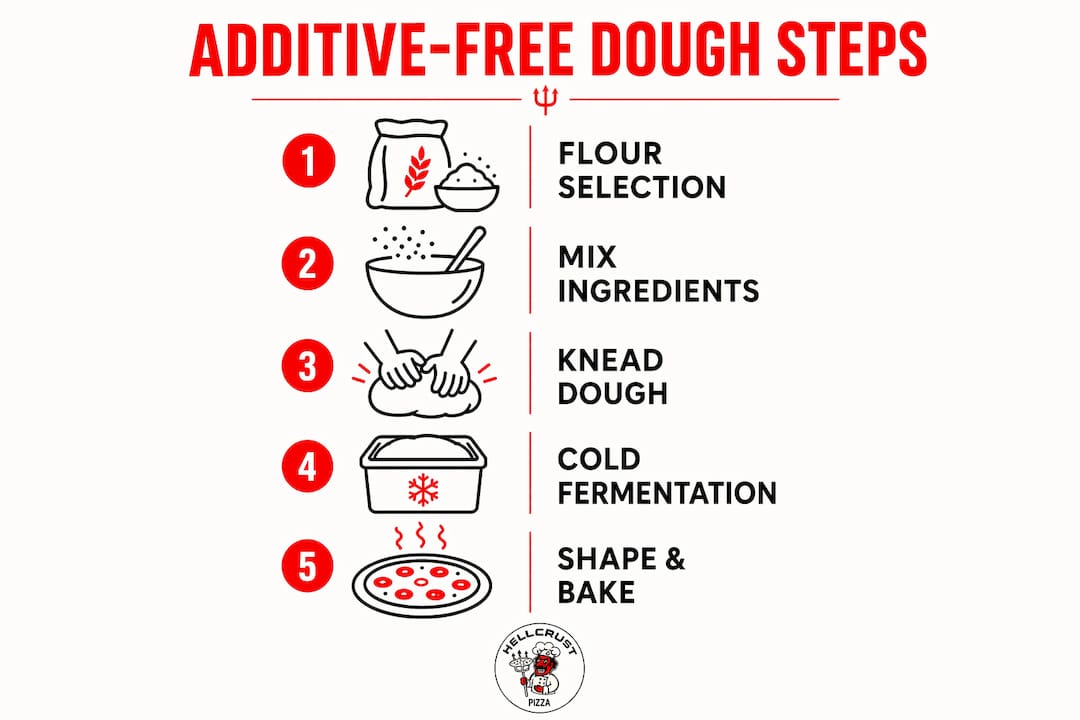
- Combine flour and salt in a large bowl. Dissolve yeast in water separately, then add to the flour gradually.
- Mix until a shaggy dough forms, then knead for 8–10 minutes until smooth and elastic.
- If using organic flour, adjust your hydration by 2–5% compared to a standard recipe, since organic flour absorbs water at a different rate.
- Shape the dough into a ball, cover tightly, and refrigerate for a minimum of 24 hours. Forty-eight hours produces an even richer result.
- Remove from the fridge 1–2 hours before baking to allow the dough to come to room temperature and relax.
- Bake on a preheated pizza stone or steel at the highest oven temperature your appliance allows, typically 250–280°C. The intense heat replicates the floor of a wood-fired oven and produces a properly blistered, crisp crust.
| Step | Key action | Why it matters |
|---|---|---|
| Flour selection | Use high-protein bread or "00" flour | Builds gluten without conditioners |
| Hydration | Adjust by 2–5% for organic flour | Prevents dense or sticky dough |
| Cold fermentation | Minimum 24 hours in the fridge | Develops flavour and digestibility naturally |
| Kneading | 8–10 minutes by hand | Creates elasticity without chemical oxidizers |
| Baking surface | Pizza stone or steel at maximum heat | Produces authentic crust texture |
Pro Tip: Weigh your ingredients rather than measuring by volume. A kitchen scale eliminates the single biggest source of inconsistency in home dough-making.
Key takeaways
Additive-free pizza dough requires only flour, water, salt, and yeast, and its quality depends entirely on technique, fermentation time, and flour selection.
| Point | Details |
|---|---|
| Four ingredients only | Authentic dough contains flour, water, salt, and yeast with no synthetic conditioners. |
| Potassium bromate is banned | Canada, the EU, India, and China have prohibited this common dough additive due to safety concerns. |
| Cold fermentation is the key technique | A minimum 24-hour cold ferment builds flavour and structure without any chemical assistance. |
| Additive-free does not mean automatically healthy | Overall nutritional profile and topping choices determine the health value of the finished pizza. |
| Organic flour needs hydration adjustment | Increase water by 2–5% when using organic flour to compensate for its different absorption rate. |
Why I think most people are asking the wrong question about additive-free dough
jaskirat Singh
Most of the conversation around additive-free pizza dough focuses on what is removed. I think that framing misses the more interesting point entirely.
The real story is what gets added back when you take the chemicals out: time, attention, and genuine craft. Cold fermentation does not just replace potassium bromate. It produces a dough that is categorically different in flavour, digestibility, and texture. The absence of additives forces you to slow down, and that slowness is where the quality lives.
I have spent time troubleshooting home-baked doughs that came out dense, gummy, or flat, and almost every failure traced back to one of two causes: impatience with fermentation or ignoring hydration adjustments when switching flour types. Neither problem has anything to do with additives. Both are solved by understanding your ingredients.
The evolving consumer awareness around "ultra-processed" foods is genuinely positive, but it can tip into anxiety that is not always proportionate to actual risk. Regulated additives in commercial dough are not the same as unregulated contaminants. The more useful question is not "does this contain additives?" but "do I understand and trust every ingredient in this dough?" Additive-free dough answers that question with a confident yes, and that transparency is worth something real.
Experimenting with fermentation times and flour blends is one of the most satisfying things you can do in a home kitchen. Start with a 24-hour cold ferment, taste the result, then push to 48 hours and taste again. The difference will tell you everything you need to know about why this approach matters.
— jaskirat Singh
Hellcrustpizza's commitment to additive-free pizza
At Hellcrustpizza, we built our dough around the same principles this article describes: no synthetic conditioners, no artificial preservatives, and no shortcuts. Our Biga multigrain dough uses a preferment process that delivers the rich, mature flavour and open crumb structure that only genuine fermentation can produce.

We know that choosing additive-free pizza is a values decision as much as a taste decision. That is why we pair our wholesome dough with fresh, customisable toppings and make the whole experience accessible through deals designed for real families and real budgets. If you want to savour what genuinely clean pizza tastes like without making it yourself, current coupons and deals make it easy to try Hellcrustpizza and taste the difference that honest ingredients make.
FAQ
What does additive-free pizza dough mean?
Additive-free pizza dough contains only flour, water, salt, and yeast, with no synthetic conditioners, bleaching agents, emulsifiers, or artificial preservatives. It relies on fermentation and technique rather than chemicals to achieve texture and flavour.
Is potassium bromate banned in Canada?
Yes. Canada, the EU, India, and China have all prohibited potassium bromate as a food additive due to safety concerns. Additive-free dough excludes it entirely by design.
Does additive-free dough taste different from regular pizza dough?
Additive-free dough fermented for 24 hours or more develops a noticeably more complex, slightly tangy flavour that industrial dough cannot replicate. The texture is also more open and chewy because gluten development happens naturally over time.
Is additive-free pizza automatically healthier?
Not automatically. Dietitians note that "free-from" labels require attention to the overall nutritional profile and what replaces the removed additives. Additive-free dough is a cleaner foundation, but topping choices and portion size still determine the meal's nutritional value.
Can I make additive-free dough with whole wheat flour?
Yes, but replacing more than 30% of bread flour with whole wheat reduces gluten and elasticity. A longer cold fermentation of 48 hours softens the bran and restores a workable texture without any chemical conditioners.