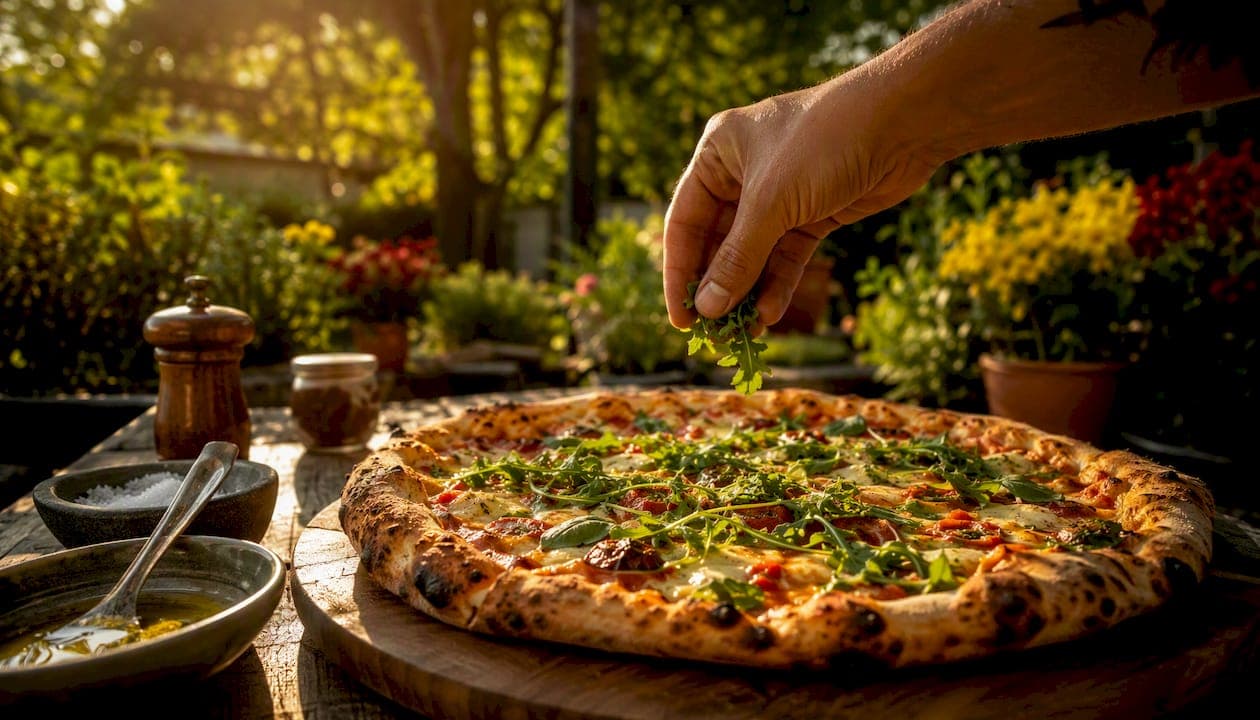
Add your fresh herbs after the pizza comes out of the oven. That single rule captures the role of fresh herbs on finished pizza better than any recipe ever could. Delicate leaves like basil and chives carry volatile aromatic compounds that evaporate almost instantly above 150°C, so the oven destroys the very thing you are trying to taste. A brief short rest on a board, a light drizzle of extra-virgin olive oil, and then your herbs — that sequence is the difference between a pizza that smells alive and one that smells like scorched grass.
Quick timing guide:
- Delicate herbs (basil, chives, parsley, dill, cilantro): always add after baking, once the cheese has just set
- Sturdy herbs (rosemary, thyme): can go on before or during the bake in small amounts; their woody structure survives heat
- Arugula: scatter immediately after slicing so residual warmth barely wilts the leaves
- Dried oregano: add before baking to enhance its flavor blooms its oils and deepens the sauce
Key takeaways
Fresh herbs belong on finished pizza, not in the oven — timing, preparation, and a drizzle of quality EVOO are the three levers that make the difference between a flat garnish and a genuinely aromatic finish.
| Point | Details |
|---|---|
| Add delicate herbs after baking | Basil, parsley, chives, and arugula go on post-bake to preserve volatile aromatics. |
| Rest before finishing | Wait 15–60 seconds after pulling from the oven before scattering herbs. |
| EVOO drizzle carries aroma | A light drizzle of extra-virgin olive oil binds aromatic compounds and slows evaporation. |
| Fresh-to-dried ratio | Use roughly three times more fresh herb than dried when substituting in a recipe. |
| Hellcrustpizza | Each pizza is made with fresh ingredients and additive-free Biga dough, finished to order. |
Table of Contents
- Which fresh herbs work on pizza, and what does each one bring?
- When to add fresh herbs: before, during, or after baking?
- How to prepare fresh herbs so they taste their best
- Why an EVOO drizzle makes fresh herbs taste even better
- Common mistakes when finishing pizza with fresh herbs
- Which herbs pair best with common pizza styles?
- A practical finishing routine you can repeat every time
- Hellcrustpizza brings the finished craft to your door
- Sources
Which fresh herbs work on pizza, and what does each one bring?
Knowing your herbs by flavour and heat tolerance is what separates a thoughtful finish from a random garnish. Here is a compact guide to the herbs most commonly used as fresh herbs pizza toppings, with notes on how each behaves.
| Herb | Flavour note | Best use | Fresh-to-dried ratio |
|---|---|---|---|
| Basil | Sweet, floral, faintly anise | Finish after baking | 3:1 (3 tsp fresh = 1 tsp dried) |
| Oregano | Earthy, peppery, robust | Sauce or pre-bake (dried); finish sparingly if fresh | 3:1 |
| Parsley | Bright, grassy, clean | Finish after baking | 3:1 |
| Thyme | Floral, slightly lemony | Pre-bake or finish (woody stems removed) | 3:1 |
| Rosemary | Piney, resinous, bold | Pre-bake in small amounts | 3:1 |
| Arugula | Peppery, bitter, fresh | Post-slice scatter | Use fresh only |
| Chives | Mild onion, delicate | Finish after baking | Use fresh only |
| Dill / Cilantro | Bright, citrusy, assertive | Finish after baking | 3:1 |
Fresh herbs are non-negotiable for finishing because drying strips the lighter, more volatile aromatic compounds that give basil its floral lift and parsley its clean brightness. Dried herbs are more concentrated in the heavier, heat-stable compounds, which is exactly why they perform so well in sauce and under cheese. When you do swap dried for fresh, use roughly one-third the volume of dried herb — a ratio consistently recommended across cooking guides.
When to add fresh herbs: before, during, or after baking?
Timing is everything when it comes to how herbs enhance pizza flavour. The oven runs at 230–290°C for a home bake, and most of the aromatic compounds in leafy herbs are gone within seconds at those temperatures. What you get instead is a bitter, darkened leaf that adds nothing pleasant to the slice.
The rule is straightforward: woody herbs tolerate heat, leafy herbs do not. Rosemary and thyme have protective cell structures and lower moisture content, so a short bake concentrates rather than destroys their character. Basil, parsley, and chives are mostly water and essential oil, and both evaporate fast.
| Timing | Herbs | Expected flavour outcome |
|---|---|---|
| Before baking | Dried oregano, rosemary, thyme | Bloomed, toasty, integrated into crust and sauce |
| During baking (last 2 min) | Thyme sprigs (sparingly) | Lightly wilted, warm herbal note |
| After baking (15–60 sec rest) | Basil, parsley, chives, arugula, dill | Bright, fresh, aromatic — full volatile impact preserved |
The brief rest after baking is the detail most home cooks skip. Dropping basil onto molten cheese immediately wilts it into a dark, slippery mess within moments. Waiting a short time lets the cheese firm slightly and the surface temperature drop enough that the herbs warm gently rather than cook. That window is where the aroma is preserved and the colour stays vivid green.
How to prepare fresh herbs so they taste their best
Preparation method matters almost as much as timing. Rough chopping bruises cell walls unevenly, releasing bitter compounds alongside the pleasant ones. Tearing basil by hand is the preferred approach: it ruptures cells cleanly, releases essential oils without excessive oxidation, and keeps the leaf pieces large enough to stay visually appealing on the slice.
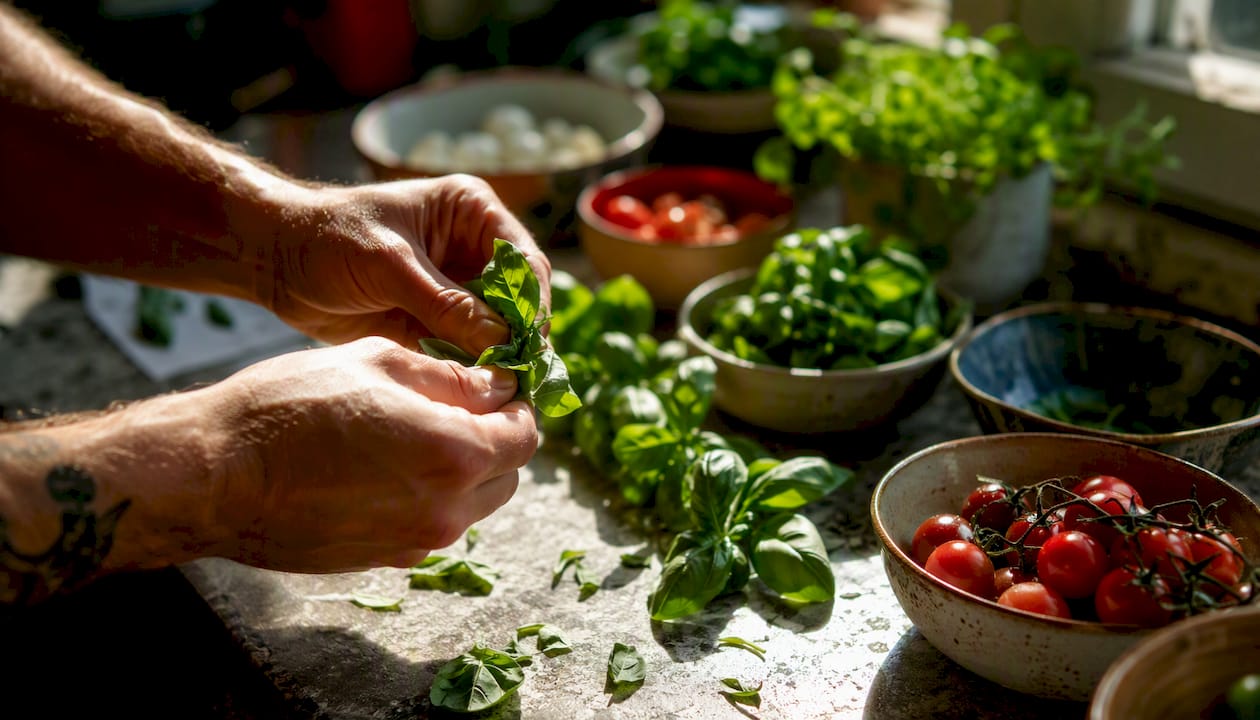
For herbs like parsley and chives, a clean, sharp knife chop is fine — their structure is more forgiving. Rosemary and thyme benefit from stripping the leaves from the woody stem before use; the stems themselves are fibrous and unpleasant to bite into.
A few practical prep notes:
- Chiffonade (stacking leaves and slicing into thin ribbons) works well for basil when you want even coverage across a large pizza; it looks elegant but should be done at the very last moment before serving to prevent browning
- Whole leaves are best for a rustic Margherita finish — they look intentional and release aroma as you bite
- Reviving limp herbs: submerge stems in cold water for 10–15 minutes; most leafy herbs recover their structure well
- Measure loosely: a small handful of torn basil (roughly 6–8 large leaves per pizza) is plenty; more than that tips from fragrant to overwhelming
Pro Tip: Prep your herbs while the pizza is in its final two minutes of baking. That way they are ready the moment the pizza rests, and you hit the finishing window without scrambling.
Why an EVOO drizzle makes fresh herbs taste even better
A light drizzle of quality extra-virgin olive oil over your finished herbs is not just a chef's flourish. Oil acts as both a protector and an aromatic carrier. The fat molecules bind to the volatile compounds released by torn herbs and slow their evaporation, which means more of that fragrance reaches your palate rather than drifting into the air above the pizza.
Practically, this means drizzling immediately after the brief rest, just before or just after scattering the herbs. Use a small amount — roughly one teaspoon across a 30 cm pizza — and choose an oil with genuine character. A grassy, peppery extra-virgin olive oil adds its own flavour dimension; a bland refined oil does not.
There is also a broader culinary benefit to the oil finish. Research on Pizza Napoletana composition shows that olive oil increases the bioaccessibility of certain compounds in pizza, including lycopene from tomato sauce, and contributes phenolic compounds of its own. The finishing step is good technique and, quietly, good nutrition.
Pro Tip: Add a pinch of flaky sea salt and a few turns of black pepper alongside the EVOO drizzle. Salt draws out moisture from the herbs, which amplifies their aroma in the first few seconds after serving.
Common mistakes when finishing pizza with fresh herbs
Most herb-finishing errors come down to impatience or excess. Here are the ones worth knowing:
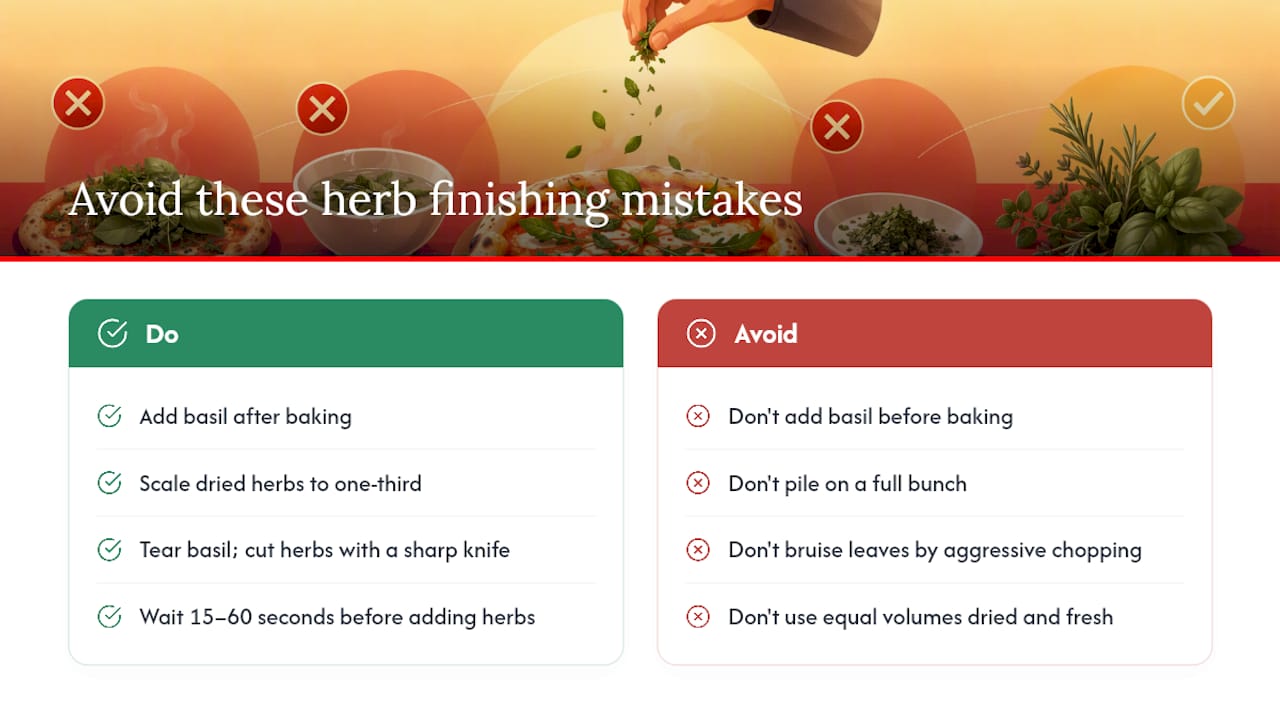
Adding basil before the bake. This is the most common mistake. Basil blackens within minutes in a hot oven, turning bitter and visually unpleasant. Always add it after baking.
Overloading with herbs. Fresh herbs are high-impact in small quantities. Piling on a full bunch of basil buries the cheese and sauce rather than complementing them. A few well-placed leaves do more than a generous fistful.
Aggressive chopping. Mincing basil or parsley with a dull knife bruises the leaves, releasing chlorophyll and bitter compounds. Tear basil by hand; use a sharp knife for parsley and chives, and cut with a single clean motion rather than rocking back and forth repeatedly.
Swapping dried herbs for fresh without adjusting quantity. Dried herbs are roughly three times more concentrated. Using the same volume of dried oregano as you would fresh results in an overpowering, medicinal flavour. Scale down to one-third the amount.
Skipping the rest window. Herbs added to a pizza straight from the oven wilt immediately. The 15–60 second rest is the fix — it costs nothing and makes a visible difference.
If you have already over-herbed a slice, a small squeeze of lemon juice or a few drops of EVOO can soften the intensity and bring the flavours back into balance.
Which herbs pair best with common pizza styles?
Pairing herbs to toppings is less about rules and more about contrast and harmony. Strong, fatty toppings need brighter, more assertive herbs or an oil carrier to cut through; mild toppings welcome subtler, more aromatic finishes.
- Margherita: torn basil leaves and a drizzle of EVOO are the classic finish; a little lemon zest over the basil adds unexpected brightness that lifts the whole pizza
- Pepperoni or sausage: flat-leaf parsley or fresh oregano cut through the fat; chives add a mild onion note without competing with the spice
- Mushroom or white pizza: thyme is the natural partner here, either pre-baked into the base or scattered fresh at the finish; goat cheese and thyme is a particularly well-matched combination
- Seafood pizza: dill and chives are the go-to finishers; cilantro works well if the toppings lean toward a lighter, citrus-forward profile
- Vegetarian: arugula scattered post-slice adds peppery bite and visual freshness; basil and parsley together work well on herb-forward vegetarian styles
One unconventional combination worth trying: basil with a few drops of lemon zest and a small amount of chilli flakes. The citrus amplifies the floral notes in the basil while the heat gives the finish a gentle edge. If you are growing your own supply, starting with basil and thyme at home gives you the two most versatile pizza herbs year-round.
A practical finishing routine you can repeat every time
This is the sequence we use, and it works whether you are pulling a pizza from a home oven, a pizza stone, or a cast-iron pan. The whole routine takes under 90 seconds.
- Pull the pizza from the oven and transfer it to a wooden board or cooling rack.
- Drizzle EVOO immediately — one thin pass across the surface.
- Wait 15–30 seconds. The cheese firms, the surface cools slightly, and the oil settles.
- Slice the pizza first, especially if you are adding delicate toppings like basil with prosciutto. Slicing after the herbs go on crushes them under the cutter.
- Scatter your herbs — torn basil, parsley, arugula, or chives, depending on the style.
- Finish with flaky salt and a second very light drizzle of oil if the pizza looks dry.
The 15–30 second window is the heart of this routine. It is warm enough that the herbs release their aroma on contact, but cool enough that they stay bright and intact. This sequence holds across oven types with only minor adjustments — a wood-fired pizza cools faster than a home oven bake, so you can shorten the rest to 10–15 seconds.
Hellcrustpizza brings the finished craft to your door
If you love the idea of a perfectly finished pizza but want to savour the result rather than manage the technique, Hellcrustpizza crafts every order with fresh, quality ingredients and an unwavering commitment to flavour from crust to finish. Built on an additive-free Biga multigrain dough, each pizza is made to be enjoyed as it arrives — aromatic, wholesome, and crafted with the same care this guide describes.

You can absolutely apply every finishing step in this guide at home. But when you want that same quality without the prep, Hellcrustpizza delivers it directly to you. Check out the full menu and exclusive app deals at Hellcrustpizza and place your order today.
Sources
- The Key Tip To Remember When Adding Fresh Herbs To Your Pizza
- Fresh Basil, Dried Oregano, and Herbs on Pizza: When and How | JayArr Pizza
- Nutraceutical properties and bioaccessibility of Pizza Napoletana marinara TSG
- Fresh herb pizza recipe (Food Network – Ree Drummond)
- 12 Best Herbs to Put on Homemade Pizza