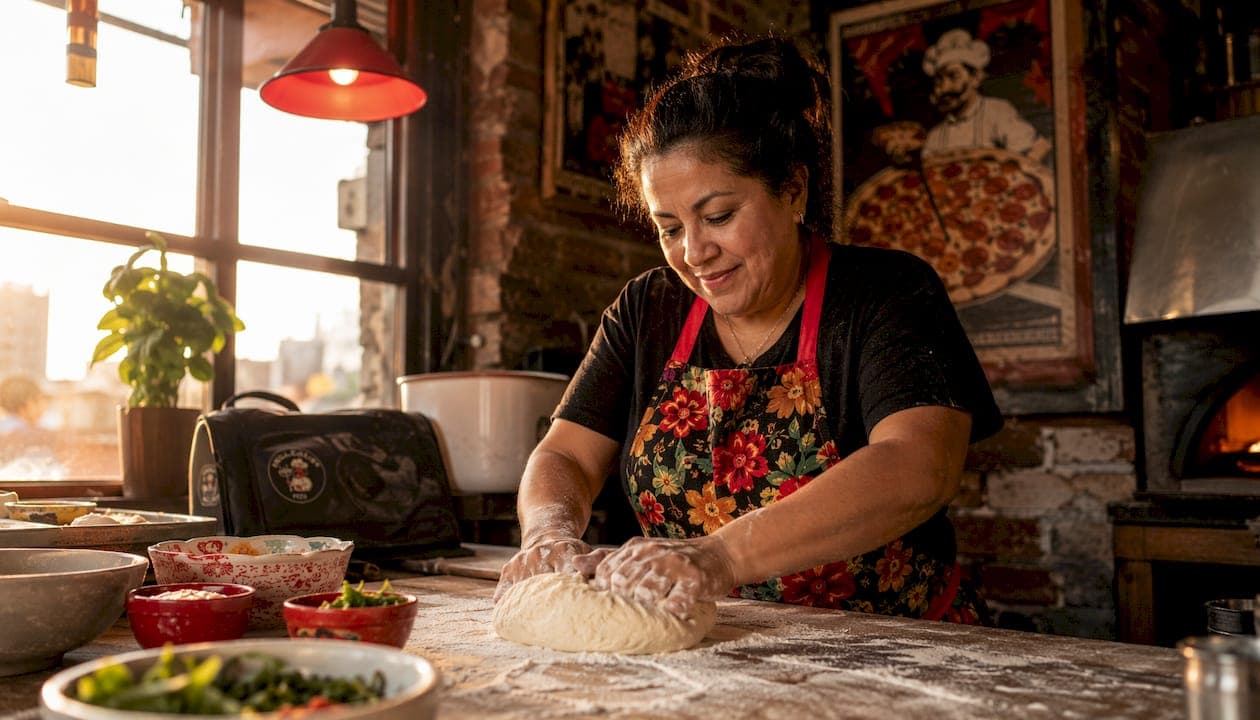
What makes artisan pizza dough different from the rest?
Artisan pizza dough is defined by three things: handcrafted technique, high-quality ingredients, and long, slow fermentation rather than industrial speed. The result is a crust with flavour depth, irregular bubbles, and a texture that mass-produced dough simply cannot replicate. If you have ever bitten into a pizza and wondered why it tasted so alive, so complex, the answer almost always lives in the dough.
The four main artisan dough styles you will encounter are:
- Neapolitan: Thin, charred, and blistered. Baked at 800–900°F in under two minutes. Soft and pillowy inside with a leopard-spotted crust.
- New York style: Slightly oily, foldable, and chewy. Baked at more moderate temperatures. Uses high-gluten flour and a longer fermentation.
- Canotto: Extremely high hydration, producing a dramatically puffed rim that resembles a small inflatable dinghy. Light and airy throughout.
- Biga: A preferment-based dough where a portion of flour, water, and yeast ferments separately before the final mix. Adds flavour complexity and dough strength, especially in multigrain formulations.
Each style sits at a different point on the hydration and fermentation spectrum. Neapolitan dough typically runs at moderate hydration with a short, room-temperature proof. Canotto pushes to very high hydration, demanding careful handling. Biga dough earns its character from the preferment stage, which develops acids and aromas that a straight dough cannot produce in the same timeframe. Understanding where each style sits on that spectrum is the foundation for everything else.
Table of Contents
- How hydration, fermentation, and ingredients shape every crust
- How to make artisan pizza dough at home
- The main artisan pizza dough styles, up close
- What Hellcrustpizza's Biga multigrain dough taught us about craft
- Key takeaways
- Hellcrustpizza brings artisan Biga dough to your door
How hydration, fermentation, and ingredients shape every crust
The texture you taste in a great artisan crust is not accidental. It is the product of deliberate choices about water, time, flour, and fat, each one pulling the dough in a specific direction.
Hydration and its effect on crumb
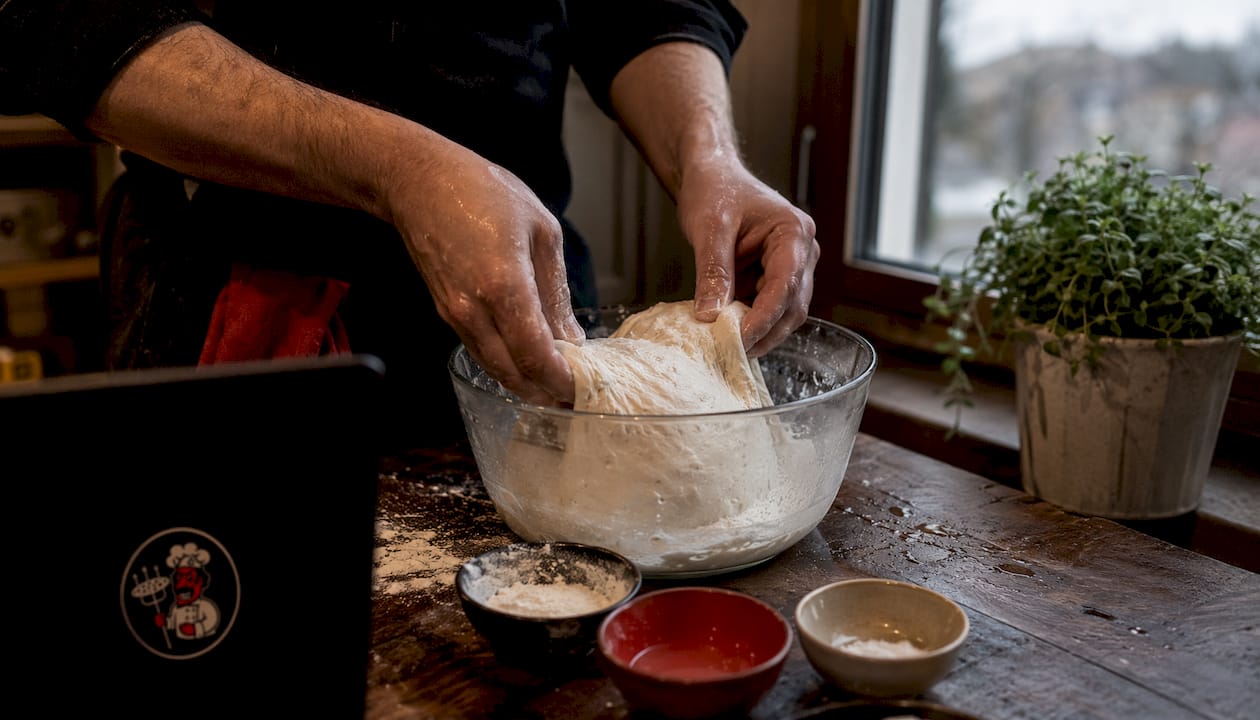
Hydration directly shapes crumb structure. Higher hydration doughs provide more water for starch to absorb during gelatinisation, producing a more developed gel and a softer, moister crumb. Doughs with high hydration yield that open, pillowy interior prized in pan-style and Canotto pizzas. Lower-hydration doughs produce a denser, crisper crumb because less water is available for the gel phase. The relationship is direct: more water, more steam in the oven, more expansion of air cells.
Crust texture also depends on protein content, starch gelatinisation, and temperature management between 50°C and 97°C. Starch granules begin absorbing water and swelling at around 50°C, locking the bubble network into its final shape as the crust sets. Push the oven temperature higher and you get faster lift, more char, and a crisper exterior shell, within typical artisan baking ranges.
Fermentation: the flavour engine
Long fermentation times of up to 48–60 hours improve dough extensibility and flavour complexity by breaking down gluten proteins and developing gas cells. The enzymes in the dough make it more extensible, so it stretches without snapping back and rises dramatically in the oven. A dough fermented for 48 hours at cold temperature will taste noticeably more complex than one proofed for two hours at room temperature. That complexity is not a marketing claim. It is the result of organic acids, esters, and carbon dioxide building up slowly in the gluten matrix.
Cold fermentation also keeps the alveoli (the hole structure) fine and even, which matters for styles like New York where you need a uniform crumb that folds cleanly without drooping.
The role of each ingredient
- Flour: Protein content is the single biggest variable. High-protein flours (12–14%) build stronger gluten networks suited to long fermentation and open crumb. 00 flour suits Neapolitan's extreme heat but is not mandatory for every artisan style. Bread flour at high hydration produces an excellent New York crust. Multigrain flours add fibre, mineral complexity, and a nuttier flavour profile.
- Water: As absorption increases, dough becomes more fluid and extensible, contributing to a larger crumb structure. Too much water collapses the cell walls during baking, so balance matters.
- Salt: Salt regulates fermentation rate and gluten toughness. Excess salt slows fermentation and toughens gluten, inhibiting cell expansion. Adjusting yeast levels compensates when salt is higher.
- Oil: Oil coats cell walls, improving gas retention and crumb texture. Some formulations omit fat entirely to alter crumb structure, which is why Neapolitan dough contains no oil while New York dough does.
- Sugar: Sugar feeds yeast activity during long fermentation periods, supporting consistent leavening without directly affecting cell structure.
Pro Tip: Adapt your hydration to your kitchen environment. On a humid summer day, reduce water by 2–3% to keep the dough manageable. In a dry Canadian winter, you may need to add a touch more to achieve the same extensibility. Artisan dough making relies on tactile feel and environmental adaptation more than rigid formulas.
How to make artisan pizza dough at home
Great artisan dough at home is absolutely achievable. The process rewards patience more than skill, and the steps below apply across Neapolitan, New York, and Biga-style doughs with the variations noted.
What you need
Ingredients:
- Strong bread flour or 00 flour (or a multigrain blend for Biga-style)
- Water (filtered or cold tap)
- Fine sea salt
- Active dry yeast or sourdough starter (or Biga preferment)
- Olive oil (for New York style; omit for Neapolitan)
Equipment:
- Digital kitchen scale (weight is more reliable than volume)
- Large mixing bowl
- Bench scraper
- Airtight dough containers or lightly oiled bowls with cling wrap
- Pizza stone or steel (strongly recommended for home ovens)
- Infrared thermometer (optional but useful)
Step-by-step process
- Autolyse: Combine flour and water (hold back the salt and yeast). Mix until no dry flour remains, then rest for 20–30 minutes. This allows the flour to fully hydrate and begins gluten development without mechanical effort.
- Add salt and yeast: Dissolve salt in a small amount of water, then add to the dough along with yeast. Mix thoroughly until incorporated.
- Develop the gluten: For high-hydration doughs, use the Bertinet method (slap and fold) rather than aggressive kneading. Avoid overworking high-hydration dough to preserve the open crumb structure. For lower-hydration doughs, a standard 8–10 minute knead works well.
- Bulk fermentation: Cover and ferment at room temperature for 1–2 hours, then transfer to the refrigerator for cold fermentation. For best results, allow 24–48 hours cold. For Biga-style, mix the preferment (70% flour, 45% water, a pinch of yeast) 12–16 hours ahead, then incorporate into the final dough.
- Ball and proof: Divide dough into portions, shape into tight balls, and proof in covered containers for 2–4 hours at room temperature before baking.
- Shape: Stretch by hand on a lightly floured surface. Never use a rolling pin for Neapolitan or Canotto styles. A rolling pin deflates the gas cells you spent days building.
- Bake: Preheat your oven with a pizza stone or steel at maximum temperature for at least 45 minutes. The hotter the surface, the better the oven spring and char.
Pro Tip: If your dough keeps snapping back during shaping, it needs more rest, not more force. Cover it for 10 minutes and try again. Snap-back means the gluten is still tight, and fighting it tears the crumb structure you worked hard to build.
Hydration and fermentation at a glance
| Dough style | Hydration | Fermentation time | Crumb character |
|---|---|---|---|
| Neapolitan | 62–65% | 8–24 hours (room temp or cold) | Thin, soft, blistered |
| New York style | 60–65% | 48–60 hours (cold) | Chewy, uniform, foldable |
| Canotto | 75% and above | 24–48 hours (cold) | Very airy, large alveoli |
| Biga-based | 65–75% | 12–16 hr preferment + 24 hr cold | Complex, flavourful, open crumb |
| Sourdough artisan | 68–75% | 12–24 hours (room temp or retarded) | Tangy, chewy, irregular |
The main artisan pizza dough styles, up close
Understanding the differences between artisan dough varieties goes beyond hydration percentages. Each style has its own baking logic, its own ideal flour, and its own personality in the mouth.
Neapolitan style
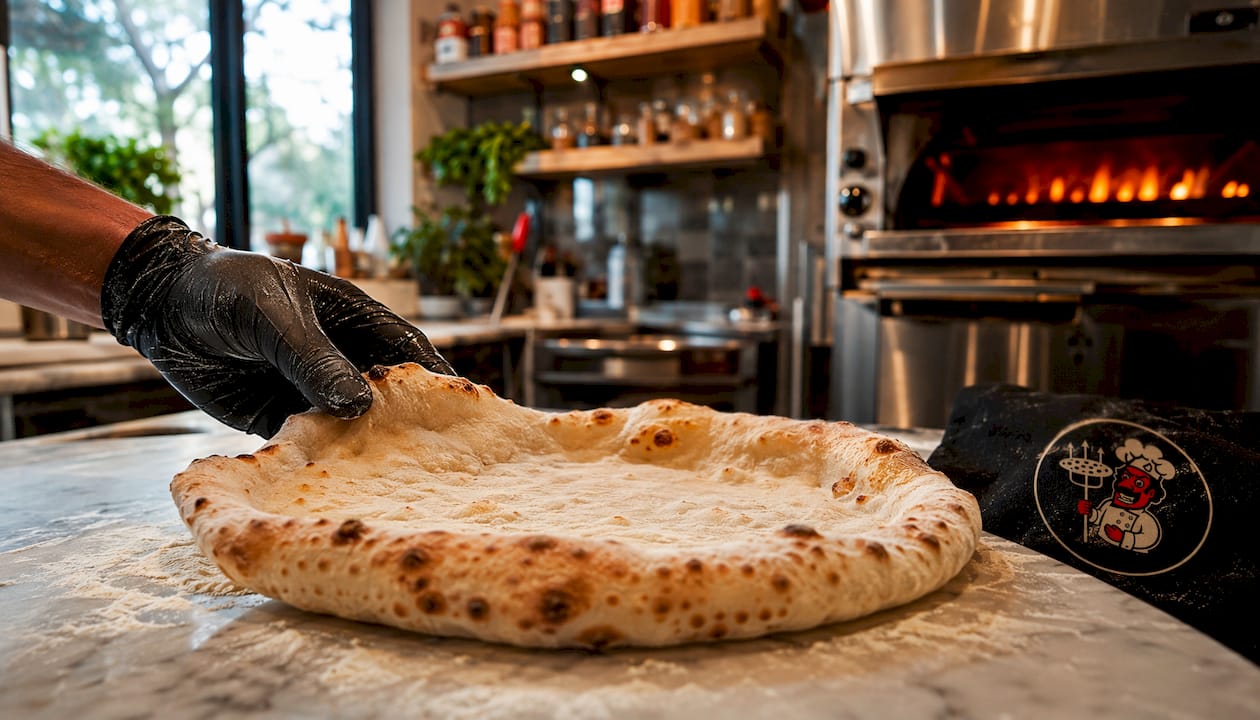
Neapolitan dough is the original artisan pizza crust, and it remains the most demanding to replicate at home. The crust is thin at the centre, with a dramatically puffed and charred cornicione (the outer rim). Authentic Neapolitan pizza bakes at 800–900°F in roughly 90 seconds, which creates the leopard-spotted char and a soft, almost wet interior that no home oven can fully match without a pizza steel and maximum heat. Tipo 00 flour is the traditional choice, prized for its fine milling and workability at lower hydration. The dough contains no oil and no sugar.
New York style
New York dough is Neapolitan's American descendant, adapted for gas ovens and a longer bake. It uses high-gluten bread flour, a touch of olive oil, and often a small amount of sugar to support browning at lower temperatures. Fermentation of 48–72 hours at cold temperature is standard among serious pizza makers, with some pushing to 96 hours or beyond. The result is a crust that is crispy on the bottom, chewy through the crumb, and sturdy enough to fold in half without drooping. That foldability comes from a uniform crumb structure where air cells are small and evenly distributed.
Canotto style
Canotto translates loosely to "little dinghy," which perfectly describes the inflated, boat-like rim this style produces. It is a relatively recent evolution in artisan pizza, pushing hydration to 75% and above. The high water content creates enormous alveoli in the cornicione, giving it a light, almost hollow puffiness that contrasts with a thin, crisp base. Handling Canotto dough requires confidence and a gentle touch. Because the dough is so wet, it cannot be tossed or aggressively stretched. Cold fermentation is non-negotiable for structure.
Biga-based dough
Biga is a stiff Italian preferment, typically mixed at low hydration and left to ferment for a half-day before being incorporated into the final dough. Biga starter cultures enhance flavour and dough strength for artisan-style crusts, producing a complex, slightly tangy flavour that straight doughs cannot achieve in the same timeframe. At Hellcrustpizza, the Biga process is applied to a multigrain, additive-free formulation, which adds fibre and mineral depth alongside the flavour complexity the preferment brings. The crumb is open and irregular, and the crust carries a richness that you notice from the first bite.
Sourdough artisan dough
Sourdough artisan dough replaces commercial yeast with a live starter culture of wild yeast and lactic acid bacteria. The fermentation is slower and less predictable, which is precisely what gives sourdough its character. The lactic and acetic acids produced during fermentation contribute a mild tang, improve digestibility, and create a crust with a deeply caramelised exterior. Hydration typically runs 68–75%, and the dough benefits from a long cold retard (overnight in the refrigerator) after bulk fermentation. Sourdough pizza is not faster or easier than commercial yeast pizza. It is simply different, and for many pizza enthusiasts, worth every extra hour.
Roman al taglio style
Pizza al taglio is Rome's answer to the question of what to do with a very high-hydration dough baked in a rectangular pan. Hydration often exceeds 75%, the dough is proofed directly in the oiled pan, and the result is a thick, airy slab with a crisp underside and a soft, open crumb. It is cut to order, often with scissors, and topped after baking with fresh ingredients. The pan bake means home cooks can replicate it without a pizza stone, making it one of the more accessible high-hydration styles.
Sicilian style
Sicilian dough is pan-baked, thick, and deliberately bready. It uses a moderate hydration (around 65–70%) and a longer proof in the pan to develop height and a pillowy interior. The underside crisps in the oiled pan, producing a fried-bread quality that is deeply satisfying. Because it bakes at modest temperatures, it is forgiving for home cooks. Sicilian dough does not demand the same precision as Neapolitan or Canotto, but it rewards good flour and a patient proof.
What Hellcrustpizza's Biga multigrain dough taught us about craft
We have spent a lot of time thinking about what separates a truly great pizza from one that is merely good. The answer, every time, comes back to the dough.
At Hellcrustpizza, our unwavering commitment to quality starts with our additive-free Biga multigrain dough. We use a Biga preferment because we believe you get what you pay for when it comes to fermentation time. The 12–16 hour preferment stage builds acids, aromas, and a gluten structure that a same-day dough simply cannot replicate. When you savour a slice from Hellcrustpizza, that rich, mature flavour in the crust is not a seasoning. It is the natural result of time and craft.
Here is what shapes our approach, and what you can apply to your own dough making:
- No artificial additives: Our dough contains no preservatives, no dough conditioners, and no artificial flavour enhancers. The complexity comes from fermentation, not from a packet. Fresh ingredients in both the dough and the toppings make a measurable difference to flavour.
- Multigrain flour blend: We incorporate whole grains alongside refined flour, which adds fibre, a nuttier depth, and a more complex mineral character to the finished crust.
- Hydration adjusted by environment: Our team adjusts hydration based on seasonal temperature and humidity. A dough mixed in a Canadian January kitchen behaves differently than one mixed in July. Adapting to your environment, rather than following a rigid formula, is what separates craft from production.
- Gentle handling: We never rush the shaping process. High-hydration dough handled with care retains its open crumb structure. Rushed or overworked dough loses the gas cells that fermentation spent hours building.
- Customisable toppings on a wholesome base: Because the dough itself carries so much flavour, our toppings do not need to overpower it. You can customise your crust and toppings knowing the foundation is already doing its job.
True artisan dough accepts natural irregularities. The bubbles will not be perfectly uniform. The edges will not be perfectly round. That is not a flaw. It is the signature of something made by hand, with care, by people who understand that real artisan pizza values flavour complexity over speed and visual consistency.
Key takeaways
Artisan pizza dough's defining advantage over mass-produced dough is long fermentation combined with high-quality, additive-free ingredients, producing flavour complexity and crust texture that no industrial process can shortcut.
| Point | Details |
|---|---|
| Hydration drives crumb character | Higher hydration around 70–75% yields a soft, airy crumb; lower hydration produces a denser, crisper result. |
| Fermentation builds flavour | Cold fermentation of 48–60 hours breaks down gluten proteins and develops the gas cells that give artisan crust its depth. |
| Flour choice must match your method | 00 flour suits Neapolitan's extreme heat; high-protein bread flour supports New York's long fermentation and foldable crumb. |
| Handle high-hydration dough gently | Overworking wet dough collapses the open crumb structure that slow fermentation spent hours creating. |
| Hellcrustpizza's Biga multigrain dough | Hellcrustpizza uses an additive-free Biga preferment with multigrain flour, delivering flavour complexity and a wholesome crust in every order. |
Hellcrustpizza brings artisan Biga dough to your door
Crafting artisan dough at home is deeply rewarding, and we hope this guide gives you the confidence to try. But on the nights when you want that rich, mature Biga flavour without the 48-hour wait, Hellcrustpizza is here.

Our Biga multigrain, additive-free dough is the real thing: a preferment-based crust with no shortcuts, no artificial additives, and no compromise on flavour. We pair it with fresh ingredients and offer Mix & Match deals and family-sized specials that make a wholesome, handcrafted pizza accessible on any budget. Every order through our app is straightforward, and exclusive deals make it even easier to savour something crafted with genuine care.
Ready to taste the difference that real fermentation makes? Order from Hellcrustpizza today and experience what an unwavering commitment to quality actually tastes like.