
Yes, takeout pizza can fit a balanced diet — the role of nutrition in takeout pizza comes down to three control points you hold every time you order: portion size, crust type, and topping choices. A single slice of a standard cheese pizza from a fast-food chain delivers roughly 285 calories, 12 g of protein, and 640 mg of sodium according to USDA FoodData Central data. That sodium figure alone represents more than a quarter of Health Canada's recommended daily intake of 2,300 mg for adults. The good news is that every one of those numbers shifts meaningfully when you make deliberate choices.
The three nutritional levers that matter most:
- Portion size — one slice versus three changes the entire caloric and sodium picture
- Crust type — whole-grain or thin crust raises fibre and lowers glycaemic load compared with a thick refined-flour base
- Toppings and cheese — vegetables add micronutrients and fibre; processed meats and extra cheese push sodium and saturated fat up sharply
Hellcrustpizza publishes this guide to help you make those choices with confidence, drawing on the Canadian Nutrient File, USDA FoodData Central, and registered dietitian guidance.
Table of Contents
- What does a typical takeout pizza slice actually contain?
- How each pizza component shapes what you eat
- Can takeout pizza actually be healthy?
- Practical ways to make your takeout order healthier
- Takeout pizza and specific health conditions
- How to estimate calories when there is no nutrition label
- What a healthier Hellcrustpizza order looks like in practice
- Additives and preservatives in takeout pizza: what you should know
- Key takeaways
- Pizza, nutrition, and the pleasure of eating well
- Hellcrustpizza: where nutrition meets real takeout pizza
- Useful sources and Canadian resources
What does a typical takeout pizza slice actually contain?
The numbers vary more than most people expect. A plain cheese slice from a fast-food chain typically contains moderate calories, while a loaded deep-dish pepperoni slice can be noticeably higher. Sodium is the nutrient that surprises people most: even a modest slice contains a significant amount, and a generous portion from an independent pizzeria can exceed typical levels considerably. Research on takeaway food nutritional profiles confirms that pizzas rank highest in energy density among common takeaway categories, and that variability between establishments is wide.
Typical per-slice nutrition ranges by pizza style
| Style | Calories | Protein | Carbs | Total Fat | Sodium | Fibre |
|---|---|---|---|---|---|---|
| Fast-food cheese | 285 kcal | 12 g | — | 10.4 g | 640 mg | 1.9 g |
| Pizzeria / Neapolitan (thin) | 285 kcal | 12 g | — | 10.4 g | 640 mg | 1.9 g |
| Deep-dish / stuffed crust | — | 12 g | — | 14–18 g | — | — |
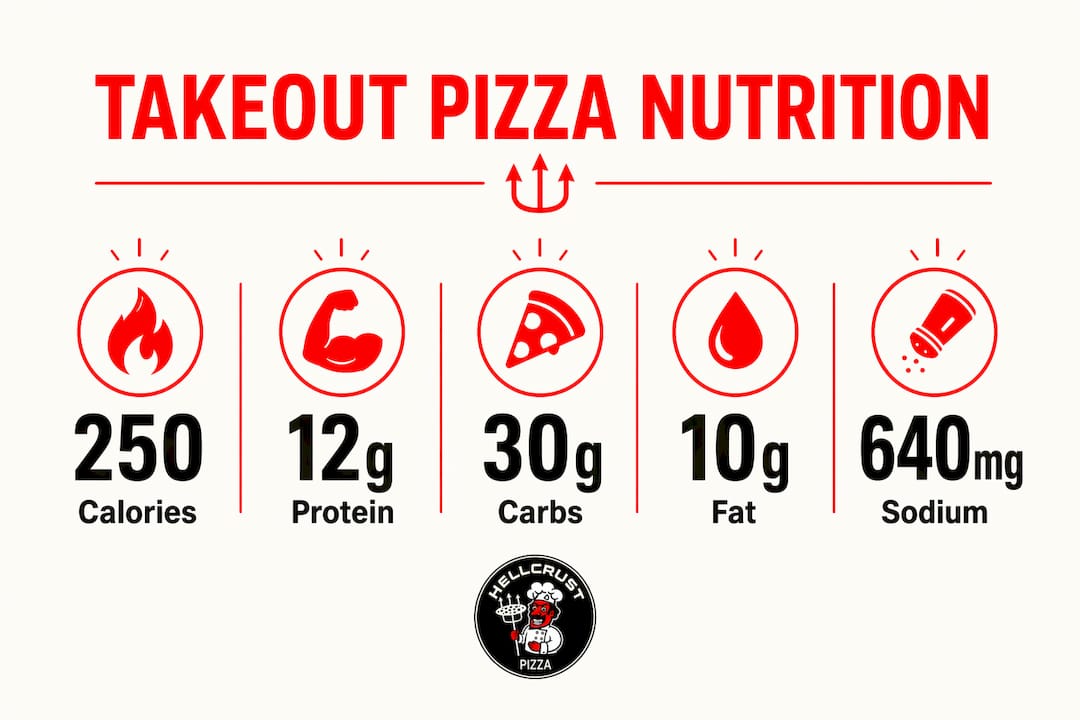
Sources: USDA FoodData Central; USDA Nutrient Database SR18 reference values.
Three nutrients deserve the most attention in any takeout order. Sodium is a primary concern: a two-slice meal from a chain can provide a substantial portion of daily recommended intake before you have added a single side. Saturated fat climbs quickly with processed-meat toppings and extra cheese. Calorie density is the third issue, because the energy per bite is high enough that portion boundaries blur easily, especially with a larger pie in front of you.
Why do the numbers vary so much? Portion weight, cheese quantity, crust density, and the fat content of processed toppings all compound each other. A thin-crust veggie slice and a deep-dish pepperoni slice are nutritionally almost different foods.
How each pizza component shapes what you eat
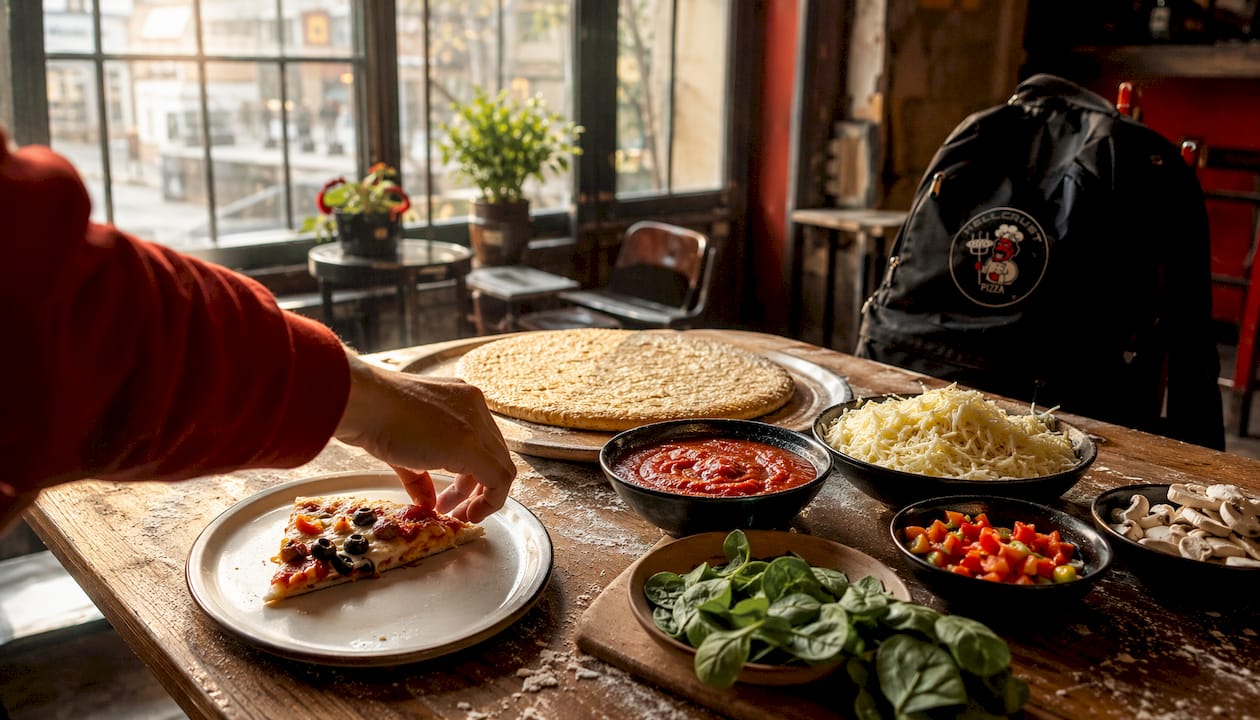
Understanding where calories and nutrients actually come from lets you target your swaps precisely rather than guessing.
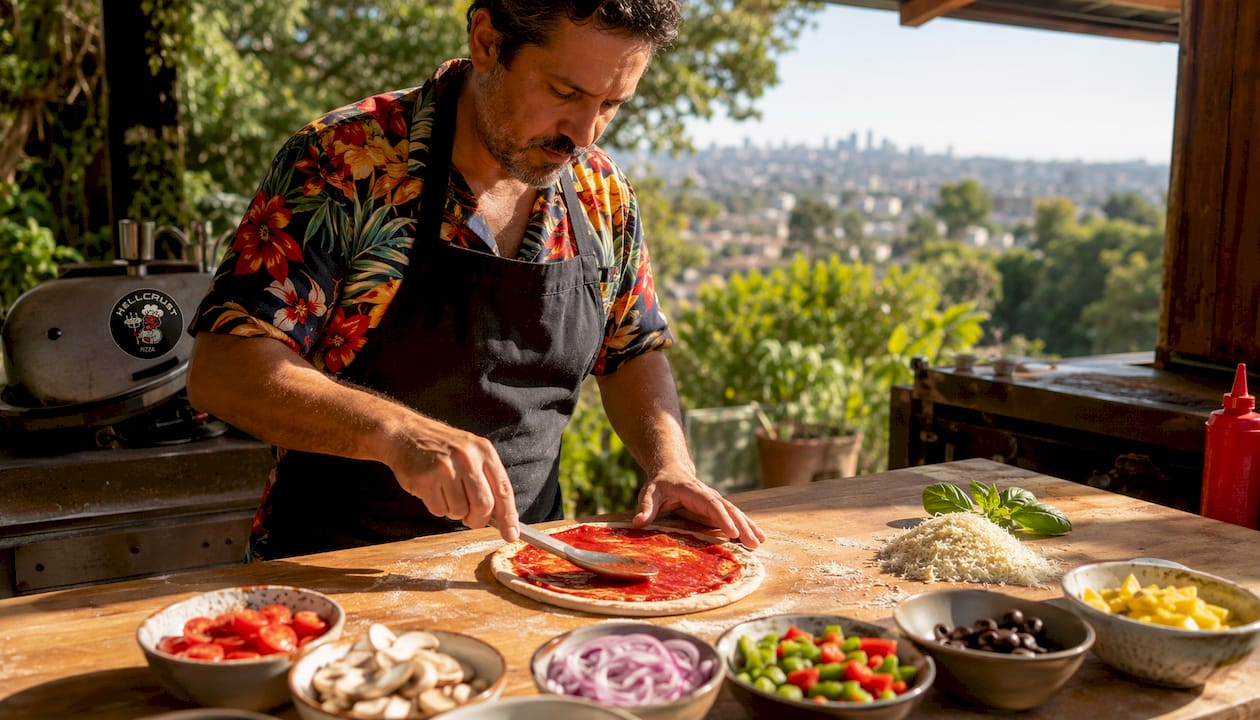
Crust
The crust sets the foundation for fibre, glycaemic load, and calorie count. Refined white-flour crusts digest quickly and offer minimal fibre. Whole-grain crusts increase fibre content and moderate the blood glucose response compared with refined flour, which matters particularly for anyone managing blood sugar. A thin crust of any type reduces total carbohydrate and calorie load simply by using less dough. Cauliflower-based crusts lower carbs further but often add sodium through binding ingredients, so read labels when available.
Sauce
Tomato sauce is genuinely one of pizza's nutritional bright spots. Cooked tomatoes are a concentrated source of lycopene, an antioxidant linked to cardiovascular and prostate health. The pitfall is added sugar: some commercial pizza sauces include sweeteners that nudge the glycaemic load upward. A sauce with tomatoes, olive oil, garlic, and herbs as the primary ingredients is the version worth choosing.
Cheese
Cheese is a double-edged ingredient: it contributes meaningful protein and calcium, but it also adds saturated fat and sodium in proportion to how much is used. Asking for light cheese, or mixing in a small amount of a flavourful aged variety, lets you use less without losing taste. A standard portion of mozzarella on a takeout pizza can account for a third of the day's saturated fat allowance on its own.
Toppings
Vegetable toppings — bell peppers, spinach, mushrooms, onions, artichokes — add fibre, vitamins, and antioxidants while contributing very few calories. Vegetarian and vegetable-forward toppings are growing in popularity precisely because they improve the nutritional profile without sacrificing satisfaction. Processed meats (pepperoni, salami, sausage) raise sodium significantly and introduce nitrites, which are discussed further in the additives section below.
Practical swaps and their effects
| Swap | Effect |
|---|---|
| Thin crust instead of thick | Reduces calories and carbs per slice by roughly 20–30% |
| Whole-grain crust instead of refined | Adds fibre, lowers glycaemic load |
| Light cheese instead of standard | Cuts saturated fat and sodium noticeably |
| Double vegetables instead of processed meat | Adds fibre and micronutrients; reduces sodium and nitrites |
| Tomato-herb sauce instead of cream or BBQ base | Lowers saturated fat and added sugar |
Pro Tip: Request sauce on the side when ordering a white pizza or a cream-based variant. You control how much goes on, and you can often halve the saturated fat in that component alone.
Can takeout pizza actually be healthy?
Honestly, the answer depends on what "healthy" means in your eating pattern. Pizza brings real nutritional benefits to the table alongside its well-known risks.
Nutritional benefits worth acknowledging:
- Protein from cheese and meat toppings supports satiety and muscle maintenance
- Calcium from mozzarella contributes to bone health
- Lycopene from cooked tomato sauce is a meaningful antioxidant
- Vegetable toppings add vitamins A, C, and K, plus dietary fibre
- A well-built slice provides a reasonable macronutrient balance when portioned thoughtfully
Genuine risks to manage:
- Sodium per slice is high; two or three slices can approach or exceed Health Canada's daily 2,300 mg guideline in a single meal
- Saturated fat from cheese and processed meats adds up quickly
- Refined-flour crusts contribute to glycaemic load with little fibre to slow digestion
- Energy density makes it easy to eat more than intended, particularly with larger slice sizes
Research on takeaway food nutritional profiles found that takeaway pizzas were highest in energy per portion among common takeaway categories, and that the majority of meals exceeded recommended salt levels. That context matters: pizza is not uniquely harmful, but it does concentrate several nutrients that Canadians already tend to over-consume.
As an everyday choice, a two-slice meal built on thin or whole-grain crust with vegetable toppings and light cheese is reasonable within a varied diet. As a deep-dish, extra-cheese, processed-meat order eaten three or four times a week, it becomes a meaningful dietary risk.
Practical ways to make your takeout order healthier
Small ordering decisions compound into a genuinely different nutritional outcome. These steps are worth building into your regular routine.
- Choose thin or whole-grain crust. This single swap reduces calories, carbs, and glycaemic load before you have touched anything else on the order.
- Request light cheese. Ask explicitly — most takeout kitchens will honour it, and it cuts saturated fat and sodium without eliminating the flavour you came for.
- Load up on vegetables. Double the vegetable toppings and skip or limit processed meats. Customising your toppings is the most direct way to shift the nutritional profile of any order.
- Limit yourself to two slices as a starting point. Pair them with a large green salad or a side of roasted vegetables to round out the meal with fibre and micronutrients.
- Add fresh greens after delivery. Arugula, baby spinach, or fresh basil laid over a hot slice adds nutrients and volume with essentially zero calories.
- Blot excess oil. A quick press with a paper towel on a greasy slice removes a meaningful amount of surface fat, particularly from processed-meat toppings.
- Toast in the oven for a few minutes. Crisping a delivered slice reduces the doughy texture that encourages eating more, and it concentrates flavour so you feel more satisfied with less.
Pro Tip: When ordering, ask for the sauce on the side or request "light sauce" if you are watching sodium. Tomato sauce is nutritious, but commercial versions can be saltier than they taste.
For a practical framework on balancing nutrition in a pizza family meal, combining pizza with fibre-rich sides is one of the most reliable strategies.
Takeout pizza and specific health conditions
Nutrition in takeout pizza is not a one-size-fits-all conversation. If you are managing a specific health condition, a few targeted adjustments make a real difference.
Sodium-sensitive individuals and heart health:
- Skip processed meats entirely — pepperoni and sausage are among the highest-sodium toppings
- Request light cheese and a lighter hand with the sauce
- Choose vegetable toppings, which contribute very little sodium
- Limit to one or two slices and avoid adding table salt or salty dipping sauces
- Discuss specific sodium targets with a registered dietitian or your physician
Diabetes and glycaemic control:
- Thin or whole-grain crust slows glucose absorption compared with thick refined-flour bases
- Pair pizza with a fibre-rich salad to blunt the blood glucose response
- Limit portion to one or two slices and avoid high-sugar sauce bases
- Cheese and protein toppings slow digestion, which helps moderate the glycaemic impact
- A meal plan using pizza delivery that incorporates balanced sides can support consistent blood sugar management
Weight management:
- Energy density is the primary concern; two slices of a thin-crust veggie pizza is a very different caloric load than two slices of deep-dish
- Eating slowly and pairing with a large salad helps you reach satiety before overeating
- Frequency matters as much as composition; occasional takeout pizza fits most caloric budgets, while multiple orders per week requires careful portion discipline
Heart health:
- Prioritise vegetable toppings and avoid processed meats to reduce saturated fat and nitrite intake
- A drizzle of olive oil instead of extra cheese adds heart-healthy monounsaturated fat
- The lycopene in tomato sauce has genuine cardiovascular benefits when consumed regularly
If you have a diagnosed condition, these are practical starting points, not a substitute for personalised guidance from a registered dietitian or your healthcare provider.
How to estimate calories when there is no nutrition label
Chain restaurants in Canada are increasingly required to post calorie counts on menus, but independent pizzerias rarely provide full nutrition panels. Here is a reliable estimation approach.
- Estimate the slice weight. A standard slice from a 12-inch pizza (cut into 8) weighs roughly 100–120 g. A larger 14-inch slice can weigh 130–150 g.
- Use a baseline figure. A plain cheese slice at roughly 100 g runs approximately 237–285 calories based on USDA FoodData Central reference values. Use this as your anchor.
- Adjust upward for toppings. Each processed-meat topping adds roughly 30–50 calories per slice; extra cheese adds a similar amount. Vegetable toppings add very little.
- Scale for crust thickness. A deep-dish slice of the same diameter can be 40–50% higher in calories than a thin-crust equivalent.
- Cross-check with a food-tracking app. Apps that draw from the Canadian Nutrient File or USDA FoodData Central give reasonable estimates for named chain items and generic pizza entries.
Trustworthy tools for Canadian readers:
- Canadian Nutrient File (Health Canada) — the primary government database for nutrient composition; use it for baseline values
- USDA FoodData Central — extensive branded and generic pizza entries; highly reliable for chain items
- Cronometer — draws from both databases and is widely used by Canadian dietitians for its accuracy
- MyFitnessPal — large database of chain-specific entries, though user-submitted entries vary in accuracy; cross-check against government sources when possible
Pro Tip: If you are at a local pizzeria with no posted nutrition info, photograph the slice next to a common object for scale, then use a 100 g baseline from the Canadian Nutrient File and adjust for visible toppings. It is not laboratory precision, but it gets you within a useful range.
What a healthier Hellcrustpizza order looks like in practice
Hellcrustpizza's multigrain Biga dough is a meaningful departure from the standard refined-flour base most takeout chains use. Biga is a preferment dough process: the dough ferments slowly before baking, which develops a richer, more complex flavour and improves digestibility. The multigrain composition adds fibre that a white-flour crust simply cannot match.
A healthier configuration at Hellcrustpizza might look like this:
- Multigrain Biga crust (thin or standard thickness)
- Tomato-herb sauce, standard amount
- Light mozzarella
- Double vegetable toppings (spinach, bell peppers, mushrooms, red onion)
- No processed meats
The nutritional effects of that build, compared with a standard processed-meat deep-dish order:
- Higher dietary fibre from the multigrain crust and vegetable load
- Lower saturated fat from the light cheese and absence of processed meats
- Lower sodium overall, with the biggest reduction coming from skipping pepperoni or sausage
- Meaningful lycopene from the tomato sauce
- A more moderate calorie count per slice
Pro Tip: When ordering through the Hellcrustpizza app, select "light cheese" in the customisation options and add two or three vegetable toppings. The app's Mix & Match feature makes it easy to build this configuration without paying a premium for each individual swap.
Additives and preservatives in takeout pizza: what you should know
Most takeout pizza from chain establishments contains a range of food additives that go beyond the core ingredients. Understanding what they are and why they are used helps you make more informed choices.
Common additives and their roles:
- Sodium nitrite and nitrate — used as preservatives in processed meats like pepperoni and sausage. They inhibit bacterial growth and maintain colour. High intake of nitrites from processed meats has been associated with increased health risks in population research, which is one reason dietitian guidance consistently recommends limiting processed-meat toppings.
- Modified starches and gums — used in commercial dough and sauce to improve texture and shelf stability. They are generally recognised as safe but add no nutritional value.
- Artificial flavour enhancers (e.g., monosodium glutamate) — present in some processed toppings and seasoning blends; they contribute to sodium load beyond what the salt content alone suggests.
- Preservatives in cheese blends — some commercial mozzarella blends used in chain pizza contain cellulose or natamycin to extend shelf life. These are not harmful in the amounts used, but they signal a more processed product.
- Dough conditioners — azodicarbonamide and similar agents are used in some commercial doughs to speed up processing. They are permitted in Canada under Health Canada regulations, though they are absent from artisan or preferment doughs like Biga.
The practical implication is straightforward: the fewer processed toppings and commercial shortcuts in your pizza, the lower the additive load. Choosing a pizzeria that uses fresh ingredients and traditional dough methods, or one that explicitly avoids artificial additives, reduces your exposure to these compounds without requiring you to read a chemistry textbook. Fresh ingredients also tend to deliver better flavour, which means you are more satisfied with a smaller portion.
Key takeaways
Takeout pizza fits a healthy diet when you control portion, choose whole-grain or thin crust, load vegetables, and limit processed meats and excess cheese.
| Point | Details |
|---|---|
| Sodium is the top concern | A single fast-food cheese slice contains 640 mg sodium; two slices can approach Health Canada's daily 2,300 mg guideline. |
| Crust choice changes everything | Whole-grain or thin crust raises fibre and lowers glycaemic load compared with a thick refined-flour base. |
| Toppings drive the nutritional gap | Doubling vegetables and skipping processed meats reduces sodium, saturated fat, and nitrite intake in one move. |
| Estimate calories with confidence | Use the Canadian Nutrient File or USDA FoodData Central as your baseline; adjust for crust thickness and toppings. |
| Hellcrustpizza's Biga approach | Hellcrustpizza's multigrain Biga dough, additive-free commitment, and customisable toppings let you apply these principles to a real takeout order. |
Pizza, nutrition, and the pleasure of eating well
There is a tendency in nutrition writing to treat takeout pizza as a guilty pleasure to be minimised rather than a food to be understood. That framing does not serve you well. Pizza, at its best, is a genuinely nourishing meal: fermented dough, cooked tomatoes rich in lycopene, quality cheese, and an abundance of vegetables. The problem has never been pizza itself. It has been the industrial shortcuts — the refined flour, the processed meats, the excess sodium, the artificial additives — that crept in when convenience became the only priority.
What we appreciate about Hellcrustpizza's approach is that it takes the craft seriously. The Biga preferment process is not a marketing phrase; it is a real commitment to dough that ferments slowly, develops flavour naturally, and digests more gently than a fast-mixed commercial base. The multigrain flour adds fibre that most takeout crusts simply do not offer. And the absence of artificial additives reflects an unwavering commitment to wholesome ingredients that you can actually feel good about.
Enjoying pizza every week is not at odds with eating well. The two coexist comfortably when you know which levers to pull. Choose your crust thoughtfully, load your vegetables generously, and savour every bite of something crafted with real care.
Hellcrustpizza: where nutrition meets real takeout pizza
If you have been looking for a takeout option that actually aligns with the principles in this article, Hellcrustpizza is worth a serious look. The multigrain Biga dough delivers fibre and digestibility that refined-flour crusts cannot match. Every pizza is built without artificial additives, and the fully customisable toppings mean you can request light cheese, double vegetables, and skip processed meats without any friction in the ordering process.
The Mix & Match deals and family-sized specials make it practical to build a nutritionally balanced meal without paying a premium for every individual customisation. Whether you are ordering for yourself or feeding a family with different preferences, the flexibility is genuinely there.
Check out the current pizza deals and coupons at Hellcrustpizza and build your next order around the swaps that matter most to you. This article is general nutritional information; for personalised dietary advice, consult a registered dietitian.
Useful sources and Canadian resources
These are the primary references used throughout this article, organised by the sections they support most directly.
- USDA FoodData Central — per-slice calorie, protein, sodium, and macronutrient values for chain and generic pizza entries. Used in the nutritional snapshot and calorie-estimation sections.
- Canadian Nutrient File (Health Canada) — Canada's primary government nutrient database. Use it as your baseline for any food-tracking or estimation exercise.
- Nutritional composition of takeaway food (LJMU peer-reviewed study) — peer-reviewed research on energy density and sodium in takeaway categories including pizza. Used in the pros/cons and sodium sections.
- Pizza nutrition facts, calories and carbs — Verywell Fit — dietitian-reviewed guidance on whole-grain crust, glycaemic impact, and ordering strategies. Used in the components explainer and special-considerations sections.
- I'm a dietitian and I eat pizza every week — Food Network — registered dietitian perspective on component swaps, cheese strategy, and customisation. Used in the components explainer and practical tips sections.
- SnapCalorie — takeout cheese pizza nutrition — real-world per-slice figures illustrating variability by crust and toppings. Used in the nutritional snapshot.
- FoodStruct — pizza nutrition — aggregated micronutrient, glycaemic index, and sodium data. Used in the special-considerations and pros/cons sections.
- Independence Health — tips for a healthier pizza night (2025) — consumer-facing ordering tips for reducing sodium and saturated fat. Used in the practical tips section.