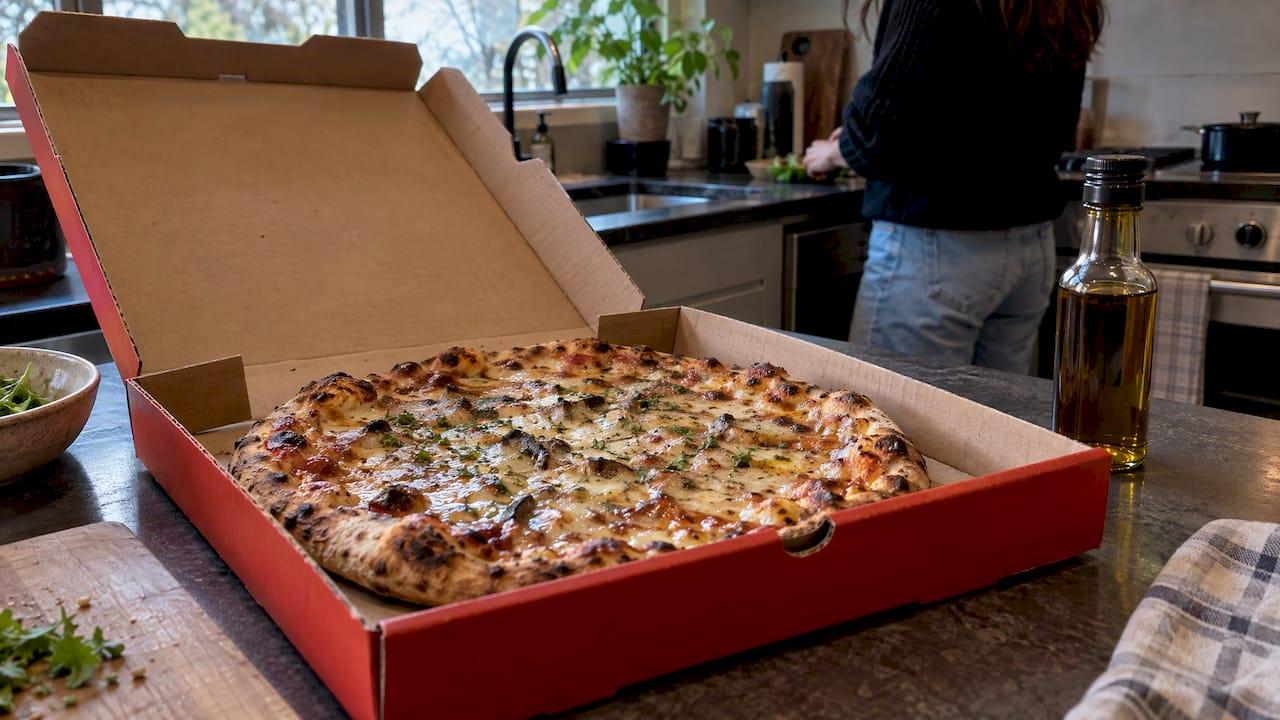
Have you ever opened a pizza box, caught a whiff of something earthy and luxurious, and wondered why your own attempt at it smells like a science project? The answer is almost always timing and quantity. Truffle oil belongs on a pizza after the bake, in a very small amount, on toppings gentle enough to let it speak. Get those three things right and one teaspoon turns a good pizza into a special-occasion one.
This guide is for anyone who wants that result without wasting a pricey bottle: families treating themselves on a Friday, couples planning a casual date night, students splurging a little, and pizza lovers who like trying new toppings.
TL;DR
- Drizzle truffle oil only after the pizza leaves the oven, never before or during the bake. Heat drives off its aroma.
- Use about 1 teaspoon for a whole 12-inch pizza. If you can smell it strongly before serving, you have used too much.
- Pair it with mild, creamy or earthy toppings: mushrooms, potato, egg, burrata, prosciutto, arugula. Pick one or two, not six.
- Most truffle oil gets its aroma from a lab-made flavour compound, not from real truffles, so choose by how it smells and what the label says.
- Skip it on marinara, anchovy and heavily smoked pizzas, and on anything you plan to reheat.
Table of Contents
- What truffle oil actually is
- When to add it: after the oven, always
- How much to use
- What to put under it
- When to leave it off
- Choosing and storing a bottle
- What to drink with a truffle pizza
- Truffle oil at home on a delivered pizza
- Build your pizza, then finish it your way
- FAQ
- Sources
What truffle oil actually is
Truffle oil is not pressed from truffles. Bon Appétit's ingredient guide describes it as an oil, such as olive or sunflower, infused with the aroma of white or black truffles. Its intense scent comes from a compound that closely resembles truffle, often listed on the label as "natural flavors", rather than from the fungus itself.
There is a practical reason for that. America's Test Kitchen explains that truffle flavour does not extract reliably into oil, so makers add flavour molecules instead. Many use the synthetic compound 2,4-dithiapentane, which is the dominant flavour compound in real truffles. The Spruce Eats adds that truffle aroma is highly volatile: fresh truffles hold it for only about five days, and oils infused with actual truffles lose their potency just as quickly.
What does that mean at your kitchen counter? Truffle oil is a seasoning for aroma, closer to a perfume than a cooking fat. The base oil matters too, since it carries the scent and sits on your tongue. A clean, fruity extra virgin olive oil base, the kind explained in this piece on single origin olive oil, gives the aroma a good foundation.
Why some chefs roll their eyes at it
You may have heard that professional cooks look down on truffle oil. The Times of India reports that the backlash is at least two decades old, with well-known chefs dismissing it as fake. The complaint is mostly about heavy-handed use and about the oil standing in for the real thing. Used as a light finishing touch, it is a pleasant, affordable way to bring a truffle note to a home pizza night, and that is how the rest of this guide treats it.
There is one label point worth knowing. Wikipedia's entry on truffle oil notes that nothing regulates how the flavouring is labelled, so "truffle aroma" or "truffle flavour" can appear even when no truffle was involved. A bottle that says "natural" does not tell you more, because America's Test Kitchen points out that the term is regulated only for meat and poultry in the United States.
When to add it: after the oven, always
This is the single rule that matters most. Truffle's aroma compounds are volatile and break down under heat. Dough Dorks' usage guide explains that if you add the oil before baking, most of the flavour is gone by the time the pizza is done. Milan Truffle's guide puts the timing plainly: drizzle as soon as the pizza comes out of the oven, before it cools, and never before or during baking.
Why right away? The pizza is at its hottest and the cheese is still soft, so the oil spreads, warms and releases its scent just as you carry the pizza to the table. Wait ten minutes and you lose some of that lift.
You will see recipes that drizzle truffle oil on before baking. You will get far more aroma from the finishing method, and you will use less oil to get it.
How much to use
Less than you think. Truffle oil is intense, and over-application makes the pizza taste flat and one-note instead of subtle, according to PizzaHQ's topping profile.
Here are the amounts published by oil sellers and guides, side by side:
| What you are topping | Amount | Source |
|---|---|---|
| One whole 12-inch pizza | About 1 teaspoon | Milan Truffle |
| A finished pizza pie | About 1 teaspoon | Muskoka Olive Oil Co. |
| One serving of a dish, as a starting point | About ¼ to ½ teaspoon | Muskoka Olive Oil Co. |
| A pasta or risotto portion | 3 to 5 drops | Milan Truffle |
A simple test: smell the pizza before serving. If the truffle hits you from across the table, you have gone too far. The same guide gives that exact warning. Start with a few drops per slice, taste, and add more only if you want it.
A worked example for a family table
Say you have a 12-inch pizza cut into eight slices and four people at the table. Measure one level teaspoon into a small bowl. Dip a spoon and drizzle in a thin zigzag across the whole pie, or, better for mixed tastes, put a few drops on each adult's slices and leave the kids' slices plain. Truffle is an acquired taste for many children, so this keeps everyone happy without making two pizzas.
What to put under it
Truffle oil needs a gentle backdrop. Muskoka Olive Oil Co.'s Canadian pairing guide names eggs, plain pasta, potatoes and mushrooms as natural matches because their mild flavours let truffle stand out, and notes that creamy textures and a little fat help carry the aroma through each bite.
On pizza, that translates into a short list:
- Mushrooms. The classic. Earthy on earthy, and a meat-free pizza that feels hearty.
- Potato. Thin slices with a little rosemary give a soft, starchy base for the aroma.
- Egg. A baked or just-set egg adds richness that the oil lifts.
- Burrata or creamy cheeses. Fat carries scent. Add the burrata after baking, along with the oil.
- Prosciutto and arugula. Salt and peppery greens add contrast, a pairing Milan Truffle lists among its best.
- Caramelised onion. Sweetness against earthiness.
Gozney's topping guide agrees that truffle oil and mushrooms are a classic gourmet pairing that works through contrast, and that two to five toppings is usually enough. Milan Truffle is stricter about the truffle itself: choose only one or two of the partners above so the truffle has somewhere to sit.
Black or white truffle oil?
Milan Truffle recommends black truffle oil for pizzas with tomato, cured meat or strong cheese, because it is earthier and holds its ground. White truffle oil suits delicate pizzas such as potato, egg and burrata, because it is finer. The same company's product page suggests white for pizza bianca, potato pizza and creamy cheeses and black for mushroom pizza.

If you only want one bottle, black is the more forgiving choice for a typical pizza night, since it copes with tomato and cured meat.
Three combinations worth trying
- Mushroom and mozzarella. Bake as usual, then add a few drops of black truffle oil to each slice and a handful of arugula.
- Potato, rosemary and cream cheese base. White truffle oil after baking, nothing else.
- Prosciutto, soft cheese and roasted garlic. A Canadian shop suggests finishing a pie of Robiola, prosciutto and roasted garlic with white truffle oil after the bake, as in Muskoka Olive Oil Co.'s pairing ideas.
If cheese choice is where you get stuck, our guide to cheese varieties used on gourmet pizzas walks through what melts, what stays creamy and what to add after the oven. For more ideas on what makes a topping feel special, see premium pizza toppings and our broader look at indulgent pizza topping choices.
When to leave it off
Some pizzas fight the oil instead of flattering it.
- Marinara pizza. With no cheese or fat to carry the aroma, the scent just disappears, says Milan Truffle.
- Anchovy or heavily smoked pizzas. Their flavour overpowers truffle. If you love anchovies, our guide to anchovies on pizza shows what to pair them with instead.
- Pizza you will reheat. Heat kills the aroma. For leftovers, drizzle the individual slice you are about to eat, not the whole pizza.
- Delicate cheeses and blue cheese. PizzaHQ cautions that truffle oil can drown out delicate cheeses such as fior di latte and clash with blue cheese. It also shares an earthy aroma with other dominant toppings like aubergine, so let one lead.
Strong herbs deserve the same care. Fresh basil or parsley is lovely, but pile on too much and it competes. Our note on fresh herbs on finished pizza covers timing and quantity so the oil stays the star.
Choosing and storing a bottle
You do not need the most expensive bottle, but a few habits help:
- Read the ingredients. Look for extra virgin olive oil as the base and a short list. Remember that "aroma" or "flavour" on the label is how most truffle oils are described.
- Buy small. The aroma fades, so a small bottle you finish in a few months beats a large one that sits.
- Smell it first when you can. It should smell pleasantly earthy, not sharp or chemical.
- Keep it away from heat and light. A cupboard away from the stove is better than the counter next to the oven.
- Never cook with it. It is a finishing oil, and the heat wastes it.
If you want to go a step further, the Times of India notes that some chefs now shave small pieces of real truffle over home-baked pizzas. That is a treat for special evenings; for a regular Friday, a careful teaspoon of oil is plenty.
What to drink with a truffle pizza
Earthy, creamy pizzas pair best with wines that are not too heavy: a crisp white with some body, or a light, fruity red. For the logic behind it, these wine pairing basics set out rules you can test at the table. For a quick shortcut, our guide to wine pairings for every pizza topping gives you one bottle to keep chilled. A simple salad is the other easy companion, and we have ideas in salads that go with pizza.
Truffle oil at home on a delivered pizza

Here is the easy route for busy evenings. A pizza that arrives hot from the box is already at the right moment for the finishing drizzle: open the box, add a few drops to the slices you want, and serve. You skip the dough and the oven altogether, and you keep the truffle aroma at its brightest. A plain, cheese-led or mushroom-style pizza is the natural canvas; keep the other toppings few.
It also suits some occasions well. Couples can finish one half of a pie with truffle and leave the other half classic. For a kids' birthday table, keep the oil to the adults' slices, and let the children enjoy their own pizza as it comes.
Our view: the crust is where flavour begins
We love a good finishing touch, and a few drops of truffle oil can be a lovely one. But we have always believed a topping can only be as good as the crust beneath it. That is why our dough is a Biga multigrain, artificial additive free dough, prepared in advance so it can develop a rich, mature flavour and a crust that is fibre-rich and more digestible.
A drizzle of something aromatic sits best on a base with its own character. Earthy mushrooms, creamy cheese and a thoughtful finishing oil all sit well on a crust that has some depth of its own, rather than one that only carries toppings.
That is also why we like to keep things honest and simple: fresh ingredients, toppings you can customize, and a few pairings that really work, rather than a pile of everything. You get what you pay for, and we would rather you savour one well-made slice than six rushed ones.
jaskirat Singh
Build your pizza, then finish it your way
You can order a pizza on our Biga multigrain, artificial additive free dough, choose your own toppings with Create Your Own Pizza, or pick from our Signature Pizzas and Vegan Pizzas. Order for delivery or pickup through our app, where exclusive offers are available. Browse everything on our menu.

When it arrives, add your finishing drizzle while the pizza is still hot.
FAQ
Can I put truffle oil on pizza before baking?
It is not recommended. The aroma compounds are volatile and break down in the oven, so most of the flavour is gone by the time the pizza is done. Add it right after the pizza comes out, while it is still hot, as Dough Dorks explains.
How much truffle oil should I use on a pizza?
About one teaspoon for a whole 12-inch pizza, according to Milan Truffle. Start with a few drops per slice if you are unsure. If you can smell it strongly before serving, you have used too much.
What is truffle oil made of?
It is usually olive or another oil with truffle aroma added. Bon Appétit notes that the scent typically comes from a compound resembling truffle, often listed as "natural flavors", rather than from truffles themselves.
Why don't some chefs use truffle oil?
Many feel it is largely synthetic and too often used heavily, so it can taste one-dimensional next to real truffle, as The Times of India reports. Used lightly as a finishing touch at home, it still adds a pleasant earthy note.
What toppings go best with truffle oil?
Mushrooms, potato, egg, burrata, prosciutto, arugula and caramelised onion. Keep to one or two of them so the truffle stands out.
Sources
- Truffle Oil | Bon Appétit
- The Truth About Truffle Oil | America's Test Kitchen
- What Is White Truffle Oil? | The Spruce Eats
- What you're smelling isn't truffle | The Times of India
- Truffle oil | Wikipedia
- What Is Truffle Oil? Usage Guide | Dough Dorks
- 14 Best Pairings for Truffle Oil on Pizza | Milan Truffle
- How to Use Truffle Oil Correctly | Milan Truffle
- Olive Oil for Pizza | Milan Truffle
- Truffle Oil Pairings | Muskoka Olive Oil Co.
- Truffle oil (finishing) | PizzaHQ
- The Best Pizza Topping Ideas | Gozney
- Single Origin Olive Oil | Sangre de Olivo Elixir
- Wine Pairing Basics | Aflamas