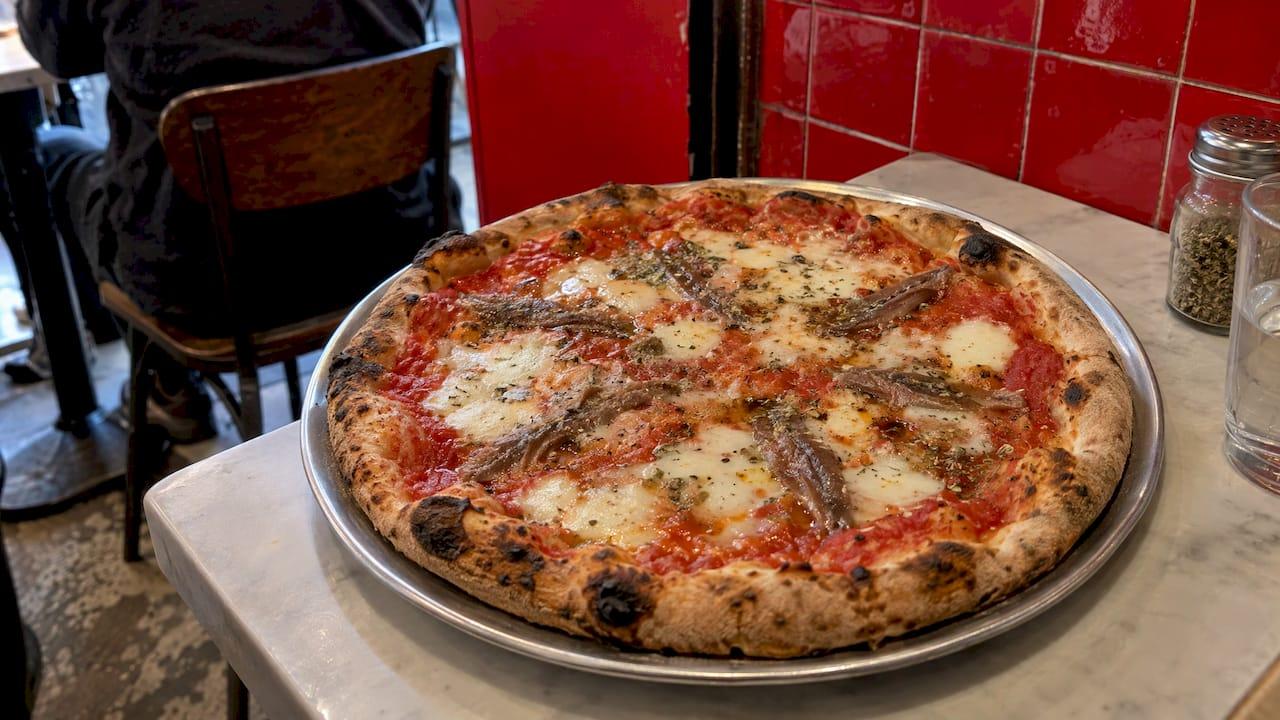
Anchovies on pizza taste salty and deeply savoury, not fishy, when you use them well. Baked on, a good fillet melts into the sauce and cheese and works like a seasoning. Added after baking, it keeps its shape and gives you a bright, briny bite. The classic pizza with anchovies is called pizza Napoli, and it is far less scary than its reputation suggests.
So why does this tiny fish split dinner tables? We think it comes down to how anchovies are handled. Too many, too salty, or sitting on a flimsy crust, and they overwhelm. Used with a little care, they are one of the quietest ways to make a pizza taste richer. Here is how to get there.
TL;DR
- The classic anchovy pizza is pizza Napoli: tomato, anchovies, oregano, often capers, sometimes mozzarella.
- Cured anchovies taste of umami and salt, and when baked they largely dissolve into the pizza.
- Anchovies are fish, not meat, so they suit pescatarian eaters but not vegetarians or vegans.
- Pair them with olives, capers, garlic, chili and oregano, and go easy on any other salt.
- Bake them on for melting depth, or add them after the oven for a firmer, saltier bite.
Table of Contents
- What is a pizza with anchovies called?
- What do anchovies taste like on pizza?
- Do anchovies count as meat?
- Baked on or added after: two ways to use anchovies
- How many anchovies, and how to prepare them
- Toppings that pair well with anchovies
- Anchovy pizza combinations to try
- Why the crust matters with anchovies
- Build your own pizza with us
- Practical tips for first-time anchovy eaters
- FAQ
- Sources
What is a pizza with anchovies called?
In Italy, the classic version is pizza Napoli: tomato, mozzarella, anchovies and oregano, often with capers. It is a separate thing from pizza marinara, which has no anchovies at all. In the strictest Neapolitan tradition, that source explains, there are only two official pizzas, Margherita and marinara, so the anchovy pie is technically something else entirely.
The name shifts depending on who is talking. GialloZafferano describes a simple Neapolitan preparation of mozzarella, tomato, oregano, anchovies and olive oil on thin dough, which in Naples may be called Roman pizza and elsewhere pizza Napoli. Some cooks skip the mozzarella and add capers instead. Others, like Honest Cooking, simply think of it as a Margherita topped with anchovies and capers, sometimes with black olives too.
Anchovies also star in sfincione, Palermo's thick Sicilian street pizza. According to The Pizza Craft, it is dressed with onions, anchovies, breadcrumbs and caciocavallo. So if you see "anchovy pizza" on a menu, expect either a thin, tomato-led Neapolitan style or a soft, bready Sicilian one.

What do anchovies taste like on pizza?
Mostly salty and savoury. Very little of it tastes like fish.
The reason is the curing. Fresh anchovies are packed in salt for months. Pizza.guide explains that enzymes break the muscle protein into free amino acids, mainly glutamate, the same compound behind aged parmesan, soy sauce and slow-cooked tomato. What lands on your tongue is concentrated umami with a salty edge.

Global News made the same point in a column on cooking with anchovies: after months of salt curing, the dominant flavours come from enzymes and good bacteria rather than the flesh. Cooked, the fillets dissolve and leave a big savoury flavour with no sign of fish.
That is why anchovies are a standard ingredient in Italy, and also why people who say they hate them have often only met a bad version: a whole, unrinsed, overly salty fillet dropped on a pizza that already had plenty of salt. In Pizza Today, pizza writer Scott Wiener notes that anchovies have a bad reputation in the United States, unlike almost every other country, where they are celebrated. He adds that just a few in a pizza or pasta sauce can bring a depth that would not otherwise be there.
A simple way to think about it
Imagine a squeeze of lemon or a pinch of good parmesan. Neither is the star of the plate, yet both make everything around them taste more like itself. A baked anchovy does the same job for tomato sauce.
Do anchovies count as meat?
No. Anchovies are fish, and they are usually classed as oily fish. That makes an anchovy pizza a pescatarian-friendly choice, and traditionally a popular one for meatless Fridays and Lent, as The Pizza Craft notes.
Two practical points for ordering for a group:
- Vegetarians and vegans do not eat fish, so anchovies are out for them. If you are feeding a mixed table, keep the anchovies on one half or on a separate pie, and give the plant-based eaters something just as exciting. Our guide to vegan pizza toppings has ideas that really work.
- Anyone with a fish allergy should avoid anchovy pizza entirely, and that includes shared surfaces and sauces where anchovy paste may be hidden. If that is you or a guest, speak to your doctor or allergist about what is safe, and always ask how a pizza was made before ordering.
Baked on or added after: two ways to use anchovies
The single biggest decision is when the fish goes on. The Pizza Craft lays out two techniques.
| Baked on | Added after baking | |
|---|---|---|
| Style | Traditional pizza Napoli approach | Modern finishing touch |
| Texture | Fillets soften and mostly dissolve | Fillets keep their shape |
| Flavour | Deep, round, savoury through the whole pizza | Sharper, saltier, more aroma |
| Best fillets | Oil-packed | White anchovies (boquerones) or oil-packed |
| Best for | Anchovy sceptics | Anchovy fans |
Baked on is the gentle introduction. The oil-packed fillets soften and melt, and their flavour spreads into the sauce and cheese. Every bite tastes more savoury, but no single bite is "fishy".
After baking, the pizza's residual heat warms the fillets just enough to release their aroma while they keep their shape and brine. The same source says this is the only correct way to treat white anchovies, whose delicate vinegar-marinated texture would be ruined by oven heat. The Star explains that white anchovies are marinated in a mild vinegar solution and then olive oil, which bleaches the fish and gives them a gentler character.
How many anchovies, and how to prepare them
A sensible starting point is about 6 to 10 fillets on a 12-inch pizza, going easy on other salt because the fish brings plenty of its own. If you are cooking for sceptics, begin at the low end, or tear the fillets into small pieces and scatter them so no one bite is a whole fillet.
A few preparation habits take the edge off:
- Drain well. Oil-packed fillets should be lifted out and patted lightly.
- Rinse if you want a softer salt. A quick rinse removes excess brine, so the pizza is savoury rather than aggressively salty.
- Soak salted ones. The Star reports that some cooks soak plain salted or preserved anchovies in water or white wine for 15 to 30 minutes before using them.
- Mash for a hidden effect. The Global News recipe for a flatbread with anchovy oil mashes two oil-packed fillets into olive oil with crushed garlic and chili flakes, then coats the base before baking. The fish vanishes into a savoury paste.
- Cut back on other salt. Go lighter on salty cheese, cured meats and extra seasoning.
Toppings that pair well with anchovies
Anchovies like company that is bright, bitter, briny or sweet. According to The Pizza Craft, the traditional friends are olives and capers, garlic and chili, and fresh oregano. The Unico Foods recipe calls anchovy, caper and olive Italy's most reliable trio.
| Pairing | Why it works |
|---|---|
| Black olives | Briny and bitter, they echo the anchovy's salt and add depth |
| Capers | Sharp acidity cuts through the richness |
| Garlic | Mellows in the oven and rounds off the saltiness |
| Chili flakes | Heat balances the savoury depth |
| Fresh oregano | Lifts the whole pizza with a herbal note |
| Tomato sauce | Its sweetness balances the salt |
| Roasted red peppers | Sweetness embraces the cured flavour, as Craftbeering points out |
| Ricotta | A mild, creamy backdrop for salty anchovies, per the same page |
| Arugula and lemon | A fresh, peppery finish for white pizzas |
Sauce matters here more than people expect. A sweet, slowly cooked tomato sauce gives anchovies something to lean against. If you want to understand why, our guide to how sauce shapes pizza flavour walks through it. And if you finish your pizza with something green, fresh herbs on a finished pizza is worth a read, especially for oregano and basil.
Anchovy pizza combinations to try
Here are five directions, from gentle to bold. The first three come straight from the traditions and chefs above.
- The classic Napoli. Tomato, mozzarella, anchovies, oregano and capers. Simple, traditional and the best place to start. The Bacalalo write-up describes anchovies added after baking as a salty, umami punch balanced by tomato's sweetness and the capers' acidity.
- Puttanesca style. Red sauce, olives, capers, red onion, anchovies, parmesan and mozzarella, a pizza take on the pasta of the same name.
- Brussels sprouts and onion. Scott Wiener's favourite is whole anchovies with roasted sweet onions, Brussels sprouts, marinara, garlic and grated parmesan. He describes a pie at a New Jersey restaurant where the anchovies melt into the pie and win over even anchovy haters.
- White pizza with a fresh finish. A white base with arugula, lemon juice and extra virgin olive oil, topped with white anchovies after the oven. The same article suggests this combination.
- Spinach and mushroom flatbread. Anchovy oil base, baby spinach, sliced white button mushrooms and shredded fontina, baked at 500°F for 10 minutes, as in the Global News recipe.
If your group leans toward richer toppings, our guide to indulgent pizza topping choices will help you build around a bold ingredient. If you are curious how other regions handle toppings, there is also our regional pizza topping styles guide. And when the pizza is salty and rich, a crisp side helps, so see which salads pair best with pizza.
Why the crust matters with anchovies
Bold, salty toppings need a base with some character. A pale, sweet, bland crust gets steamrolled by anchovies, olives and capers. A crust with flavour of its own holds its ground and makes the whole pizza taste balanced.
That is exactly the thinking behind our dough, and it is where we want to share our own point of view.
Our perspective on bold toppings
We believe the crust is where a pizza is won or lost. Our dough is a Biga multigrain, made without artificial additives and prepared in advance. That slow preferment is designed to give a rich, mature flavour and a crust that is more fibre-rich and more digestible. A dough with that kind of character is made for toppings that speak up.
When you love something like anchovies, you want a base that can stand next to the salt and the umami without disappearing. We think multigrain does that well: it has a little nuttiness and body that plays beautifully against briny, savoury flavours.
Our approach is simple. Start with a crust you would happily eat on its own, use fresh ingredients, and let customers build the pizza that suits them. Whether you love bold, adventurous combinations or prefer to keep things mild, you get what you pay for, and we put our care into the dough first.
jaskirat Singh
Build your own pizza with us
When you are ready to put these ideas into practice, our menu is a good place to start. You can create your own pizza with customizable toppings, choose from our signature pizzas, or go with vegan options, all on our Biga multigrain, artificial additive-free dough. Our family and group deals and app-exclusive offers make it easier to feed a table with different tastes.
Ordering for a mixed group? Take a look at the full HellCrust Pizza menu for pizzas, baked pastas, sides and more, available for delivery or pickup in North Vancouver, Vancouver and West Vancouver. For ordering for two, popular couple pizza choices has ideas for a relaxed date night.
Practical tips for first-time anchovy eaters
- Start with the melt. Choose a baked-on style so the fish dissolves rather than standing out.
- Share a half. Order one half with anchovies and one half without, so nobody is forced into it.
- Balance the salt. Pair with something sweet or creamy: sweet tomato, roasted peppers, ricotta.
- Add acid or heat. Lemon, capers or a pinch of chili keep the pizza lively.
- Skip extra seasoning. The anchovies already bring the salt.
- Think about the crust. If you are weighing extra cheese against extra toppings, remember that cheese mutes saltiness while olives and capers intensify it, as the Bacalalo article notes.
FAQ
Is anchovies on pizza good?
Yes, if you like savoury, salty flavours and use them with restraint. Baked on, the fillets mostly dissolve into the sauce and cheese, adding depth much like parmesan does. Pair them with olives, capers and tomato, and they taste balanced rather than fishy.
What do anchovies taste like?
Mainly salty and umami-rich. Pizza.guide explains that salt curing breaks proteins into glutamates, the compounds that make parmesan and tomatoes taste deep. Whole, unrinsed fillets taste stronger than melted ones.
Are anchovies meat?
No, they are fish. That makes anchovy pizza suitable for pescatarians, but not for vegetarians or vegans. Anyone with a fish allergy should avoid it and ask their doctor or allergist for advice.
What is a pizza with anchovies called?
The traditional name is pizza Napoli, sometimes called pizza alla napoletana. It typically has tomato, anchovies, oregano and often capers, with or without mozzarella. Palermo's sfincione is another anchovy-topped classic, with onions and breadcrumbs on thick dough.
How many anchovies should I put on a pizza?
About 6 to 10 fillets for a 12-inch pizza is a good guide, according to The Pizza Craft. Use fewer if you are new to them, and cut back on other salty ingredients to keep things balanced.
Sources
- Anchovies on Pizza: How to Use Them, and Why They Belong (The Pizza Craft)
- Hiding in all the right places (The Star)
- Roman Pizza (GialloZafferano)
- Homemade Pizza Napoli: Simple Ingredients, Big Flavors (Honest Cooking)
- Anchovies on Pizza: Why They Work (and Who Hates Them) (Pizza.guide)
- How to use anchovies to make a flatbread pizza with anchovy oil (Global News)
- Anchovies: Little Fish, Bold Flavor (Pizza Today)
- Anchovy, olive, and caper pizza (Bacalalo)
- Tomato, Anchovy and Olive Pizza (Unico)
- Anchovies on Pizza: Recipe and Tips (Craftbeering)
- Anchovies as food (Wikipedia)