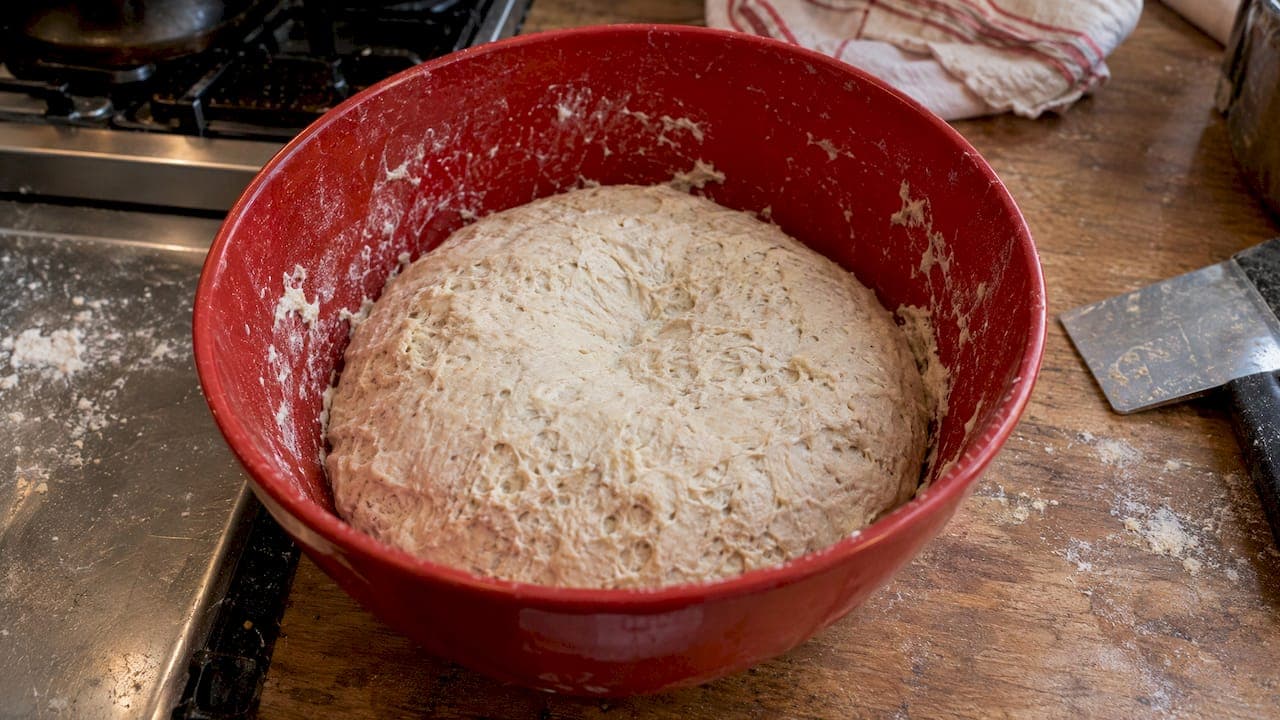
Biga is a stiff Italian preferment made from flour, water and a very small amount of yeast, left to ferment overnight before it goes into the final pizza dough. It gives you a stronger dough, a deeper flavour and a crust with real character. Below you will find how it works, how it compares with poolish and sourdough, a ratio to start from, and a fermentation schedule you can adjust to the temperature of your kitchen.
TL;DR
- Biga is a stiff preferment, usually 50 to 60% water, that ferments for roughly 8 to 16 hours at 15 to 20°C before you mix the final dough.
- Compared with poolish (about 100% hydration), biga builds a stronger dough and a sharper, more complex flavour.
- Biga uses commercial yeast, so it is more predictable than a sourdough starter.
- Start with a 2:1 flour to water ratio, mix without kneading, and look for a slightly domed, bubbly, pleasantly yeasty biga.
- Short on time? We bake our Biga multigrain dough in advance so you can simply order a pizza.
Table of Contents
- What biga is, and why bakers love it
- Biga vs poolish: which one for pizza?
- Biga vs sourdough and levain
- How to make biga at home
- Biga fermentation time and temperature
- From ripe biga to finished pizza
- Our perspective
- Skip the wait and order our biga crust
- FAQ
- Sources
What biga is, and why bakers love it
Have you ever wondered why a pizzeria crust tastes so much richer than a same-day dough? Very often, the answer is a preferment, and in Italy one of the oldest is the biga.
The American Society of Baking describes biga as a stiff preferment, typically 50 to 60% water, made from flour, water and yeast. It strengthens the dough, improves gluten functionality and boosts aroma and flavour. A traditional biga ferments for 8 to 16 hours at 15 to 20°C. When it is ripe, it is domed and just beginning to recede in the centre.
Baker Ken Forkish, quoted on Ooni Canada's blog, puts it this way: a biga is a pre-fermented dough culture made of flour, water and a small amount of yeast, and the long rest builds flavour-producing gas, acids and bacteria that carry into the finished dough.
What a biga does for your crust
Three things matter most to a home baker:
- Flavour. The slow fermentation develops compounds a same-day dough simply cannot reach. Arla Pro points to enhanced flavour as a main benefit of a biga.
- Texture. The same source notes a more extensible dough that is easier to stretch, though it also says biga changes how dough behaves, so handle it gently and avoid overworking it.
- Digestibility. The long fermentation breaks down complex carbohydrates in the flour. An academic study on Pinsa Romana made with a sourdough biga found that a 48-hour fermentation at 16°C gave the lowest predicted glycemic index and the best protein quality indexes of the doughs tested. That study used a specific product and process, so treat it as a sign of what slow fermentation can do, not a promise for every dough.
This is the same thinking behind our own dough. We prepare our Biga multigrain, artificial additive-free dough in advance, because time is the ingredient that cannot be rushed. If you would like the longer story, we explain why biga dough elevates your pizza experience on our blog.
Biga vs poolish: which one for pizza?
This is the comparison most bakers search for, and it comes down to water. Crustology's pre-ferment guide puts biga at 45 to 50% hydration and poolish at 100%. That one difference drives everything else.
| Biga | Poolish | |
|---|---|---|
| Consistency | Stiff, shaggy, crumbly | Wet, batter-like |
| Typical hydration | 45 to 60% | About 100% |
| Dough it produces | Strong, holds gas well | More extensible, easier to stretch |
| Flavour | Sharper, more complex, a little tangy | Rounder, sweeter, wheaty |
| Handling | Needs breaking up into the final dough | Pours and stirs in easily |
Biga favours acetic acid production, which is why its flavour reads as sharper and more acidic than poolish, according to a preferment guide from Pizza Blab. Forkish adds on the Ooni Canada page that a wetter biga makes acetic acid more quickly than a drier one.
For texture, the Canadian blog The Flavor Lab found its biga pizza puffier and more open than a poolish version, with more chew and a deep, rich flavour that reminded the author of sourdough. That is one baker's experiment, but it matches what the technique is known for.
Which should you choose?
- Choose biga if you want a puffy, chewy crust with structure and a pronounced flavour, such as a New York style or a thick, airy rim.
- Choose poolish if you want a lighter, thinner crust that stretches without a fight.
Both are used across Neapolitan and Roman styles, according to That Pizza Kitchen, so neither is the wrong answer. If you are still finding your preferred crust, our guide to artisan pizza dough types walks through the main styles.
Biga vs sourdough and levain
The simplest way to remember it: biga is made with commercial yeast, and sourdough is made with wild yeast and bacteria cultivated in a starter. Pala Pizza's guide notes that wild yeast is trickier to work with and less dependable, and that it is what gives sourdough its own flavour and aroma.

Levain is a French term for a sourdough-style starter, so the comparison with biga is the same as with sourdough. A levain is a living culture you feed and keep going from week to week. A biga is made fresh for each bake and thrown into the dough, with no maintenance in between.
For most home kitchens that is the appeal. You get a good share of the slow-ferment flavour without keeping a starter alive. The two can also be combined: the Pinsa study above used a biga that included sourdough.
For a deeper look at why long fermentation matters at all, see our home cook's guide to the role of fermentation in pizza dough and why dough fermentation affects flavour.
How to make biga at home
Biga is among the easiest preferments to make because there is nothing to knead. You need flour, water and a pinch of yeast.
Ingredients and ratios
The American Society of Baking gives a traditional formula: bread flour at 100%, water at 50 to 60%, and fresh yeast at 0.8 to 1.5% or instant yeast at 0.1%. Mix only until the dough is homogeneous, because full gluten development is not the target.
At home, a common starting ratio is 2:1 flour to water. One example from Pala Pizza uses 500 g flour, 250 g water and 2 g instant dry yeast. Because recipes differ, here is how the published ranges line up:
| Biga style | Hydration | Source |
|---|---|---|
| Traditional, bread flour | 50 to 60% | American Society of Baking |
| US pizza biga | 50 to 60%, as low as 45% | Pizza Today |
Pizza Today adds that with about 0.2 to 0.3% instant yeast and 50 to 60% water, a biga ferments properly in roughly 12 to 18 hours at ambient temperature.
Use a strong flour. Italian Pizza Secrets recommends high-protein flour, above 300W or 13 g of protein, for the biga. Pizza Blab cautions against combining a biga with very strong flours in a way that leaves the dough overly elastic, with a tough, chewy crumb, so match the flour to the style you want.
Step by step
- Weigh the flour, water and yeast. Use cool water, around the temperature of a cool room.
- Stir or squeeze everything together until no dry flour remains. Do not knead. It should look rough and lumpy.
- Cover the bowl or container and leave it to ferment (see the schedule below).
- Check it: the top should be slightly domed, with bubbles on the surface and a mildly fermented, yeasty smell.
- Break the ripe biga into pieces and use it in your final dough.
If you want something easy on a night when you do not have time for a preferment at all, the no-yeast pizza bases for weeknights from a baking mix recipe page are a handy quick option, and a biga is the slower weekend project.
Biga fermentation time and temperature
There is no single correct number of hours, because temperature runs the show. Fond Kitchen offers a clear schedule:
| Temperature | Fermentation time |
|---|---|
| 15 to 16°C | 18 to 24 hours (most flavour development) |
| 18 to 20°C | 12 to 16 hours (the most common approach) |
| 22 to 24°C | 8 to 12 hours |
The American Society of Baking's traditional range is 8 to 16 hours at 15 to 20°C, which sits comfortably inside this table.
Warm kitchen? Use the fridge

If your room is warmer than about 18°C, baker Sanne Littooij of Stadler Made suggests leaving the biga out for 2 to 3 hours, then refrigerating it at 4°C for 16 to 18 hours. She aims for a final biga temperature between 19 and 21°C before mixing.
How to tell it is ready
- It has roughly doubled and the surface is slightly domed.
- It smells pleasantly yeasty, not sharply sour.
- It is just starting to recede in the centre, which signals it is at its peak.
A collapsed structure and an alcoholic, sharp smell suggest it has gone too far. Pizza Today also notes that too much acid over a very long fermentation can affect gluten structure, and that cooler, drier conditions favour acetic acid and a more astringent flavour, while prolonged warmth above about 27°C (80°F) shifts toward a creamier, lactic character.
From ripe biga to finished pizza
Once the biga is ready, you build the final dough around it. Stadler Made describes a method that works well as a template:
- Break the biga into pieces and add about 80% of the water. Cover and rest for 30 minutes.
- Knead for around 10 minutes, then add the remaining water, then the salt, and knead for 5 more minutes.
- Let the dough bulk ferment for 1 to 2 hours.
- Divide into balls of 230 to 260 g and rest at room temperature for 2 to 4 hours.
- Stretch, top and bake.
That source bakes at 400°C, which only a specialised oven reaches. In a home oven, use the highest temperature it offers and a preheated steel or stone. The ideal dough temperature after mixing is 21 to 25°C, according to the same source.
Planning your timeline
A realistic schedule for a Friday pizza night:
- Wednesday evening: make the biga and leave it covered in a cool spot, or refrigerate it per the schedule above.
- Thursday morning: mix the final dough, bulk ferment, then ball it.
- Friday: bring the balls to room temperature a few hours before baking, stretch gently and bake.
Adjust the times to your kitchen. If you are thinking about hydration for the final dough, our piece on the 60 to 70% hydration range is a helpful starting point.
Handling tips
Biga dough can be a little less forgiving to stretch than a same-day dough, so be patient. Let it rest if it springs back, and avoid overworking it. Press from the centre outward and keep the rim intact so the crust keeps its air.
Our perspective
We built HellCrust Pizza around one belief: you get what you pay for, and the best part of a pizza is the part nobody sees being made. Our dough is a Biga multigrain, artificial additive-free dough prepared in advance, so it has time to mature before it ever meets the oven.
To us, that waiting is craftsmanship. A mature dough has a rich, wholesome flavour that you can savour in every bite, and we design our crust to be more fibre-rich and more digestible than a hurried one. The multigrain adds depth, and the slow preparation is our unwavering commitment to doing it properly.
We also believe good pizza should be accessible. That is why we pair that dough with creative deals, Mix & Match options and family-sized specials, plus vegan pizzas and customizable toppings, so a family, a student or a couple on date night can all find something that fits.
If you bake at home, we hope this guide helps you make a beautiful biga. If you would rather have the work done for you, we would be proud to bake it for you.
jaskirat Singh
Skip the wait and order our biga crust
Making a biga is rewarding, but it takes planning. If you want that slow-fermented character tonight, our menu is built on our Biga multigrain, artificial additive-free dough. You can build your own pizza, pick a signature, choose a vegan pizza, or add pastas, wings, dips and desserts. Our app also gives you access to exclusive deals.

See everything on our full menu, or visit HellCrust Pizza to order for delivery or pickup in North Vancouver, Vancouver and West Vancouver. If you like to know how crust choices change your pizza, our piece on hand-tossed vs pan with Biga multigrain is a good next read.
FAQ
What is biga dough?
Biga is a stiff Italian preferment made from flour, water and a small amount of yeast, usually at 50 to 60% hydration. It ferments for hours before you add it to the final dough. The result is more strength, aroma and flavour.
How long should biga ferment?
It depends on temperature. At 18 to 20°C, about 12 to 16 hours is the most common approach, while 15 to 16°C can take 18 to 24 hours and 22 to 24°C only 8 to 12 hours. It is ready when roughly doubled, slightly domed and pleasantly yeasty.
Is biga better than poolish for pizza?
Neither is better for everything. Biga (45 to 50% hydration) builds a strong dough with a sharper, more complex flavour and a chewy, puffy crust. Poolish (about 100% hydration) gives a more extensible dough with a rounder, sweeter flavour.
Is biga the same as sourdough?
No. Biga is leavened with commercial yeast and made fresh for each bake. Sourdough relies on wild yeast and bacteria in a starter that you keep alive and feed. Levain is the French word for that kind of starter.
Do you need to knead a biga?
No. Mix the flour, water and yeast only until everything is combined, then let time do the work. Kneading comes later, when you build the final dough around the ripe biga.
Sources
- Biga, American Society of Baking
- Sourdough Biga Fermentation Improves the Digestibility of Pinsa Romana, MDPI Nutrients
- The Great Debate: Biga vs. Poolish, Ooni Canada
- Guide: Making Pizza with Biga, Arla Pro
- Poolish vs Biga vs Sourdough for Pizza, Crustology
- Biga Preferment Guide, Pizza Blab
- Experiment 98: Pizza with Biga, The Flavor Lab
- Biga vs Poolish, That Pizza Kitchen
- Complete Guide: 100% Biga Pizza Dough, Pala Pizza
- A Biga Preferment, Pizza Today
- Essential guide to biga for pizza, Italian Pizza Secrets
- What Is Biga?, Fond Kitchen
- Biga, Stadler Made
- 3 Fast No Yeast Pizza Bases for Weeknights, Missy Lala