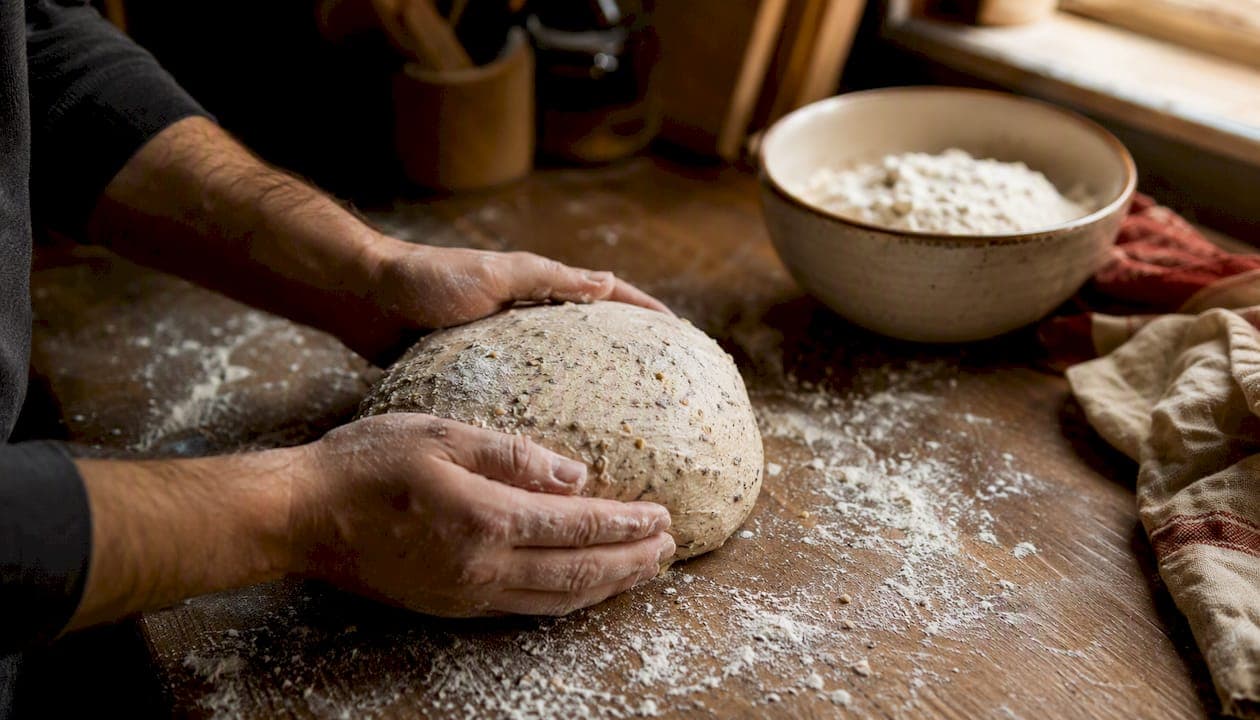
Fermentation changes bread flavour by producing volatile metabolites — alcohols, organic acids, esters, and carbonyls — and by freeing sugars and amino acids that fuel Maillard and caramelisation reactions during baking. That single biochemical cascade is why a slow-fermented loaf tastes complex and a rushed one tastes flat.
- Time and temperature are your most powerful levers: a cold retard of extended duration shifts metabolism toward fruity esters and complex acids, while a shorter warm bulk produces milder, more straightforwardly yeasty notes.
- Culture type matters as much as schedule: yeast (primarily Saccharomyces cerevisiae) drives ethanol and CO₂ production, while lactic acid bacteria (LAB) layer in lactic acid, acetic acid, diacetyl, and ketones — each contributing distinct sensory notes.
- Preferment choice shapes the fingerprint: a stiff biga leans nutty and roasty; a liquid poolish reads sweet and yeasty; a sourdough levain delivers tangy, layered complexity.
Peer-reviewed volatile compound analyses, food-science reviews on Maillard precursor formation, and practitioner guides like Serious Eats all converge on the same conclusion: fermentation is not just about rise. It is the primary flavour-building stage of any bread or pizza dough.
Key takeaways
Fermentation builds flavour by producing volatile metabolites and freeing Maillard precursors — and controlling time, temperature, and culture type gives you direct command over the result.
| Point | Details |
|---|---|
| Metabolites drive flavour | Ethanol, esters, organic acids, and diacetyl produced during fermentation are the primary flavour compounds in finished bread. |
| Cold retard deepens complexity | A 12–72 hour fridge ferment shifts metabolism toward fruity esters and complex acids rather than harsh alcohols. |
| Preferment type shapes the fingerprint | Biga produces nutty and roasty notes; poolish leans sweet and yeasty; sourdough levain delivers tangy, layered complexity. |
| Proteolysis feeds the Maillard reaction | Extended fermentation raises free amino acids that become crust aroma precursors when the dough hits a hot oven. |
| Change one variable at a time | A controlled two-batch experiment (same recipe, one variable changed) is the fastest way to understand and repeat a flavour outcome. |
Table of Contents
- Why dough fermentation affects flavour: the biochemistry behind every bite
- What do the key volatile compounds actually taste and smell like?
- How does fermentation time, temperature, and preferment type change what you taste?
- How does fermentation change dough handling and crumb texture?
- What causes off-flavours, and how do you fix them?
- How can you shape flavour intentionally at home?
- A baker's note on what a chilled biga actually does to a crust
- Authoritative studies and practical readings for deeper study
- Sources
Why dough fermentation affects flavour: the biochemistry behind every bite
The flavour in your finished bread does not come from the oven alone. It is assembled, compound by compound, during fermentation — and the oven simply reveals what the dough has already built.
The process begins the moment water hydrates flour. Amylase enzymes break starch chains into simple sugars (maltose, glucose), while proteases cleave storage proteins into shorter peptides and free amino acids. These are not flavour compounds themselves, but they are the raw material everything else depends on.
Once those sugars and amino acids are available, microbial metabolism takes over. Yeast runs glycolysis, converting glucose into ethanol, CO₂, and a range of secondary metabolites: higher alcohols (fusel alcohols), esters, and small amounts of organic acids. LAB follow a different pathway, producing lactic acid (smooth, milky sourness), acetic acid (sharp, vinegary bite), diacetyl (buttery), and various aldehydes and ketones. The two populations coexist in sourdough and influence each other's output depending on temperature, hydration, and available substrate.
The pathway, simplified, looks like this:
Flour + Water → Enzymatic breakdown (amylases, proteases) → Simple sugars + Free amino acids → Yeast metabolism + LAB metabolism → Volatile metabolites + Organic acids → Maillard/caramelisation reactions in the oven → Final flavour and crust aroma
That final Maillard step is where fermentation's investment pays off visibly. Research confirms that fermentation acts as a kind of predigestion, concentrating the very precursors — reducing sugars and free amino acids — that the Maillard reaction needs to produce hundreds of roasty, nutty, and caramel-like aroma compounds in the crust. A dough that skipped a proper ferment simply has fewer of those precursors available, and the crust shows it in both colour and aroma.
Processing conditions and starter composition can change volatile and amino-acid formation substantially — in controlled trials, total volatile compounds rose from seven- to 100-fold depending on fermentation settings and strain. That range tells you how much flavour potential is sitting untapped in a rushed dough.
What do the key volatile compounds actually taste and smell like?
Understanding which metabolites form — and what they contribute to your senses — lets you bake with intention rather than guesswork. Here is a practical sensory map:
- Ethanol (solventy, slightly warm): produced by yeast glycolysis; mostly bakes off, but at high levels from rapid warm fermentation it can leave a harsh, alcoholic edge in the crumb.
- Higher alcohols / fusel alcohols (solventy, pungent): formed when yeast metabolises amino acids at warm temperatures; a sign of fast, warm fermentation with excess yeast.
- Esters (fruity, floral): created when alcohols react with organic acids; favoured by cooler, slower fermentation — the compounds behind that pleasant fruitiness in a well-retarded dough.
- Diacetyl (buttery, creamy): a LAB metabolite; present in sourdoughs and some poolish-based doughs; adds richness at low concentrations.
- Aldehydes (green, grassy, malty): short-chain aldehydes from lipid oxidation and amino-acid catabolism; contribute malty notes in wheat doughs when kept in balance.
- Lactic acid (smooth, mild sourness, yoghurt-like): the dominant acid in warm sourdoughs and LAB-heavy ferments; rounds out flavour without sharpness.
- Acetic acid (sharp, vinegary): produced by heterofermentative LAB, especially at cooler temperatures with lower hydration; the acid behind a pronounced sourdough tang.
- Succinic acid (mild, savoury umami undertone): a yeast metabolite that also softens gluten — a compound that quietly improves both flavour and dough handling.
- Ketones (buttery, roasted, nutty): produced by certain LAB strains, particularly L. paracasei I1, which trials found generated higher levels of ketones alongside improved buttery and fruity notes; quinoa and Kamut® flours showed distinct volatile fingerprints compared to wheat.
- Sulphur volatiles (eggy, roasted at trace levels): minor contributors in wheat fermentation; at very low concentrations they add depth to crust aroma rather than off-notes.
Pro Tip: Lowering your bulk fermentation temperature from around 26°C to 18–20°C and extending the time by several hours shifts the metabolic balance toward ester formation and away from fusel alcohol production — the practical reason cold-retarded doughs smell fruitier and less harsh.
The Serious Eats guide to proofing bread dough captures this well: slow, chilled fermentations deepen flavour by steering metabolism toward esters and complex acids rather than the harsh alcohols that fast, warm ferments tend to produce. Patience, in baking, is a flavour strategy.
How does fermentation time, temperature, and preferment type change what you taste?
Process choices are flavour choices. Every decision about schedule and method shifts the balance of metabolites your dough produces.
Preferment flavour fingerprints
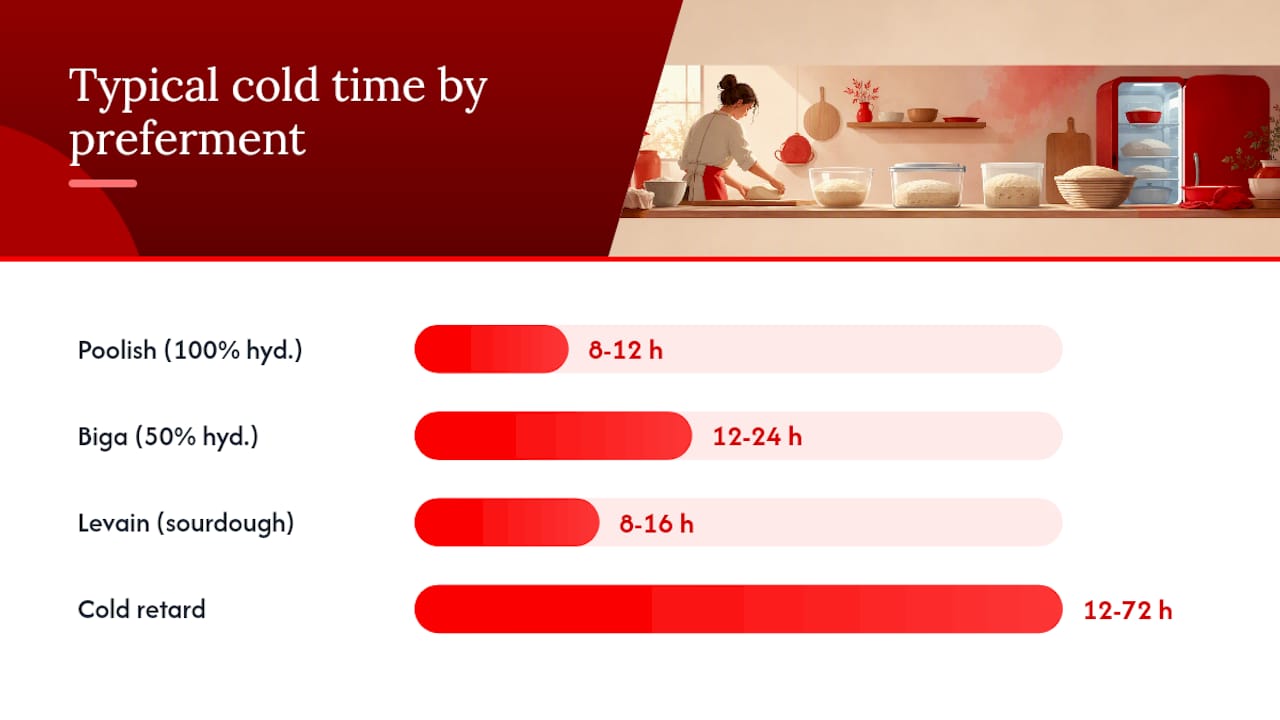
| Preferment method | Typical bulk time | Typical cold time | Dominant flavour notes |
|---|---|---|---|
| Direct (no preferment) | 1–2 hours | None | Mild, simple yeasty; limited complexity |
| Poolish (liquid, 100% hydration) | 8–16 hours at room temp | Optional 8–12 hours | Sweet, yeasty, slightly creamy |
| Biga (stiff, 50% hydration) | 12–18 hours at cool temp | Optional 12–24 hours | Nutty, roasty, mild acidity, complex |
| Levain / sourdough | 4–8 hours active + overnight | 8–16 hours | Tangy, fruity, layered, complex |
| Cold retard (any method) | Standard bulk, then retard | 12–72 hours | Deeper esters, pronounced acids, less harsh alcohol |
Comparative preferment research confirms that biga, poolish, and direct methods produce measurably different dough rheology, volume development, and pH trajectories — mechanical differences that translate directly into distinct texture and flavour outcomes. Stiff biga tends toward a firmer, more structured dough with a lower storage modulus than semiliquid preferments.
How temperature interacts with time
Warmer fermentation (above 24°C) accelerates yeast activity, producing CO₂ and ethanol quickly but generating more fusel alcohols and fewer complex esters. The dough rises fast, but the flavour profile stays relatively simple. Cooler fermentation (12–18°C) slows everything down, allowing enzymatic proteolysis to continue building free amino acids while yeast and LAB shift their metabolic output toward esters and organic acids.
A 2–4 hour warm bulk at 26°C gives you a mild, yeasty result — perfectly pleasant, but not deeply complex. Extend that same dough in the fridge for 24–48 hours and the flavour shifts noticeably: fruitier, more rounded, with a crust that browns more deeply because of the additional Maillard precursors built during the extended enzymatic phase.
- Warm and fast (above 26°C, under 3 hours): mild yeasty notes, simple crumb, less crust colour
- Cool and slow (18–22°C, 8–16 hours): balanced esters and acids, moderate complexity
- Cold retard (4–8°C, 24–72 hours): pronounced fruity/buttery esters, deeper acids, richer crust aroma
For home bakers interested in how artisan preferment types compare in practice, the differences in flavour fingerprint become especially clear when you bake the same recipe with a direct method one week and a biga the next.
How does fermentation change dough handling and crumb texture?
Flavour and texture are built by the same metabolites. The compounds that make your bread taste complex also change how the dough feels in your hands and how the crumb sets in the oven.
Rheology research shows that yeast metabolites — ethanol, succinic acid, glycerol, and glutathione released from yeast cell leakage — soften the gluten network and reduce extensional viscosity. Adding these metabolites directly to unfermented dough reproduced many of the softening effects seen in naturally fermented dough. Succinic acid and glutathione in particular alter the disulphide bonds that give gluten its strength, making the dough more extensible and less resistant to stretching.
Practical signs of fermentation's rheological effects:
- Dough stretches more easily after a long bulk than after a short one — a sign that metabolites have begun relaxing the gluten network.
- Gas retention improves with proper fermentation because a more extensible gluten network can expand around CO₂ bubbles without tearing.
- Slack, sticky dough that won't hold its shape is often a sign of over-fermentation: too much glutathione and acid have degraded the gluten past the point of recovery.
- Tight, resistant dough that tears when stretched usually signals under-fermentation — the gluten network hasn't had time to relax.
Longer fermentation also affects crumb texture measurably: trials found that extended fermentation duration generally reduced crumb hardness and chewiness while altering springiness and cohesiveness, with sensory-optimal results are observed at appropriate yeast concentrations and fermentation times.
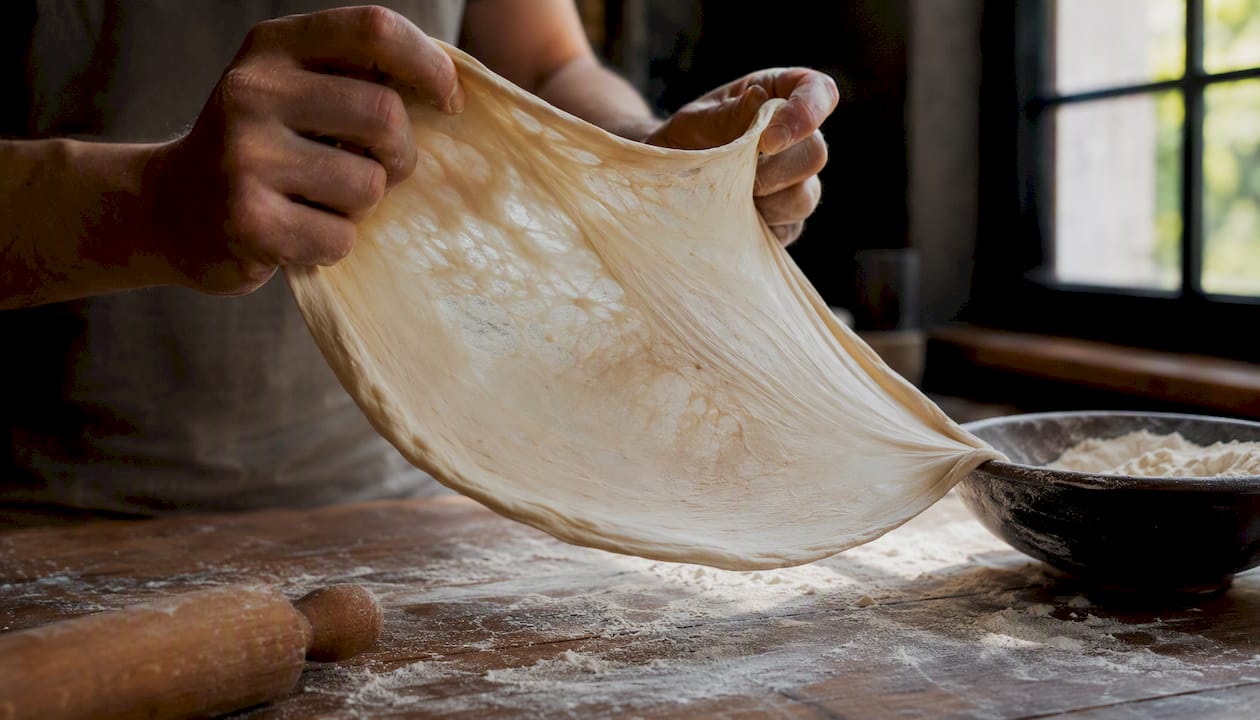
A simple home experiment worth trying: make two identical doughs from the same recipe. Ferment one for 1 hour at room temperature and the other for 18 hours in the fridge. Before baking, stretch a small piece of each between your fingers. The longer-fermented dough will stretch into a thin, translucent membrane with far less resistance. Bake both and compare the crumb: the longer ferment will typically show a more open, irregular cell structure and a deeper-coloured crust.
What causes off-flavours, and how do you fix them?
Most off-flavours in bread and pizza dough trace back to a specific imbalance in fermentation conditions. Identifying the sensory signal points you straight to the cause.
| Off-flavour | Likely cause | Quick fix |
|---|---|---|
| Overly yeasty, raw-dough smell | Under-fermentation or too much yeast | Extend bulk time, reduce yeast by 20–25% |
| Harsh, alcoholic, solventy | Warm over-fermentation or excess yeast | Lower temperature, shorten bulk, reduce yeast |
| Sharp, vinegary sourness | LAB-dominant, cool/low-hydration ferment | Raise hydration, warm the dough slightly, shorten ferment |
| Flat, floury, no aroma | Severely under-fermented | Allow full bulk until dough passes the poke test |
| Soapy or rancid | Lipase activity from old flour or over-proofed dough | Use fresh flour, shorten proof, check storage |
Two quick sensory checks before baking tell you a great deal:
- Smell the unbaked dough: a pleasant, slightly alcoholic, yeasty aroma with mild acidity is a good sign. A sharp, vinegary punch or a flat, floury smell both signal imbalance.
- Taste a small pinch of raw dough: mild, slightly tangy, and faintly sweet is ideal. Harsh bitterness or a strong alcohol hit suggests over-fermentation; a raw, starchy taste points to under-fermentation.
The poke test remains the most reliable physical check: press a floured finger about 1 cm into the dough. If the indent springs back slowly and partially, the dough is ready. If it springs back immediately, it needs more time. If it doesn't spring back at all, it has gone past its peak.
Simple corrective steps: adjust proof temperature by 2–4°C, reduce yeast by 20–25% for the next bake, add salt at the correct stage (salt slows both yeast and LAB activity, so timing matters), or perform a brief knockback and reshape to redistribute gases and give the gluten a second chance to recover.
How can you shape flavour intentionally at home?
The most reliable way to understand fermentation's flavour impact is to change one variable at a time and taste the result. Here is a structured approach:
- Choose your variable. Pick one: fermentation time, temperature, or preferment type. Keep everything else identical — same flour, same hydration, same salt percentage, same baking temperature.
- Run two batches side by side. For a time experiment: ferment batch A for 2 hours at 24°C and batch B for 18 hours in the fridge at 4°C. For a temperature experiment: ferment both for 8 hours, one at 18°C and one at 26°C. For a preferment experiment: make one batch with a direct method and one with a biga or poolish built the night before.
- Taste and document. After baking, note crust colour, crumb structure, and three sensory descriptors for each loaf. Over three or four bakes, patterns become clear and repeatable.
A quick fridge-proofing checklist:
- Hydration at 65–75% (lower hydration slows fermentation and favours acetic acid; higher hydration speeds it and favours lactic acid)
- Reduce yeast by 30–50% compared to a same-day recipe
- Cover the container tightly to prevent skin formation
- Taste the dough at 12 hours, 24 hours, and 48 hours to track flavour development
- Use the poke test before baking, not the clock, as your final readiness signal
For yeast scaling by temperature, a practical rule of thumb: for every 5°C drop in fermentation temperature, roughly double the fermentation time to achieve a comparable level of activity. This is not a precise formula, but it gives you a reliable starting point when adapting a room-temperature recipe for the fridge.
Pro Tip: Start your bake in a very hot oven (250–260°C) with steam for the first 15–20 minutes. The burst of heat drives rapid Maillard reactions on the crust, converting the fermentation-produced amino acids and sugars into those roasty, caramel-like aroma compounds. Finish without steam to allow the crust to crisp and brown fully. The fermentation built the precursors; the oven temperature determines how completely they express.
The gourmet flavour profiles that distinguish an artisan pizza from a forgettable one almost always trace back to this combination: a well-managed ferment that built the precursors, and a hot, confident bake that converted them.
A baker's note on what a chilled biga actually does to a crust
There is a moment when you pull a biga-based pizza from a very hot oven and the aroma hits you before you even see the crust properly. It is roasty and nutty with a faint fruitiness underneath — noticeably different from a same-day direct dough, even when every other variable is identical. That difference is not marketing language. It is the Maillard reaction working with a richer supply of precursors that the biga built over 16–18 hours of slow, cool fermentation.
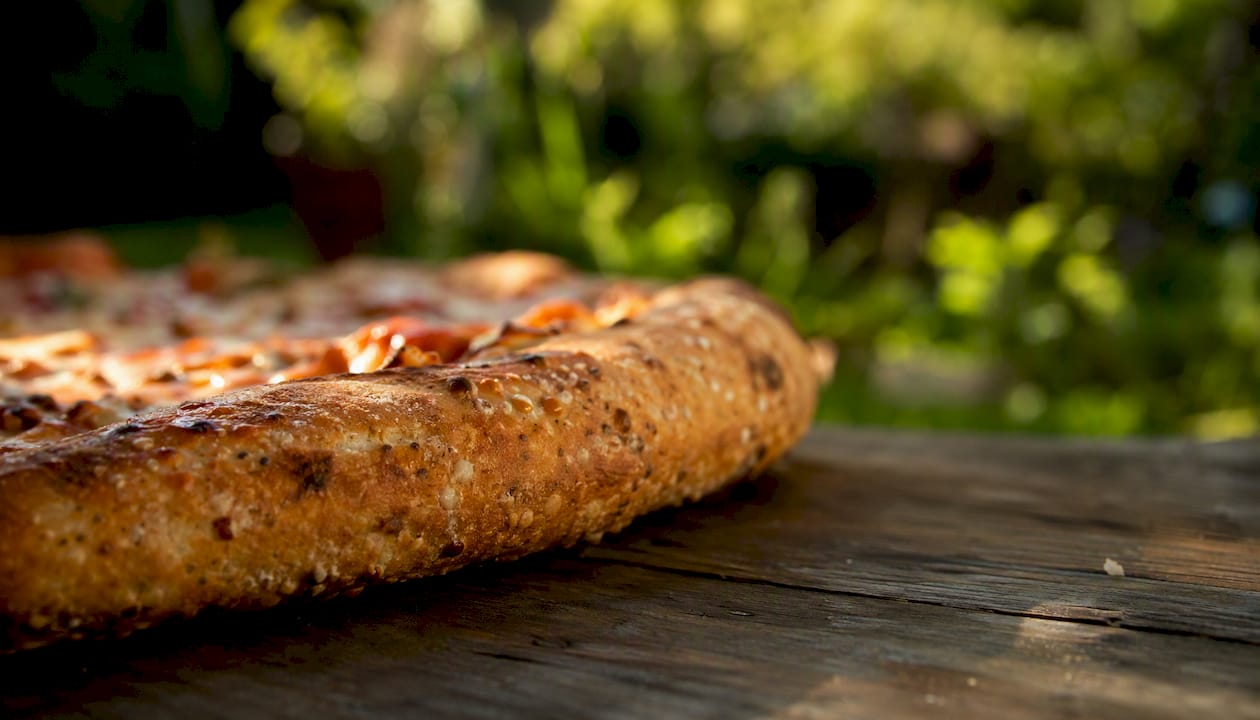
We have seen this play out consistently with Hellcrustpizza's multigrain biga approach. The stiff preferment, held at a cool temperature, concentrates free amino acids and simple sugars over time. When that dough hits a hot oven, the crust develops colour and aroma faster and more deeply than a direct dough would. The biga fermentation process is not a shortcut to flavour — it is a deliberate investment of time that pays off in every bite.
The practical takeaway for home bakers: if your pizza crust tastes pleasant but unremarkable, the fermentation stage is almost certainly where the complexity is missing. A longer, cooler ferment with a preferment like biga or poolish will shift the flavour more than any topping change ever could.
Authoritative studies and practical readings for deeper study
These are the primary sources behind the claims in this guide. Each one is worth reading if you want to go further.
- Flavoring Production in Kamut®, Quinoa and Wheat Doughs Fermented by Lactobacillus paracasei, Lactobacillus plantarum, and Lactobacillus brevis — SPME-GC/MS volatile compound analysis showing how LAB strain and flour type shift buttery, fruity, and roasted notes.
- Influence and Interactions of Processing Conditions and Starter Culture on Formation of Acids, Volatile Compounds, and Amino Acids in Wheat Sourdoughs — Response-surface study demonstrating that volatile compounds can rise many times depending on fermentation settings and strain.
- Influence of Yeast Concentrations and Fermentation Durations on the Physical Properties of White Bread — Empirical data linking fermentation time and yeast level to crumb texture and colour metrics.
- Rheological Impact of Main Yeast Metabolites on Wheat Flour Dough — Demonstrates how ethanol, succinic acid, glycerol, and glutathione soften gluten and reduce extensional viscosity.
- Contribution of Sourdough Lactobacilli, Yeast, and Cereal Enzymes to the Generation of Amino Acids in Dough Relevant for Bread Flavor — Links enzymatic proteolysis and starter activity to free amino acid levels and Maillard precursor availability.
- IntechOpen: Fermentation and Maillard Precursor Discussion — Food-science review framing fermentation as predigestion that concentrates crust aroma precursors.
- Evaluation of the Effects of Different Fermentation Methods on Dough Characteristics — Comparative preferment study (biga, poolish, direct) measuring rheology, volume development, and pH differences.
- Serious Eats: How to Make and Proof Bread Dough — Practitioner guide summarising how cold retardation deepens flavour and why patience is a flavour strategy.
Sources
- Frontiers | Flavoring Production in Kamut®, Quinoa and Wheat Doughs Fermented by Lactobacillus paracasei, Lactobacillus plantarum, and Lactobacillus brevis: A SPME-GC/MS Study
- Influence and Interactions of Processing Conditions and Starter Culture on Formation of Acids, Volatile Compounds, and Amino Acids in Wheat Sourdoughs
- Influence of yeast concentrations and fermentation durations on the physical properties of white bread
- Rheological impact of main yeast metabolites on wheat flour dough (abstract)
- Contribution of Sourdough Lactobacilli, Yeast, and Cereal Enzymes to the Generation of Amino Acids in Dough Relevant for Bread Flavor
- Serious Eats — How to make and proof bread dough
- IntechOpen chapter — fermentation and Maillard precursor discussion
- Evaluation of the Effects of Different Fermentation Methods on Dough Characteristics