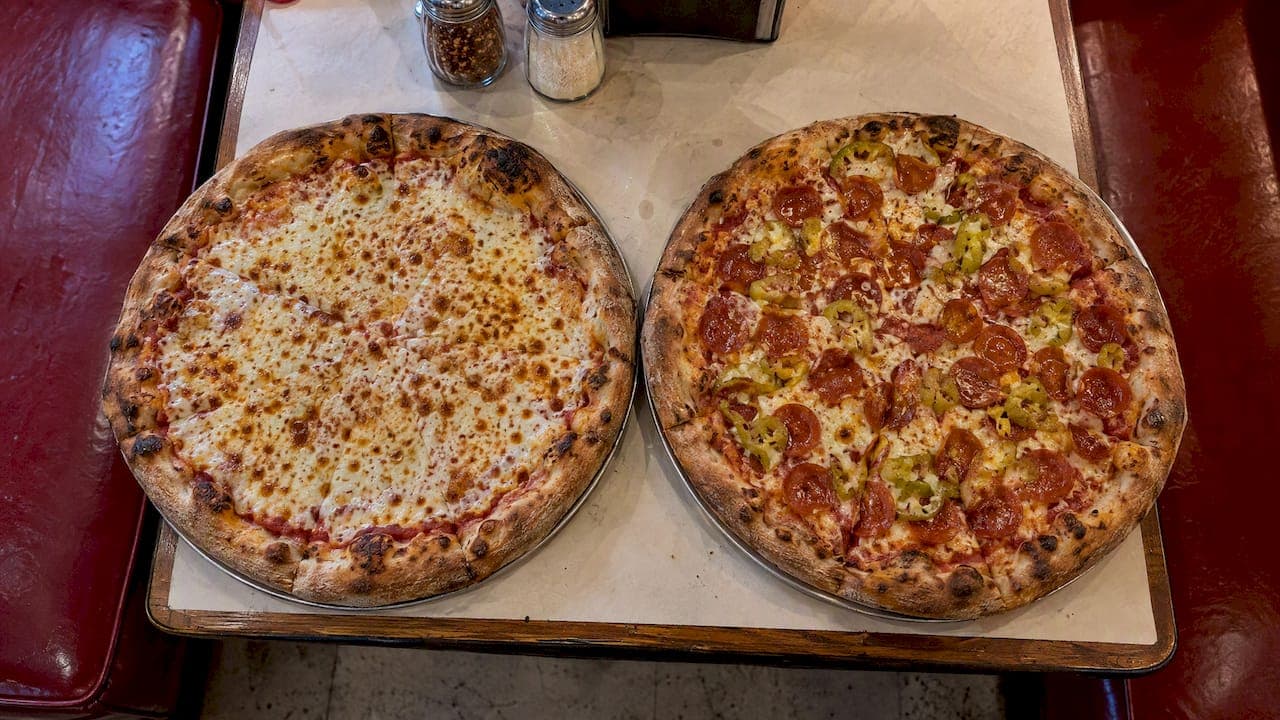
Choose extra cheese when you want a creamier, more indulgent slice, and extra toppings when you want flavour variety and contrast. Your crust decides the final call: thin crusts want restraint, thicker ones can carry more. A medium cheese pizza slice runs 210 kcal, and our Create Your Own Pizza makes testing both easy.
TL;DR:
- Per slice, cheese has 210 kcal and 515 mg sodium; vegetables have 193 kcal and 482 mg, while meat has 250 kcal and 629 mg sodium.
- Thin and New York style crusts can sag under heavy loads, while pan, Sicilian, and deep dish bases support more cheese or toppings.
- Keep toppings to two or three complementary choices; salt and dry watery vegetables or cook them first to reduce sogginess.
- Block, low moisture mozzarella melts and stretches better than pre shredded cheese, whose anti caking starches can interfere with an even melt.
- For delivery, put your key request first, ask for light sauce or a well done bake, and keep heavy additions off thin crust.
Table of Contents
- How do you choose extra cheese or extra toppings in 30 seconds?
- What does extra cheese do to taste, texture and nutrition?
- How do extra toppings change flavour, structure and nutrition?
- Which crust styles can handle extra cheese or extra toppings?
- How do you decide step by step when ordering?
- What do we recommend when you add extras?
- Where can you try both choices with HellCrust Pizza?
- FAQ
- Sources
How do you choose extra cheese or extra toppings in 30 seconds?
Think of it as richness versus freshness. Extra cheese gives you stretch, creaminess and a savoury, comforting bite. Extra toppings give you contrast: something salty, something sweet, something crisp or juicy. Neither is "better" in the abstract. The better pick is the one that suits the crust, the crowd and your mood tonight.
Run through this quick list before you order:
- Craving comfort? Go with extra cheese. It delivers the gooey, indulgent slice most people picture.
- Craving variety? Go with two or three complementary toppings, such as pepperoni with roasted peppers.
- Feeding kids or a party? Extra cheese is the safe crowd-pleaser, and a half-and-half split covers mixed tastes. If you are planning a larger gathering, a catering team such as this office lunch and party food provider shows how group orders often balance one familiar option with a few varied ones.
- Late-night craving? Extra cheese tends to satisfy fastest, since it is rich and filling.
- Health-minded? Lean on vegetable toppings and a normal amount of cheese.
- Sharing with mixed tastes? Pick toppings, since a few distinct flavours give everyone something to like.
- Thin crust? Keep both cheese and toppings modest so slices stay crisp.
- Thick or pan crust? You have room for more of either.
Two rules cover most situations. First, match the load to the crust, because a delicate base cannot hold what a sturdy one can. Second, stop at two or three toppings that work together. As Kenji López-Alt puts it in his Serious Eats guide, great pizza is about restraint, and that holds whichever extra you choose.
What does extra cheese do to taste, texture and nutrition?
More cheese adds creaminess, mouthfeel and that deep savoury note people call umami. Done well, it turns a good slice into a comforting one. Done too heavily, it backfires. López-Alt warns that excess cheese weighs down a slice, turns the mouthfeel greasy and can mask the sauce and crust you came for. His ideal is a loose matrix of cheese rather than a uniform blanket.
There is a cooking side to this too. A thick layer of cheese holds moisture and fat against the dough, so the crust can struggle to dry out and brown, especially on thinner bases. You end up with a pale, soft centre under a lot of melted cheese. If you have ever lifted a slice and watched the tip flop, this is usually why.
Nutrition at a glance: A medium (12-inch) cheese pizza comes to 210 kcal, 8 g of fat and 515 mg of sodium per 1/6 slice, while a cheese, meat and vegetable version reaches 250 kcal, 12 g of fat and 629 mg of sodium for the same slice. Extra cheese pushes you toward the heavier end of that range.
Health Canada's guidance asks people to be mindful of prepared foods that are high in sodium and saturated fat, and notes that lower-fat, lower-sodium cheese options can help trim excess intake. That does not mean skipping cheese. It means treating "extra" as a deliberate choice rather than a default.
Which cheese you get matters as much as how much. Low-moisture mozzarella melts best on most pizzas, and grating it from a block beats the bag. Pre-shredded cheese carries anti-caking starches that get in the way of a proper melt, while full-fat block mozzarella gives you the stretch people want. If you like to explore blends beyond mozzarella, our guide to cheese varieties used on gourmet pizzas walks through how different cheeses melt and taste.
Pro Tip: If you want extra cheese without the grease, ask for it spread evenly rather than piled in the centre, and skip heavy, oily toppings on the same pie.
How do extra toppings change flavour, structure and nutrition?
Toppings bring contrast, and contrast is what keeps the last slice as interesting as the first. The trick is synergy over quantity. López-Alt's advice is that two or three well-prepared, complementary toppings usually beat a long list of unrelated ones. Pepperoni with pickled peppers, mushrooms with caramelised onion, sausage with fennel: each pairing has a reason to exist.
Structure is where toppings can go wrong. Raw vegetables release water as they bake, and that moisture can leave the crust soggy unless the vegetables are salted and drained or cooked first. Meats add fat, which flavours the pie but also makes it heavier. Piled high, either one turns a crisp slice into a floppy one. If wet toppings are your thing, our 12 topping combos for avoiding soggy crusts show which pairings hold up.
Nutrition shifts with what you pick. In the Canadian figures, a medium 12-inch slice with meat added reaches 629 mg of sodium and 250 kcal, while a vegetable version sits near 193 kcal and 482 mg of sodium, against 515 mg for plain cheese. So vegetables sit lighter than cheese alone, and meat sits heavier. Neither is forbidden, but it helps to know where your pie lands.
Toppings that add punch without adding weight:
- Fresh basil or arugula added after the bake, for peppery brightness.
- Roasted red peppers, which bring sweetness and little moisture.
- Thinly sliced onion, which crisps at the edges.
- Pepperoni, which crisps and flavours the cheese beneath it.
- Pickled jalapeños, for heat and acidity that cut through richness.
- Pre-cooked mushrooms, which have already given up their water.
Quality counts here too. Fresh, well-handled ingredients taste better and behave better in the oven, which is why we wrote about why fresh ingredients matter for better pizza.
Pro Tip: Salt sliced zucchini, mushrooms or tomatoes and pat them dry before they go on the pie. You will get the flavour without the puddle.

Which crust styles can handle extra cheese or extra toppings?
Crust is the deciding factor, because it sets how much weight a slice can carry. Serious Eats makes the point plainly: thin and New York-style crusts are delicate and can flop under a heavy load, while Sicilian and pan crusts are far sturdier. Piling on too many toppings or too much cheese tends to create a greasy, heavy pie, though thicker bases forgive more.
Here is how that plays out in practice:
- Thin or New York-style: Keep both extras modest. A little more cheese or one extra topping is fine, but two heavy additions will sag the slice.
- Pan, Sicilian or deep-dish: These bases can take extra cheese, extra toppings, or both, since the thicker dough supports the weight.
- Neapolitan-style: The soft, quickly baked centre is best left lightly dressed, so one or two toppings is plenty.
- Heartier, multigrain doughs: A well-built dough with some structure, like our Biga multigrain crust, stands up better to toppings than a flimsy base.
Cooking method helps as well. Par-baking the crust before adding cheese, or giving it a little extra time in a properly hot oven, can improve browning and keep a heavy topping load from leaving the middle underdone. When you order delivery or takeout, you cannot control the oven, but you can ask for light sauce, or for wet toppings to go on in smaller amounts.
Our rule of thumb is simple: match your extra to the crust, then ask for small adjustments if the pie looks like it will be heavy. For more on how dough thickness changes the eating experience, see our guide on choosing by taste and dough, and for tweaking the base itself, our piece on customizing crust toppings is a useful companion.
How do you decide step by step when ordering?
Ordering well is easier if you follow a clear sequence. Here is the flow we suggest.
- Decide your main goal. Are you after indulgence, variety, a lighter meal or something to share? Pick one priority and let it steer everything else. If you want comfort, lean toward cheese. If you want contrast, lean toward toppings.
- Check the crust and style on the menu. Thin bases favour restraint, and thicker or pan bases give you room. Choose an extra that fits the base you have chosen, not the pizza you imagine.
- Choose your extra. For cheese, ask for a normal to generous layer of a good melting cheese. For toppings, pick two or three that complement each other, such as a salty meat with something sweet or sharp. If a topping is wet, such as fresh tomato or mushroom, plan for it to be cooked or drained first.
- Add clear order notes. Short, specific requests work best: "light sauce," "extra cheese spread evenly," "cut the toppings to three," or "well done" if you like a firmer crust. Delivery pizzas travel and steam in the box, so a slightly crisper bake helps them arrive in better shape.
- Sense-check the total. Before you confirm, ask whether the pie still feels balanced. If you picked extra cheese and three heavy toppings on a thin crust, drop one. Balance beats volume nearly every time.
- Consider splitting. If people at the table disagree, a half-and-half order, or two smaller pizzas, lets you test cheese-forward and topping-forward side by side and learn which you prefer.
Pro Tip: When ordering from a delivery or takeout menu, put your most important instruction first in the notes field, since kitchens read quickly. "Extra cheese, light sauce, well done" beats a long paragraph.
If you are not sure where to start, try one cheese-forward pie and one topping-forward pie next time. Comparing them in one sitting teaches you more than any article can, and it takes the guesswork out of your next order.
What do we recommend when you add extras?
We build our pizzas on a Biga multigrain dough, made without artificial additives and prepared in advance. That structure matters for this debate.

Here is how we would order two ways. For a cheese-forward, indulgent pie, we would keep the toppings to one or two, such as mushrooms and a little onion, and let the cheese carry the flavour. For a balanced, topping-focused pie, we would keep the cheese at a normal amount and choose three toppings that play off each other, say a salty meat, a sweet roasted vegetable and something with a little heat. Either way, we would not pile on more than the base can support.
We also like to remind people that value matters. Our app carries exclusive offers, and our family-sized options and Mix & Match deals make it easy to try both approaches without overspending. You get what you pay for, and we want every bite to feel worth it.
— jaskirat Singh
Where can you try both choices with HellCrust Pizza?
The easiest way to settle the cheese-versus-toppings question is to taste both. Our Create Your Own Pizza lets you build the pie you have been imagining, adding extra cheese, a few well-chosen toppings, or one of each on separate pizzas. Start there on our menu page, and see which one you reach for first.
- Create Your Own Pizza: choose your toppings and test your extra-cheese idea on our Biga multigrain crust.
- App-exclusive offers: save on your next order when you order through our app.
- Family-sized options and Mix & Match specials: try a few combinations without overspending.
Ready to order? Browse the full HellCrust menu and build your pie today.
FAQ
Do you put cheese on pizza first or toppings?
Most pizzas go sauce first, then cheese, then toppings, so the cheese melts over the sauce and holds the toppings in place. Some cooks put delicate toppings or fresh herbs on after the bake so they stay bright. The right order depends on the style and the topping.
What is the difference between pizza cheese and mozzarella cheese?
Mozzarella is a specific cheese, and "pizza cheese" is usually a blend or a low-moisture mozzarella chosen to melt well. Low-moisture mozzarella grated from a block tends to melt better than bagged shreds, because pre-shredded cheese contains anti-caking starches that interfere with melting.
Is extra cheese a topping or an add-on?
It depends on the restaurant. Some menus list extra cheese as a topping, while others treat it as a separate add-on with its own price. Check the menu or ask before ordering, so you know whether it counts toward your topping limit.
Which is healthier: extra cheese or extra toppings?
It depends on what you add. Vegetable toppings generally sit lighter than extra cheese, and meat toppings sit heavier, according to Canadian nutrient data comparing cheese, meat and vegetable slices. Moderation matters more than the choice itself.