
Most pizza franchise systems in Canada charge ongoing royalties of about 5% to 6% of monthly gross sales, with advertising fund contributions billed separately on top. The franchise disclosure document is the only place to confirm exact figures for a given system, so treat industry ranges as a planning baseline rather than a quote.
TL;DR:
- Define gross sales in writing before forecasting, because food, beverage, and delivery revenue may count before deductions, while inclusions vary by franchisor.
- In regulated provinces, the disclosure document must arrive at least 14 days before signing or paying a nonrefundable deposit; incomplete disclosure may create rescission rights.
- Lenders may expect cash reserves covering six to twelve months, so forecast both recurring charges and test whether weaker sales can cover them.
- Ask about temporary royalty relief during opening and territory protections, but scrutinize gross sales definitions, advertising fund audit rights, termination clauses, and rate increases.
Table of Contents
- Typical royalty rates: what numbers to expect and why they vary
- How royalties are calculated and billed
- Advertising fund contributions and other ongoing fees
- Canadian disclosure rules that govern your royalty terms
- How royalties shape your margins, break-even timing and cash flow
- Negotiation levers and fee variations worth raising
- What royalties mean for your long-term growth potential
- Initial costs and timeline items for your financial projections
- Common royalty payment schedules and deadlines
- Legal considerations specific to Canadian royalty agreements
- Publisher perspective: how we approach royalties and franchise support
- Ready to look into a HellCrust Pizza franchise?
- FAQ
- Sources
Typical royalty rates: what numbers to expect and why they vary
The common benchmark across Canadian pizza systems sits at 5% to 6% of gross sales, though the full range stretches from roughly 3% at the low end to 10% or more in some systems. The Canadian Franchise Association frames the royalty as a right-to-use fee for the trademark and operating system, one that scales with how well a location performs rather than a flat tax on opening the doors.
Where a system lands within that band usually comes down to a few practical factors.
- The depth of head-office support, including site selection, training and ongoing operations coaching.
- How tightly the supply chain is managed, since centralized purchasing and dough production add cost but also consistency.
- The scope of national versus local marketing, which shapes how much the advertising fund needs to do.
- The overall size and maturity of the system, since larger networks can sometimes spread fixed costs further.
A lower royalty can mean a leaner head office with less hands-on support. A higher one often funds a stronger supply chain and a marketing budget that can compete for attention in a crowded market.
How royalties are calculated and billed
Royalties are almost always calculated on gross sales, meaning total revenue from food, beverages and delivery fees before most deductions, though exact inclusions and exclusions vary by franchisor and should be defined precisely in the agreement. Three billing structures show up across the industry.
- Fixed percentage, where royalties are calculated as a share of gross sales, regardless of volume.
- Tiered percentage, where the rate rises or falls as monthly sales cross set thresholds, rewarding higher-volume stores or easing pressure on slower ones.
- Flat fee, a set dollar amount per period rather than a percentage. It's uncommon in pizza and can create real risk in slow months because the fee doesn't shrink when sales do.
A percentage-based royalty means the amount owed rises or falls with the store's gross sales. The percentage structure means the dollar amount always tracks the store's actual performance.
Pro Tip: Ask for the exact wording of "gross sales" in writing before you model any projections, since small exclusions can shift your numbers more than the royalty rate itself.
Advertising fund contributions and other ongoing fees
Advertising and marketing fund contributions are billed separately from royalties, typically around 2% to 3% of gross sales, and fund the campaigns, brand assets and local promotions that drive traffic to every location in the system. Beyond royalties and advertising, most agreements layer in a handful of other continuing charges.
- Technology or point-of-sale subscription fees tied to the ordering platform.
- Training fees for new staff or refresher sessions as the system evolves.
- Renewal or transfer fees when an agreement term ends or ownership changes.
- Local marketing levies for cooperative advertising in a specific territory.
You're entitled to ask how the advertising fund is spent and audited. A system with clear marketing fund reporting rights gives franchisees visibility into where those dollars actually go.
Canadian disclosure rules that govern your royalty terms
Several provinces, including Ontario, British Columbia and Manitoba, require a franchise disclosure document under legislation such as Ontario's Arthur Wishart Act, and that document must reach a prospective franchisee at least 14 days before signing any agreement or paying a non-refundable deposit. Miss that window, or receive an incomplete document, and the franchisee may hold statutory rescission rights.
The disclosure document itself is meant to spell out upfront and ongoing costs, including the royalty formula, advertising contributions, technology fees and training costs, along with any payments the franchisor receives from related parties or suppliers. Before you sign anything, work through a short checklist.
- Locate the specific item sections that itemize recurring fees and their exact calculation method.
- Request a written definition of gross sales so your projections match the franchisor's math.
- Have a franchise lawyer and an accountant review the document, not just skim it.
Our own article on what to check in Item 5 and Item 6 walks through the franchise fee versus royalty distinction in more detail, which is worth a read before any meeting with a franchisor.
How royalties shape your margins, break-even timing and cash flow
A royalty percentage comes off the top of gross sales, which means it bites hardest during slow months or while a new location is still building its customer base. The same royalty rate can have a different cash-flow impact in a strong sales month than during a slower ramp-up period, even though the percentage never changes.
A disclosure document is often the clearest early signal of long-term affordability: reviewing the fee structure before signing helps you see how even a modest 5% to 6% royalty can materially affect net margins over a full year.
Build royalties and advertising contributions into every monthly forecast line, not as an afterthought at the bottom. Many lenders expect franchisees to carry a 6 to 12 month cash buffer to cover slow stretches without missing payments on either the royalty or the loan itself.
Pro Tip: Talk to existing franchisees about their actual margins after royalties, then stress-test your pro forma using sales assumptions below your optimistic estimate.
Our break-even checklist for pizza franchises outlines realistic ramp-up windows that help set expectations before the first invoice arrives.
Negotiation levers and fee variations worth raising
Some elements of a franchise fee structure have a little give, especially for a franchisee opening in a new or underdeveloped territory. It rarely hurts to ask.
- Promotional royalty relief during the first few months after opening, sometimes offered to ease the ramp-up period.
- Reduced initial franchise fees for a pilot store in a territory the franchisor wants to prove out.
- Limited territory carve-outs that protect a new location from immediate internal competition.
The core ongoing royalty percentage and the national marketing fund terms are usually fixed in established systems, since they fund the infrastructure every location depends on. What deserves your closest attention in the contract itself includes the definition of gross sales, your audit rights over the advertising fund, the conditions for termination due to non-payment, and any clause allowing the royalty rate to escalate over time.
What royalties mean for your long-term growth potential
A royalty structure isn't just a monthly line item, it's a long-term partner in your profitability. Over time, differences in royalty rates can add up and affect how much capital you have available to reinvest in renovations, staff training or another location.
Franchisees who understand this early tend to budget more conservatively and build growth plans around realistic after-royalty margins rather than top-line sales figures. A system with a well-run advertising fund and strong supply-chain support can help offset a higher royalty by driving more consistent traffic and reducing the day-to-day cost of running the store, which can matter throughout the agreement.
Growth potential also depends on how the franchisor treats multi-unit operators. Some systems may offer reduced royalty rates or fee credits to franchisees who open additional locations. Others hold the rate flat regardless of how many stores you operate. Either way, the royalty structure you sign today is the one you'll be living with when you're deciding whether to expand, sell or simply hold steady, so it deserves the same scrutiny as your lease or your equipment financing.
Initial costs and timeline items for your financial projections
Royalties only start once a store is open and selling, so your financial projections need to account for everything that happens before that first sale. A realistic projection typically includes the initial franchise fee, build-out and leasehold improvements, kitchen equipment such as ovens and refrigeration, initial inventory, signage, point-of-sale technology and a training period before opening day.
Capital equipment is often one of the larger line items, particularly for pizza concepts where oven specification affects both throughput and product quality. It's worth budgeting carefully for commercial oven costs alongside the more obvious build-out expenses, since equipment choices made early can affect both capacity and ongoing utility costs.
Your timeline should also map out when each cost lands relative to opening day: lease signing and deposit, permitting and build-out, equipment installation, staff hiring and training, and a soft-opening period before the grand opening. Some franchisors require training to be completed before a location can open, which can add time to the schedule. Building these milestones into your pro forma, alongside realistic timing for when revenue (and royalties) actually begin, gives you a far more accurate picture than simply totalling the costs without a calendar attached.

Common royalty payment schedules and deadlines
Most Canadian pizza franchise systems bill royalties on a monthly schedule, calculated against the prior month's gross sales and due within a set number of days, often between 5 and 15 days after month end. Some systems instead invoice periodically, bundling multiple periods of sales into a single calculation and payment, which can simplify bookkeeping but requires disciplined cash management.
Many point-of-sale systems now calculate and remit royalties automatically, deducting the percentage owed directly from sales data rather than waiting for a manual reconciliation. That automation reduces the chance of a missed payment, but it also means the deduction happens whether or not the month was a strong one, so your cash flow planning needs to assume the royalty comes off the top every single day, not just at month end.
Whatever the schedule, missing a payment deadline typically triggers late fees and, in the agreement's more serious clauses, can be treated as a default that puts the franchise relationship at risk. Mark every royalty due date on your calendar the same way you'd track a loan payment, because franchisors treat it with the same seriousness.
Legal considerations specific to Canadian royalty agreements
Royalty terms in a Canadian franchise agreement don't exist in isolation from the rest of the disclosure framework. Courts and legal commentary have repeatedly emphasized that complete and timely disclosure matters as much as the numbers themselves, since incomplete or piecemeal disclosure around fees has led to rescission remedies in Canadian case law.
A Canadian disclosure document typically includes initial establishment costs, recurring fees, any earnings projections and financing terms the franchisor offers, which means your royalty obligation should never be reviewed in isolation from the rest of the financial picture. Independent legal and financial advisers consistently recommend reviewing royalty structures against your own projected gross sales for the specific location, not just against the system-wide average, since local market conditions can change the real-world impact of the same percentage.
Before signing, confirm which province's disclosure legislation applies to your situation, whether the 14-day clock has been properly triggered, and whether any verbal promises about royalty relief or marketing support appear in writing. A royalty rate that looks reasonable on paper can still carry legal risk if the surrounding disclosure obligations weren't met.

Publisher perspective: how we approach royalties and franchise support
We built our franchise structure around a simple idea: royalties and fees should fund things a franchisee can actually feel, not just head-office overhead. Prospective franchisees can ask about our franchise opportunity before making any commitment.
We'd encourage you to sit down with an independent lawyer and accountant once you have those materials in hand. A second set of eyes, one with no stake in the deal, is worth more than any sales pitch.
— jaskirat Singh
Ready to look into a HellCrust Pizza franchise?
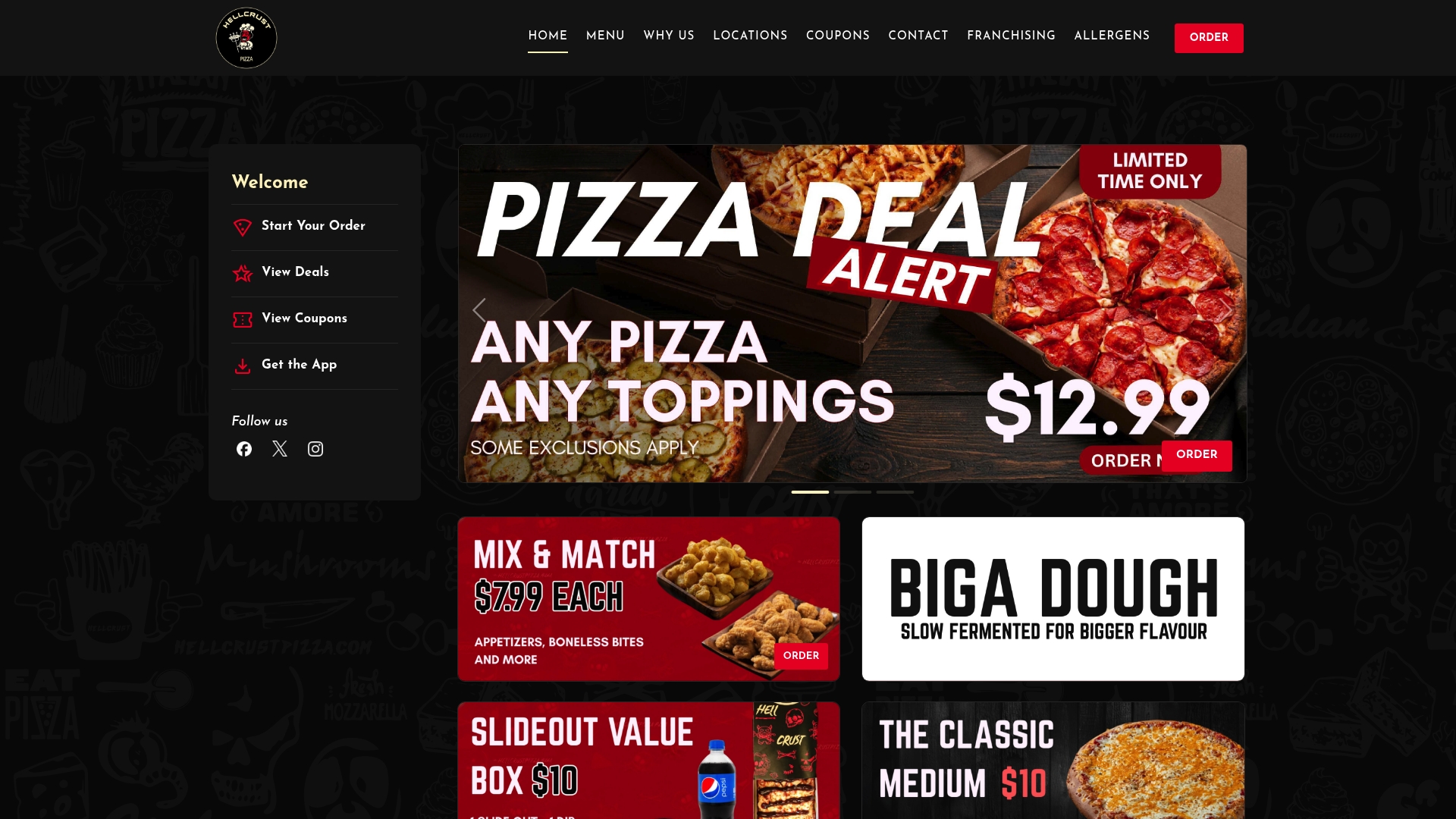
We know the appeal of franchising with us comes down to what you're actually getting for the fees: a dough process built on Biga multigrain, artificial additive-free preferment, a menu that already includes vegan and gluten-free options, and deals like Mix & Match.
If you're ready to look closer, here's where to start.
- Request our franchise disclosure document and review every itemized fee section, royalties included, before any call.
- Arrange a discovery conversation with our franchise team to talk through territory and timeline.
- Bring in an independent lawyer and accountant to review the agreement alongside you.
Browse our current menu and product lines to get a feel for what you'd be bringing to your own community, from Signature Pizzas to Baked Pasta, before your first conversation with us.
FAQ
What is a typical royalty rate for a pizza franchise in Canada?
Most Canadian pizza franchise systems charge 5% to 6% of monthly gross sales in ongoing royalties, though some systems range from about 3% up to 10% or more. The exact figure for any specific brand appears in its franchise disclosure document, which is the only reliable source for confirming terms.
How much does a Domino's franchise owner make?
Specific earnings figures for individual franchise brands aren't publicly listed and vary widely by location, sales volume and local costs. A prospective franchisee can request earnings-related disclosure, where provided, directly from the franchisor's disclosure document.
How much does it cost to open a McDonald's franchise in Canada?
Costs for specific national franchise brands aren't published in our research and vary by location, so figures aren't listed here. Prospective franchisees should request the franchisor's disclosure document directly for accurate, current cost ranges.
What should I check in the franchise disclosure document before signing?
Confirm the exact royalty calculation formula, the definition of gross sales, advertising fund contribution rates, and the timing of required disclosure, which must reach you at least 14 days before signing in regulated provinces. Review the document with an independent lawyer and accountant before committing.
Are advertising fund contributions included in the royalty rate?
No, advertising and marketing fund contributions are almost always billed separately from the core royalty, typically around 2% to 3% of gross sales. Both charges should appear as distinct line items in your disclosure document and monthly statements.