
Pizza is the practical social glue for shared-house meals. It simplifies choices, scales to different appetites, and creates an easy ritual that brings housemates together without anyone needing to negotiate for twenty minutes over what to eat. Research generally shows pizza is one of the most consistently chosen shared meals across households, with about 11% of the U.S. population eating pizza on any given day according to NHANES 2017–March 2020 data. The role of pizza in shared house meals goes well beyond convenience: it is a format that naturally accommodates mixed tastes, tight budgets, and dietary differences all at once. Hellcrustpizza offers group-friendly options, gluten-free and vegan choices, and app-based deals that make it a practical starting point for any house-share pizza night. Start with the checklist in Section 7 if you want a ready-to-use plan right now.
Table of Contents
- Why does pizza work so well for communal living?
- What are the practical advantages for housemates?
- How do you handle allergies and dietary needs safely?
- What house rules make pizza nights run smoothly?
- Operator tips from Hellcrustpizza for group orders
- Your shared-house pizza night checklist
- Key takeaways
- Why pizza nights are worth protecting in a shared house
- Hellcrustpizza makes group ordering genuinely easy
- Useful sources
Why does pizza work so well for communal living?
Pizza reduces decision friction better than almost any other shared meal. When five people with different tastes need to agree on dinner, the number of variables to negotiate determines how long that takes. Pizza collapses those variables: everyone picks a slice they want, nobody has to eat from a single communal pot, and the format naturally encourages passing, tasting and collective experience in a way that a casserole or stir-fry simply does not.
There is a psychological dimension here worth naming. Shared plates lower the social stakes of eating together. Nobody is being judged on their portion size, nobody has to ask for seconds politely, and the act of reaching for a slice is inherently casual. Food researchers describe this as "low-ego eating," where the informality of the format reduces self-consciousness and opens up conversation. Pizza is also a comfort food in the truest sense: familiar enough to feel safe, varied enough to feel chosen.
The ritual dimension matters just as much as the psychology. A weekly pizza night becomes a coordination shorthand. Housemates stop asking "what should we do tonight?" and start asking "is it pizza night?" That shift from open-ended negotiation to a standing tradition is what makes shared living feel like a community rather than a logistics problem.
Pizza nights pair naturally with low-key activities: a movie, a board game, a rotation of who picks the toppings this week. Some houses run a monthly host rotation, where one person takes responsibility for ordering and collecting payment, then passes that role to the next housemate. Others use a simple poll in the group chat. Either way, the structure gives everyone a role and a voice.
- Pizza's shared-plate format encourages conversation and reduces mealtime tension.
- Comfort-food signalling makes it an easy consensus choice on tired weeknights.
- A standing pizza night builds household rhythm and a sense of belonging.
- Rotating the host role distributes both the effort and the sense of ownership.
What are the practical advantages for housemates?
Pizza saves time and cognitive effort, and the numbers bear that out in everyday Canadian households. A large pizza from a quality local provider generally feeds several adults, making it a cost-efficient group meal option. Ordering via an app is quick, and typical urban delivery times enable dinner to be on the table relatively fast with minimal active cooking time. Compare that to coordinating a shared cook where someone has to shop, prep, and clean, and the advantage is clear.
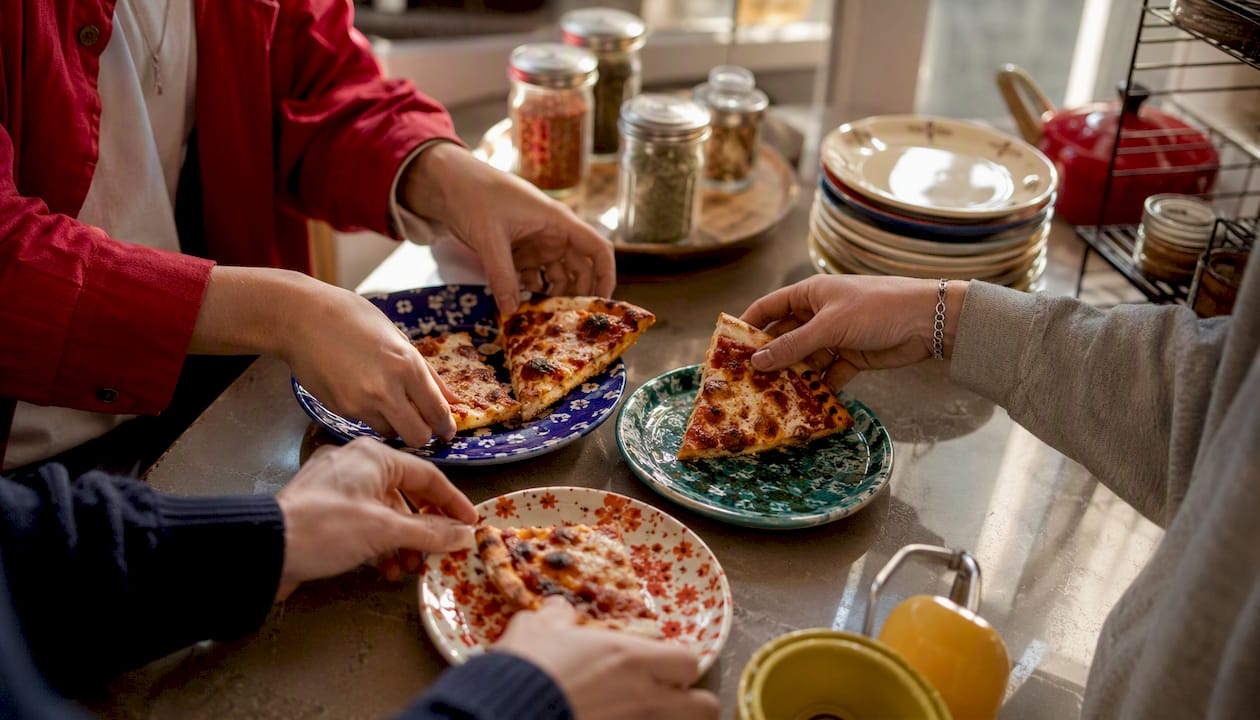
Pizza also reheats exceptionally well, which matters in a shared house where people eat at different times. Leftover slices stored in an airtight container in the fridge remain safe to eat for a few days. Reheating methods such as a dry skillet or oven can help restore the crust's crispness. Microwaving works in a pinch but softens the base.
Pro Tip: Order one fewer large pizza than you think you need, then place a second small round if appetite runs high. This approach, sometimes called "ordering in rounds," minimises waste and lets you adapt to who actually showed up.
A few practical benchmarks worth knowing before you order:
- A typical large pizza covers a group of adults, though appetite size varies.
- Adding sides like garlic bread or a salad can help stretch the meal to feed a larger group comfortably.
- Delivery fees and taxes commonly add some cost to the base order and should be considered in per-person cost calculations.
- Ordering well in advance on busy evenings helps ensure timely delivery.
- Gluten-free and specialty pizzas may come at a price premium compared to regular options.
For a detailed portion guide, Hellcrustpizza's family-sized pizza ordering checklist covers sizing decisions for groups of all sizes.
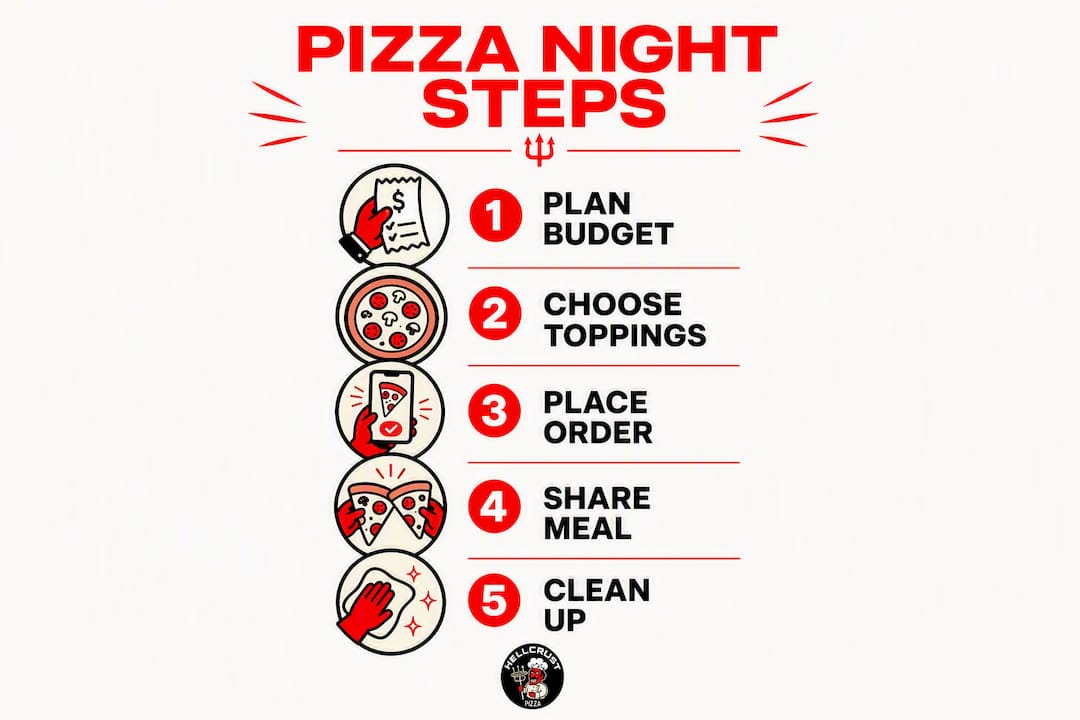
How do you handle allergies and dietary needs safely?
Pizza can be fully inclusive if you adopt a few simple protocols before the order arrives. The key risk in a shared house is cross-contamination: a gluten-free pizza placed in the same box as a regular slice, or cut with the same wheel, is no longer safe for someone with celiac disease. Celiac Canada recommends treating gluten-free food preparation as a separate workflow entirely, which applies equally to home kitchens and delivery orders.
The practical steps are straightforward:
- Request that gluten-free pizzas be boxed separately and note this explicitly in the order's special instructions.
- Use a dedicated pizza cutter and serving plate for the GF box — never the shared one.
- Keep the GF box closed and away from other pizzas until the person with celiac or a gluten sensitivity is ready to eat.
- Label the box clearly with a sticky note or marker before it hits the table.
- Wash hands before handling a GF slice, especially if you have touched other food.
Beyond gluten, a shared house often includes vegan, vegetarian, halal, kosher, or other culturally specific dietary needs. These are not afterthoughts; they are part of what makes a pizza night genuinely welcoming. Vegan cheese and plant-based toppings are now standard options at most Canadian pizza providers. For halal or kosher requirements, confirm with the provider directly whether their meat toppings and kitchen practices meet those standards — do not assume. A quick message in the house group chat before ordering, asking everyone to flag any restrictions, takes thirty seconds and prevents a lot of discomfort.
For topping ideas that work across dietary lines, Hellcrustpizza's guide to inclusive pizza toppings is a practical reference.
What house rules make pizza nights run smoothly?
Agreed rules reduce repeated conflict. This is not about being rigid; it is about removing the friction that builds up when the same arguments happen every week. A short, shared understanding of how ordering, paying, and cleaning work means everyone can relax and enjoy the meal.
Payment and cost-splitting
- Rotating host method: One person orders and pays each week; the role rotates. Works well when everyone orders roughly the same amount.
- Equal split: Total bill divided by the number of people eating. Simple, but can cause friction if one person eats one slice and another eats six.
- Pay-per-slice or pay-per-pizza: Each person claims their pizza or portion upfront and pays accordingly. Best for houses with very different appetites or budgets.
- App-based splitting: Tools like Splitwise or a shared e-transfer log keep the accounting transparent and reduce awkward follow-ups.
Topping negotiation
A simple group-chat message template removes the guesswork:
"Pizza night tonight at 7 PM. Budget is $X per person. Reply with: one topping you want, one you hate, and any dietary flags. I'll order by 6:15."
This takes under a minute to send and gives the person ordering everything they need. For houses with consistently different preferences, splitting toppings across halves or quarters of a single pizza is a practical middle ground.
Cleaning and leftover etiquette
- Label leftover boxes with your name and the date before they go in the fridge.
- Refrigerate within two hours of the pizza arriving.
- Unclaimed leftovers after 48 hours are fair game for anyone, unless the house agrees otherwise.
- Whoever orders cleans up the boxes; whoever eats the last slice takes out the recycling.
When conflicts arise — a non-payer, a late arrival who missed the order, a topping someone finds genuinely offensive — address it directly and early. A brief, calm conversation in the moment costs far less goodwill than letting resentment accumulate over several pizza nights.
Operator tips from Hellcrustpizza for group orders
Operator workflows simplify group orders in ways that most housemates never think to use. Hellcrustpizza's group ordering experience points to a few practices that consistently reduce friction and waste.
- Start with 2–3 diverse pizzas covering broad flavour profiles (one meat-heavy, one vegetarian, one specialty or GF), then add a round if appetite remains. This minimises over-ordering on the first pass.
- Flag all dietary needs in the order notes field, not just in conversation. Written instructions travel with the order; verbal ones do not.
- Request that GF and allergen-sensitive pies be packaged separately at the point of ordering, not as an afterthought when the driver arrives.
- Use the Hellcrustpizza app to access Mix & Match deals and group specials, which are often not visible on third-party delivery platforms.
- For large groups (six or more), pickup is often faster and cheaper than delivery on busy evenings. One person makes the run; everyone else sets the table.
Pro Tip: If your house has a regular pizza night, save your preferred group order as a template in the app. Reordering takes seconds, and you can adjust one or two items without rebuilding the whole cart.
For houses with picky eaters, Hellcrustpizza's guide on ordering for mixed tastes offers a practical sequence for building an order that satisfies everyone without doubling the number of pizzas.
Your shared-house pizza night checklist
Use this before, during, and after every pizza night to keep things smooth and inclusive.
Before you order
- Confirm who is eating and collect dietary flags (allergies, vegan, halal, etc.).
- Set a per-person budget and communicate it clearly.
- Run a quick poll or use the group-chat template to gather topping preferences.
- Check whether anyone needs a GF or allergen-separate box.
When ordering
- Choose sizes based on headcount: roughly one large per 3 adults as a baseline.
- Add sides (salad, garlic bread) to stretch the order and add variety.
- Note GF and allergen requests explicitly in the order instructions.
- Place the order 45–60 minutes before your intended eating time on weekends.
- Confirm the delivery address and buzzer code if applicable.
When the order arrives
- Keep GF boxes closed and separate until the relevant housemate is ready.
- Label each box if toppings are not obvious from the outside.
- Set out a dedicated plate and utensil for any allergen-sensitive pizza.
- Collect payment or confirm the split before everyone disperses.
After the meal
- Refrigerate leftovers within two hours. The USDA food safety guidance on perishable foods recommends this window as a general standard.
- Label boxes with name and date before they go in the fridge.
- Break down and recycle pizza boxes; wipe down shared surfaces.
- Note who hosted this round so the rotation stays fair.
Key takeaways
Pizza works as a shared-house staple because it reduces decision friction, accommodates diverse diets, and builds a repeatable ritual that strengthens household bonds.
| Point | Details |
|---|---|
| Pizza reduces decision friction | Familiar, customisable, and quick to order — it reaches group consensus faster than almost any alternative. |
| Dietary safety needs active steps | Request GF boxes separately, use dedicated utensils, and label allergen-sensitive slices before they hit the table. |
| Agreed house rules prevent conflict | A rotating host, a clear payment method, and a 48-hour leftover policy remove the most common friction points. |
| Order in rounds to cut waste | Start with 2–3 diverse pizzas, then add more only if appetite remains — this minimises over-ordering. |
| Hellcrustpizza supports group orders | GF and vegan options, Mix & Match deals, and app-based group specials make inclusive ordering straightforward. |
Why pizza nights are worth protecting in a shared house
There is a tendency to treat shared-house pizza nights as a convenience rather than a genuine social investment. We think that undersells what is actually happening at the table. Pizza nights are one of the few rituals in communal living that require almost no planning to feel meaningful. The low barrier to entry is the point. When housemates are tired, stressed, or barely crossing paths during a busy week, a standing pizza night is often the only moment they actually sit down together.
What we have seen, through the experience of building Hellcrustpizza around group and family ordering, is that the houses that invest even a small amount of structure into their pizza nights — a simple rotation, a group-chat template, a clear rule about leftovers — report far less friction and far more genuine enjoyment. The ritual does not need to be elaborate. It needs to be consistent and fair. That is what makes it stick.
If you have not tried the checklist in Section 7 yet, start there. It takes five minutes to set up and removes most of the friction that makes shared meals feel like work rather than pleasure.
Hellcrustpizza makes group ordering genuinely easy
Shared-house pizza nights deserve a provider built for exactly this situation. Hellcrustpizza's Biga multigrain, additive-free dough is crafted to deliver real flavour without compromise, and the menu is designed with group diversity in mind: gluten-free bases, vegan toppings, and Mix & Match deals that let your house customise without inflating the bill.

Through the Hellcrustpizza app, you can flag dietary needs directly in the order notes, request separate packaging for allergen-sensitive pies, and access group specials that are not always visible on third-party platforms. Family-sized deals and Mix & Match options mean you can cover meat lovers, vegetarians, and gluten-free housemates in a single order without paying for four separate pizzas. For something beyond delivery, Hellcrustpizza also offers in-store pizza-making events — a genuinely fun option for a house that wants to turn pizza night into an experience rather than just a meal.
Place your next group order at Hellcrustpizza and use the app to unlock deals your house will actually use.
Useful sources
A short list of authoritative resources referenced in this guide, for further reading:
- 31 Easy Weeknight Meals That Actually Beat Takeout — Practical meal-planning resource comparing pizza to other quick weeknight options, including leftover strategies.
- Hellcrustpizza — Shareable Pizza Options: The Complete Group Ordering Guide — Operator-sourced guidance on order templates, round-based ordering, and inclusive group strategies.
- How to Split Pizza Toppings for Your Family — Hellcrustpizza Blog — Practical techniques for topping negotiation and cost-splitting in mixed-preference households.