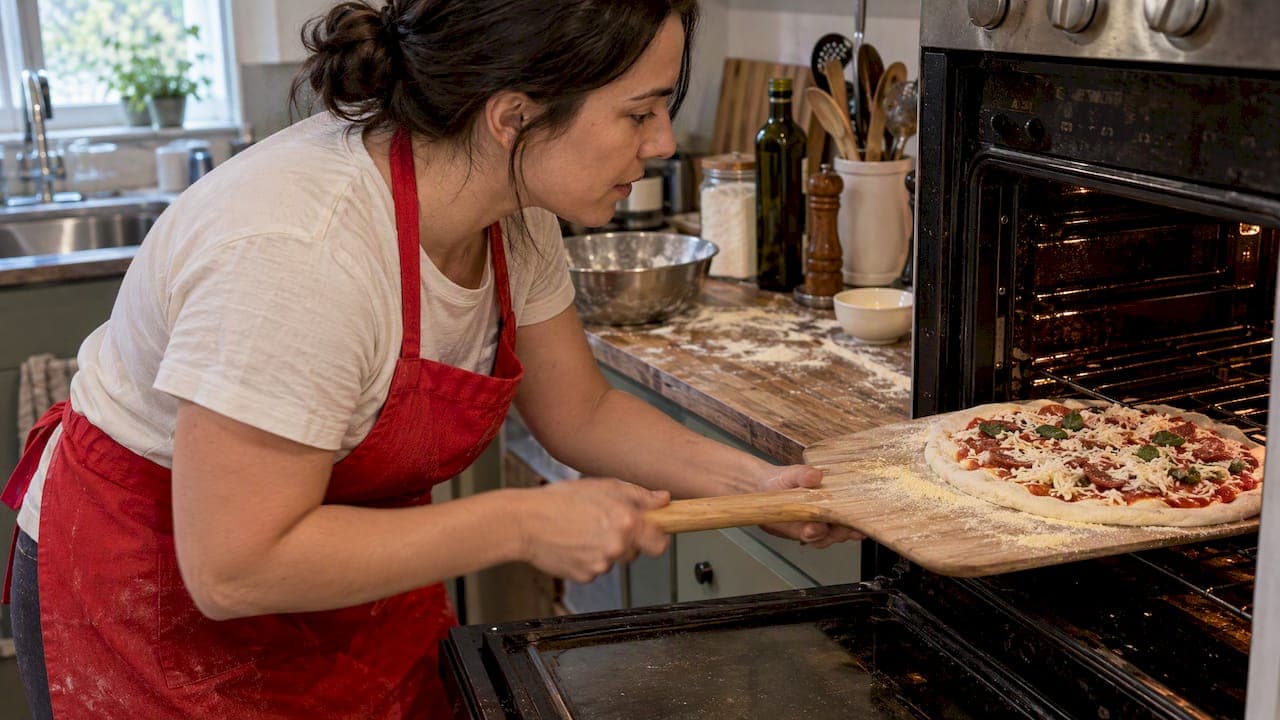
Cornmeal is used primarily as a peel release and secondarily as a texture and flavour additive in dough. For home bakers, that means a light dusting of fine or medium cornmeal keeps your pizza sliding off the peel, while a small amount mixed into the dough adds a crackly bite and a hint of corn. Keep the mix-in modest, or the gluten structure suffers.
TL;DR:
- Use fine cornmeal for peel dusting; coarse grinds stay gritty after baking, and excess can leave a sandy crust or insulate oven decks.
- A wood or composite peel sheds condensation; dust lightly, build the pizza quickly, and shake it before adding toppings to catch sticking early.
- For dough, use about one cup of cornmeal per five cups of wheat flour, and add water because cornmeal lacks gluten and absorbs moisture.
- Pizzerias often blend three parts fine cornmeal with one part semolina to reduce grit; semolina alone releases easily and chars less than plain flour.
- Brush warm stones and oven decks to remove loose granules, which can cause uneven baking and create a fire hazard in commercial ovens.
Table of Contents
- 1. Why does cornmeal make pizza slide and crisp?
- 2. How do you use cornmeal on the peel and in the dough?
- 3. Which grind or blend works best?
- 4. Two cornmeal pizza crust recipes to try at home
- 5. What do pizza professionals say about ovens and cleanup?
- Our take on cornmeal: a finish, not a crutch
- FAQ
- Sources
1. Why does cornmeal make pizza slide and crisp?
Think of cornmeal as tiny ball bearings. Its granules sit between the dough and the peel, and because cornmeal hydrates slowly, it keeps releasing even when you dress a pizza and then get distracted for a few minutes. That is why bakers call it "slip".
The sensory payoff comes in the oven. Fine or medium cornmeal browns on the bottom of the crust and gives a light, crackly texture with a mild, sweet corn flavour. It also adds a touch of golden colour that plain flour alone does not.
Grind matters here. Coarse cornmeal tends to turn gritty and hard after baking, because the large granules never fully soften in the short, hot bake. The result feels like sand between your teeth rather than a pleasant crunch. Even fine cornmeal can leave a slightly sandy bottom if you pile it on, so a light touch pays off every time.

2. How do you use cornmeal on the peel and in the dough?
Dusting and mixing in are two different jobs, and each suits a different goal.
Dusting the peel
- Choose a prep peel. Wood or composite peels shed condensation and reduce sticking before you even reach for the cornmeal.
- Sprinkle a thin, even layer of fine cornmeal across the peel.
- Tap the peel on the counter and scrape off any loose excess.
- Build your pizza quickly, then give the peel a gentle shake to confirm the dough moves freely.
- Slide the pizza onto the stone with a short, confident jerk. Metal peels release fast but dislike a slow dressing, so work briskly.
Mixing it into the dough
- Treat cornmeal as an additive, not a flour swap. It has no gluten, so it should be combined with wheat flour, and a common ratio is about 1 cup of cornmeal to 5 cups of all-purpose flour, or roughly 2 tablespoons for a two-pizza batch.
- Whisk the cornmeal into the flour before adding water and yeast.
- Add a splash more water than usual, since cornmeal soaks it up. Our guide to the 60–70% hydration range is a good starting point.
- Knead until smooth, then let the dough rest and double before shaping.
Choose dusting for deck ovens, baking stones and a crisp bottom. Choose mix-in when you want corn flavour inside the crumb and no loose debris in the oven.
Pro Tip: Shake the peel before you add toppings, not after. If the dough has already stuck, lift an edge and puff a little cornmeal underneath rather than forcing it.
3. Which grind or blend works best?
For dusting, reach for fine cornmeal. Fine is ideal, while medium or coarse grinds are usually too gritty to ride on the bottom of a crust. Check the label: products sold as "polenta" are typically the coarse stuff.
Coarse polenta does have a home, though. Mixed into the dough rather than sprinkled on top, it softens in the moisture and gives a rustic, corn-forward crumb.
Professionals often dodge grit by blending release agents. Cornmeal can leave a gritty residue, while semolina releases easily with less noticeable texture, so blends balance the two:
- Three parts fine cornmeal to one part semolina: a favourite among pizzeria operators, and one that works well on busy lines.
- Equal parts fine cornmeal, semolina and all-purpose flour: a gentler blend with the least grit and the easiest cleanup.
- Semolina alone: testing has found it chars less easily than plain flour while releasing with less grit than cornmeal.
Whichever you pick, keep a small shaker jar near your prep station so the dusting stays light and even.
4. Two cornmeal pizza crust recipes to try at home
Recipe 1: standard cornmeal dough (two 12-inch pizzas)
Ingredients:
- Unbleached all-purpose flour
- Fine or medium cornmeal
- Kosher salt
- Instant yeast
- Olive oil
- Warm water
- Whisk the dry ingredients together, then stir in the oil and water until a shaggy dough forms.
- Knead until smooth and elastic.
- Cover and let rise until doubled.
- Divide, shape, add toppings and bake on a preheated stone at about 400°F (200°C) for 15–20 minutes, depending on your oven. A grilled-dough recipe from a university kitchen follows much the same method.
Recipe 2: whole-wheat cornmeal variant
- ½ cup medium-grind cornmeal
- 2½ cups whole wheat flour
- 1–2 tbsp olive oil
- A little honey to proof the yeast, plus salt and warm water
Proportions like these appear in a Whole Grains Council recipe. Whole wheat drinks more water, so add it gradually and expect a slightly tacky dough. Bake at about 400°F for 15–18 minutes. For a gluten-free route, our psyllium crust guide shows how to keep that dough together. Want a different style entirely? Try this Pizza Diavola recipe, which comes with step timers.
Finishing tips
- Brush the rim lightly with olive oil for colour and a crisp edge.
- Rest the dough overnight in the fridge for deeper flavour.
- Freeze baked crusts flat, wrapped well.
- Chasing crunch? Our extra crispy pizza guide goes deeper.
5. What do pizza professionals say about ovens and cleanup?
Loose cornmeal does not just disappear. Surplus granules act as an insulator between the deck and the pizza, which cuts baking efficiency and causes uneven cooking. Those same sources say decks need regular brushing, since built-up debris can also become a fire hazard in commercial ovens.
That is why pros favour blends and a light hand. Surplus release material must be cleaned from oven decks to keep baking consistent and safe. Some manufacturers go further and put cornmeal inside the dough instead of on top, keeping the corn texture while avoiding oven debris.
At home, the fix is simple. Dust sparingly, brush your stone with a dry brush once it cools, and consider the mix-in method for batches you plan to bake straight from the fridge.
Pro Tip: Brush the stone while it is still warm, not hot, so stray granules sweep away before they scorch and smoke.

Our take on cornmeal: a finish, not a crutch
Cornmeal is a finishing touch, and that is how we treat it. Our Biga multigrain dough, made without artificial additives, is why we keep any dusting minimal and let the dough speak. Our Biga dough article explains why that slow start matters. Prefer to skip the peel work? Our menu has Create Your Own Pizza and Signature Pizzas ready for you.
— jaskirat Singh
FAQ
Do you use cornmeal to make pizza?
Yes, in two ways. Most bakers dust a little on the peel so the pizza slides off, and some mix a small amount into the dough for texture and flavour. Keep it modest, since cornmeal has no gluten.
How do I make pizza slide off the peel?
Use a wood or composite prep peel, dust it lightly with fine cornmeal or a cornmeal and semolina blend, and build the pizza quickly. A gentle shake before topping tells you whether it will release.
Why use semolina flour for pizza?
Semolina releases dough easily and leaves less noticeable grit than cornmeal. Many pizzerias blend it with fine cornmeal, such as three parts cornmeal to one part semolina, to balance slip and texture.
What is the secret to a crispy pizza crust?
Heat, dryness and a light hand with toppings. Avoid overloading the base, and consider a thin oil barrier or pre-cooking wet toppings so the bottom stays crisp.