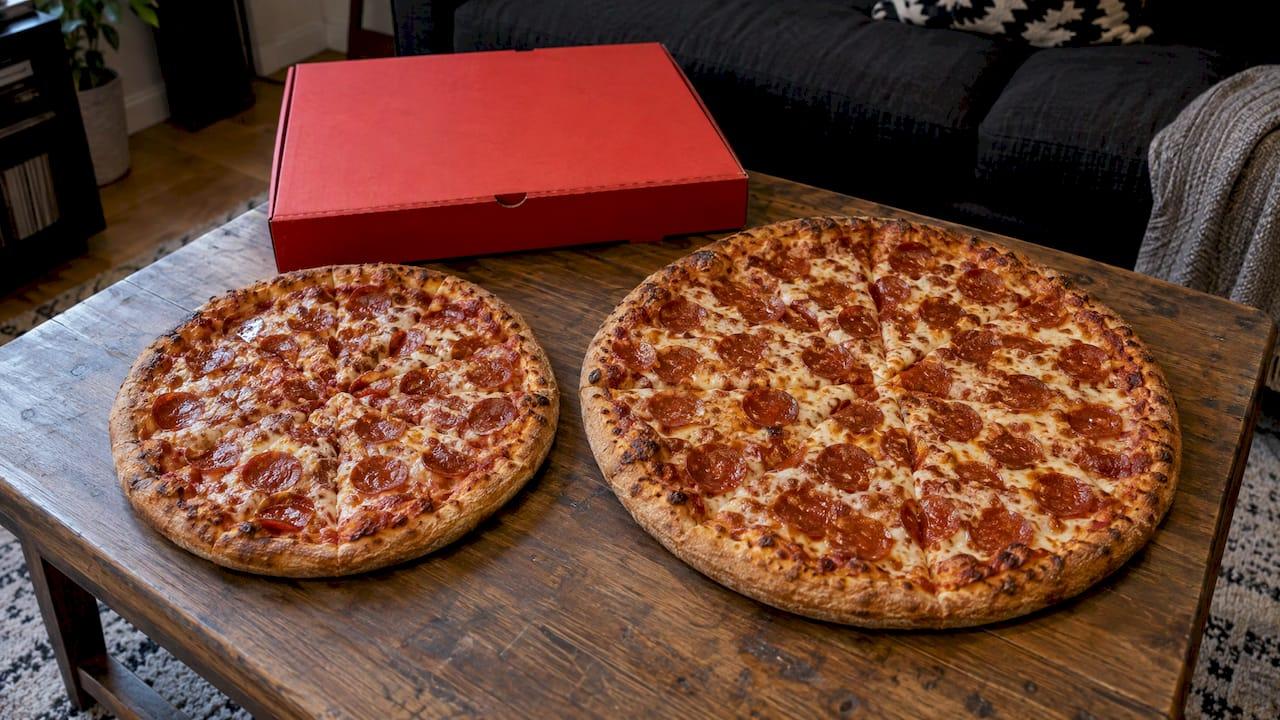
An extra large pizza is usually the better buy per bite. On the common sizing, a 16-inch extra large holds about 31% more pizza than a 14-inch large, and the upcharge is normally smaller than that. The catch is that two 12-inch mediums hold more than either one, so the best choice depends on your group, your toppings and the prices on your menu.
We make pizza on a Biga multigrain dough, so we spend a lot of time thinking about what a pizza is really made of: dough, sauce, cheese and the space you have to share them. Here is how to compare sizes honestly, with the arithmetic done for you.
TL;DR
- A 14-inch large has about 154 square inches of pizza. A 16-inch extra large has about 201, which is roughly 31% more.
- Two 12-inch mediums (about 226 square inches) hold more than one extra large, and they give you two topping choices.
- To compare any sizes, work out the area, then divide the price by it. The lowest price per square inch wins on value.
- Size names differ from shop to shop, so check the diameter on the menu before you order.
- For a rough headcount, plan around slices per person, then round up if your group has big appetites.
Table of Contents
- How much bigger is an extra large than a large?
- Is the extra large worth the upcharge?
- Two mediums vs one large: the maths that surprises people
- Crust and toppings change the value
- How many people does an extra large feed?
- A simple way to choose
- Perspective: why we care about what is in the square inches
- Order the size that fits your table
- FAQ
- Sources
How much bigger is an extra large than a large?
Much bigger than the two inches suggest. Pizza is a circle, and a circle's area grows with the square of its diameter. The formula is area = π × (diameter ÷ 2)², and it explains why a small jump in width feels like a big jump on the table.
Using the most common convention of a 12-inch medium, 14-inch large and 16-inch extra large, the numbers look like this:
| Size | Diameter | Area (sq in) | Typical slices |
|---|---|---|---|
| Medium | 12 in | about 113 | 8 |
| Large | 14 in | about 154 | 8 to 10 |
| Extra large | 16 in | about 201 | 10 to 12 |
| Jumbo (where offered) | 18 in | about 255 | 12 or more |
The 16-inch extra large has 201.1 square inches against 153.9 for the 14-inch large. Another calculator puts the gain at about 31% more area than the large, and a third expresses the same thing as 130.6% of the large's area. The step before it is steep too: a 14-inch large has about 36% more area than a 12-inch medium.
Step all the way from medium to extra large and the gap is about 78% more pizza from a pie only four inches wider.
Slice counts are a looser guide, because shops cut differently. One calculator lists a 14-inch large as 8 or 10 slices and a 16-inch extra large as 10 to 12. A 12-slice extra large therefore tends to have bigger slices than a 10-slice large, and not just more of them.

Is the extra large worth the upcharge?
Usually, yes, if you will actually eat it. The way to know is to divide price by area, which gives you the cost of each square inch of pizza.
Here is the method:
- Write down each size's diameter and price.
- Work out the area with π × (diameter ÷ 2)².
- Divide the price by the area.
- The lowest price per square inch is the best area value.
A worked example from a pizza calculator uses a 14-inch large at $15.99 and a 16-inch extra large at $18.99. The extra large gives about 31% more area for 19% more money, and costs about 9% less per square inch. These are illustrative prices, not ours, but the pattern holds almost everywhere: the bigger the pizza, the cheaper each square inch tends to be.
The same logic applies one step down. In another example, a 12-inch medium at $12.99 works out to $0.115 per square inch, while a 14-inch large at $15.99 comes to $0.104.
So the upgrade from large to extra large is often the cheapest extra pizza you can buy. Think about the reader on a popular forum thread weighing a two-dollar upgrade to extra large against a separate three-dollar add-on pizza. Run the numbers on your own menu and the answer drops out in a minute.
A quick rule: if the extra large costs less than about 30% more than the large, you are getting more pizza per dollar. The caveat is that this only matters if the extra pizza gets eaten, and we cover that below.
Two mediums vs one large: the maths that surprises people
This is the question behind most searches for "2 mediums vs 1 large", and the answer is clear. Two 12-inch mediums come to about 226 square inches, against about 154 for one 14-inch large. You get roughly 47% more pizza from two mediums than from one large, as long as prices are close.

The extra large does not beat them either. A 16-inch extra large at about 201 square inches is still smaller than two 12-inch mediums at about 226.
There is a twist. The claim depends entirely on which diameters you compare. An 18-inch pizza has about 254.5 square inches and can exceed two 12-inch pizzas. The viral rule "two mediums always win" is really a rule about two 12s against a 14, as Taste of Home's comparison makes clear.
A quick scoreboard, using the 12, 14 and 16-inch convention:
| Option | Total area (sq in) |
|---|---|
| 1 large (14 in) | about 154 |
| 1 extra large (16 in) | about 201 |
| 2 mediums (12 in each) | about 226 |
| 2 larges (14 in each) | about 308 |
| 1 large + 1 medium | about 267 |
If your shop uses square or rectangular pies, skip the circle formula and multiply length by width.
When two mediums are the smarter call
Two mediums are the better pick when you want variety. They give you two topping combinations, which makes a real difference at a table with a vegetarian, a pepperoni fan and a kid who wants plain cheese. Two boxes also cool more slowly, because one stays closed while you eat from the other.
If the price of two mediums is close to the price of one extra large, take the two mediums. If it is clearly higher, the extra large probably wins on cost.
When one extra large is the better pick
Choose the extra large when everyone agrees on the toppings, when you are ordering for one or two people with leftovers in mind, or when the upgrade is only a dollar or two. One pizza means one box to carry, one bake time and less to clear away.
Crust and toppings change the value
Square inches are not the whole story. A pizza is also what is on it and what holds it up.
A thicker, more substantial crust fills you up faster, so you may need fewer slices from the same area. Our Biga multigrain dough is prepared in advance, using a preferment, and we designed it to be a more fiber-rich and more digestible base. Many of our customers find a few slices are plenty. A thin, light crust is the opposite: you can eat more of it.
Toppings matter too. Heavily loaded pies are more filling than a plain margherita of the same diameter. If you are weighing extra cheese against extra toppings on a bigger pie, our guide on extra cheese or extra toppings explains how crust type affects the answer.
One more thing: size names are not standard. A large at one shop can be 12 inches, and an extra large at another can be 14. Always compare the diameter in inches, not the name on the menu. If the diameter is not listed, ask when you order.
How many people does an extra large feed?
As a rough planning guide, a large serves around three to four people and an extra large around four to six, depending on appetite and whether there are sides. Pizza calculators and ordering guides commonly give these ranges only as estimates, so treat them as a starting point.
The more reliable method is to count slices. Most adults eat two to three slices, teenagers and hungry guests may eat more, and young children often manage one or two. Multiply your guests by the slices they will eat, then divide by the slices per pizza. Our walk-through of slices per person does this in three steps for any group.
Some worked examples using a 10-slice large and a 12-slice extra large:
- Two adults, one with leftovers in mind: one large is enough.
- Four adults at 2 to 3 slices each (8 to 12 slices): one extra large, or one large plus a side of pasta.
- Five adults at 2 to 3 slices each (10 to 15 slices): two mediums or one extra large plus a smaller pizza. Two larges is comfortable, with leftovers. Our family ordering checklist helps you plan this.
- Ten guests: see our guide to feeding 10 guests with 3 to 4 large pizzas.
If the party is bigger or includes kids, our pizza party planning playbook and party menu ideas cover the sides and mix of pizzas.
A simple way to choose
Run through these questions in order:
- How many slices do you need? Use the slice method above and round up by a slice or two.
- Does everyone want the same toppings? If yes, lean toward one bigger pizza. If no, lean toward two mediums.
- What do the prices say? Divide price by area for each option. The lowest number is the best value per square inch.
- Will leftovers get eaten? Cold pizza is a fine breakfast, so extra area is rarely wasted for a household that likes it.
- Are there sides? Pasta, wings and dips fill people up, so you can drop down a size.
For mixed groups, a combination often works best: one extra large for the shared favourite, plus one smaller pizza for the vegetarian or gluten-free eater. Our guide to shareable pizza options and our explainer on group pizza orders go deeper on this.
Perspective: why we care about what is in the square inches
We think the size debate is only half the question. Square inches tell you how much pizza you are getting, but not what kind of pizza it is.
At HellCrust, the dough is where we start. Our Biga multigrain dough is free of artificial additives and prepared in advance, so it has time to develop a rich, mature flavour. We designed it to be fiber-rich and easier to digest, and it is the reason we say a pizza should be judged by its crust as much as its diameter. You get what you pay for, and a bigger pie on a tired base is just more of the same.
That is also why we build our deals around choice. Mix and match options and family-sized specials let a group get different toppings, vegan pizzas included, without anyone compromising on the base. Whether you go for a large, an extra large or a couple of smaller pies, we want every slice to be one you savour.
jaskirat Singh
Order the size that fits your table
Whether you are feeding a family, a study group or a casual date night, you can build the order you want on our menu: create your own pizza, pick from our signature or vegan pizzas, and add baked pasta, wings and bites, dips and desserts to round out the table. Our family and group deals, mix and match options and app-exclusive offers are designed to make the maths easier.

See sizes and options on the HellCrust menu, or start from hellcrustpizza.com to order for delivery or pickup in North Vancouver, Vancouver and West Vancouver.
FAQ
Is it better to get two medium pizzas or one extra large?
Two 12-inch mediums give you more pizza, about 226 square inches against about 201 for a 16-inch extra large. They also let you choose two toppings. If the extra large is much cheaper, or everyone wants the same pizza, it can still be the better buy.
How much bigger is an extra large than a large?
On the common 14-inch and 16-inch convention, an extra large has about 31% more area than a large. That is 201 square inches against 154. Sizes vary between shops, so check the diameters on the menu.
Is 2 large pizzas enough for 5 adults?
Usually, yes. Two 14-inch larges give about 16 to 20 slices, depending on how they are cut. At 2 to 3 slices per adult, five people need 10 to 15, so you will probably have leftovers. If sides are included, one large and one medium may do.
How do I compare pizza prices across sizes?
Calculate each pizza's area with π × (diameter ÷ 2)², then divide the price by that area. The lowest cost per square inch is the best value. Do the same for combinations, such as two mediums, by adding their areas together first.
Sources
- Pizza Size Calculator | Ekuation
- What Size Pizza Is The Best Value? Pizza Size Calculator
- Pizza Area Calculator | TotalCalc.info
- 2 Medium Pizzas vs. 1 Large Pizza: Which Is Bigger? | Taste of Home