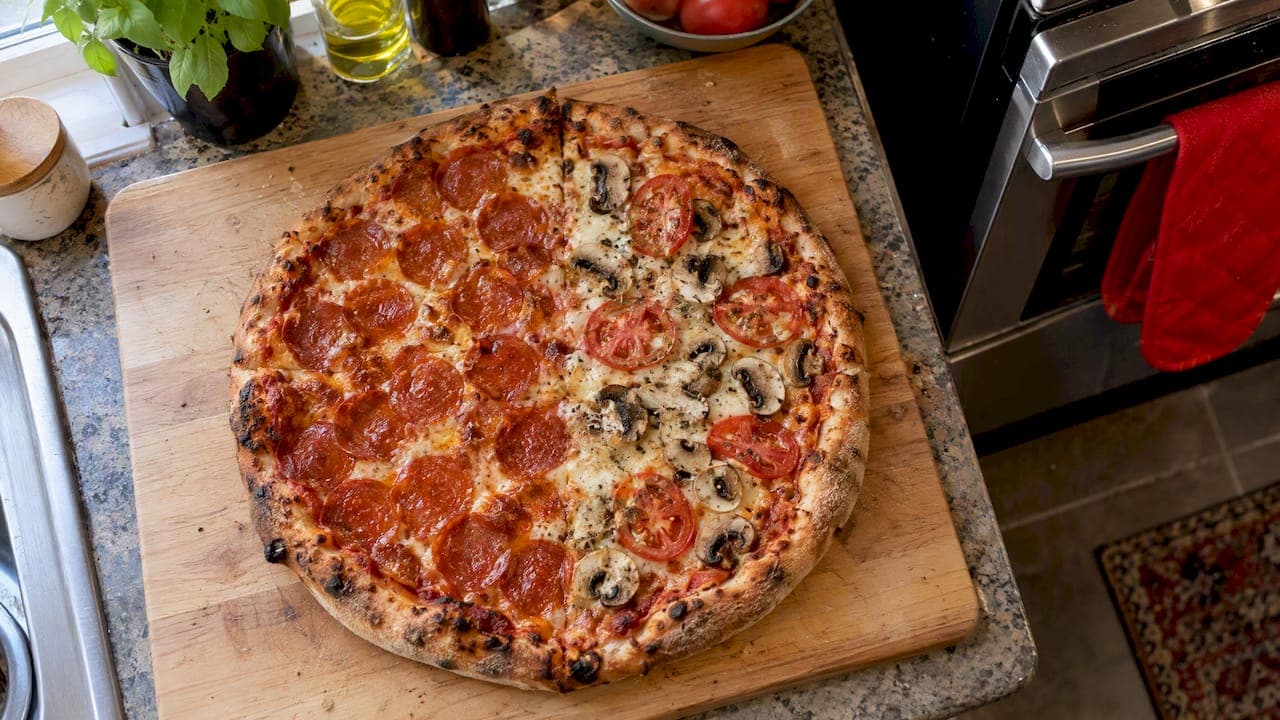
A half and half pizza is one pizza with a different topping on each side. It's the easy answer when one person wants pepperoni, another wants veggies, and nobody wants to order two whole pies. You get two flavours, one crust and a lot less arguing.
Below, we cover what the term means, how to order a good one, which pairings work, what to check if someone at the table has a dietary need, and how to make one at home. We've spent a lot of time thinking about dough and toppings, so we'll share what we know.
TL;DR
- A half and half pizza has two different topping sets on one crust, so you can try two combinations without ordering two pizzas.
- Pair one bold side with one milder side, and keep toppings moderate so both halves cook evenly.
- If someone has an allergy, say so when you order. Shared ovens, cutters and utensils can carry allergens from one half to the other.
- At home, use one dough base, divide the toppings clearly and keep the load light.
- For delivery, browse our menu and ask about splitting before you pay.
Table of Contents
- What does half and half pizza mean?
- Why people order half and half
- How the two halves get made
- How to order a half and half pizza well
- Topping pairings that work
- What to check if someone has a dietary need
- Our perspective: the crust carries both halves
- Order your pizza with us
- How to make a half and half pizza at home
- Common mistakes to avoid
- FAQ
- Sources
What does half and half pizza mean?
In most Canadian pizzerias, the phrase means one pizza prepared with different toppings on each side. The general definition is simple: one half carries one set of toppings, the other half carries another. Often the line runs straight down the middle, and each half is cut into the same number of slices.
There is also a regional tradition. Ooni Canada's French half-and-half recipe pairs a tomato-and-onion coulis and mozzarella on one side with anchovies, pistou and Parmesan on the other. That's a deliberate pairing built around two distinct flavour worlds. Most of us ordering on a Friday night aren't going that far, but it shows the idea has some range.
So the two uses are:
- The ordering option: you pick two toppings sets, or two menu pizzas, and each gets one side.
- The recipe tradition: a cook designs the two halves to contrast on purpose.
Either way, the principle holds. One crust, two personalities.
Why people order half and half
The appeal is practical. A few situations where it earns its place:
- Families with different tastes. One child wants plain cheese, the adults want something with heat.
- Couples on a casual night in. You each get your favourite without committing to two pizzas.
- Kids' birthday parties. Splitting a pie lets you offer a safe, familiar side and a more adventurous one. Our pizza party menu ideas go deeper on sides and packs for casual, kids and adult tables.
- Students and young professionals on a budget. You sample two combinations in one meal. Our notes on affordable topping choices can help you pick halves that don't push the total up.
- Undecided pizza lovers. Sometimes you simply can't choose between a classic and something new.
The short answer to whether it lets you try two combinations without ordering two pizzas: yes. You eat both flavours from a single crust, usually at a lower total than two separate pies would cost. Pricing rules for splits differ from one pizzeria to the next, so check how a given shop charges for a second set of toppings before you confirm.
How the two halves get made
Behind the scenes, an ordering system treats each half as its own selection. Ordering software can assign separate toppings or predefined pizza choices to the left and right halves. That's why you'll often see a "left half / right half" choice, or a prompt to pick two menu pizzas.
In the kitchen, the cook builds one base, then dresses each side to the instruction. The two halves bake at the same time, in the same oven, for the same time. That matters for the next section.

How to order a half and half pizza well
A few habits make the difference between a good split and a disappointing one.
1. Decide the line before you pick toppings
Agree who gets which side. If two people share and one is picky, put the simpler toppings on the picky person's side. It sounds obvious, but it saves the "who took my pepperoni" conversation.
2. Pair a bold half with a gentler one
The flavours sit side by side, and they'll mix at the centre. King Arthur Baking suggests matching assertive toppings with a milder sauce, and it demonstrates a half-and-half pizza with distinct sauces and topping combinations. The takeaway is balance: if one half is heavy with cured meats, give the other half something fresher or lighter.
3. Keep each side moderate
It's tempting to load both halves because you're excited about both. Don't. Sobeys' guide to homemade pizza advises distributing toppings evenly and warns that overload makes cooking harder, which can leave toppings underdone while the crust keeps baking. That advice applies just as much to a pizzeria order as to your own kitchen.
4. Watch the moisture
Some toppings release water as they cook, such as fresh tomatoes, pineapple and mushrooms. Put two of them on one half and the crust can turn soft. Our guide to stopping soggy crusts with 12 topping combos shows which pairings hold up.
5. Ask how the split is priced
Some shops charge by the more expensive half, others add a fee per extra topping. Ask before you order and you won't be surprised at checkout.
Topping pairings that work
These are combinations we'd happily put side by side. They're ideas, not rules.
| Half one | Half two | Why it works |
|---|---|---|
| Pepperoni and mozzarella | Roasted vegetables and herbs | Familiar and rich next to fresh and light |
| Spicy sausage and peppers | Plain cheese | Gives the milder eater a safe side |
| Bacon and caramelized onion | Spinach, feta and olives | Sweet and salty against briny and green |
| Chicken and BBQ sauce | Mushroom and garlic | Smoky sweetness against earthy depth |
| Meat lovers | Vegan pizza | Everyone at the table is covered |
If you're leaning towards meaty halves, our piece on the best topping pairings for meat lovers will help you avoid a pile of competing salty flavours. And if you're debating how much to add per side, read about extra cheese versus extra toppings, because your crust decides which one works better.
Sobeys also suggests choosing combinations you enjoy, whether familiar savoury toppings or contrasting sweet, salty, spicy and global flavours. That's the whole brief, really. Don't overthink it.
What to check if someone has a dietary need
This is where a half and half pizza needs a little more care. Two halves share one crust, one oven and often one cutter. If a guest has a food allergy, splitting the pizza doesn't make one half allergen-free.
Food Allergy Canada notes that restaurants aren't required to list priority allergens for menu items, so it's up to you to ask about ingredients and cross-contamination. It advises telling staff about the allergy before you order, making clear it isn't a preference, and asking how the food is prepared, since shared equipment and utensils can spread allergens.
In practice, here is what to do:
- Say it first. Tell the person taking your order about the allergy before you pick toppings.
- Ask about shared surfaces. Ask whether cutters, ovens, sauces and utensils are shared between pizzas.
- For a serious allergy, consider a whole pizza. If the risk is severe, a single dedicated pizza is a safer plan than a split. Talk to the restaurant, and to your allergist if you're unsure what level of risk is right for you or your child.
- Preferences are different. For vegetarian or vegan guests who avoid animal products by choice rather than for medical reasons, a split can work well. Ask staff how they handle the topping layout.
We offer vegan pizzas and gluten-free options on our menu. If you're curious about making a gluten-free base yourself, we have a tested walkthrough: a reliably crisp gluten free pizza crust with psyllium. For any order with a dietary requirement, tell us what you need and ask how it will be prepared.
Our perspective: the crust carries both halves
When we think about half and half pizza, we think about the dough first. Two toppings sets are only as good as the crust holding them, and a crust has to be sturdy enough to carry two personalities without going limp in the middle.
That's why we make our dough the way we do: a Biga multigrain dough, free of artificial additives, prepared in advance. A Biga is a preferment, which means part of the dough is started ahead of time and allowed to mature. Time gives the dough a rich, mature flavour, and in our experience a more digestible, fibre-rich crust. We think a crust like that is a good partner for a split pizza, because it has flavour of its own and doesn't vanish under the toppings.

It also changes how we think about toppings. With a crust that tastes like something, you don't need to pile on. A moderate amount on each side lets every bite stay balanced, and lets the two halves each have their say. If you want help splitting toppings across a table, here is how we split pizza toppings for a family, and for tuning a build, see how to customize crust and toppings.
You get what you pay for with food, and we think a half and half pizza should taste like two good decisions, not one good one and one compromise.
— jaskirat Singh
Order your pizza with us
If you're in North Vancouver, Vancouver or West Vancouver, we'd love to be your next pizza night. Our menu includes Create Your Own Pizza, Signature Pizzas and Vegan Pizzas, plus Slide Outs, Baked Pasta, Appetizers, Wings & Bites, Desserts, Dips and Beverages, so a shared table is easy to cover. Our app also carries exclusive offers.

Looking for something to pair with your two halves? Browse the full HellCrust menu and, if you want a split, ask about it before you pay so we can confirm how your order will be built. For a bigger group, our group ordering guide to shareable pizza can help you plan quantities.
How to make a half and half pizza at home
Home baking is a good way to test pairings before you order. The method is the same as for any pizza, with one extra step: divide the surface.
What you need
- One dough ball for one pizza
- Sauce, with one or two choices
- Two topping sets, prepared separately
- A hot oven and a pizza stone or tray
The steps
- Prepare the dough. Ooni Canada's French half-and-half recipe makes one 12-inch (30-centimetre) pizza and recommends allowing 3 to 4 hours for the dough to proof. It lists 20 minutes of preparation, not counting the dough, and a cook time of 11 to 16½ minutes in an Ooni oven.
- Preheat properly. For a home oven, Sobeys suggests preheating to at least 400°F (205°C) and keeping an eye on the pies. Ricardo recommends preheating a pizza stone at 400°F (200°C) on the lowest rack, using flour or cornmeal to prevent sticking, and sliding the pizza on with a peel or a rimless cookie sheet.
- Mark the line. Lightly press a line down the centre of the stretched dough with the back of a knife, or keep a mental line using a long spoon as a guide.
- Dress each side. Spread sauce, then add each topping set to its side. Keep toppings away from the line so they don't drift.
- Keep it light. Distribute evenly and don't pile too high. Too many toppings make it hard for the oven to heat everything while the crust keeps cooking.
- Bake and check early. Different toppings cook at different speeds, so watch both sides and rotate if one side browns faster.
One extra habit helps: pre-cook raw chicken and ground meat, and sauté mushrooms to reduce their moisture, as Zach Miller advises in his pizza-kitchen guide. This keeps the wet half from soaking the crust and lets both sides finish at the same time.
A sample home pairing
Try this one: tomato sauce across the whole pizza, mozzarella everywhere, then pepperoni on one side and roasted peppers, red onion and olives on the other. Finish the veggie side with a little basil after baking. It's familiar, it's forgiving, and it reads well on a table where people have different preferences.
Common mistakes to avoid
- Two heavy halves. If both sides are loaded with salty meat, nothing stands out. Give one side a lighter job.
- Wet toppings at the centre. Liquid travels. Keep watery toppings away from the dividing line.
- Forgetting the sauce. A spicy sauce on one half is a flavour decision for the whole pie unless you apply it by side.
- Assuming a split is allergen-safe. It isn't, unless the restaurant tells you how it prevents cross-contact.
- Ordering sides that repeat the pizza. A crisp salad is a good counterweight, and our guide to salads that go with pizza shows which ones work.
FAQ
What does half and half pizza mean?
It means one pizza with different toppings on each half. You can choose two menu pizzas or build each side yourself. The two halves bake together on the same crust.
Is a half and half pizza cheaper than ordering two pizzas?
Usually it costs less than two separate pizzas, because you're buying one crust. Pricing varies by shop: some charge the price of the more expensive half, others charge per extra topping. Ask before you confirm your order.
Can I do a half and half pizza if someone has a food allergy?
Tell the restaurant about the allergy before you order and ask how the pizza is prepared. Shared ovens, cutters and utensils can carry allergens from one half to the other, so for a serious allergy a single dedicated pizza may be safer. Check with your allergist if you're unsure.
Which toppings go best together on a half and half pizza?
Pair something bold with something milder, such as spicy sausage next to plain cheese, or bacon next to spinach and feta. Keep toppings moderate on each side so the oven can cook everything evenly.
Can I make a half and half pizza at home?
Yes. Use one dough base, divide the toppings into two sides and bake as you would any pizza, preheating the oven to at least 400°F (205°C). Pre-cook raw meat and wet vegetables so both sides finish together.
Sources
- Half and half, Wikipedia
- French Half-and-Half Pizza Recipe, Ooni Canada
- Half/half topping, ordering system support article
- Tips for saucing your favorite pizza, King Arthur Baking
- Your Guide to Homemade Pizza, Sobeys
- Dining out, Food Allergy Canada
- Ricardo's Tips for Homemade Pizza Made Easy, RICARDO
- How to Pre-Cook Pizza Toppings, That Pizza Kitchen