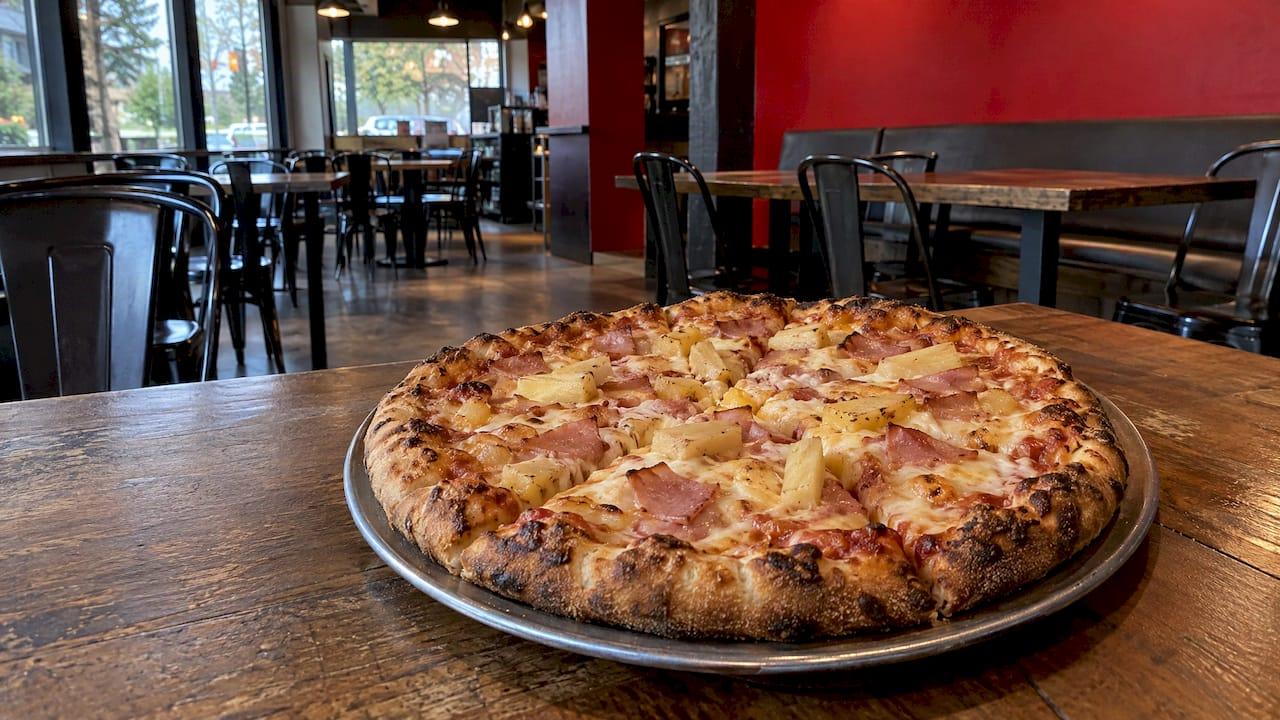
Pineapple belongs on pizza more than most people admit, and the proof starts close to home: the Hawaiian pizza was first made in a restaurant in Chatham, Ontario. The sweetness of the fruit, the salt of the ham and the richness of the cheese balance each other, and the right dough underneath makes that balance even better. Whether you love it, hate it or are just curious, here is the story, the science and a practical guide to building a pineapple pizza you will want to order again.
TL;DR
- Hawaiian pizza is a Canadian invention, credited to Sam Panopoulos and his brothers at the Satellite Restaurant in Chatham, Ontario, in 1962.
- The topping works because sweet fruit, salty meat and rich cheese contrast and reinforce one another, and pineapple's acidity cuts through the fat.
- A 2021 Research Co. poll found 73% of Canadians would eat pineapple on pizza, so the debate is louder than the numbers suggest.
- Ham is the classic partner, but peppers, jalapeños, red onion, mushrooms and a barbecue base all give pineapple a new personality.
- A sturdy, well-fermented crust matters: it carries the juicy fruit without turning soggy or flat.
Table of Contents
- Where pineapple on pizza really comes from
- Why the combination works
- The great debate, in numbers
- Toppings that go well with pineapple
- Making it right: the crust is half the story
- Our view on pineapple
- Order pineapple your way with HellCrust
- FAQ
- Sources
Where pineapple on pizza really comes from
Despite the name, Hawaiian pizza has nothing to do with Hawaii. The Canadian Encyclopedia traces it to Sam Panopoulos, a Greek-born Canadian who opened the Satellite Restaurant in Chatham, Ontario, with his brothers in 1962. He had been inspired partly by the sweet-and-tangy flavours of Americanized Chinese dishes, so he tried ham and pineapple on a pizza. The name came from the canned pineapple brand he used, not from the island state.
Pizza itself was new to Canada then. In a CBC Radio interview, Panopoulos recalled that pizza reached Canada through Detroit and Windsor, that the popular toppings were mushrooms, bacon and pepperoni, and that nobody liked the pineapple version at first. Then, in his words, they went crazy about it. He kept selling pizzas in Chatham and London for the next four decades or so. Years later he described the dish as "an invention by accident".
The idea was not entirely out of the blue. Food writer Andrew Coppolino pointed out in CBC News that the 1931 edition of the Joy of Cooking already included a recipe for chopped ham piled on a pineapple ring over toasted bread. Ham and pineapple were old friends before they ever met a pizza crust.
In 2017, when Iceland's president joked that he would ban pineapple on pizza if he could, Prime Minister Justin Trudeau answered by calling it a delicious southwestern Ontario creation, as AP News reported. Panopoulos died later that year at 83 in London, Ontario.
Why the combination works
The taste logic is simple once you break it down. Pineapple is 12 to 15% sugar and has a pH of 3 to 4, which means it is both sweet and acidic. Pizza, on the other hand, is built from salt, fat and umami: cured meat, melted cheese, cooked tomato. Put the two together and each side makes the other more interesting.
Sweet meets salty. Science Meets Food explains that sweetness signals an energy source and salt signals electrolyte balance, so people may be wired to enjoy sweet-salty combinations. Think of salted caramel or prosciutto with melon.
Acid cuts fat. The same source notes that pineapple's acidity cuts through the fatty feel of cheese, which keeps each bite from feeling heavy. That is why a slice with pineapple can feel lighter than one with only meat and cheese.
Contrast and reinforcement at once. Flavour chemist Terry Miesle told IFLScience that pineapple does both: it reinforces and contrasts, but with different components of the pizza.
Heat creates new flavours. When pineapple bakes, it develops nutty aroma compounds, including 2-methylbutanal and 3-methylbutanal, which also appear in cheeses like cheddar and mozzarella, according to researcher Zhimin Xu. So the baked fruit and the cheese share a flavour thread.

CBC's Coppolino draws a comparison with gastrique and agrodolce, two classic sauces that combine sweet, savoury and sour. Seen that way, a Hawaiian is less a prank on tradition than a quick, casual take on a very old idea.
A note on the cheese
Because sweetness shows up strongly against mild flavours, cheese choice matters. The Science Meets Food piece cites a study in which Emmentaler was the best cheese pairing for pineapple. At home, a nutty, slightly sharp cheese alongside mozzarella is an easy upgrade. Our guide to cheese varieties on gourmet pizzas covers more options.
The great debate, in numbers
The arguments against pineapple are well known. Some say fruit has no place on pizza apart from the tomato. BBC Bitesize reports that chef Franco Pepe blames a "double acidity" when pineapple meets tomato, and the extra sugar in canned fruit. CBC's report lists objections that the soft texture of canned pineapple clashes with soft cheese.

Those are fair points about technique, and they have practical answers: use well-drained or fresh pineapple, bake on a crust with real structure, and balance the acid with salt and fat. Coppolino adds that tomatoes are technically a fruit, and that Canadians already put fruit with cheese and cured meat on charcuterie boards and honey on Brie.
And the numbers lean toward the fans:
| Poll | Finding |
|---|---|
| YouGov, 2017 | 82% liked pineapple, 53% liked it on pizza, 29% hated the idea |
| Research Co., October 2021 (Canada) | 73% of Canadians would definitely or probably eat it, up seven points from July 2019 |
The Canadian poll is the more interesting one for us. It found Albertans most in favour at 90%, British Columbians at 83%, Ontarians at 76% and Quebec lowest at 55%. Research Co. president Mario Canseco, who works out of Vancouver, said there is momentum for Hawaiian-style pizza, although pepperoni, mushrooms and green peppers still rank higher when people design their own. In other words, on the West Coast, pineapple is firmly mainstream.
Toppings that go well with pineapple
Ham or bacon is the traditional partner, and The Canadian Encyclopedia describes the standard Hawaiian as tomato sauce, cheese, pineapple chunks and either ham or bacon. But the same source lists plenty of variations: a barbecue sauce base instead of tomato, mixed peppers or jalapeños, and extra or substitute toppings such as mushrooms, red onions and shrimp. Panopoulos himself said that today you can put almost anything on a pizza and everybody eats it.
Here is how to think about pairings, by the job each topping does:
| Topping | What it does with pineapple | Best for |
|---|---|---|
| Ham or bacon | Salt and smoke against sweetness; the classic | Anyone, kids included |
| Jalapeños or chili flakes | Heat makes the sweetness feel brighter | Date night, spice fans |
| Red onion | Sharp, slightly sweet bite that frames the fruit | Adults and teens |
| Mushrooms | Earthy depth that rounds out the sweetness | Vegetarian-leaning tables |
| Peppers | Fresh crunch and gentle bitterness | Families who want colour |
| Barbecue sauce base | Smoky-sweet bridge between fruit and meat | Meat lovers |
| Shrimp | Light, briny sweetness | Couples, a lighter pie |
If you like the idea of heat, our walk-through of spicy pizza topping combinations shows how to dial it up without drowning the fruit. If you want to go meatier, see topping pairings for meat lovers. And if you are curious how other places treat fruit and sweet toppings, there is a foodie's guide to regional topping styles.
Three combinations worth trying
- The classic. Ham, pineapple, mozzarella. Keep the pineapple in chunks, not tiny bits, so you get juicy bites.
- Sweet heat. Pineapple, jalapeño and red onion. The jalapeño brings the fire; the pineapple cools and balances it.
- Smoky barbecue. Barbecue base, bacon, pineapple and red onion. This one tends to win over people who swear they dislike Hawaiian.
Making it right: the crust is half the story
Most complaints about pineapple pizza are really complaints about a weak foundation: a thin, bland base that goes limp under wet fruit. Pineapple is juicy and acidic, so it deserves a crust with flavour and backbone of its own.
That is one reason we build our pizzas on a Biga multigrain dough with no artificial additives. A biga is a preferment: a portion of the dough is mixed ahead of time and left to mature, which gives the finished crust a richer, more mature flavour and a more digestible bite. The multigrain adds fibre and a slightly nutty taste, and nutty is exactly the note that bridges sweet fruit and savoury cheese. A crust like that does not just hold the toppings. It joins the conversation.
A few tips for any pineapple pizza, whoever makes it:
- Drain the fruit. Pat canned pineapple dry, or use fresh, so the juice does not pool.
- Go chunky. Larger pieces caramelize at the edges instead of steaming.
- Add salt and fat. Ham, bacon or a sharper cheese give the sweetness something to push against.
- Finish with a fresh note. A few torn basil leaves or cilantro lift the whole slice. We cover timing in our guide to fresh herbs on a finished pizza.
If you bake at home on the weekend, high, even heat helps the pineapple edges brown. A ceramic pizza stone is one way to get a crisp base for a fruit-topped pie in a grill or oven.
What to drink with it
Sweet-and-salty pizza likes a drink with some acidity or bubbles. For adults, our wine pairing guide is a good starting point. For kids and designated drivers, there are non-alcoholic pairings that take 10 minutes to put together. A crisp salad is a natural side too: see which salads pair best with pizza.
Our view on pineapple
We are not here to settle an argument that has run since 1962. We are here to say that a topping is only as good as what sits under it and around it.
Pineapple shows its best side when the crust is mature, flavourful and a little nutty, which is why we make our dough with Biga, a preferment we prepare in advance, with multigrain and no artificial additives. That slow start gives the crust a rich flavour and a more digestible bite, and it gives sweet toppings something real to lean on.
We also believe the table should decide, not the debate. Some people want the classic ham and pineapple. Others want a vegan pizza with fruit and peppers, or a build-your-own with jalapeños and red onion. Our menu is made for that kind of variety, and our deals, including Mix & Match options and family-sized specials, mean the whole table can try a different idea without stretching the budget. You get what you pay for, and we want you to savour every bite.
jaskirat Singh
Order pineapple your way with HellCrust
When you want to put these pairings into practice, our menu lets you start from Create Your Own Pizza, where you choose the toppings yourself, or browse our Signature Pizzas and Vegan Pizzas. Add baked pasta, wings and bites, dips, desserts and beverages to round out the table. We deliver and offer pickup in North Vancouver, Vancouver and West Vancouver, and our app gives you access to exclusive offers and coupons.

If you are planning a kids' birthday party, we also host in-store kids' pizza-making events, which is a fun way to let young pizza fans decide for themselves whether pineapple belongs. You can start at hellcrustpizza.com.
FAQ
Who invented pineapple on pizza?
Sam Panopoulos, a Greek-born Canadian, is widely credited with it. He and his brothers ran the Satellite Restaurant in Chatham, Ontario, where he put ham and pineapple on a pizza in the early 1960s. He named it Hawaiian after the brand of canned pineapple he used.
Why do people hate pineapple on pizza?
The common reasons are tradition, since fruit is not a classic pizza topping, and technique, such as a clash between acidic fruit and tomato or the soft texture of canned pineapple. BBC Future also notes that some people simply dislike sweet with salty, while others love the sweet-and-sour balance. Draining the fruit and using a sturdy crust solves most of the practical complaints.
What are the best toppings with pineapple?
Ham and bacon are the classics. Jalapeños, red onion, mushrooms, peppers and a barbecue base also work well, and shrimp is a lighter option. Choose one salty or smoky topping and one sharp or spicy one, and the pineapple will have something to play against.
Is pineapple pizza popular in Canada?
Yes. In an October 2021 Research Co. poll of 1,000 Canadian adults, 73% said they would definitely or probably eat pineapple on pizza, and British Columbians came in at 83%. Pepperoni, mushrooms and green peppers still rank higher for custom pizzas.
Sources
- Hawaiian Pizza, The Canadian Encyclopedia
- Sam Panopoulos, The Canadian Encyclopedia
- Pineapple on pizza? Andrew Coppolino takes on pizza toppings, CBC News
- Canadian inventor of Hawaiian pizza defends pineapple, CBC Radio
- Pineapple on pizza may be divisive, but a new poll finds most Canadians like it, CBC Radio
- A pizza topping that divides the world, BBC Future
- Does pineapple belong on pizza? Science Meets Food
- Pineapple on pizza: what science says, IFLScience
- Who invented pineapple on pizza, BBC Bitesize
- Reported inventor of Hawaiian pizza dies in Canada, AP News
- Ceramic pizza stone