
A restaurant loyalty program rewards you for coming back. You earn points, stamps or visits with each order, and you trade them for food, discounts or perks. Whether one is worth joining comes down to four things: how the rewards are earned, when they expire, what personal information you hand over, and what each dollar spent actually returns. This guide walks through all four, with Canadian sources, so you can judge any program in a few minutes.
TL;DR
- Most programs fall into a few models: points, visits, amount spent, or specific items. Know which one you are in before you sign up.
- Check expiry first. Points often lapse after 6 to 12 months, and a claimed reward can lapse in as little as 30 days.
- Share only what the program needs. Marketing emails should be optional, not a condition of earning points.
- Turn any program into cents back per dollar spent. Ordinary returns range widely, from 15 cents to $5 per $100.
- Check the final price too. A rewards program never beats a lower total on the same order.
Table of Contents
- What a restaurant loyalty program actually is
- The main ways you earn rewards
- What makes a program easy to live with
- Expiry: where most rewards quietly disappear
- What you share: privacy and your loyalty account
- Is it really saving you money? A simple test
- Our perspective
- Reading the offers around you
- A short checklist before you join
- Order with us
- FAQ
- Sources
What a restaurant loyalty program actually is
According to Square Canada's guide, published in October 2025, a restaurant loyalty program is a customer retention strategy that rewards people for dining and engaging with a brand. The restaurant tracks what you do, and you collect something in return.
That sounds simple, and it is. The details are where programs differ, and they decide whether the program feels generous or like a chore. We have spent a lot of time thinking about this, because as a pizza kitchen we want you to come back for the right reason: you liked the food, and the deal made it easier to say yes again.
The main ways you earn rewards
The same Square Canada guide describes four earning methods you will meet most often.
| Model | How you earn | What it suits |
|---|---|---|
| Points-based | Points for every purchase | People who order often and in varying amounts |
| Visit-based | A reward after a set number of visits | Regulars who like a clear finish line |
| Amount-spent | Rewards tied to how much you spend per transaction or over time | Larger orders, family and group meals |
| Item- or category-based | Points when you buy certain menu items or categories | People who always order the same thing |
The guide names nine program types in all. Beyond the four above, it lists tiered programs (levels that unlock better rewards), paid or subscription programs, value-based programs tied to a cause, coalition programs shared between partner brands, and game-based programs where you play for a prize. It gives a visit-based example in which points arrive after six separate visits.
Which model fits how you eat
A student who orders a single pizza every second Friday is better off with a visit-based program: the finish line is easy to see. A family that orders big on birthdays and game nights tends to do better with points or amount-spent, because one large order moves the balance quickly. Someone who always orders the same dish should look at item-based rewards.
Tiered programs deserve a closer look. The National Restaurant Association points out that rising reward levels create a "barrier to exit": the more you build up, the less you want to walk away. That is great if you genuinely love the place. If you like to spread your orders around, a tiered program may nudge you into spending where you would not otherwise.

What makes a program easy to live with
The same association says a good program is easy to join, without asking for too much information at the start. It should work online, on mobile and in person, and it should let you scan a receipt afterwards to add points you missed.
Use that as a quick checklist before you sign up:
- Can you join in under a minute, using just an email or phone number?
- Does it work the same way on the app, the website and in the shop?
- If a code or scan was missed at checkout, can you add the order afterwards?
- Do you see your balance and next reward without hunting for it?
If the answer to two or more is no, expect friction every time you order.
Expiry: where most rewards quietly disappear
Expiry is the first thing to read, because it decides whether you will ever use what you earn. The Office of Consumer Affairs at ISED lists the expiry date for redeeming points among the points consumers should weigh, alongside how often you will use the rewards, any annual fee, and how much the program offers.
Canadian programs show a wide spread:
- One burger chain's program, as described by Credit Card Genius, earns 10 points per $1 on the pre-tax amount. Points expire 365 days after earning, a claimed reward expires 30 days later, and third-party delivery orders do not earn points.
- According to Frugal Flyer, updated in May 2026, points at several coffee programs expire after 6 months, and one national coffee program allows 12 months.
- The National Restaurant Association notes that many operators expire points after long inactivity, such as 6 months or a year. Once you earn enough for a reward, you usually get a shorter window of 60 or 90 days to use it.
Two habits help. First, note the date of your last qualifying order, because a single purchase often keeps an account alive. Second, redeem when you reach a reward instead of banking it. A reward you never claim is worth nothing.
Other terms worth a glance
Terms of service for one Canadian loyalty platform, VIP Guests, say stamps, points and rewards have no cash value, cannot be sold or transferred, and work only at the venue that issued them. Rewards may carry expiry dates, and expired rewards cannot be redeemed. That pattern is common, so assume it unless the program says otherwise.
The delivery exclusion in the burger example matters too. If you mostly order through a delivery marketplace, check whether those orders earn anything. Ordering directly from the restaurant is often the way to be sure your purchase counts. Our own guide to app ordering tips for Canadians shows how to catch fees before you pay, and our explanation of pizza delivery fees in Canada covers what belongs on a delivery bill.
What you share: privacy and your loyalty account
A loyalty account is a record of what you eat, when and how much you spend. That is personal information, and Canadian law has something to say about it.
The Office of the Privacy Commissioner of Canada explains that PIPEDA requires private-sector organizations to collect, use or disclose personal information fairly and lawfully, with consent, and only for stated, reasonable purposes. A business may only collect what is essential to the transaction. The same page lists names, email addresses, purchases and spending habits among the protected details, and says organizations must keep them secure and destroy them when no longer needed.
The Canadian Marketing Association's loyalty program rules go further for marketers. They say consent should be meaningful, you should understand what is collected and why, and enrolment, marketing consent and data-sharing consent should each stand on their own. Marketing opt-in should be optional, not a requirement to earn or redeem points.
In practice, that gives you a short privacy routine:
- Join with the minimum details. If a form asks for far more than a name and contact, ask yourself why.
- Leave marketing boxes unticked unless you want the offers. You should still be able to earn points.
- Read what the program says about sharing your data with partners.
- Know how to close the account and have the data deleted.
Personalized offers
According to money.ca, published in November 2025, many programs collect detailed purchase histories and use algorithms to target promotions. The article notes that a customer judged high-value may receive fewer incentives because the system assumes they will buy anyway. So being a loyal regular does not guarantee the best offer. It is a fair reason to look at public deals and coupons as well as your personal ones.
Is it really saving you money? A simple test
The most useful habit is to convert any program into a percentage back. Canooq argues that the only fair comparison is cents per dollar spent, and reports that on ordinary spending, before bonus offers or credit card points, $100 returns anywhere from 15 cents to $5 depending on the program.
That range is huge, so do the maths once:
- Find the points earned per dollar (say 10 points per $1).
- Find what the cheapest useful reward costs in points and what it would cost in cash.
- Divide the cash value by the points required. That gives cents per point.
- Multiply by points per dollar. That is your return per dollar spent.
As a reference point, SuperCards calculates that one national coffee program earns 10 points per $1 before tax, values points at 0.34 to 0.66 cents depending on the redemption, and returns about 5 to 8% at base. Their team also notes that the point cost is the same for every drink size, so the best value comes from redeeming for the largest drink at the mid tiers. The lesson applies anywhere: how you redeem changes the return as much as how you earn.
How much do you need to spend or visit?
There is no universal threshold. A visit-based program that rewards you after about six separate visits, as in the Square example above, suits a monthly habit. A points program might take a few large orders. Work it out with your own ordering rhythm: if the first reward is more than a year of your normal orders away, and points expire in 6 to 12 months, you may never reach it. Pick programs whose first reward you can reach within the expiry window.
The final price still wins
Canooq also reminds readers to look at the price you pay, not just the points. A $110 basket with 5% back effectively costs $104.50, which is more than the same basket at $100 elsewhere. A rewards balance is a bonus on top of a fair price. It does not rescue an inflated one.
If you pay with a rewards credit card, the Office of Consumer Affairs advises paying the balance in full each month, since interest charges can outweigh the benefits of any rewards.
Our perspective
We make our pizza on a Biga multigrain dough, prepared in advance and free of artificial additives, and we believe the food itself should be the first reason you come back. A loyalty program should never be the reason you put up with a dough that disappoints. As the saying goes, you get what you pay for, and we want what you pay for to be wholesome, honestly crafted and worth savouring.
That is also why we think the best rewards are the ones you can see right away. Our approach is built around creatively designed deals, such as Mix & Match options and family-sized specials, plus exclusive offers in our app. For a family feeding four, or a student splitting a pizza on a tight budget, a clear saving on tonight's order often beats points that take months to add up.
When you judge any program, ask the same questions we ask of ourselves. Is it simple? Is it transparent about expiry and your information? Does the food earn the repeat order? A program that answers yes to all three is one you can enjoy without second-guessing it.
jaskirat Singh
Reading the offers around you
Program rewards are only one of the ways restaurants say thank you. Many local kitchens, ours included, lean on coupons, bundled meal deals and app offers that apply to the very order in front of you, with no balance to track.
If you like to stack savings, our walkthrough of a three-layer pizza coupon workflow shows how to keep the checkout total in check. For a view of why bundles help budgets, see how meal deals reduce food costs. Families can see how a mix and match pizza deal lets everyone pick a different pie, and groups can compare tools in our piece on pizza apps for large families.
There is also a service side to loyalty. People return to places that are quick, accurate and easy to follow. Restaurant operators who want to understand that side often begin with how they cut kitchen ticket times, since a hot pizza arriving when promised is a reward every customer notices. On the customer end, our guide to pizza order tracking explains how to see where your order is at any moment.
A short checklist before you join
Before you sign up for any restaurant loyalty program in Canada, run through these questions:
- How do I earn? Points, visits, amount spent, or specific items.
- When does it expire? Both the points and the claimed reward.
- What is excluded? Third-party delivery, gift cards, certain items.
- What does it cost? An annual fee or paid tier changes the maths.
- What data is collected? Only what the program needs, with marketing optional.
- What do I get back? Convert it to cents per dollar and compare it with the price of the same order elsewhere.
- Will I actually use it? The Office of Consumer Affairs lists this as one of the key questions, and it is the honest one.
If a program passes, join it and enjoy it. If it fails two or three, skip it and look for straightforward deals instead.
Order with us
We would love to be your regular spot. Our menu covers Create Your Own Pizza, Signature Pizzas, Vegan Pizzas, Slide Outs, Baked Pasta, Appetizers, Wings & Bites, Desserts, Dips and Beverages, all available for delivery or pickup in North Vancouver, Vancouver and West Vancouver. Order through our app to see exclusive offers, and build a pie on our Biga multigrain, artificial additive-free dough.
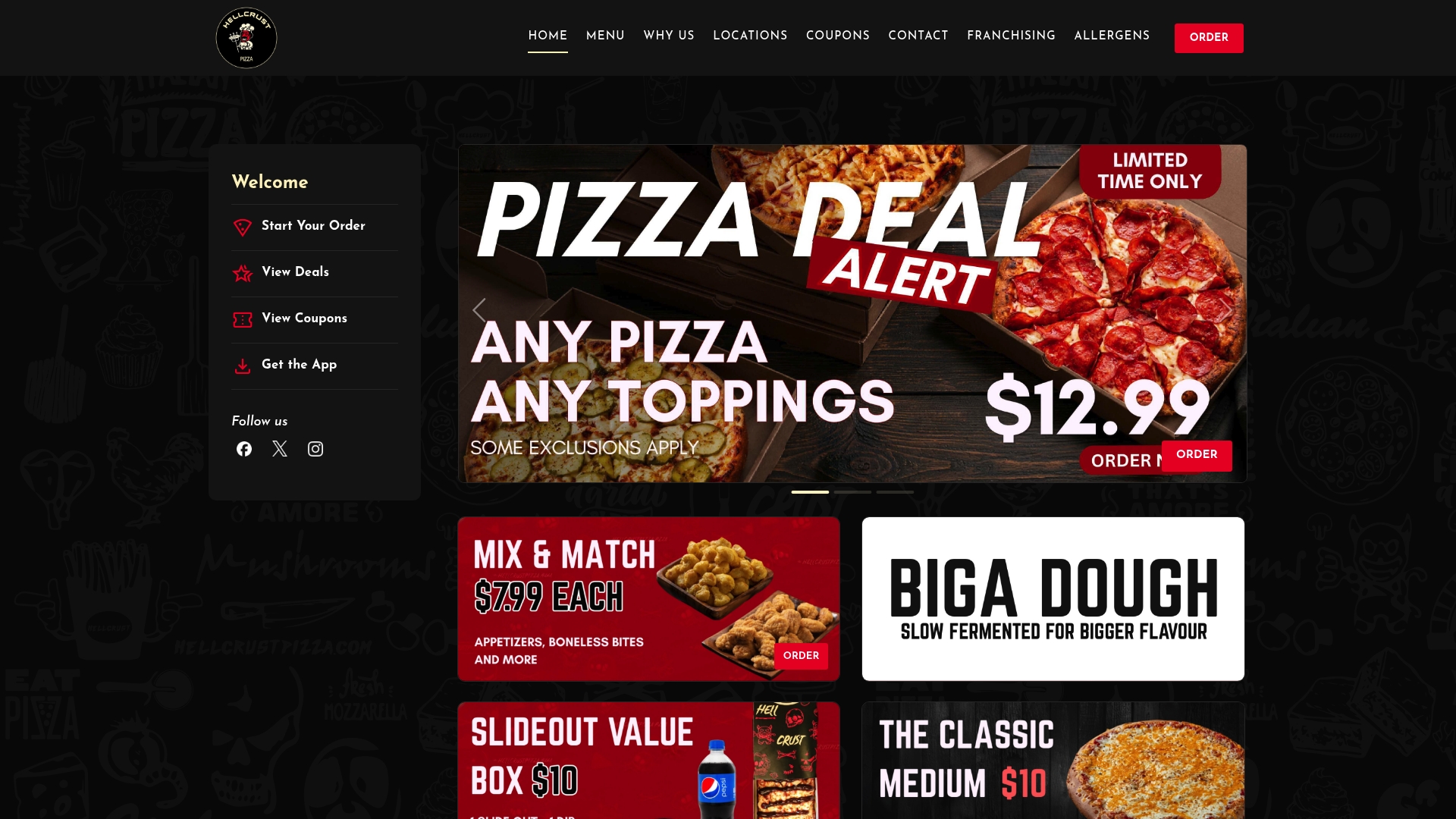
You can start at HellCrust Pizza and pick your toppings, your sides and your deal in a few taps.
FAQ
Are restaurant loyalty programs free to join?
Most are free, but some are paid or subscription-based, and Square Canada's guide lists paid programs among the common types. The Office of Consumer Affairs recommends checking for any annual fee or cost to join. A fee only makes sense if the extra rewards clearly exceed it.
Do loyalty points expire?
Often, yes. Canadian examples range from 6 to 12 months for points, and a claimed reward may expire in as little as 30 days. The National Restaurant Association also notes that operators commonly allow 60 or 90 days to use a newly earned reward. Always read the program's own terms.
Do delivery orders earn points?
It depends on the program. One Canadian burger program does not award points on third-party delivery orders, according to Credit Card Genius. Check the eligible-orders section of the terms, and consider ordering direct from the restaurant when you want to be sure an order counts.
What personal information should I give a loyalty program?
Give only what the program needs to run the account. The Office of the Privacy Commissioner says organizations may collect only information essential to the transaction, with your consent. The Canadian Marketing Association says marketing opt-in should be optional, so you should be able to earn and redeem points without agreeing to promotional messages.
How do I know if a program is worth it?
Convert it to cents back per dollar spent, then compare the final price of your order with other options. Canooq reports that ordinary returns range from 15 cents to $5 per $100, so the gap between programs is wide enough to matter.
Sources
- How To Create a Restaurant Loyalty Program, Square Canada
- What Makes a Good Restaurant Loyalty Program, National Restaurant Association
- Reward and customer loyalty programs, Office of Consumer Affairs (ISED)
- How to Maximize the Wendy's Rewards Program, Credit Card Genius
- Comparing Canadian Coffee Rewards Programs, Frugal Flyer
- Terms of Service, VIP Guests
- Businesses and your personal information, Office of the Privacy Commissioner of Canada
- Loyalty Program Rules for Marketers, Canadian Marketing Association
- Why loyalty programs can cost more for Canadians, money.ca
- Tim Hortons Tims Rewards, SuperCards
- Which loyalty programs are worth joining in Canada, Canooq
- Cut Kitchen Ticket Times in 30 Days, The Commercial Oven Store