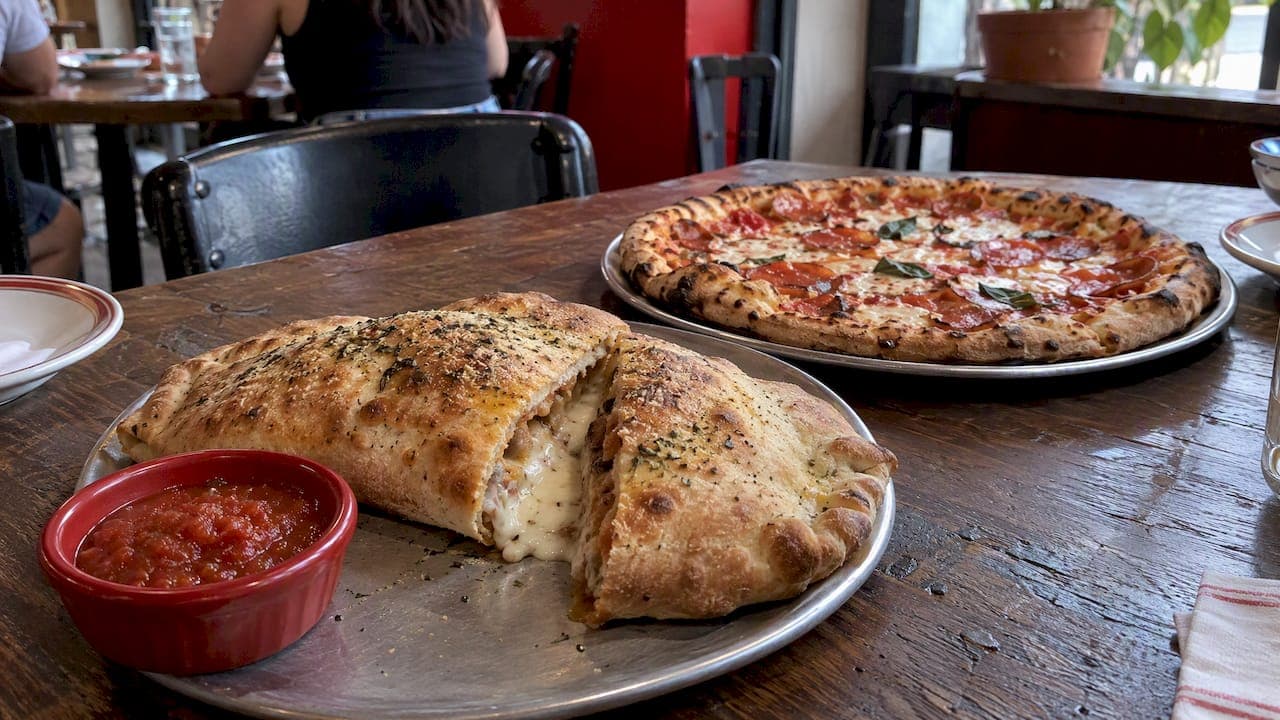
What actually separates a calzone from a pizza? Mostly the fold. Both start with pizza dough, but a pizza is baked open-faced with toppings on top, while a calzone is folded over its filling into a sealed half-moon pocket. That one change affects the crust, the heat, the sauce and how you eat it.
Below we walk through the differences, settle the calzone vs stromboli question, and look at stuffed crust, thin crust and regular crust, so you know what to order the next time the family can't agree.
TL;DR
- A pizza is open and flat, with sauce and toppings on the surface. A calzone is folded and crimped, with the filling sealed inside, and usually a little marinara on the side for dipping.
- A calzone is a folded half-circle pocket that comes from Naples. A stromboli is a rolled cylinder that comes from Philadelphia. Calzones almost always contain ricotta, while strombolis do not.
- Stuffed crust adds cheese to the edge, which means more calories, fat and sodium per slice. Thin crust usually saves calories.
- The dough matters more than the shape. A well-fermented, multigrain crust changes how either one tastes and sits with you.
Table of Contents
- The short answer: pizza is open, a calzone is closed
- Side-by-side: how calzone and pizza compare
- The crust: same dough, different experience
- Fillings: what goes inside a calzone
- Calzone vs stromboli
- Which one is better for you?
- Stuffed crust vs regular crust vs thin crust
- When to choose a calzone, and when to choose pizza
- Making calzones at home
- Our perspective
- Order a pizza built on our Biga dough
- Frequently asked questions
- Sources
The short answer: pizza is open, a calzone is closed
Picture a classic pizza: a round disk of dough, sauce spread across it, mozzarella and toppings on top, baked until the edges blister. According to a comparison published by Mashed, pizza bakes at roughly 450 to 500°F and is usually cut into triangular slices.
Now picture the same dough folded in half over its filling. That is a calzone: a semi-circular pouch of pizza-like crust, usually filled with ricotta and mozzarella, which the same source says bakes at about 550°F and often arrives with marinara on the side.
The ingredients overlap almost entirely. What changes is where they end up. On a pizza, everything is exposed to the oven. In a calzone, the filling steams inside its own crust while the outside turns golden and crisp.
Side-by-side: how calzone and pizza compare
| Pizza | Calzone | |
|---|---|---|
| Shape | Flat disk, open-faced | Folded half-moon, sealed |
| Dough | Pizza dough | The same pizza dough |
| Sauce | Spread under the cheese | Usually served on the side for dipping |
| Cheese | Mostly mozzarella | Mozzarella plus ricotta, typically |
| Baking | Around 450 to 500°F | Around 550°F |
| Serving | Cut into triangular slices | Usually one pocket per person, cut open or eaten by hand |
| Crust-to-filling ratio | Crust is a base | Crust wraps the whole thing |
| Reheating | Easy, but can dry out | Stays hot longer, and heats gently |
The temperatures and ricotta detail come from the Mashed comparison above. The point about heat retention comes from TASTE, which notes that a calzone's sealed, pocket-like construction traps heat better than an open pizza does.
The crust: same dough, different experience
A common question is whether calzone dough differs from pizza dough. In most kitchens it doesn't. Bon Appétit notes that calzones and strombolis are both made with pizza dough. The difference is in how the dough behaves once it is folded.
On an open pizza, the dough has one job: carry the toppings and crisp underneath. The edge, the cornicione, puffs up and chars. On a calzone, both sides of the dough face the oven and the inside faces the filling. You get a crisp outer shell, a softer, steamier inner layer where the dough meets the cheese, and a thick sealed seam that is chewy and satisfying.
This is why dough quality matters even more in a calzone. There is nowhere for a bland crust to hide. A dough that has been given time to ferment develops flavour, and a crust with some structure holds up to wet fillings without turning to paste.
Why we care about the dough
Our own crust is a Biga multigrain dough, made without artificial additives and prepared in advance. A biga is a preferment: a portion of flour, water and yeast that is left to mature before it goes into the final dough. We make ours this way because we like the rich, mature flavour it gives the crust, and because we designed the dough to be a more digestible, fibre-rich base than a quick-rise white crust. If you're curious about what whole grains bring to a crust, we've written about what whole grain crust actually gives you.
Fillings: what goes inside a calzone
The classic calzone filling is built around cheese. Bon Appétit says the cheese blend almost always includes ricotta, and that fillings can also include cured meats, vegetables and herbs. Ricotta is what makes the inside creamy rather than stringy, and it is the quickest way to tell a calzone from other stuffed breads.
Popular combinations include:
- Ricotta, mozzarella and ham, the straightforward Italian-style classic.
- Pepperoni or salami with mozzarella, the closest to a standard pizza.
- Spinach, mushroom and ricotta, a good meat-free pocket.
- Roasted peppers, onion, olives and herbs, for a lighter vegetable filling.
A few practical tips apply whatever you choose. Keep the filling relatively dry: wet vegetables like fresh tomato or raw mushrooms release steam and can burst the seam. Leave a clear border around the edge so you can crimp it properly. And cut a small vent in the top, so steam can escape rather than blowing out the side.
The sauce is the other big difference. On a pizza, sauce is part of the base. With a calzone, it's more often a dip, so the crust stays crisp and you control how saucy each bite is.
Calzone vs stromboli
People searching for calzone vs pizza often end up asking about stromboli too, and the two are easy to mix up. Both are stuffed, baked pizza dough. The difference is shape and origin.
| Calzone | Stromboli | |
|---|---|---|
| Shape | Round dough folded in half, edges crimped | Rectangular dough rolled into a cylinder |
| Origin | Naples | Philadelphia |
| Cheese | Almost always includes ricotta | No ricotta |
| Sauce | Served on the side for dipping | May be placed inside |
| Served | Whole, as a half-moon | Sliced into rounds |
All of this comes from Bon Appétit's explainer. In short: if it's a half-moon with ricotta and a side of marinara, it's a calzone. If it's a rolled log you slice, it's a stromboli.
Which one is better for you?
Neither has a built-in nutritional advantage. What matters is the dough, the cheese, the toppings and the portion.
One thing is worth knowing about calzones: because the crust wraps everything, you get more dough per bite than you do with a thin-crust pizza. A big, cheese-heavy calzone can be a very filling meal, and it is easy to eat a whole one without sharing. A pizza, shared across a table, naturally invites portion control.
The research on pizza in Canada points the same way. A report from Laval University's observatory, prepared for review by Health Canada, found that Canadian pizzas are often high in saturated fat and sodium, with deli meats and cheese as the main contributors. Most of the pizzas examined went over 30% of the Daily Value for saturated fat and sodium. The same report found thin-crust pizzas with 25% less cheese were as acceptable to tasters as the original, and lower in calories, sodium and saturated fat.
So whichever shape you pick, the useful levers are the same:
- Go lighter on cheese. A little less cheese makes a measurable difference.
- Add vegetables. They add bulk, fibre and flavour.
- Choose leaner proteins when you want meat, and keep the cured meats to a topping rather than the main event.
- Share or save half. A calzone reheats well, and a half portion makes a good lunch the next day.
If you want more ideas for lighter crust and topping swaps, this guide to healthy pizza alternatives and ingredient swaps covers several practical options. And for takeout in particular, we've put together what to know about nutrition in takeout pizza.
Stuffed crust vs regular crust vs thin crust
Calzone fans often wonder about stuffed crust, since it is a kind of halfway house: an open pizza with a cheese-filled edge. Is stuffed crust worth it? That depends on what you value.
What stuffed crust is
A stuffed crust is a pizza whose outer rim is wrapped around a core of cheese. According to Saputo Foodservice, mozzarella sticks, or Cheddar and Provolone, can be used to give the edge a smooth, stretchy texture, and softer cheeses such as Brie, Camembert or goat cheese are another route for a more distinctive version.
What it costs you nutritionally
The numbers are modest per slice but they add up. Consumer Reports stated in 2018 that adding a cheese-stuffed crust to a large chain pizza adds about 20 calories, 2 g of fat and 120 mg of sodium per slice. Eat three or four slices and the sodium alone climbs quickly. The same article said thin crust usually saves calories when it's available, with examples of about 60 to 70 fewer calories per large slice compared with regular crust at two major chains.

Older guidance from the Center for Science in the Public Interest, reported by CBC, advised avoiding stuffed-crust pizzas and multi-meat combinations and suggested halving the cheese and loading up on vegetables.
Which crust suits which meal
| Crust | Texture | Best for |
|---|---|---|
| Thin | Crisp, light, cracker-like at the edge | Lighter meals, loaded toppings, sharing |
| Regular (traditional) | Chewy edge, soft centre | All-round family orders |
| Stuffed | Soft, gooey, rich edge | Cheese lovers, kids who skip the crust |
| Thick or deep-dish | Hearty, bready, substantial | A big comforting dinner |
In Canada, thin crust is the most common style, at 42% of the market studied by the Laval report, followed by traditional crust at 39%. Calzone-style pizzas made up a smaller 19%. So most of us still reach for an open pizza, but the stuffed and folded styles have a real following.
So, is stuffed crust worth it? If you love cheese, and you are treating yourself, yes, it can be a lovely extra. If you often end up leaving the crust on the plate, a stuffed edge is wasted. If you're watching sodium or saturated fat, a thin crust with plenty of vegetables is the easier route. For a deeper look at the choice, read our guide to thin crust vs thick crust for any meal.

When to choose a calzone, and when to choose pizza
Choose a calzone when:
- You want something portable or easy to eat with one hand.
- You like to control the sauce by dipping.
- You're ordering for one and want a self-contained meal.
- You're taking food somewhere. A calzone stays hot longer than an open pizza, as TASTE notes.
Choose a pizza when:
- You're feeding a group. Slices are easier to share and mix and match.
- You like variety. One pizza can be split into different toppings by the half, and several pizzas can cover different diets.
- You like a crisp base with a fresh topping on top.
- You want flexibility with dietary needs, such as vegan or gluten-free.
A pizza also offers more room to customize. You can choose your own toppings, ask for a lighter hand with the cheese, or build the whole thing yourself.
Making calzones at home
If you want to try a calzone, the process is simple. A how-to published on the topic suggests that calzones cook much like pizza, about 10 to 12 minutes with a mid-bake rotation, until you see dark spots and good sizzling. Here is a simple method:
- Heat the oven as hot as it will go, with a baking sheet or stone inside.
- Stretch a round of dough to about the size of a dinner plate.
- Fill one half with ricotta, mozzarella and one or two toppings, leaving a clean border.
- Fold and crimp the edges firmly. Cut a small vent in the top.
- Brush with a little oil and bake until deep golden.
- Rest it for a few minutes. The filling is much hotter than it looks.
That last step matters. Steam trapped inside will burn your mouth if you cut in right away. And for leftovers, the oven beats the microwave every time. See our notes on the best way to reheat pizza in the oven, which works for a calzone as well. If you're after a crisp finish, our tips for an extra crispy pizza at home also help, and if you're carrying dinner across town, you can keep pizza warm without a soggy crust.
Our perspective
We've spent a lot of time thinking about what makes a great crust, and our answer is always the same: time. Our Biga multigrain dough is prepared in advance, so the flour has hours to mature and the flavour has time to deepen. It is made without artificial additives, because we believe you get what you pay for, and a wholesome dough is the foundation of every pizza we send out.
A calzone is a wonderful thing, but it hides nothing. The crust is the whole experience. That's the reason we put our energy into the dough first, and into the pizza on top of it second. A crust that is fibre-rich, more digestible and full of rich, mature flavour makes every bite a testament to the care behind it, whether you're sharing a family order or treating yourself on a quiet night.
What we love about pizza is how much choice it gives you. You can build your own, pick a signature pie, go vegan, or mix and match to feed a crowd, all on the same dough. That's why we focus on open pizza: it lets every person at the table have what they love, and everybody leaves happy.
jaskirat Singh
Order a pizza built on our Biga dough
If this has you craving something hot, crusty and generous, we deliver across North Vancouver, West Vancouver and Vancouver, with pickup available too. Build your own pizza with your choice of toppings, pick one of our signature pizzas, or go for a vegan pizza. Pair it with baked pasta, wings and bites, dips and dessert, and watch for the exclusive offers in our app.

See everything we make on our full menu, or start from HellCrust Pizza and order for delivery or pickup.
Frequently asked questions
Is a calzone just a folded pizza?
Very nearly. It is made from the same pizza dough, folded over its filling and crimped shut, so the filling bakes inside instead of on top. The usual calzone filling adds ricotta to the mozzarella, and the sauce tends to come on the side for dipping.
Is a calzone healthier than pizza?
Not automatically. A calzone usually has more dough and a richer cheese filling per portion, while a thin-crust pizza with vegetables can be lighter. Research on Canadian pizzas shows that cheese and deli meats drive saturated fat and sodium, so lighter cheese and more vegetables help in either format.
What is the difference between a calzone and a stromboli?
A calzone is a round of dough folded into a half-moon and crimped. It comes from Naples and uses ricotta. A stromboli is a rectangle of dough rolled into a cylinder and sliced. It comes from Philadelphia and does not use ricotta.
Is stuffed crust worth it?
It is worth it if you love cheese and you'll actually eat the crust. Stuffed crust adds about 20 calories, 2 g of fat and 120 mg of sodium per slice on a large chain pizza, according to Consumer Reports. If you want something lighter, go thin crust and add vegetables.
Do calzones stay hot longer than pizza?
Yes. The sealed pocket traps heat better than an open pizza surface, so a calzone stays warm longer on the way home. Let it rest a few minutes before cutting, because the steam inside is very hot.
Sources
- Despite Their Similar Ingredients, Pizza and Calzones Are Different (Mashed)
- Got Home Pizza Mastered? Graduate to the Calzone (TASTE)
- What Is the Difference Between a Calzone and a Stromboli? (Bon Appétit)
- Pizzas report, Laval University observatory
- 5 Trending Pizza Crusts (Saputo Foodservice)
- 6 Ways to Order a Healthy Pizza (Consumer Reports)
- More cheese on your pizza means more crust in your arteries (CBC)
- 6 Fast Healthy Pizza Alternatives (Granavitalis)