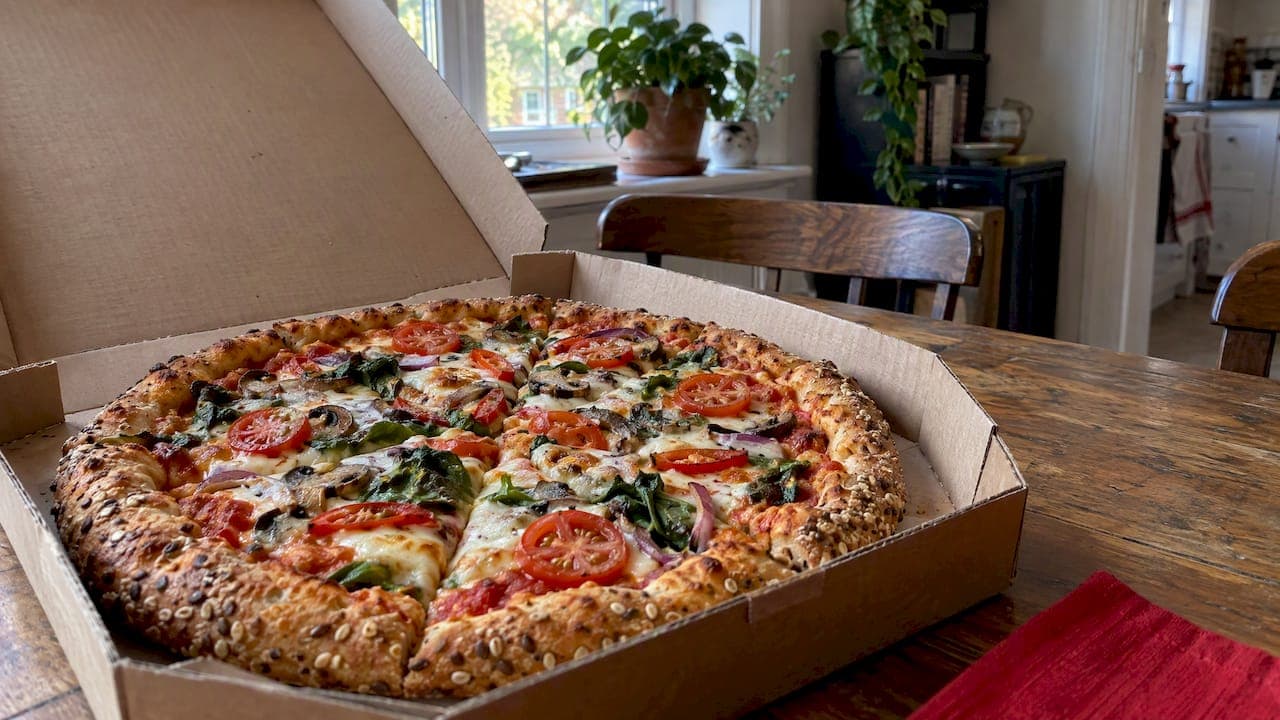
A digestive-friendly pizza is one built around what your own gut tolerates: a slowly matured, whole-grain crust, a lighter sauce, modest cheese, plenty of vegetables, and a portion you can eat calmly. No pizza is "safe" for everyone. If you live with IBS, coeliac disease or a food allergy, the right pizza depends on your triggers, and the right guide is your doctor or a registered dietitian. What follows is the practical part: what actually changes how a pizza feels afterwards, and how to order accordingly.
We make pizza for a living, so we have strong opinions about dough. We will share them, and we will also be plain about what dough can and cannot do.
TL;DR
- Dough matters most. A crust made from a long-matured preferment such as Biga, with whole grains, is a gentler starting point than a quick, refined-flour base, though it is not a medical guarantee.
- If you follow a low FODMAP plan, garlic, onion, wheat and some dairy are the usual pizza trouble spots. Ask about sauces, swap garlic for garlic-infused oil, and keep toppings simple.
- Build-your-own beats set combinations, because you control the sauce, cheese and toppings.
- How you eat counts too: regular meals, slow chewing and sensible portions can ease symptoms independently of what is on the pizza.
- If you have IBS, coeliac disease or a diagnosed allergy, work with a professional before cutting foods out.
Table of Contents
- What "digestive friendly" really means
- Start with the crust
- Sauce, cheese and the hidden triggers
- Toppings: what to pile on and what to ease off
- If you have IBS: a careful note
- How to order a gentler pizza, step by step
- Our perspective: why we start with the dough
- Pizza after exercise or a long day
- Order a pizza built around your gut
- FAQ
- Sources
What "digestive friendly" really means
There is no official standard for the phrase. When people search for it, they usually mean one of three things.
- Heaviness. The pizza leaves you bloated, sluggish or uncomfortably full.
- Blood sugar swings. A quick spike and crash after a white-flour slice.
- A diagnosed condition. IBS, coeliac disease, lactose intolerance or a food allergy, where certain ingredients cause real symptoms.
The first two respond well to better dough, better toppings and better habits. The third needs a more careful approach, because the triggers are personal. A registered dietitian, Andrea Hardy, describes IBS tolerance like a bucket: the size of the bucket decides how many FODMAP-rich foods one person can handle before symptoms appear, so perfection is not required. That is a kinder way to think about pizza night than a list of forbidden foods.
Start with the crust
Most of a pizza is dough, so most of the story is dough.
Refined flour and the blood sugar question
Pizza is generally rated moderate to high on the glycemic index because of the refined wheat flour in standard crusts. The published GI values for pizza range widely, from about 36 for some thick, vegetable-heavy pizzas to about 80 for certain commercial white-flour varieties. The same source notes that sourdough, high-fibre toppings and mixed or whole-grain crusts tend to digest more slowly.
Canada's Food Guide points the same way. Health Canada lists whole grain pizza crusts among the healthier choices you can make on a restaurant or fast-food menu.
Why time in the dough matters
Traditional bakers have long used a preferment: a portion of flour, water and yeast mixed ahead of time and left to mature, which then goes into the final dough. Biga is the Italian version, stiff and slow. During that long rest the dough develops a deeper, more mature flavour and a more open, airy crumb.

On the digestive side, the best-documented example comes from sourdough. Fructans, the carbohydrates in wheat that often trouble people with IBS, can be lower in true 24-hour fermented sourdough than in standard commercial yeast doughs. We want to be careful here: Biga is not sourdough, and we do not claim our crust is low in fructans or suitable for a low FODMAP diet. What we can say is that we prepare our dough in advance, we believe in giving it time, and many of our customers tell us they find it a lighter-feeling crust. Time is an ingredient, and rushed dough is a different product.
Multigrain, with no artificial additives
Our crust is a Biga multigrain dough made without artificial additives. Whole grains bring fibre, and fibre slows digestion, which is the same principle behind the lower glycemic responses above. It also means a short, recognizable ingredient list, which suits people who prefer to know what they are eating. If that is you, our post on why fresh ingredients matter for better pizza explains how we think about it.
One honest limit: a multigrain wheat crust contains gluten and fructans. If you have coeliac disease or a wheat allergy, it is not the right crust for you, and we offer gluten-free options for exactly that reason. Our guide to cauliflower versus gluten-free crusts covers the cross-contact questions worth asking, and two tested allergy-friendly doughs is useful if you cook at home.
Sauce, cheese and the hidden triggers
The crust sets the foundation, but sauce and cheese are where many digestive complaints actually start.
Sauce
Commercial pizza sauces often carry garlic and onion, both high in fructans. If you are on a low FODMAP plan, ask what goes into the sauce before you order, or choose a simple tomato base. The same dietitian's eating-out tips suggest checking menus ahead of time, asking for sauces on the side, and choosing build-your-own items because they are easier to modify.
Sodium is the other sauce issue. A school-board healthy pizza guideline, drawn from Canadian dietary advice, suggests limiting sodium in sauce to 360 mg or less per serving. That is a benchmark for institutional menus, not a rule for your dinner, but it shows how much a sauce can vary.
The garlic trick
Garlic flavour does not have to disappear. The FODMAPs in garlic are water-soluble but not oil-soluble, so garlic-infused olive oil delivers the taste without the same trigger. It works at home, where you can make or buy the oil, and it is worth asking about when you order. A tricolore-style pizza keeps the topping list short, and this tricolore recipe is a good model for a home version built on fewer, better ingredients.
Cheese
Lactose is the other common culprit. Part-skim mozzarella (20% milk fat or less) is among the standard healthy-pizza modifications in that same guideline. If dairy bothers you, ask for lighter cheese, or look at our vegan pizzas, which skip dairy altogether. Our vegan protein pizza guide shows how to keep them filling.
Toppings: what to pile on and what to ease off
The plate method in Canada's Food Guide says to make half your plate vegetables and fruits. A pizza will never be half vegetables, but a side salad and a generous vegetable topping move you closer.
| Topping choice | Why it can help | Watch for |
|---|---|---|
| Spinach, peppers, tomato, zucchini | Fibre and volume without heaviness | Onion and mushroom can trigger some people on low FODMAP plans |
| Grilled chicken | Lean protein that steadies the meal | Seasoning blends that contain garlic or onion |
| Fresh basil, olives | Big flavour for very little effort | Salty olives add sodium |
| Lighter cheese, or less of it | Less fat and lactose per slice | Too little cheese can leave the pizza feeling less satisfying |
| Processed cured meats | Flavour | High sodium and fat, slower to digest |
The canon of the Canadian guidance is the same: whole-grain crust, lean protein, a variety of vegetables and mindful portions, as the school-board guideline summarizes it. If you want help matching toppings to a multigrain base, we wrote about how to pair toppings on a multigrain pizza base. On protein, why protein toppings are popular explains the appeal.
If you have IBS: a careful note
The low FODMAP diet is the most recognized dietary approach to IBS, according to the Canadian Digestive Health Foundation. It is an elimination-style diet, run in phases: elimination, reintroduction and maintenance. Studies suggest roughly 70% of people with IBS get symptom relief on it.

The same source is just as clear on the caution. Changes like this should be guided by a professional, because elimination diets can be nutritionally restrictive, and symptoms are not always caused by FODMAPs alone. If you suspect IBS, see your family doctor first. If you have already been diagnosed, ask your doctor to refer you to a registered dietitian before you start removing foods.
Behaviour matters as well. Dietitians advise addressing eating habits alongside food choices: regular meals, no distractions while eating, and chewing thoroughly. That guidance comes from the British Dietetic Association, but the habits are universal, and they can reduce symptoms regardless of the food.
How to order a gentler pizza, step by step
- Check the menu first. Look online before you are hungry, as dietitians suggest for any eating out.
- Pick the crust that fits you. Whole grain and matured for most people; gluten-free if you avoid gluten for medical reasons.
- Build your own. A custom pizza lets you choose the sauce, the cheese amount and every topping.
- Ask about seasonings. Garlic and onion hide in sauces, marinades and spice blends.
- Add vegetables or a salad. Our salad pairing guide gives ideas that suit pizza night.
- Portion before you start. Put two or three slices on your plate and put the box away.
- Eat slowly and sit down. It sounds trivial and it is not.
Our perspective: why we start with the dough
Why does a pizza that looks healthy on paper sometimes still sit badly? In our experience, because the foundation was rushed. Great bread has always depended on patience, and pizza is bread with company.
We prepare our Biga multigrain dough in advance because we want a crust with a rich, mature flavour, more fibre and a more digestible character than a quick refined-flour base. We keep artificial additives out of it. You get what you pay for, and we would rather spend our effort on flour, water, time and fresh ingredients than on shortcuts.
We are also realistic. Nobody should read "more digestible" as "a treatment". Our crust is a thoughtful choice for people who want a wholesome, satisfying pizza. It does not replace medical advice, and if a particular ingredient is a problem for you, tell us when you order and choose a vegan, gluten-free or simpler build instead.
We design our deals, including Mix & Match and family specials, so that eating well does not need a bigger budget. If you are feeding a table of mixed needs, one person on vegan, another on gluten-free, the kids on plain cheese, our inclusive toppings guide and our note on balancing nutrition in a family pizza meal may help.
— jaskirat Singh
Pizza after exercise or a long day
Digestive comfort is also about timing. A very heavy, greasy pizza right after hard training can feel unpleasant, while a balanced one with protein and carbohydrates suits many people. We cover this in ordering healthy pizza after the gym. The general rule: choose lean protein, add vegetables, and give yourself time to eat without rushing.
Order a pizza built around your gut
We deliver and offer pickup in North Vancouver, Vancouver and West Vancouver. Our menu lets you create your own pizza, choose from signature and vegan pizzas, and add baked pasta, sides, dips and desserts. Start with the Biga multigrain crust, build the toppings that suit you, and use the app for exclusive offers. You can also see everything we do at hellcrustpizza.com.
FAQ
Is pizza bad for digestion?
Not inherently. Refined-flour crusts, heavy cheese, fatty meats and large portions are what usually cause discomfort. A whole-grain crust, vegetables, lighter cheese and a sensible portion make a noticeable difference for many people.
Can pizza be IBS friendly?
Sometimes, with modifications. Garlic, onion, wheat and lactose are common triggers, so a simple build with a garlic-infused oil, a suitable crust and a short topping list is easier to manage. Triggers are individual, so work with your doctor or a registered dietitian rather than guessing.
Is a multigrain or Biga crust low FODMAP?
We do not claim that. Our Biga multigrain dough is made with wheat-based grains, and wheat contains fructans. The long preparation gives a flavourful, fibre-rich crust, but if you follow a strict low FODMAP plan, ask your dietitian before ordering.
Is sourdough easier to digest than regular pizza dough?
Often, yes. Long fermentation can lower fructans compared with fast commercial yeast doughs, and sourdough tends to produce a lower glycemic response. It is still not safe for coeliac disease, since it contains gluten.
Sources
- IBS and Diet, Canadian Digestive Health Foundation
- 10+ Tips for Eating Out on the Low FODMAP Diet, Ignite Nutrition
- FODMAP-Friendly Cheat Meals, CheatMeal
- Pizza glycemic index, FoodStruct
- Choose healthy menu options, Canada.ca
- Make healthy meals with Canada's food guide plate, Canada.ca
- Healthy Pizza Days guideline, Algonquin and Lakeshore Catholic school board
- Irritable Bowel Syndrome and Diet, British Dietetic Association