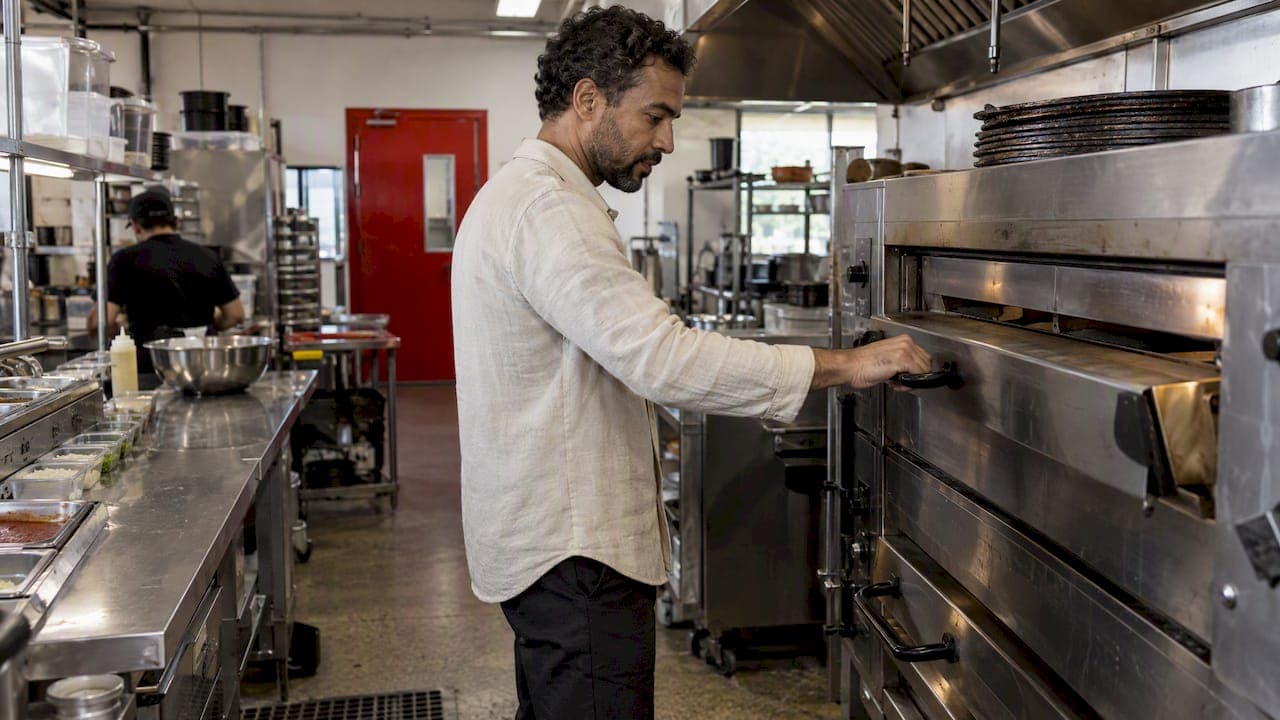
A ghost kitchen pizza franchise means running a branded, delivery-only pizza operation out of a commercial kitchen with no dining room, and paying a franchisor for the brand, the recipes and the system. In Canada it is a lower-cost way into pizza than a full storefront, but it is not a shortcut. You still need permits, working capital and a plan for the delivery-app commissions that eat into every order.
We make pizza for a living, and we are asked about this more often than you might think. So here is the honest version: what it costs, what the law expects, where the model works and where it quietly fails.
TL;DR
- A ghost kitchen can start at roughly CAD $10,000 to $30,000, against $55,000 to $175,000 for a small takeout or delivery shop, and $250,000 to $450,000+ for a standard franchise store. These are industry estimates, not quotes.
- "Delivery-only" does not mean "lightly regulated". You still need a Business Number, a food service permit, municipal approvals and insurance.
- Third-party delivery commissions can reach as much as 30%, so food cost and speed decide whether you profit.
- Plan for 3 to 6 months of working capital, and read the franchise agreement for royalties, training and territory before you sign.
Table of Contents
- What a ghost kitchen pizza franchise actually is
- What it costs in Canada
- The rules: delivery-only is not rule-free
- The economics: where margin goes
- Ghost kitchen or a storefront franchise?
- Questions to ask any franchisor before you sign
- Our perspective: the product still has to be worth ordering
- See the product before you decide
- A realistic first-year plan
- FAQ
- Sources
What a ghost kitchen pizza franchise actually is
A ghost kitchen, also called a virtual or dark kitchen, is a delivery-only food business with no dine-in space. Orders arrive through your own website or app, or through third-party platforms, and the food is prepared in a commercial kitchen set up for that purpose.
There are really three setups hiding under the phrase:
- A shared or rented ghost kitchen. You rent space, often in a facility that houses several brands, and run your pizza concept from it.
- A dedicated delivery-only unit. You lease and build out your own small premises, with no front-of-house.
- A second brand inside an existing kitchen. A restaurant uses its slow hours to cook for a separate delivery-only pizza label.
The franchise part adds a brand, a menu, supplier arrangements and training. In exchange you pay fees and usually ongoing royalties. Pizza suits delivery well: it is built to travel, it has a predictable prep sequence, and customers already think of it as a delivery food.
The model also suits experimentation. Operators can test several virtual brands from one kitchen footprint, using the same staff and equipment, and drop what does not sell based on delivery-platform data. That agility is real. So is the discipline it demands.
What it costs in Canada
Numbers vary by city, equipment and lease terms, so treat every figure below as a planning range and ask for written quotes. The most useful comparison we found, from a 2026 industry guide on starting a pizza business, looks like this:
| Model | Typical startup range (CAD) |
|---|---|
| Ghost kitchen | $10,000 to $30,000 |
| Small takeout or delivery pizza shop | $55,000 to $175,000 |
| Standard 1,000 to 1,200 sq. ft. franchise store | $250,000 to $450,000+ |
The same guide puts franchise fees for a standard store at $20,000 to $35,000, with liquidity requirements often between $150,000 and $225,000. A franchisor offering a delivery-only format may set different fees, so ask for the figures for that format specifically, not the brand's store numbers.
Rent versus build-out
The low end of the ghost kitchen range assumes you rent. The guide splits costs between a turnkey shared facility at $3,000 to $5,000 a month and a dedicated build-out at $60,000 to $100,000 or more. Listings bear this out: one fully equipped basement kitchen near College and Bathurst in Toronto is advertised at $3,500 all included.
A cheaper route is cooking in a kitchen you already have. One 2026 breakdown of independent operators estimates $2,000 to $5,000 for packaging, a tablet and a menu redesign when you deliver from your existing kitchen, with no added rent. That only works if you already hold a food premises permit and your kitchen has genuine slow hours.

The cash you do not see on the quote
Many first-time owners underestimate the 3 to 6 months of working capital needed to reach break-even. Rent, wages and ingredients all come due before orders build. If you are borrowing, our guides on what lenders want for pizza franchises in Canada and financing a pizza franchise with a cash buffer walk through how a bank reads your numbers. For timelines, see our break-even checklist.
The rules: delivery-only is not rule-free
This is the pitfall we see most. Because there is no dining room, some people assume the rules relax. They do not. Provincial health authorities and municipal offices apply the same food premises standards to delivery-only kitchens.
To operate legally in Canada, a ghost kitchen generally needs, according to one national startup guide:
- a Business Number registered with the CRA
- a provincial or territorial food service licence
- municipal zoning and building permits
- a passed health inspection
- liability and business insurance
The details differ by province. Ontario, for example, regulates these premises under O. Reg. 493/17, as that guide notes. In the Vancouver area, where we operate, food service permits and inspections come through the regional health authority. Vancouver Coastal Health lists food service permits and restaurant inspections among its health protection programs, so that is where a North Vancouver, West Vancouver or Vancouver operator starts. Check with the health authority and your municipality before you sign a lease, not after.
Transparency matters to customers too
In British Columbia, shared-space virtual restaurants can be hard to find on public inspection sites. The Vancouver Sun's guide to B.C.'s ghost kitchens encourages customers to confirm permit status with their local health authority when it is not clearly posted. If you run one, post your permit where it can be seen and say so on your menu page. It builds trust before the first slice is eaten.
The economics: where margin goes
Ghost kitchens are a lower-risk entry point, but experts are clear that they are not a get-rich-quick scheme. The main reason is delivery commissions, which can run as high as 30% on third-party apps. On a pizza that sells at a modest price, that leaves little room for error.
A few practical consequences:
- Own your ordering channel. An app or website that customers use directly keeps commission out of the picture. This is one of the reasons we built exclusive offers into our own app.
- Watch food cost obsessively. Dough, cheese and toppings are your margin. Waste is your enemy, and a tight menu helps.
- Understand delivery fees. What you charge customers and how tax applies is not a free-for-all. We explain it in pizza delivery fees in Canada, including Competition Bureau rules and GST/HST.
- Check your kitchen agreement. Some shared facilities, especially baking-focused or incubator ones, prohibit delivery-app pickup to protect their licensing. Make sure your rental explicitly allows the platforms you plan to use.
Being found in a crowded delivery app
In a delivery app, your pizza competes on a thumbnail and a star rating. Beyond the app, you need your own pages that rank for the neighbourhoods you serve. If you plan several kitchens or brands, a sound multi-location content strategy keeps each location's page distinct instead of a copy of the last.
Ghost kitchen or a storefront franchise?
Neither is better in the abstract. It depends on your cash, your appetite for risk and what you want to build.
| Question | Ghost kitchen format | Storefront format |
|---|---|---|
| Upfront capital | Lower, per the ranges above | Much higher |
| Walk-in customers | None | Yes |
| Dependence on delivery apps | High unless you build direct orders | Lower |
| Brand visibility in the neighbourhood | Mostly digital | Signage, foot traffic, events |
| Community events, such as kids' parties | Hard to host | Natural fit |
Storefronts earn something a ghost kitchen cannot: people who walk by, smell the oven and come back. If you are still deciding whether to join a system at all, our comparison of franchise versus independent restaurant ownership is a good next read. Owners who want to grow later can look at multi-unit franchise ownership.
Questions to ask any franchisor before you sign
Whatever the format, put these on paper and get answers in writing.
- What are the total fees for the delivery-only format? Franchise fee, equipment, technology, opening inventory and marketing contributions, itemized.
- What are the royalties and how are they calculated? We lay out how to model them in pizza franchise royalties in Canada.
- What training do you provide? Ask what is taught, for how long and where. See what to verify about pizza franchise training.
- What are the requirements to qualify? Liquidity, experience and location. We cover them in the real requirements to buy a pizza franchise.
- Can I speak with current franchisees? Ask them how long it took to break even and what surprised them.
- Who controls delivery-platform accounts and customer data? This matters if you ever leave.
- How is territory defined for delivery? Delivery radii overlap in ways store territories do not.
Our perspective: the product still has to be worth ordering
Delivery-only models invite a particular temptation: when nobody sees your kitchen, it is easy to cut corners on what goes in the box. We think that is backwards. When the only thing a customer experiences is the pizza that arrives at their door, the dough is the whole brand.
That is why our crust starts as a Biga, a preferment dough made in advance, using multigrain flour and no artificial additives. Time does the work. The dough matures, takes on a rich, deeper flavour and, in our experience, gives a crust that is more digestible and fibre-rich than a rushed one. It also travels well, because a crust with character does not turn to cardboard in fifteen minutes. You get what you pay for, and a customer ordering from a screen is paying for exactly one thing.

Our view for anyone weighing a franchise, ghost kitchen or otherwise, is simple. Cheap entry is not a business model. Ask whether the recipe, the dough and the ingredients are good enough that a stranger will reorder, because repeat orders are what pay your rent. And whatever the format, be straight with customers about where and how the food is made.
If you are exploring a delivery-focused format with HellCrust, we would rather talk it through openly than sell you something that does not fit your market. Start with the questions above and bring them to us.
— jaskirat Singh
See the product before you decide
If you want to judge a pizza brand, taste what it sells. Our menu covers create-your-own pizzas, signature and vegan pizzas, baked pastas, wings, sides and desserts, and our app carries exclusive offers. Order a few pies and see what a Biga crust does for yourself, then read more about HellCrust and our franchising options.
A realistic first-year plan
If a ghost kitchen pizza franchise still looks right, here is a sensible order of work:
- Define your budget with a buffer. Use the ranges above, add the 3 to 6 months of working capital, and see how much you can lose without damage.
- Talk to the health authority and municipality first. Confirm your intended premises can be permitted for food preparation and that zoning allows it.
- Read the kitchen agreement line by line. Delivery-app permission, hours, shared equipment, storage, and who cleans what.
- Test before scaling. Run a soft launch in one delivery zone, track food cost per pizza and delivery times, and adjust the menu.
- Build a direct channel from day one. Collect orders through your own site or app so every repeat customer is not paying a commission.
- Review monthly. Compare actual figures to the franchisor's projections, and ask questions early if they differ.
FAQ
How much does a ghost kitchen pizza franchise cost in Canada?
Industry guidance puts ghost kitchen startup costs at roughly CAD $10,000 to $30,000, depending on equipment and kitchen rental terms. Franchise fees, royalties and any build-out come on top, and vary by franchisor. Always request a written breakdown for the specific format.
Do I need a licence to run a delivery-only pizza kitchen?
Yes. Delivery-only kitchens are held to the same food premises standards as other restaurants, which typically means a food service permit, municipal approvals and a health inspection. In the Vancouver area, start with Vancouver Coastal Health. Elsewhere, contact your provincial health authority.
Is a ghost kitchen cheaper than opening a pizza shop?
Usually, at the start. A small takeout or delivery shop is estimated at $55,000 to $175,000 in the same guide, against $10,000 to $30,000 for a ghost kitchen. Delivery commissions of up to 30% can narrow the gap over time, so compare running costs as well as the entry price.
Can I rent a ghost kitchen in Toronto or Vancouver?
Yes, shared and dedicated kitchens are listed in both cities, with Toronto listings such as a fully equipped kitchen near College and Bathurst. Before renting, confirm the agreement allows delivery-app pickup and that your franchisor accepts the premises.
Sources
- How to Start a Pizza Business in 2026: Costs, Models and What Actually Works
- How to Start a Ghost Kitchen (2025 Guide)
- Commissary and Ghost Kitchens in Canada: A Practical Guide
- Safe to eat? A guide to B.C.'s ghost kitchens and virtual restaurants, Vancouver Sun
- Vancouver Coastal Health: Health protection, permits and licensing
- Ghost Kitchen for Rent, College and Bathurst, Toronto
- Ghost Kitchen Economics: Worth It for Independents?
- Retail Insider: Winnipeg-based ghost kitchen and pizza brand interview