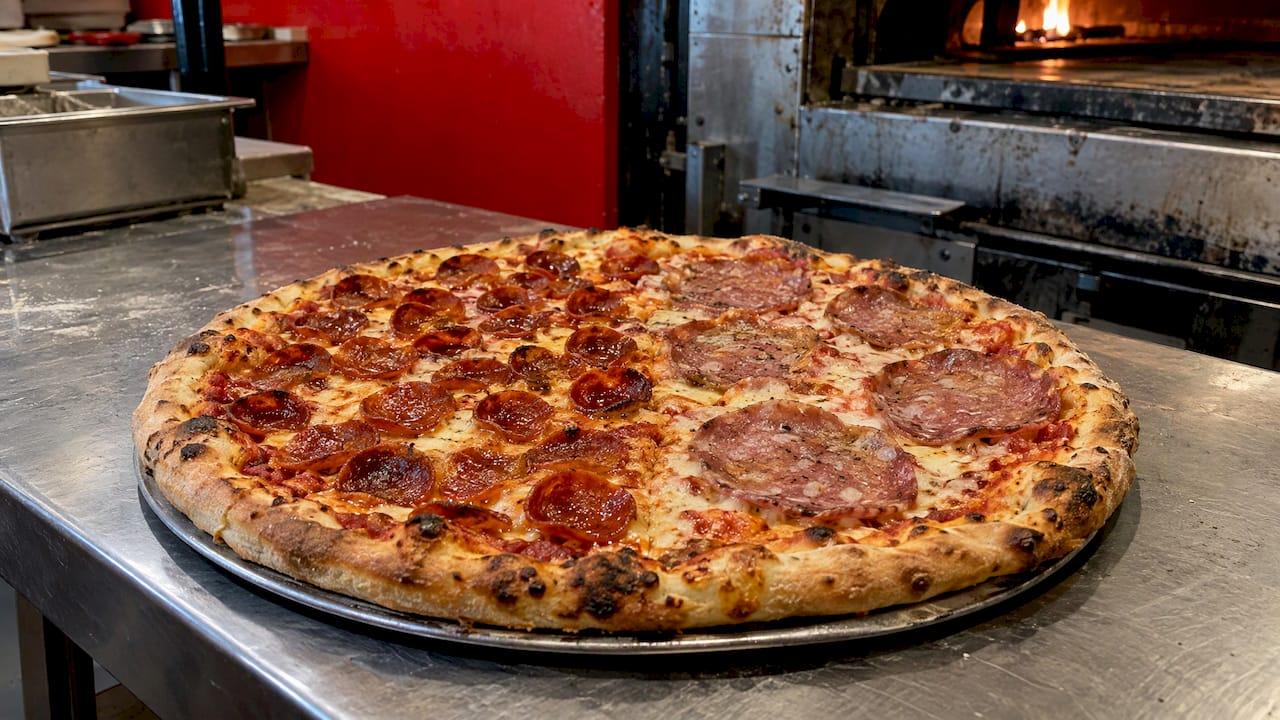
Here is the short answer: pepperoni is a kind of salami. Every pepperoni is a salami, but plenty of salami is nothing like pepperoni. Pepperoni is a spicy, fine-textured style made to be cooked, while most salami is made to be eaten cold. That one idea explains almost everything about taste, texture and how each behaves in a hot oven.
So which belongs on your pizza? If you want smoky heat, crisp edges and little pools of spiced oil, pepperoni is the classic. If you want garlic, fennel or a milder, more rustic bite, a good salami has plenty to say. Below we walk through the real differences, what is in each, what the curing words on the label mean, how the nutrition compares and how to get the best result from either one.
TL;DR
- Pepperoni is a type of salami: spicier, finer in grain, softer and built for baking. Salami is the wider family, with flavours from garlic to fennel to wine.
- Pepperoni is usually beef and pork with paprika and chilli. Salami is most often pork, though beef and other meats appear.
- Both are cured, so both normally contain nitrite or nitrate. In Canada these are regulated, and "uncured" labels describe a different source of curing agent, not a meat with no preservation at all.
- Both are high in sodium and fat. Per gram they come out close, so portion size matters more than which one you pick.
- On a pizza, space the slices out so they crisp rather than steam, and balance their salt with fresh, bright ingredients.
Table of Contents
- What is the difference between pepperoni and salami?
- How do they taste and feel different?
- Pepperoni vs salami on pizza
- What is actually in pepperoni: nitrates, nitrites and "uncured"
- Nutrition: how pepperoni and salami compare
- Our perspective
- How to choose between them
- Build your own at HellCrust
- FAQ
- Sources
What is the difference between pepperoni and salami?
Salami is a centuries-old family of cured sausages found in many food cultures. Pepperoni is one member of that family, and it is a specific cured sausage most associated with the United States, where it became the signature pizza topping. When someone asks about "salami" in a Canadian deli, they usually mean one of the Italian-style or European-style sausages sold whole or sliced thin for sandwiches and charcuterie boards. When they say "pepperoni," they mean the red, paprika-spiced sausage that goes on pizza.
The name itself is a clue. One food site suggests that "pepperoni" comes from the Italian word for bell pepper, "peperone", and that the name may have signalled a sausage that was not the usual mild salami. That reading fits what we taste today: pepperoni is the one with the pepper in it.
The quick comparison
| Pepperoni | Salami | |
|---|---|---|
| Family | A style of salami | The broad family of cured sausages |
| Typical meat | Pork and beef | Mostly pork; beef, venison and others also used |
| Grind | Fine, smooth and firm | Coarse to fine, depending on the type |
| Flavour | Smoky, spicy, tangy, paprika and chilli | Varies widely: garlic, fennel, pepper, wine |
| Usually eaten | Cooked, on pizza | Cold, in sandwiches, on boards, in salads |
The meat and texture points come from a cheesemonger's guide to salami, and the point that salami can be made from pork, beef, venison and other meats is why you will see such a range at the deli counter.
How do they taste and feel different?
Pepperoni leads with spice and tang. Food Network describes it as an air-dried sausage of beef and pork seasoned with salt, paprika, chilli flakes or cayenne, fennel seed and garlic, and notes that fermentation gives it a distinctly tangy flavour. The same source points out that it is ground finer than most salamis, with smaller pieces of fat, which is why it tends to be softer.
Salami is more of a choose-your-own-adventure. One type leans on garlic, another on fennel seed, another on cracked black pepper or a splash of wine. The grain can be so coarse you see distinct flecks of fat, or fine enough to look almost like pepperoni. If you have ever bitten into a salami and thought it was mellow and savoury, and then another that was sharp and garlicky, both were honest examples of the category.

Is pepperoni spicy?
Usually, yes, though gently. The Kitchn calls it a spicy, air-dried sausage with a smoky, peppery taste, built on paprika and sometimes hot peppers. The heat is a warm background more than a burn, and it blooms when the slices crisp in the oven. If you like to dial heat up or down across a whole pizza, our guide to getting pizza spice right covers how to ask for exactly what you want.
A word on soppressata
Readers often ask how soppressata fits in. It is another Italian-style salami, typically coarser and more rustic than pepperoni, so it sits on the salami side of this comparison. It is a good candidate if you want the heat of pepperoni with a chunkier, chewier bite.
Pepperoni vs salami on pizza
This is where the two really part ways. Pepperoni was made for the oven. Salami can go there, but it behaves differently.
The cup and char effect
Traditional pepperoni is cured in a natural casing. In a hot oven, that casing makes the slice curl into a small cup at the edge while the centre stays flat. The cup collects rendered fat and the rim crisps and chars. Commercial production later removed the casing, which produced slices that lie flat. The curled style remains popular in some American cities, including around Cleveland and Buffalo, and regained ground in the 2010s.

One baking guide explains the mechanics: the bottom of a casing slice shrinks faster than the top, curling it into a tiny bowl that traps the fat, while casingless slices stay flat and the fat pools across the pizza. We mention it so you know what to expect, but the simple takeaway is this: curled pepperoni gives you crisp edges and concentrated flavour, and flat pepperoni gives you an even, softer layer.
Using salami on a pizza
Salami slices are generally larger, and because the grind is often coarser and the seasoning milder, they bring a savoury, garlicky or fennel-scented note instead of heat. Since most salami is made to be eaten cold, it can taste saltier and more intense once baked, so a lighter hand helps. A common trick is to add thin slices in the last minutes of baking, or to finish a pizza with them after it comes out, letting the residual heat warm them through.
Placement matters
A recent pizza-baking guide recommends arranging around 18 slices of pepperoni or spicy salami without overlapping, because overlapping slices release fat and leave the area underneath underdone. It suggests baking for 10 to 12 minutes at 250°C, and judging doneness by a golden crust, bubbling cheese and browned, curled pepperoni edges. Home ovens vary, so use those figures as a starting point and trust your eyes.
If you are building a pizza around meat, our piece on topping pairings for meat lovers shows what plays well with both.
What is actually in pepperoni: nitrates, nitrites and "uncured"
This is the question behind many searches for nitrates in pepperoni, additives in pepperoni and preservative-free pepperoni, so here is the plain version.
Why cured meats contain nitrite
Curing uses salt together with nitrite or nitrate salts. According to the Canadian Food Inspection Agency, these are added to meat products to improve colour, texture and flavour and to prevent or delay undesirable microbial growth and toxin production. Alberta's meat-curing factsheet says the same about improved colour, texture and flavour and delayed microbial growth. That is why dry sausages like pepperoni and salami get their rosy colour and their shelf life.
In Canada the use of these agents is regulated. Under the CFIA's guidance, when "cured" is a mandatory process for a product, salt and at least 100 ppm of nitrite or nitrate salts must be added. Alberta's factsheet notes limits that are generally set at 200 ppm for most cured meat products.
What "uncured" and "preservative-free" really mean
These labels can be confusing. "Uncured" means the meat was not preserved with synthetic nitrates or nitrites, and uncured pepperoni is still preserved, relying on natural salts and flavourings instead of man-made ones. In practice, that often means ingredients such as celery powder or sea salt, which carry naturally occurring nitrates. Some Canadian-made pepperoni is sold as nitrite-free and preservative-free, so the choice does exist if it matters to you.
The practical advice: read the ingredient list, not just the front of the package. A short list and a clear statement about how the product is cured tell you far more than a marketing word.
Not all pepperoni is made the same way
Food Network notes that inexpensive commercial pepperoni is often not cured and lacks the tangy flavour of handcrafted pepperoni. Quality varies a great deal between a slice with real fermentation behind it and one that is simply seasoned and cooked. This is one reason two pizzas with "pepperoni" can taste so different.
Nutrition: how pepperoni and salami compare
Both are rich, salty foods, and neither is a health food in the everyday sense. That does not make them off limits on a pizza night. It just means the numbers are worth knowing.
Health Canada's Nutrient Value of Some Common Foods table (2008) lists these servings:
| Food | Serving | Calories | Protein | Fat | Sodium |
|---|---|---|---|---|---|
| Pepperoni (pork, beef) | 10 slices (55 g) | 252 | 11 g | 22 g | 966 mg |
| Salami (beef and pork) | 2 slices (46 g) | 118 | 6 g | 9 g | 490 mg |
| Salami (pork and beef, dry or hard) | 5 slices (50 g) | 185 | 12 g | 15 g | 900 mg |
The servings are different sizes, so a fair comparison needs a little arithmetic. Working from those same figures, dry salami comes to about 3.7 calories per gram and pepperoni about 4.6. Sodium is almost identical per gram, roughly 18 mg for dry salami against 17.6 mg for pepperoni. In other words, pepperoni tends to be a bit richer in fat and calories by weight, and both are salty.
What changes the real-world picture is how much lands on your plate. A pizza dotted with a modest number of slices delivers far less than a sandwich piled with salami. Values also shift by brand and recipe, so treat any table as a guide rather than a promise.
What is the healthiest meat on a pizza?
There is no single answer, because it depends on what you are balancing. Cured meats are high in sodium and fat. If you want to ease off, use fewer slices, pair them with vegetables, and let the other toppings carry more of the flavour. People who follow a plant-based diet have another route entirely, which we cover in our comparison of vegan and regular pepperoni.
Our perspective
We come at this question as people who care about what goes under the toppings as much as the toppings themselves. A pizza is a whole, and the crust is half of the story. That is why our dough is a Biga multigrain, free of artificial additives, prepared in advance so it has time to develop a rich, mature flavour. A good crust deserves a topping that respects it.
When we think about pepperoni versus salami, we think about balance. Pepperoni brings smoke, spice and a little salt, and it loves a crust with real character underneath. A milder, garlicky salami asks for something fresh beside it. Neither is wrong. What matters is that you can choose the pairing you actually crave, rather than being handed one fixed answer.
That belief shapes how we build a menu. You can create your own pizza and pick the toppings that suit your table, try one of our signature pizzas, or go vegan when that is what the day calls for. You get what you pay for, and we would like you to savour every bite of it.
jaskirat Singh
How to choose between them
Start with what you want the meat to do.
- You want heat and crisp edges. Pick pepperoni, ideally with a casing so the slices cup and char. Space them out.
- You want savoury depth without much spice. Pick a garlic or fennel salami, sliced thin, and add it late or after the bake.
- You want something rustic and chewy. Reach for a coarser salami such as soppressata.
- You are watching sodium. Use fewer slices and round out the pizza with vegetables and fresh herbs. Our guide to fresh herbs on a finished pizza shows how brightness can balance a salty topping.
- You are avoiding added nitrite. Look for a product that states how it is cured, and read the full ingredient list.
Pairing ideas that work
Pepperoni likes a creamy cheese and a sauce with a little sweetness to cool the spice. Our look at how sauce shapes pizza flavour explains why, and the cheeses used on gourmet pizzas gives you options beyond the usual. If you enjoy heat, try the ideas in spicy topping combinations to try at home.
For drinks, a crisp, acidic wine or a sparkling non-alcoholic option cuts through the fat well. We have notes on wine pairings by topping and on non-alcoholic pairings.
Regional tastes
What counts as the right topping depends on where you are. Some cities prize the curled, charred pepperoni cup, while others favour an even, flat layer. If you like exploring, our guide to regional topping styles is a fun detour.
Build your own at HellCrust
If this has you craving a pizza, we make it easy to put the thinking into practice. Our menu covers Create Your Own Pizza, Signature Pizzas and Vegan Pizzas, along with baked pastas, wings and bites, dips, desserts and drinks. We serve North Vancouver, Vancouver and West Vancouver, for delivery or pickup, and our app is where you will find exclusive deals.
Pick your toppings, pair them with our Biga multigrain dough, and see how a good crust changes the whole pizza. Browse our full menu and order when you are ready.
We also host in-store kids' pizza-making experiences, which are a lovely way to let little ones decide for themselves whether they are team pepperoni or team salami.
FAQ
Is pepperoni the same as salami?
Not quite. Pepperoni is a type of salami, so it belongs to the family, but it has its own character: finer grain, more paprika and chilli, and a softer bite. Most other salami is milder, coarser and meant to be eaten cold.
Is salami or pepperoni spicier?
Pepperoni is usually the spicier of the two, thanks to paprika and chilli or cayenne. Salami varies by type. Some are fiery, but many lean on garlic, fennel or pepper for flavour instead of heat.
Can I use salami instead of pepperoni on pizza?
Yes. Salami works well, especially a spicy or garlicky variety. Because it is often saltier and not designed for the oven, slice it thin, space it out and consider adding it near the end of baking. Expect a more savoury, less smoky result.
Does pepperoni contain nitrates or nitrites?
Traditionally cured pepperoni does, because curing relies on nitrite or nitrate salts to protect colour and flavour and to slow microbial growth. In Canada their use is regulated by the CFIA. Some products are labelled uncured or nitrite-free and use natural sources instead, so check the ingredient list.
Which is healthier, pepperoni or salami?
Neither is a low-sodium or low-fat food. By Health Canada's figures, they are close in sodium per gram, with pepperoni a little richer in fat and calories by weight. The amount you eat matters more than the type, so go lighter on slices if you are watching your intake.
Sources
- What Is Salami? How It's Made, Types & How to Serve It
- What Is The Difference Between Salami And Pepperoni?
- What's The Difference Between Salami And Pepperoni?
- Salami vs Pepperoni
- What Is Pepperoni Made Of? | Food Network
- What Is Pepperoni Made of? | The Kitchn
- Pepperoni | Wikipedia
- Spicy Sausage Pizza: Choosing Pepperoni, Salami and Chorizo
- Preventive control recommendations on the use of nitrites | CFIA
- Meat curing factsheet | Alberta
- What Is Pepperoni Made of? | Sporked
- Nutrient Value of Some Common Foods | Health Canada